SUBSCRIBE TO OUR FREE NEWSLETTER
Daily news & progressive opinion—funded by the people, not the corporations—delivered straight to your inbox.
5
#000000
#FFFFFF
To donate by check, phone, or other method, see our More Ways to Give page.
Daily news & progressive opinion—funded by the people, not the corporations—delivered straight to your inbox.
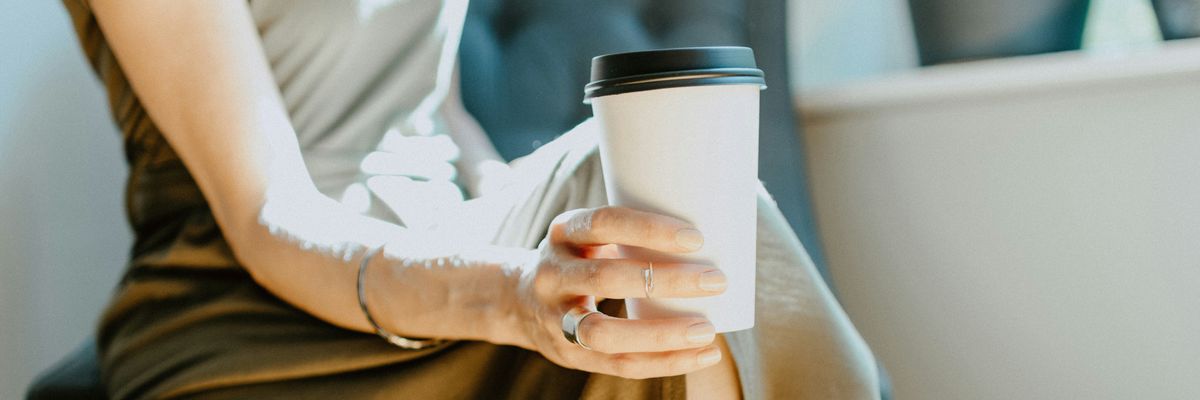
A woman holds a paper coffee cup with a plastic lid.
Join the global social movement helping millions of people around the world reduce their plastic waste by choosing to refuse single-use items like disposable cups.
Whether you’re reading this article at home, work, or on the go, there’s a good chance you’re one of the billions of people worldwide who will the enjoy the pleasure of having someone else make your coffee today. To say we are a society powered by coffee is not an overstatement. An estimated 500 billion disposable coffee cups are produced globally each year.
That our takeaway coffee habit served in a disposable cup has become one of the number one single-use items we throw away says a lot about our culture and choices. Originally made from Styrofoam and other petroleum-based plastics, single-use cups are increasingly made from paper but lined with a thin layer of plastic to prevent the liquid seeping out and served with a plastic lid. Unfortunately, even these paper cups are not readily recycled, most are landfilled and some are littered, breaking up into microplastics that cause lasting harm to wildlife and marine ecosystems. Without systems to collect and process even paper-based packaging, they aren’t a sustainable solution either.
This July millions of people around the world are making different choices from drinking their coffee in disposable cups, and many more choices besides! Together, these choices are adding up to make a big difference. This month it’s Plastic-Free July, the global social movement helping millions of people around the world reduce their plastic waste by choosing to refuse single-use plastic.
After all this isn’t really a problem we are leaving behind. Much of this single-use plastic will outlive us all. It is a problem we are leaving forward.
Despite the name, this campaign isn’t about being completely plastic free. It is about making small changes, simply choosing to refuse the single-use plastics we find in our daily lives. Whether that’s taking a reusable cup for a takeaway coffee (or dining in), remembering reusable shopping bags or water bottles, choosing loose produce, or skipping the plastic straw, small steps do make a big difference.
From 40 people in Perth Australia who joined me when I started Plastic-Free July in 2011, now hundreds of millions of people from over 190 countries have taken part in our global social movement by choosing to refuse single-use plastic. We know that people don’t just make change in July—our research shows 87% of participants make changes that become habits and a way of life. Over the last five years, Plastic-Free July participants have together avoided 10 billion kilograms of household waste, more than the world’s biggest cleanups combined!
From schools in Nepal to California, community groups in Kenya to New Zealand, and companies like NASA and Harrods, people are taking action. Cafes, councils, NGOs, and even the State of New York have embraced reuse and refill schemes, changed packaging, and shifted to plastic-free options.
It has become increasingly clear that we can’t recycle our way out of the plastic pollution problem. Plastic waste is projected to double and plastic pollution in the ocean will almost triple by 2040. Despite our best efforts, we have only managed to recycle 9% of all the plastic ever made. That is why we advocate for reducing plastic at the source, turning off the “plastics tap.” By using less (through refusing, reducing, and reusing) we are also decreasing the resources required to make new products, from extraction of natural resources (whether that’s the fossil fuels used to make plastic or the harvesting of trees required for paper-based packaging) to the resources required for manufacture, transport, and disposal.
Studies show taking action to reduce waste can also increases well-being and community connections. It turns out that being mindful of our consumption and taking steps for a cleaner environment—such as sitting for a few minutes to smell and enjoy our coffee made from beans grown in Brazil or Columbia and carefully brewed by a barista rather than scrolling through our phones while we wait and then juggling a cup as we rush to the next thing—can also be good for us. On my walk this morning as I saw people with their takeaway coffees, I couldn’t help wondering how carrying around this special beverage in a piece of landfill has become normal?
As I’ve worked on the plastic problem over the last 14 years, I’ve seen how change that happens at an individual and community level can make a difference. Actions can speak louder than words as behaviours spread and change culture, and go on to influence business and governments. In November 2024, United Nations member states will gather in Busan, South Korea for the final round of negotiations on an international legally binding instrument on plastic pollution.
In the face of the scale and complexity of this problem, changing our coffee habits by switching to reusables is a very small step, but all change has to start somewhere and we can all make small changes. Together we could reduce the 500 billion single-use cups we are leaving in landfills or littering every year and reconsider our wasteful habits. Not sure how to get started? Why not join thousands of people this year making a Plastic-Free Pledge and sharing it online with colleagues friends and family. Simply download a pledge card, take a photo, and share online—this will help inspire others to make a difference too.
After all this isn’t really a problem we are leaving behind. Much of this single-use plastic will outlive us all. It is a problem we are leaving forward. Facing our consumption is an uncomfortable truth, but unless we act now, the buildup of plastic pollution will be increasingly uncomfortable for future generations.
Dear Common Dreams reader, It’s been nearly 30 years since I co-founded Common Dreams with my late wife, Lina Newhouser. We had the radical notion that journalism should serve the public good, not corporate profits. It was clear to us from the outset what it would take to build such a project. No paid advertisements. No corporate sponsors. No millionaire publisher telling us what to think or do. Many people said we wouldn't last a year, but we proved those doubters wrong. Together with a tremendous team of journalists and dedicated staff, we built an independent media outlet free from the constraints of profits and corporate control. Our mission has always been simple: To inform. To inspire. To ignite change for the common good. Building Common Dreams was not easy. Our survival was never guaranteed. When you take on the most powerful forces—Wall Street greed, fossil fuel industry destruction, Big Tech lobbyists, and uber-rich oligarchs who have spent billions upon billions rigging the economy and democracy in their favor—the only bulwark you have is supporters who believe in your work. But here’s the urgent message from me today. It's never been this bad out there. And it's never been this hard to keep us going. At the very moment Common Dreams is most needed, the threats we face are intensifying. We need your support now more than ever. We don't accept corporate advertising and never will. We don't have a paywall because we don't think people should be blocked from critical news based on their ability to pay. Everything we do is funded by the donations of readers like you. When everyone does the little they can afford, we are strong. But if that support retreats or dries up, so do we. Will you donate now to make sure Common Dreams not only survives but thrives? —Craig Brown, Co-founder |
Whether you’re reading this article at home, work, or on the go, there’s a good chance you’re one of the billions of people worldwide who will the enjoy the pleasure of having someone else make your coffee today. To say we are a society powered by coffee is not an overstatement. An estimated 500 billion disposable coffee cups are produced globally each year.
That our takeaway coffee habit served in a disposable cup has become one of the number one single-use items we throw away says a lot about our culture and choices. Originally made from Styrofoam and other petroleum-based plastics, single-use cups are increasingly made from paper but lined with a thin layer of plastic to prevent the liquid seeping out and served with a plastic lid. Unfortunately, even these paper cups are not readily recycled, most are landfilled and some are littered, breaking up into microplastics that cause lasting harm to wildlife and marine ecosystems. Without systems to collect and process even paper-based packaging, they aren’t a sustainable solution either.
This July millions of people around the world are making different choices from drinking their coffee in disposable cups, and many more choices besides! Together, these choices are adding up to make a big difference. This month it’s Plastic-Free July, the global social movement helping millions of people around the world reduce their plastic waste by choosing to refuse single-use plastic.
After all this isn’t really a problem we are leaving behind. Much of this single-use plastic will outlive us all. It is a problem we are leaving forward.
Despite the name, this campaign isn’t about being completely plastic free. It is about making small changes, simply choosing to refuse the single-use plastics we find in our daily lives. Whether that’s taking a reusable cup for a takeaway coffee (or dining in), remembering reusable shopping bags or water bottles, choosing loose produce, or skipping the plastic straw, small steps do make a big difference.
From 40 people in Perth Australia who joined me when I started Plastic-Free July in 2011, now hundreds of millions of people from over 190 countries have taken part in our global social movement by choosing to refuse single-use plastic. We know that people don’t just make change in July—our research shows 87% of participants make changes that become habits and a way of life. Over the last five years, Plastic-Free July participants have together avoided 10 billion kilograms of household waste, more than the world’s biggest cleanups combined!
From schools in Nepal to California, community groups in Kenya to New Zealand, and companies like NASA and Harrods, people are taking action. Cafes, councils, NGOs, and even the State of New York have embraced reuse and refill schemes, changed packaging, and shifted to plastic-free options.
It has become increasingly clear that we can’t recycle our way out of the plastic pollution problem. Plastic waste is projected to double and plastic pollution in the ocean will almost triple by 2040. Despite our best efforts, we have only managed to recycle 9% of all the plastic ever made. That is why we advocate for reducing plastic at the source, turning off the “plastics tap.” By using less (through refusing, reducing, and reusing) we are also decreasing the resources required to make new products, from extraction of natural resources (whether that’s the fossil fuels used to make plastic or the harvesting of trees required for paper-based packaging) to the resources required for manufacture, transport, and disposal.
Studies show taking action to reduce waste can also increases well-being and community connections. It turns out that being mindful of our consumption and taking steps for a cleaner environment—such as sitting for a few minutes to smell and enjoy our coffee made from beans grown in Brazil or Columbia and carefully brewed by a barista rather than scrolling through our phones while we wait and then juggling a cup as we rush to the next thing—can also be good for us. On my walk this morning as I saw people with their takeaway coffees, I couldn’t help wondering how carrying around this special beverage in a piece of landfill has become normal?
As I’ve worked on the plastic problem over the last 14 years, I’ve seen how change that happens at an individual and community level can make a difference. Actions can speak louder than words as behaviours spread and change culture, and go on to influence business and governments. In November 2024, United Nations member states will gather in Busan, South Korea for the final round of negotiations on an international legally binding instrument on plastic pollution.
In the face of the scale and complexity of this problem, changing our coffee habits by switching to reusables is a very small step, but all change has to start somewhere and we can all make small changes. Together we could reduce the 500 billion single-use cups we are leaving in landfills or littering every year and reconsider our wasteful habits. Not sure how to get started? Why not join thousands of people this year making a Plastic-Free Pledge and sharing it online with colleagues friends and family. Simply download a pledge card, take a photo, and share online—this will help inspire others to make a difference too.
After all this isn’t really a problem we are leaving behind. Much of this single-use plastic will outlive us all. It is a problem we are leaving forward. Facing our consumption is an uncomfortable truth, but unless we act now, the buildup of plastic pollution will be increasingly uncomfortable for future generations.
Whether you’re reading this article at home, work, or on the go, there’s a good chance you’re one of the billions of people worldwide who will the enjoy the pleasure of having someone else make your coffee today. To say we are a society powered by coffee is not an overstatement. An estimated 500 billion disposable coffee cups are produced globally each year.
That our takeaway coffee habit served in a disposable cup has become one of the number one single-use items we throw away says a lot about our culture and choices. Originally made from Styrofoam and other petroleum-based plastics, single-use cups are increasingly made from paper but lined with a thin layer of plastic to prevent the liquid seeping out and served with a plastic lid. Unfortunately, even these paper cups are not readily recycled, most are landfilled and some are littered, breaking up into microplastics that cause lasting harm to wildlife and marine ecosystems. Without systems to collect and process even paper-based packaging, they aren’t a sustainable solution either.
This July millions of people around the world are making different choices from drinking their coffee in disposable cups, and many more choices besides! Together, these choices are adding up to make a big difference. This month it’s Plastic-Free July, the global social movement helping millions of people around the world reduce their plastic waste by choosing to refuse single-use plastic.
After all this isn’t really a problem we are leaving behind. Much of this single-use plastic will outlive us all. It is a problem we are leaving forward.
Despite the name, this campaign isn’t about being completely plastic free. It is about making small changes, simply choosing to refuse the single-use plastics we find in our daily lives. Whether that’s taking a reusable cup for a takeaway coffee (or dining in), remembering reusable shopping bags or water bottles, choosing loose produce, or skipping the plastic straw, small steps do make a big difference.
From 40 people in Perth Australia who joined me when I started Plastic-Free July in 2011, now hundreds of millions of people from over 190 countries have taken part in our global social movement by choosing to refuse single-use plastic. We know that people don’t just make change in July—our research shows 87% of participants make changes that become habits and a way of life. Over the last five years, Plastic-Free July participants have together avoided 10 billion kilograms of household waste, more than the world’s biggest cleanups combined!
From schools in Nepal to California, community groups in Kenya to New Zealand, and companies like NASA and Harrods, people are taking action. Cafes, councils, NGOs, and even the State of New York have embraced reuse and refill schemes, changed packaging, and shifted to plastic-free options.
It has become increasingly clear that we can’t recycle our way out of the plastic pollution problem. Plastic waste is projected to double and plastic pollution in the ocean will almost triple by 2040. Despite our best efforts, we have only managed to recycle 9% of all the plastic ever made. That is why we advocate for reducing plastic at the source, turning off the “plastics tap.” By using less (through refusing, reducing, and reusing) we are also decreasing the resources required to make new products, from extraction of natural resources (whether that’s the fossil fuels used to make plastic or the harvesting of trees required for paper-based packaging) to the resources required for manufacture, transport, and disposal.
Studies show taking action to reduce waste can also increases well-being and community connections. It turns out that being mindful of our consumption and taking steps for a cleaner environment—such as sitting for a few minutes to smell and enjoy our coffee made from beans grown in Brazil or Columbia and carefully brewed by a barista rather than scrolling through our phones while we wait and then juggling a cup as we rush to the next thing—can also be good for us. On my walk this morning as I saw people with their takeaway coffees, I couldn’t help wondering how carrying around this special beverage in a piece of landfill has become normal?
As I’ve worked on the plastic problem over the last 14 years, I’ve seen how change that happens at an individual and community level can make a difference. Actions can speak louder than words as behaviours spread and change culture, and go on to influence business and governments. In November 2024, United Nations member states will gather in Busan, South Korea for the final round of negotiations on an international legally binding instrument on plastic pollution.
In the face of the scale and complexity of this problem, changing our coffee habits by switching to reusables is a very small step, but all change has to start somewhere and we can all make small changes. Together we could reduce the 500 billion single-use cups we are leaving in landfills or littering every year and reconsider our wasteful habits. Not sure how to get started? Why not join thousands of people this year making a Plastic-Free Pledge and sharing it online with colleagues friends and family. Simply download a pledge card, take a photo, and share online—this will help inspire others to make a difference too.
After all this isn’t really a problem we are leaving behind. Much of this single-use plastic will outlive us all. It is a problem we are leaving forward. Facing our consumption is an uncomfortable truth, but unless we act now, the buildup of plastic pollution will be increasingly uncomfortable for future generations.