

SUBSCRIBE TO OUR FREE NEWSLETTER
Daily news & progressive opinion—funded by the people, not the corporations—delivered straight to your inbox.
5
#000000
#FFFFFF
To donate by check, phone, or other method, see our More Ways to Give page.
Daily news & progressive opinion—funded by the people, not the corporations—delivered straight to your inbox.
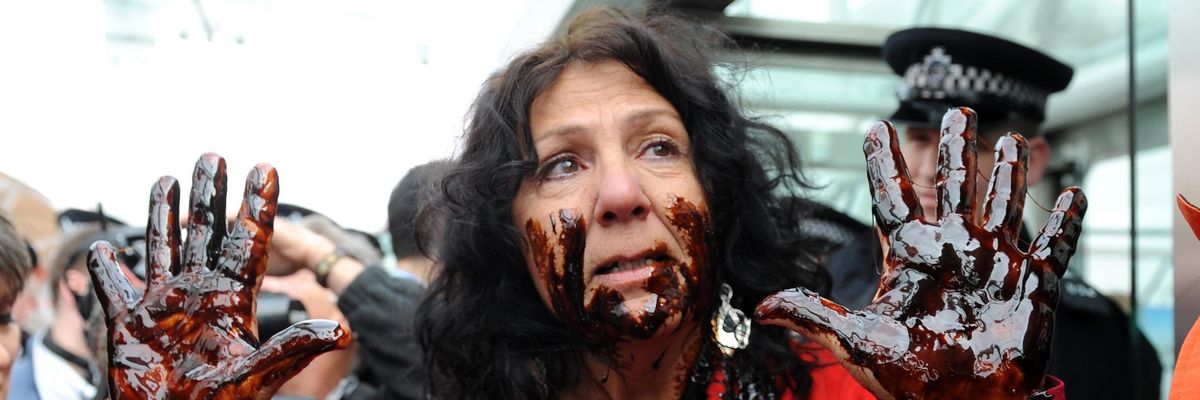
Environmental activist Diane Wilson is pictured during a 2011 demonstration in London.
One Goldman Environmental Prize recipient was Diane Wilson, who won a historic $50 million settlement in a case against Formosa Plastics.
Activists from Zambia, Indonesia, Turkey, Finland, Brazil, and the United States were awarded the 2023 Goldman Environmental Prize on Monday for fighting destructive mining projects, working to protect imperiled marine ecosystems, shielding Indigenous land from corporate plunder, and holding a powerful plastics company accountable for dumping toxic waste on Texas' Gulf Coast.
"Now that the world has awakened to acute environmental crises like climate change, fossil fuel extraction, and pollution of our air and water, we are much more aware of our connections to each other and to all life on the planet," said John Goldman, president of the Goldman Environmental Foundation. "A grassroots activist in Malawi working to combat plastic pollution in her own country is directly connected to us, and vice versa; and she has much to teach us about how we can do that work at home, where we live. This work, and our fates, are all intertwined."
This year's recipients of the prize, awarded annually to grassroots campaigners from the world's six inhabited continents, were Chilekwa Mumba of Zambia, Zafer Kizilkaya of Turkey, Tero Mustonen of Finland, Delima Silalahi of Indonesia, Alessandra Korap Munduruku of Brazil, and Diane Wilson of the United States.
In 2019, Wilson—a fourth-generation shrimper—won a $50 million settlement in a landmark case against the petrochemical behemoth and notorious polluter Formosa Plastics. The Texas Tribune noted that the 2019 settlement, which a judge ordered the company to place in a trust devoted to habitat restoration and other efforts on the Texas Gulf Coast, was "the largest in U.S. history involving a private citizen's lawsuit against an industrial polluter under federal clean air and water laws."
Other Goldman prize recipients helped score victories against powerful companies.
Alessandra Korap Munduruku of Brazil "organized community efforts to stop mining development by British mining company Anglo American in Brazil's Amazon rainforest," forcing the firm to "withdraw 27 approved research applications to mine inside Indigenous territories," the Goldman Environmental Foundation noted.
Chilekwa Mumba of Zambia, for his part, coordinated legal action against Vedanta Resources, the United Kingdom-based parent company of a massively polluting mining operation in the African nation's Copperbelt Province.
"Chilekwa's victory in the U.K. Supreme Court set a legal precedent—it was the first time an English court ruled that a British company could be held liable for the environmental damage caused by subsidiary-run operations in another country," the Goldman Environmental Foundation said. "This precedent has since been applied to hold Shell Global—one of the world's 10 largest corporations by revenue—liable for its pollution in Nigeria."
A formal award ceremony will be held in Washington, D.C. on Monday at 8:30 pm ET.
Watch live:
This country and this world are at a monumental crossroads. US voters have an opportunity to beat back the forces of fascism and confront the billionaires who are rigging the economy, our media system, and our democracy, making it increasingly impossible for ordinary people to get by. We’re not just talking about the election. We’re talking about what must be done once these fascist elements are vanquished from power. We need a bolder set of solutions than what either major party has so far been willing to offer and a working-class movement ready to fight like hell for it. Trump didn't emerge from nowhere. The conditions that fueled MAGA authoritarianism were created by decades of radical neoliberal economic policies and a corrupt political system dominated by corporate interests. They slashed taxes on the super-rich, promising that the benefits would trickle down. They said giveaways to the corporate titans would make life more affordable for the rest of us. It was all bullshit. And when a bitter, betrayed populace searches for someone to blame, right-wing demagogues have little trouble finding scapegoats. People know when they're being lied to, but you won't hear any of this from the corporate media. Only independent journalism—powered and funded by people who believe in building a better world—can deliver truly trustworthy daily news. If you share our vision, please contribute whatever you can to sustain our work. |
Activists from Zambia, Indonesia, Turkey, Finland, Brazil, and the United States were awarded the 2023 Goldman Environmental Prize on Monday for fighting destructive mining projects, working to protect imperiled marine ecosystems, shielding Indigenous land from corporate plunder, and holding a powerful plastics company accountable for dumping toxic waste on Texas' Gulf Coast.
"Now that the world has awakened to acute environmental crises like climate change, fossil fuel extraction, and pollution of our air and water, we are much more aware of our connections to each other and to all life on the planet," said John Goldman, president of the Goldman Environmental Foundation. "A grassroots activist in Malawi working to combat plastic pollution in her own country is directly connected to us, and vice versa; and she has much to teach us about how we can do that work at home, where we live. This work, and our fates, are all intertwined."
This year's recipients of the prize, awarded annually to grassroots campaigners from the world's six inhabited continents, were Chilekwa Mumba of Zambia, Zafer Kizilkaya of Turkey, Tero Mustonen of Finland, Delima Silalahi of Indonesia, Alessandra Korap Munduruku of Brazil, and Diane Wilson of the United States.
In 2019, Wilson—a fourth-generation shrimper—won a $50 million settlement in a landmark case against the petrochemical behemoth and notorious polluter Formosa Plastics. The Texas Tribune noted that the 2019 settlement, which a judge ordered the company to place in a trust devoted to habitat restoration and other efforts on the Texas Gulf Coast, was "the largest in U.S. history involving a private citizen's lawsuit against an industrial polluter under federal clean air and water laws."
Other Goldman prize recipients helped score victories against powerful companies.
Alessandra Korap Munduruku of Brazil "organized community efforts to stop mining development by British mining company Anglo American in Brazil's Amazon rainforest," forcing the firm to "withdraw 27 approved research applications to mine inside Indigenous territories," the Goldman Environmental Foundation noted.
Chilekwa Mumba of Zambia, for his part, coordinated legal action against Vedanta Resources, the United Kingdom-based parent company of a massively polluting mining operation in the African nation's Copperbelt Province.
"Chilekwa's victory in the U.K. Supreme Court set a legal precedent—it was the first time an English court ruled that a British company could be held liable for the environmental damage caused by subsidiary-run operations in another country," the Goldman Environmental Foundation said. "This precedent has since been applied to hold Shell Global—one of the world's 10 largest corporations by revenue—liable for its pollution in Nigeria."
A formal award ceremony will be held in Washington, D.C. on Monday at 8:30 pm ET.
Watch live:

