SUBSCRIBE TO OUR FREE NEWSLETTER
Daily news & progressive opinion—funded by the people, not the corporations—delivered straight to your inbox.
5
#000000
#FFFFFF
To donate by check, phone, or other method, see our More Ways to Give page.
Daily news & progressive opinion—funded by the people, not the corporations—delivered straight to your inbox.
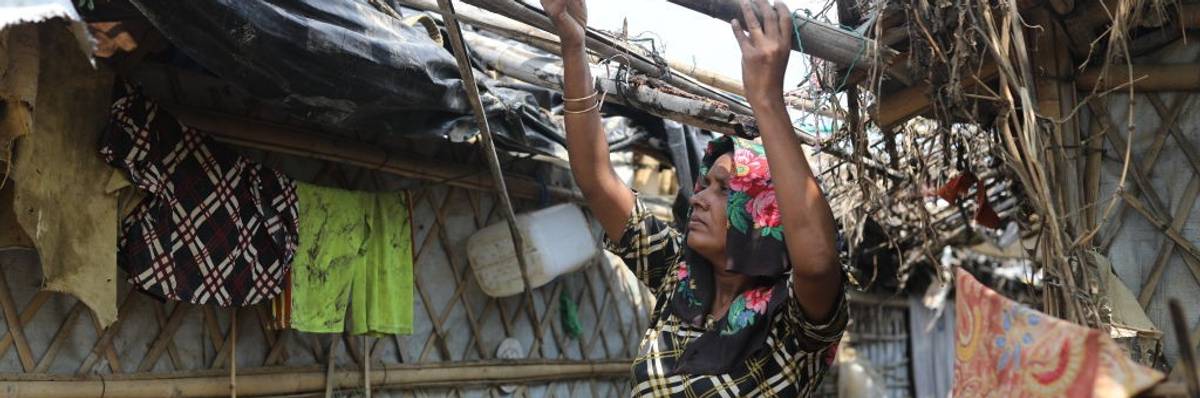
Rohingya refugees rebuilt their temporary house as Cyclone Mocha hits Teknaf, Bangladesh on May 15, 2023.
Host countries’ interests in protecting the rights and services of their own citizens keeps refugees from being fully integrated into society or obtaining citizenship.
The number of people forced from their homes, primarily because of conflict or climate change, is on the rise, topping 100 million people in 2022—more than double the number of displaced people in 2012.
About a third of those 100 million people are refugees. Refugees live in a legal limbo that can increasingly stretch for decades. And the number of people remaining refugees for five years or longer more than doubled over the past decade, topping 16 million in 2022. These are people who do not have a clear path to residency in any country but are unable to return to their homes because they are unsafe.
Typically, because of domestic political pressure and other issues, the countries hosting refugees do not want to offer them permanent residency.
“We escaped our home and belonging to save our lives from bullets. Now, we are hanging in uncertainties.”
I have spent years interviewing Rohingya people—members of an ethnic minority who have lived in Myanmar for centuries but without actual citizenship—in refugee camps in Bangladesh. These talks show the real-life effects of people remaining refugees for years.
“We escaped our home and belonging to save our lives from bullets. Now, we are hanging in uncertainties—no right to attain higher education, no permission to work, no claim over property. Yet no path to return,” Jafar, a 27-year-old Rohingya refugee, told me during my fieldwork in the Kutupalong refugee camp in Bangladesh in July 2022.
I am a Bangladeshi scholar who researches refugees’ everyday lives. I have closely followed the trajectory of Kutupalong, which grew to become the largest refugee camp in the world in 2017.
My research shows that host countries’ interests in protecting the rights and services of their own citizens keeps refugees from being fully integrated into society or obtaining citizenship.
In the absence of legal protection outside their home countries, refugees’ livelihoods and well-being often remain in jeopardy, an effect that can span generations.
People can get refugee status when a government or international organization such as the U.N. finds that they have a legitimate fear of persecution because of their race, religion, nationality, political opinion, or membership in a particular social group in their home country.
Refugees are legally protected under international law from deportation but often do not have safe places to live or the opportunity to legally work in their host countries. Most refugees live outside of formal camps, in informal settlements in cities.
Only 204,500 of the world’s 32 million refugees were able to return home or get resettled permanently in 2022.
Some wealthier countries are developing restrictive policies that make it harder for refugees to cross their borders.
Generally, people are remaining refugees for longer periods for three reasons.
First, conflicts in places ranging from Ethiopia to Syria are lasting longer than conflicts have historically, dragging on for more than a decade in some cases.
Second, there generally aren’t cohesive international, regional, or national strategies to handle large numbers of refugees. Low- or middle-income countries like Turkey that do not guarantee a path to citizenship host more than two-thirds of the world’s refugees.
And third, some wealthier countries are developing restrictive policies that make it harder for refugees to cross their borders. They are also taking actions that make it harder for refugees to ever cross their borders—including building more border walls, detaining refugees in offshore islands, and intercepting refugee boats.
One general exception to this trend is the protection granted by European Union countries to 4 million Ukrainian refugees fleeing the war, including giving them the legal right to work, for several years.
The Rohingya situation demonstrates the civic and physical dangers of long-term legal refugee limbo.
In 2017, Mynamar’s military launched widespread violent attacks against the Rohingya people that the United Nations considers genocide.
Hundreds of thousands of Rohingya people fled across the border to Bangladesh. Now, about 930,292 Rohingya refugees live in a sprawling refugee camp in Cox’s Bazar in the southern part of Bangladesh.
Syrian refugees in Turkey, Sri Lankan Tamil refugees in India, Afghan refugees in Pakistan, and Somali refugees in Kenya are among the large groups of refugees who fled conflict and have lived for decades in another place without the protections of citizenship.
Negotiations over repatriating Rohingya people to Myanmar stalled in 2021 following a military coup in Myanmar.
But the Rohingya situation in Bangladesh is not unique.
Syrian refugees in Turkey, Sri Lankan Tamil refugees in India, Afghan refugees in Pakistan, and Somali refugees in Kenya are among the large groups of refugees who fled conflict and have lived for decades in another place without the protections of citizenship.
During my fieldwork in Cox’s Bazar in August 2022, I met with a 65-year-old refugee named Kolim who lost both his legs in a shooting by the Myanmar army. He said that the local nonprofit organization that had supported him with a disability allowance for five years just ended its project, because the organization could not secure funding for the next year.
This follows an overall trend of major international humanitarian organizations and smaller nonprofits alike tending to give the most money following an emergency response or crisis.
Similarly, long-term conflicts and continuing humanitarian crises that last years tend to see drops in funding and help over time.
Refugees in dire situations also often engage in work without permission and risk being arrested by the police.
Meanwhile, only about half of refugee children are in school.
Refugees—who are typically unable to legally work in their host countries—also tend to undertake informal kinds of employment, working as day laborers in construction, for example, or as street vendors.
Refugees in dire situations also often engage in work without permission and risk being arrested by the police. Some of my research shows that competition to find work also generates tension between the host and the refugee communities.
There have been some recent efforts at the international level to address the challenges facing refugees and host countries alike.
In 2018, countries in the U.N. agreed to an informal plan to jointly share the responsibility to host refugees and migrants.
These countries committed to a framework for shared responsibilities in their response to refugee crises.
But nonprofit groups that work with refugees have said it is unclear whether the plan has resulted in any change, noting that few countries have implemented the strategy into their domestic planning.
Without any systematic solutions to deal with migration and refugees, refugees continue to forge ahead without a clear direction.
Dear Common Dreams reader, It’s been nearly 30 years since I co-founded Common Dreams with my late wife, Lina Newhouser. We had the radical notion that journalism should serve the public good, not corporate profits. It was clear to us from the outset what it would take to build such a project. No paid advertisements. No corporate sponsors. No millionaire publisher telling us what to think or do. Many people said we wouldn't last a year, but we proved those doubters wrong. Together with a tremendous team of journalists and dedicated staff, we built an independent media outlet free from the constraints of profits and corporate control. Our mission has always been simple: To inform. To inspire. To ignite change for the common good. Building Common Dreams was not easy. Our survival was never guaranteed. When you take on the most powerful forces—Wall Street greed, fossil fuel industry destruction, Big Tech lobbyists, and uber-rich oligarchs who have spent billions upon billions rigging the economy and democracy in their favor—the only bulwark you have is supporters who believe in your work. But here’s the urgent message from me today. It's never been this bad out there. And it's never been this hard to keep us going. At the very moment Common Dreams is most needed, the threats we face are intensifying. We need your support now more than ever. We don't accept corporate advertising and never will. We don't have a paywall because we don't think people should be blocked from critical news based on their ability to pay. Everything we do is funded by the donations of readers like you. When everyone does the little they can afford, we are strong. But if that support retreats or dries up, so do we. Will you donate now to make sure Common Dreams not only survives but thrives? —Craig Brown, Co-founder |
The number of people forced from their homes, primarily because of conflict or climate change, is on the rise, topping 100 million people in 2022—more than double the number of displaced people in 2012.
About a third of those 100 million people are refugees. Refugees live in a legal limbo that can increasingly stretch for decades. And the number of people remaining refugees for five years or longer more than doubled over the past decade, topping 16 million in 2022. These are people who do not have a clear path to residency in any country but are unable to return to their homes because they are unsafe.
Typically, because of domestic political pressure and other issues, the countries hosting refugees do not want to offer them permanent residency.
“We escaped our home and belonging to save our lives from bullets. Now, we are hanging in uncertainties.”
I have spent years interviewing Rohingya people—members of an ethnic minority who have lived in Myanmar for centuries but without actual citizenship—in refugee camps in Bangladesh. These talks show the real-life effects of people remaining refugees for years.
“We escaped our home and belonging to save our lives from bullets. Now, we are hanging in uncertainties—no right to attain higher education, no permission to work, no claim over property. Yet no path to return,” Jafar, a 27-year-old Rohingya refugee, told me during my fieldwork in the Kutupalong refugee camp in Bangladesh in July 2022.
I am a Bangladeshi scholar who researches refugees’ everyday lives. I have closely followed the trajectory of Kutupalong, which grew to become the largest refugee camp in the world in 2017.
My research shows that host countries’ interests in protecting the rights and services of their own citizens keeps refugees from being fully integrated into society or obtaining citizenship.
In the absence of legal protection outside their home countries, refugees’ livelihoods and well-being often remain in jeopardy, an effect that can span generations.
People can get refugee status when a government or international organization such as the U.N. finds that they have a legitimate fear of persecution because of their race, religion, nationality, political opinion, or membership in a particular social group in their home country.
Refugees are legally protected under international law from deportation but often do not have safe places to live or the opportunity to legally work in their host countries. Most refugees live outside of formal camps, in informal settlements in cities.
Only 204,500 of the world’s 32 million refugees were able to return home or get resettled permanently in 2022.
Some wealthier countries are developing restrictive policies that make it harder for refugees to cross their borders.
Generally, people are remaining refugees for longer periods for three reasons.
First, conflicts in places ranging from Ethiopia to Syria are lasting longer than conflicts have historically, dragging on for more than a decade in some cases.
Second, there generally aren’t cohesive international, regional, or national strategies to handle large numbers of refugees. Low- or middle-income countries like Turkey that do not guarantee a path to citizenship host more than two-thirds of the world’s refugees.
And third, some wealthier countries are developing restrictive policies that make it harder for refugees to cross their borders. They are also taking actions that make it harder for refugees to ever cross their borders—including building more border walls, detaining refugees in offshore islands, and intercepting refugee boats.
One general exception to this trend is the protection granted by European Union countries to 4 million Ukrainian refugees fleeing the war, including giving them the legal right to work, for several years.
The Rohingya situation demonstrates the civic and physical dangers of long-term legal refugee limbo.
In 2017, Mynamar’s military launched widespread violent attacks against the Rohingya people that the United Nations considers genocide.
Hundreds of thousands of Rohingya people fled across the border to Bangladesh. Now, about 930,292 Rohingya refugees live in a sprawling refugee camp in Cox’s Bazar in the southern part of Bangladesh.
Syrian refugees in Turkey, Sri Lankan Tamil refugees in India, Afghan refugees in Pakistan, and Somali refugees in Kenya are among the large groups of refugees who fled conflict and have lived for decades in another place without the protections of citizenship.
Negotiations over repatriating Rohingya people to Myanmar stalled in 2021 following a military coup in Myanmar.
But the Rohingya situation in Bangladesh is not unique.
Syrian refugees in Turkey, Sri Lankan Tamil refugees in India, Afghan refugees in Pakistan, and Somali refugees in Kenya are among the large groups of refugees who fled conflict and have lived for decades in another place without the protections of citizenship.
During my fieldwork in Cox’s Bazar in August 2022, I met with a 65-year-old refugee named Kolim who lost both his legs in a shooting by the Myanmar army. He said that the local nonprofit organization that had supported him with a disability allowance for five years just ended its project, because the organization could not secure funding for the next year.
This follows an overall trend of major international humanitarian organizations and smaller nonprofits alike tending to give the most money following an emergency response or crisis.
Similarly, long-term conflicts and continuing humanitarian crises that last years tend to see drops in funding and help over time.
Refugees in dire situations also often engage in work without permission and risk being arrested by the police.
Meanwhile, only about half of refugee children are in school.
Refugees—who are typically unable to legally work in their host countries—also tend to undertake informal kinds of employment, working as day laborers in construction, for example, or as street vendors.
Refugees in dire situations also often engage in work without permission and risk being arrested by the police. Some of my research shows that competition to find work also generates tension between the host and the refugee communities.
There have been some recent efforts at the international level to address the challenges facing refugees and host countries alike.
In 2018, countries in the U.N. agreed to an informal plan to jointly share the responsibility to host refugees and migrants.
These countries committed to a framework for shared responsibilities in their response to refugee crises.
But nonprofit groups that work with refugees have said it is unclear whether the plan has resulted in any change, noting that few countries have implemented the strategy into their domestic planning.
Without any systematic solutions to deal with migration and refugees, refugees continue to forge ahead without a clear direction.
The number of people forced from their homes, primarily because of conflict or climate change, is on the rise, topping 100 million people in 2022—more than double the number of displaced people in 2012.
About a third of those 100 million people are refugees. Refugees live in a legal limbo that can increasingly stretch for decades. And the number of people remaining refugees for five years or longer more than doubled over the past decade, topping 16 million in 2022. These are people who do not have a clear path to residency in any country but are unable to return to their homes because they are unsafe.
Typically, because of domestic political pressure and other issues, the countries hosting refugees do not want to offer them permanent residency.
“We escaped our home and belonging to save our lives from bullets. Now, we are hanging in uncertainties.”
I have spent years interviewing Rohingya people—members of an ethnic minority who have lived in Myanmar for centuries but without actual citizenship—in refugee camps in Bangladesh. These talks show the real-life effects of people remaining refugees for years.
“We escaped our home and belonging to save our lives from bullets. Now, we are hanging in uncertainties—no right to attain higher education, no permission to work, no claim over property. Yet no path to return,” Jafar, a 27-year-old Rohingya refugee, told me during my fieldwork in the Kutupalong refugee camp in Bangladesh in July 2022.
I am a Bangladeshi scholar who researches refugees’ everyday lives. I have closely followed the trajectory of Kutupalong, which grew to become the largest refugee camp in the world in 2017.
My research shows that host countries’ interests in protecting the rights and services of their own citizens keeps refugees from being fully integrated into society or obtaining citizenship.
In the absence of legal protection outside their home countries, refugees’ livelihoods and well-being often remain in jeopardy, an effect that can span generations.
People can get refugee status when a government or international organization such as the U.N. finds that they have a legitimate fear of persecution because of their race, religion, nationality, political opinion, or membership in a particular social group in their home country.
Refugees are legally protected under international law from deportation but often do not have safe places to live or the opportunity to legally work in their host countries. Most refugees live outside of formal camps, in informal settlements in cities.
Only 204,500 of the world’s 32 million refugees were able to return home or get resettled permanently in 2022.
Some wealthier countries are developing restrictive policies that make it harder for refugees to cross their borders.
Generally, people are remaining refugees for longer periods for three reasons.
First, conflicts in places ranging from Ethiopia to Syria are lasting longer than conflicts have historically, dragging on for more than a decade in some cases.
Second, there generally aren’t cohesive international, regional, or national strategies to handle large numbers of refugees. Low- or middle-income countries like Turkey that do not guarantee a path to citizenship host more than two-thirds of the world’s refugees.
And third, some wealthier countries are developing restrictive policies that make it harder for refugees to cross their borders. They are also taking actions that make it harder for refugees to ever cross their borders—including building more border walls, detaining refugees in offshore islands, and intercepting refugee boats.
One general exception to this trend is the protection granted by European Union countries to 4 million Ukrainian refugees fleeing the war, including giving them the legal right to work, for several years.
The Rohingya situation demonstrates the civic and physical dangers of long-term legal refugee limbo.
In 2017, Mynamar’s military launched widespread violent attacks against the Rohingya people that the United Nations considers genocide.
Hundreds of thousands of Rohingya people fled across the border to Bangladesh. Now, about 930,292 Rohingya refugees live in a sprawling refugee camp in Cox’s Bazar in the southern part of Bangladesh.
Syrian refugees in Turkey, Sri Lankan Tamil refugees in India, Afghan refugees in Pakistan, and Somali refugees in Kenya are among the large groups of refugees who fled conflict and have lived for decades in another place without the protections of citizenship.
Negotiations over repatriating Rohingya people to Myanmar stalled in 2021 following a military coup in Myanmar.
But the Rohingya situation in Bangladesh is not unique.
Syrian refugees in Turkey, Sri Lankan Tamil refugees in India, Afghan refugees in Pakistan, and Somali refugees in Kenya are among the large groups of refugees who fled conflict and have lived for decades in another place without the protections of citizenship.
During my fieldwork in Cox’s Bazar in August 2022, I met with a 65-year-old refugee named Kolim who lost both his legs in a shooting by the Myanmar army. He said that the local nonprofit organization that had supported him with a disability allowance for five years just ended its project, because the organization could not secure funding for the next year.
This follows an overall trend of major international humanitarian organizations and smaller nonprofits alike tending to give the most money following an emergency response or crisis.
Similarly, long-term conflicts and continuing humanitarian crises that last years tend to see drops in funding and help over time.
Refugees in dire situations also often engage in work without permission and risk being arrested by the police.
Meanwhile, only about half of refugee children are in school.
Refugees—who are typically unable to legally work in their host countries—also tend to undertake informal kinds of employment, working as day laborers in construction, for example, or as street vendors.
Refugees in dire situations also often engage in work without permission and risk being arrested by the police. Some of my research shows that competition to find work also generates tension between the host and the refugee communities.
There have been some recent efforts at the international level to address the challenges facing refugees and host countries alike.
In 2018, countries in the U.N. agreed to an informal plan to jointly share the responsibility to host refugees and migrants.
These countries committed to a framework for shared responsibilities in their response to refugee crises.
But nonprofit groups that work with refugees have said it is unclear whether the plan has resulted in any change, noting that few countries have implemented the strategy into their domestic planning.
Without any systematic solutions to deal with migration and refugees, refugees continue to forge ahead without a clear direction.