SUBSCRIBE TO OUR FREE NEWSLETTER
Daily news & progressive opinion—funded by the people, not the corporations—delivered straight to your inbox.
5
#000000
#FFFFFF
To donate by check, phone, or other method, see our More Ways to Give page.
Daily news & progressive opinion—funded by the people, not the corporations—delivered straight to your inbox.
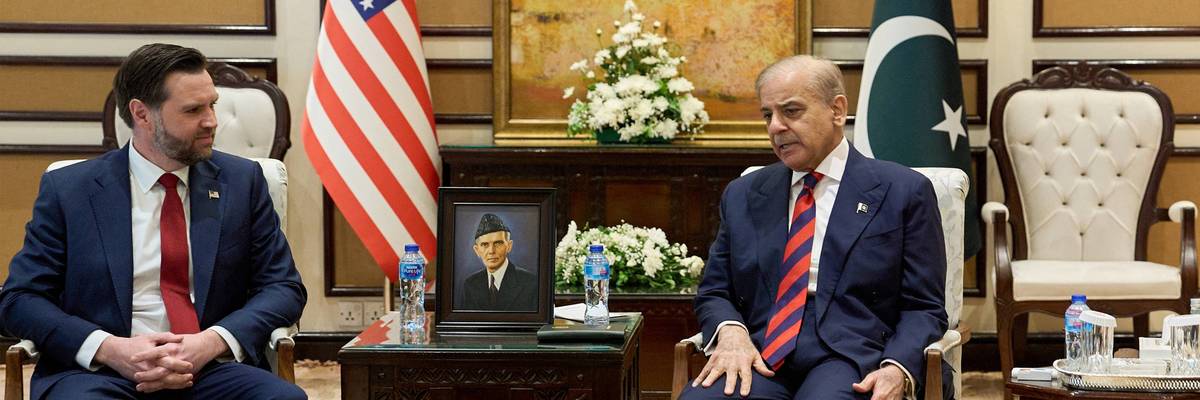
US Vice President JD Vance (L) speaks with Pakistani Prime Minister Shehbaz Sharif ahead of their meeting on Iran amid the US-Iran peace talks in Islamabad on April 11, 2026.
The challenges of structuring a peace process that can overcome 47 years of mutual grievances between the US and Iran were highlighted by the recent talks between the US and Iran in Pakistan.
Although the international community still knows very little about the highest-level peace talks between the US and Iran in 47 years, facilitated by Shehbaz Sharif, the Prime Minister of Pakistan, some obvious red flags appeared in the morning-after news reports—as JD Vance, Steve Witkoff, and Jared Kushner flew home less than 24 hours after their arrival in Islamabad.
As The New York Times reported: “Vice President JD Vance summed up the failure of 21 hours of negotiations with Iran in one sentence: ‘They have chosen not to accept our terms.’ To Iranian officials, that line reflected their biggest problem with the talks: The United States they argue, had not come to negotiate.” As Javid Zarif (who led the Iranian negotiating team on the Joint Comprehensive Plan of Action, negotiated by the Obama administration to keep Iran from developing a nuclear weapon, but later torn up by President Donald Trump) wrote on X, “No negotiations—at least with Iran—will succeed based on ‘our/your terms.’”
This highlights that, as expected, the talks took the form of a “hard-bargaining” (also called distributive bargaining) approach to negotiation where the parties seek to achieve a zero-sum (win-lose) outcome rather than a positive sum (win-win) outcome. Too often, however, they end up with a lose-lose outcome, as occurred in this situation. In hard bargaining, parties present their positions (i.e., their preferred solution to the issues) as demands—the Iranians offered a 10-point plan; the US, a 15-point plan—both exchanged before the talks began, a tactic that is not recommended by experienced peacemakers.
In the lead-up to the negotiations, it was initially reported that indirect “proximity talks” were planned—where the third-party mediator moves back and forth between the delegations, who are placed in close proximity to one another in nearby, but separate locations. This typically tends to be a much more productive means of negotiation than direct talks, as it represents each party talking to and negotiating with the impartial third-party mediator, rather than the other party, allowing each delegation to avoid the confrontation and aggravation of dealing directly with its adversary. Moreover, it allows the mediator to try out various possibilities for creative solutions by using a “one-text procedure” to develop a text that is controlled by the mediator and continuously adjusted to address each party’s concerns and allow the mediator, over time, to get ever closer to agreement.
Parties need a constructive process to help them engage in meaningful problem solving, especially where there is no trust and they have a long-term hostile relationship.
On the day, however, after brief separate meetings by US and Iranian delegations with the Pakistani prime minister, direct talks were convened. Unlike the common wisdom that it is good to have the parties talking to one another, this kind of negotiation is not helpful to constructive problem solving. Instead, it is likely to break down into confrontational exchanges, whereby each party simply reiterates its positions and demands—and typically issues threats and ultimatums and employs other pressure tactics to try to force the other to concede, causing each to become ever more entrenched in its positions and more resistant to new ideas.
Another problem was the totally unrealistic expectation that was created for the talks—the idea that an agreement settling decades of serious grievances between the US and Iran might be negotiated within a weekend. A much more realistic approach would have been to schedule talks to be held over a much longer time frame or to schedule additional rounds of talks.
The continuous, marathon nature of the talks are also not a good way to structure peacemaking negotiations. The talks began soon after both delegations arrived (the US delegation had traveled for 18 hours) and lasted all afternoon and most of the night. Indeed, such a schedule is not at all conducive to constructive outcomes, as the parties were tired upon arrival and became ever more exhausted and stressed as the talks continued, reducing their ability to listen to and understand the other party’s issues and concerns and to even to consider or create any new, innovative possibilities that could help bridge differences or create trade-offs.
Moreover, such a format offers no time for the delegations to engage in discussions with their own team or reflect on the exchanges that have occurred at the table between the parties. As confirmed by The New York Times, at the end of the talks, “Exhausted and frustrated after 21 hours on the ground, Mr. Vance provided few details, took three questions, and departed.” The Iranians, for their part, are actually known for their “long-winded, relentless approach to deal-making,” which the Iranian Foreign Minister, Abbas Araghchi, has called “market style,” meaning “continuous and tireless bargaining.” This is why it is important to have an experienced mediator who knows how to control the process and who will structure negotiation in a paced manner, over a number of days, with breaks during each day and time to sleep and rest overnight.
It also appeared that Mr. Vance was not plenipotentiary in having full authority to take independent action, since he reportedly broke off negotiations on multiple occasions to phone President Trump, perhaps because, over Easter, Trump said that: “If it doesn’t happen, I’m blaming JD Vance... if it does happen, I’m taking full credit.”
The overriding issue that is often neglected by well-meaning, but unseasoned third parties, as well as by inexperienced delegations, is their total focus on the substance of a negotiation—to the neglect of the process. Although substance is, of course, important, the process of how negotiations are structured is crucial to finding an acceptable outcome that achieves agreement on substance. Parties need a constructive process to help them engage in meaningful problem solving, especially where there is no trust and they have a long-term hostile relationship.
Where the peace process goes from here is uncertain. Trump has already announced that the US will carry out a naval blockade of Iranian ports. It will, of course, help greatly if the ceasefire can be maintained and extended beyond the two weeks, since the longer a cessation of hostilities is in place, the more time there will be for additional meaningful talks to occur. One thing that is certain, however, is that all of those working to promote an end to the war in Iran (Pakistan, Türkiye, Egypt, and other regional partners, as well China, the United Nations, others) have a huge challenge ahead of them in crafting a process that will allow for an integrative approach that will have a chance of resolving this long-standing, intractable conflict.
Dear Common Dreams reader, It’s been nearly 30 years since I co-founded Common Dreams with my late wife, Lina Newhouser. We had the radical notion that journalism should serve the public good, not corporate profits. It was clear to us from the outset what it would take to build such a project. No paid advertisements. No corporate sponsors. No millionaire publisher telling us what to think or do. Many people said we wouldn't last a year, but we proved those doubters wrong. Together with a tremendous team of journalists and dedicated staff, we built an independent media outlet free from the constraints of profits and corporate control. Our mission has always been simple: To inform. To inspire. To ignite change for the common good. Building Common Dreams was not easy. Our survival was never guaranteed. When you take on the most powerful forces—Wall Street greed, fossil fuel industry destruction, Big Tech lobbyists, and uber-rich oligarchs who have spent billions upon billions rigging the economy and democracy in their favor—the only bulwark you have is supporters who believe in your work. But here’s the urgent message from me today. It's never been this bad out there. And it's never been this hard to keep us going. At the very moment Common Dreams is most needed, the threats we face are intensifying. We need your support now more than ever. We don't accept corporate advertising and never will. We don't have a paywall because we don't think people should be blocked from critical news based on their ability to pay. Everything we do is funded by the donations of readers like you. When everyone does the little they can afford, we are strong. But if that support retreats or dries up, so do we. Will you donate now to make sure Common Dreams not only survives but thrives? —Craig Brown, Co-founder |
Although the international community still knows very little about the highest-level peace talks between the US and Iran in 47 years, facilitated by Shehbaz Sharif, the Prime Minister of Pakistan, some obvious red flags appeared in the morning-after news reports—as JD Vance, Steve Witkoff, and Jared Kushner flew home less than 24 hours after their arrival in Islamabad.
As The New York Times reported: “Vice President JD Vance summed up the failure of 21 hours of negotiations with Iran in one sentence: ‘They have chosen not to accept our terms.’ To Iranian officials, that line reflected their biggest problem with the talks: The United States they argue, had not come to negotiate.” As Javid Zarif (who led the Iranian negotiating team on the Joint Comprehensive Plan of Action, negotiated by the Obama administration to keep Iran from developing a nuclear weapon, but later torn up by President Donald Trump) wrote on X, “No negotiations—at least with Iran—will succeed based on ‘our/your terms.’”
This highlights that, as expected, the talks took the form of a “hard-bargaining” (also called distributive bargaining) approach to negotiation where the parties seek to achieve a zero-sum (win-lose) outcome rather than a positive sum (win-win) outcome. Too often, however, they end up with a lose-lose outcome, as occurred in this situation. In hard bargaining, parties present their positions (i.e., their preferred solution to the issues) as demands—the Iranians offered a 10-point plan; the US, a 15-point plan—both exchanged before the talks began, a tactic that is not recommended by experienced peacemakers.
In the lead-up to the negotiations, it was initially reported that indirect “proximity talks” were planned—where the third-party mediator moves back and forth between the delegations, who are placed in close proximity to one another in nearby, but separate locations. This typically tends to be a much more productive means of negotiation than direct talks, as it represents each party talking to and negotiating with the impartial third-party mediator, rather than the other party, allowing each delegation to avoid the confrontation and aggravation of dealing directly with its adversary. Moreover, it allows the mediator to try out various possibilities for creative solutions by using a “one-text procedure” to develop a text that is controlled by the mediator and continuously adjusted to address each party’s concerns and allow the mediator, over time, to get ever closer to agreement.
Parties need a constructive process to help them engage in meaningful problem solving, especially where there is no trust and they have a long-term hostile relationship.
On the day, however, after brief separate meetings by US and Iranian delegations with the Pakistani prime minister, direct talks were convened. Unlike the common wisdom that it is good to have the parties talking to one another, this kind of negotiation is not helpful to constructive problem solving. Instead, it is likely to break down into confrontational exchanges, whereby each party simply reiterates its positions and demands—and typically issues threats and ultimatums and employs other pressure tactics to try to force the other to concede, causing each to become ever more entrenched in its positions and more resistant to new ideas.
Another problem was the totally unrealistic expectation that was created for the talks—the idea that an agreement settling decades of serious grievances between the US and Iran might be negotiated within a weekend. A much more realistic approach would have been to schedule talks to be held over a much longer time frame or to schedule additional rounds of talks.
The continuous, marathon nature of the talks are also not a good way to structure peacemaking negotiations. The talks began soon after both delegations arrived (the US delegation had traveled for 18 hours) and lasted all afternoon and most of the night. Indeed, such a schedule is not at all conducive to constructive outcomes, as the parties were tired upon arrival and became ever more exhausted and stressed as the talks continued, reducing their ability to listen to and understand the other party’s issues and concerns and to even to consider or create any new, innovative possibilities that could help bridge differences or create trade-offs.
Moreover, such a format offers no time for the delegations to engage in discussions with their own team or reflect on the exchanges that have occurred at the table between the parties. As confirmed by The New York Times, at the end of the talks, “Exhausted and frustrated after 21 hours on the ground, Mr. Vance provided few details, took three questions, and departed.” The Iranians, for their part, are actually known for their “long-winded, relentless approach to deal-making,” which the Iranian Foreign Minister, Abbas Araghchi, has called “market style,” meaning “continuous and tireless bargaining.” This is why it is important to have an experienced mediator who knows how to control the process and who will structure negotiation in a paced manner, over a number of days, with breaks during each day and time to sleep and rest overnight.
It also appeared that Mr. Vance was not plenipotentiary in having full authority to take independent action, since he reportedly broke off negotiations on multiple occasions to phone President Trump, perhaps because, over Easter, Trump said that: “If it doesn’t happen, I’m blaming JD Vance... if it does happen, I’m taking full credit.”
The overriding issue that is often neglected by well-meaning, but unseasoned third parties, as well as by inexperienced delegations, is their total focus on the substance of a negotiation—to the neglect of the process. Although substance is, of course, important, the process of how negotiations are structured is crucial to finding an acceptable outcome that achieves agreement on substance. Parties need a constructive process to help them engage in meaningful problem solving, especially where there is no trust and they have a long-term hostile relationship.
Where the peace process goes from here is uncertain. Trump has already announced that the US will carry out a naval blockade of Iranian ports. It will, of course, help greatly if the ceasefire can be maintained and extended beyond the two weeks, since the longer a cessation of hostilities is in place, the more time there will be for additional meaningful talks to occur. One thing that is certain, however, is that all of those working to promote an end to the war in Iran (Pakistan, Türkiye, Egypt, and other regional partners, as well China, the United Nations, others) have a huge challenge ahead of them in crafting a process that will allow for an integrative approach that will have a chance of resolving this long-standing, intractable conflict.
Although the international community still knows very little about the highest-level peace talks between the US and Iran in 47 years, facilitated by Shehbaz Sharif, the Prime Minister of Pakistan, some obvious red flags appeared in the morning-after news reports—as JD Vance, Steve Witkoff, and Jared Kushner flew home less than 24 hours after their arrival in Islamabad.
As The New York Times reported: “Vice President JD Vance summed up the failure of 21 hours of negotiations with Iran in one sentence: ‘They have chosen not to accept our terms.’ To Iranian officials, that line reflected their biggest problem with the talks: The United States they argue, had not come to negotiate.” As Javid Zarif (who led the Iranian negotiating team on the Joint Comprehensive Plan of Action, negotiated by the Obama administration to keep Iran from developing a nuclear weapon, but later torn up by President Donald Trump) wrote on X, “No negotiations—at least with Iran—will succeed based on ‘our/your terms.’”
This highlights that, as expected, the talks took the form of a “hard-bargaining” (also called distributive bargaining) approach to negotiation where the parties seek to achieve a zero-sum (win-lose) outcome rather than a positive sum (win-win) outcome. Too often, however, they end up with a lose-lose outcome, as occurred in this situation. In hard bargaining, parties present their positions (i.e., their preferred solution to the issues) as demands—the Iranians offered a 10-point plan; the US, a 15-point plan—both exchanged before the talks began, a tactic that is not recommended by experienced peacemakers.
In the lead-up to the negotiations, it was initially reported that indirect “proximity talks” were planned—where the third-party mediator moves back and forth between the delegations, who are placed in close proximity to one another in nearby, but separate locations. This typically tends to be a much more productive means of negotiation than direct talks, as it represents each party talking to and negotiating with the impartial third-party mediator, rather than the other party, allowing each delegation to avoid the confrontation and aggravation of dealing directly with its adversary. Moreover, it allows the mediator to try out various possibilities for creative solutions by using a “one-text procedure” to develop a text that is controlled by the mediator and continuously adjusted to address each party’s concerns and allow the mediator, over time, to get ever closer to agreement.
Parties need a constructive process to help them engage in meaningful problem solving, especially where there is no trust and they have a long-term hostile relationship.
On the day, however, after brief separate meetings by US and Iranian delegations with the Pakistani prime minister, direct talks were convened. Unlike the common wisdom that it is good to have the parties talking to one another, this kind of negotiation is not helpful to constructive problem solving. Instead, it is likely to break down into confrontational exchanges, whereby each party simply reiterates its positions and demands—and typically issues threats and ultimatums and employs other pressure tactics to try to force the other to concede, causing each to become ever more entrenched in its positions and more resistant to new ideas.
Another problem was the totally unrealistic expectation that was created for the talks—the idea that an agreement settling decades of serious grievances between the US and Iran might be negotiated within a weekend. A much more realistic approach would have been to schedule talks to be held over a much longer time frame or to schedule additional rounds of talks.
The continuous, marathon nature of the talks are also not a good way to structure peacemaking negotiations. The talks began soon after both delegations arrived (the US delegation had traveled for 18 hours) and lasted all afternoon and most of the night. Indeed, such a schedule is not at all conducive to constructive outcomes, as the parties were tired upon arrival and became ever more exhausted and stressed as the talks continued, reducing their ability to listen to and understand the other party’s issues and concerns and to even to consider or create any new, innovative possibilities that could help bridge differences or create trade-offs.
Moreover, such a format offers no time for the delegations to engage in discussions with their own team or reflect on the exchanges that have occurred at the table between the parties. As confirmed by The New York Times, at the end of the talks, “Exhausted and frustrated after 21 hours on the ground, Mr. Vance provided few details, took three questions, and departed.” The Iranians, for their part, are actually known for their “long-winded, relentless approach to deal-making,” which the Iranian Foreign Minister, Abbas Araghchi, has called “market style,” meaning “continuous and tireless bargaining.” This is why it is important to have an experienced mediator who knows how to control the process and who will structure negotiation in a paced manner, over a number of days, with breaks during each day and time to sleep and rest overnight.
It also appeared that Mr. Vance was not plenipotentiary in having full authority to take independent action, since he reportedly broke off negotiations on multiple occasions to phone President Trump, perhaps because, over Easter, Trump said that: “If it doesn’t happen, I’m blaming JD Vance... if it does happen, I’m taking full credit.”
The overriding issue that is often neglected by well-meaning, but unseasoned third parties, as well as by inexperienced delegations, is their total focus on the substance of a negotiation—to the neglect of the process. Although substance is, of course, important, the process of how negotiations are structured is crucial to finding an acceptable outcome that achieves agreement on substance. Parties need a constructive process to help them engage in meaningful problem solving, especially where there is no trust and they have a long-term hostile relationship.
Where the peace process goes from here is uncertain. Trump has already announced that the US will carry out a naval blockade of Iranian ports. It will, of course, help greatly if the ceasefire can be maintained and extended beyond the two weeks, since the longer a cessation of hostilities is in place, the more time there will be for additional meaningful talks to occur. One thing that is certain, however, is that all of those working to promote an end to the war in Iran (Pakistan, Türkiye, Egypt, and other regional partners, as well China, the United Nations, others) have a huge challenge ahead of them in crafting a process that will allow for an integrative approach that will have a chance of resolving this long-standing, intractable conflict.