SUBSCRIBE TO OUR FREE NEWSLETTER
Daily news & progressive opinion—funded by the people, not the corporations—delivered straight to your inbox.
5
#000000
#FFFFFF
To donate by check, phone, or other method, see our More Ways to Give page.
Daily news & progressive opinion—funded by the people, not the corporations—delivered straight to your inbox.
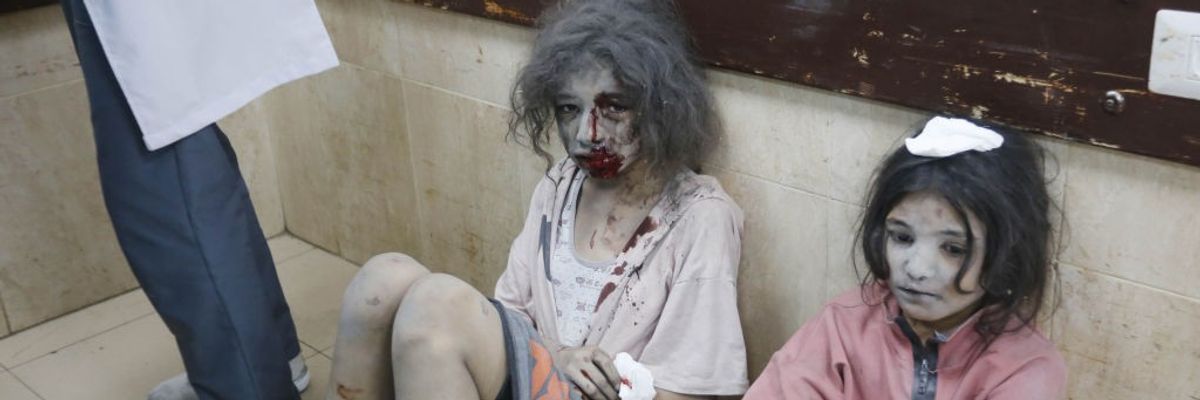
Injured Palestinian children are taken to the al-Aqsa Hospital after the Israeli airstrike in Deir al-Balah, Gaza on October 22, 2023.
Your heart aches. You scroll. You cry. You’re repeatedly stunned by the brutality you’re witnessing.
There are people better suited than me to analyze the news, to report on disinformation, to dissect the politics.
There are journalists risking their lives and the lives of their families to bring you uncensored news coverage. I hope you are following them.
My purpose here is different. Though it’s not as urgent as encouraging you to donate to Gaza or to press your governments to demand a ceasefire, this message is also important from an emotional, psychological, and mental health perspective.
You’re feeling isolated. You feel like you’re being eaten alive. That is why I must remind every Palestinian, in every country around the globe, that you are part of a family and that you are deeply loved.
We are living in a surreal time. The Nakba of 1948 was not televised; our ancestors told us stories and there are some pictures. But today, we are being exposed to photographs, videos, and interviews attesting to the brutality being inflicted on the bodies and hearts, and psyches of a civilian population in Gaza.
And what about the families who chose to sleep in different locations, to increase the chance of some of them surviving, while others sleep huddled together, choosing to die together?
You think about them while, in your own bed, sleep eludes you as cruelly as peace. You think about Wadea al-Fayoume, which makes you think about Muhammad al-Durrah, then the Bakr boys playing football on the beach, and then it’s all the children… under the rubble, on a stretcher, gasping, shivering, and stunned after a blast.
There was a video of a cat, nuzzling one last time with the dead body of a toddler, its former playmate and best friend. You cynically entertained this thought: “This video has a sweet cat in it. Maybe, if I post it, people will care now?”
Of course, you chide yourself: nothing you’re experiencing can compare to the actual terror being endured in Gaza. You have seen videos of traumatized children, shaking from clinical shock, asking, “Am I still alive?” They are scared and helpless, and you want to embrace them all, as I do, and put a stop to their misery.
You are experiencing survivor’s guilt intensely, and you’re having trouble functioning at work, in school, among your friends and family.Yesterday, you watched as a mother wrote her children's names on their limbs and added her own, so their parts would be returned to her. Even if she's also dead, at least they can be buried together. She's been forced, you realize, to accept the icy logic of despair.
And as you go about performing mundane, everyday tasks, you ask yourself: “What evil is this?”
I’m writing to you because you live in a country where there is little empathy for the plight of your own people. Your robotic politicians seem undisturbed by the fact that 2.3 million people have been without water, food, and electricity for two weeks now.
A civilian population - elders who look like your grandparents, children who resemble your own - is being carpet-bombed with a cruelty that is beyond measure. An Israeli minister called them “human animals,” and President Joe Biden publicly doubts the numbers of casualties reported by the Palestinians.
You know, as he surely does, that the number is probably higher, that the missing people are not really "missing"; they're dead under the rubble.
Your heart aches. You scroll. You cry. You’re repeatedly stunned by the brutality you’re witnessing.
Your grandparents may have been born outside of Palestine. Maybe you’ve never ever seen Palestine yourself. Maybe you don’t speak or understand Arabic at all. In the past, these factors have made you feel distanced from your heritage, but this moment reminds you of how Palestinian you truly are, especially as you realize something we all do: there is a concerted effort to erase us.
You thought you were living in a more progressive time. At last, during the past decade, the ugly history of slavery, the genocide of indigenous Americans, the oppression of women and minorities are being discussed in open, if contested and heated, forums. #BlackLivesMatter gave you a way to describe systemic racism and articulate injustice as well as a path to rectify it.
The silver lining of the incessant book bans in the United States was that at least more honest and compassionate books were being made available, at last, to Black, indigenous, and other people of color and marginalized readers.
Your colleagues and friends might offer a 'I’m praying for both sides', which falls on your ears as: 'Keep me out of this'
Kimberle Crenshaw taught you the valuable term intersectionality, to understand how multiple factors—race, gender, class and more—contribute to oppression and marginalization. You have books, forums, seminars, entire university departments, dedicated to studying and analysing social justice.
Suddenly, your social media feed has fallen silent. A family friend was called in to meet with their supervisor over posting about Palestine. Even as I type this, I wonder and worry about who will deliberately misunderstand me. Your colleagues and friends might offer an “I’m praying for both sides”, which falls on your ears as: “Keep me out of this.”
Instead of saying, “This is a genocide”, they may tell you, “My heart is hurting.”
Meanwhile, your own heart is busted.
You may be Muslim, Christian, Jewish, or Druze. You might be an atheist. As a Quaker, I say that never has it felt more dangerous to utter a simple truth: human life is sacred. The murder of civilians should be utterly condemned. And yet, you wonder why it’s so hard for people to speak this truth when the victims look like you.
Being expected to stay silent in the face of absolute brutality is a unique and horrific level of pain. And here's my point: nobody understands you better in this moment than your Palestinian family. When you’re not sure what to do, I urge you to consider how Palestinians, in the worst situations, cope.
A week ago, a video depicted a young girl who’d been orphaned in the bombing. Her face is bloodied and her body covered in burns; she lies, perhaps sleeping, perhaps unconscious, on the floor of a hallway that is jammed with other urgent cases.
Sitting by her side is a Palestinian mother of four, who explains to the camera that she’s stayed beside this child since hearing the doctors say that she had nobody else. She plans to keep the orphaned girl, who is completely unknown to her, as her own.Another example: in a Gaza hospital, a group of doctors sing together, a gorgeous song of solidarity and unity. They will not abandon their patients. Despite the very real possibility that the hospital will be destroyed, they will stay till the end. And they sing to console one another. Their song is an act of pure love. You cannot stop watching it.
In another video, a little boy, who survived a bombing, is being interviewed by a news crew; he cannot stop trembling as he struggles to speak. A doctor passing by notices and tells the interviewer to stop. The doctor scoops the boy into his arms, kissing his forehead and murmuring, “don't be afraid. I’m with you”. It's only then that the boy bursts into tears, when he senses he’s safe with someone who loves him.
And there, my dear cousin, is your playbook.
Take this message from the people of Gaza: we, the Palestinian community, despite being cast all over the globe in our diaspora, are a family. And we will survive as families do, by bonding together, consoling each other, gifting each other the gentleness that the world denies us.
When your sense of self is threatened, we will tell you stories of who we are. Of our ancestors and their dreams. Of our passion for life and our great love for the world, despite how it has treated us. This is how we have always kept our stories - and ourselves - alive. Trust us to gather around you, and keep your heart safe.
We will not be erased.
Dear Common Dreams reader, It’s been nearly 30 years since I co-founded Common Dreams with my late wife, Lina Newhouser. We had the radical notion that journalism should serve the public good, not corporate profits. It was clear to us from the outset what it would take to build such a project. No paid advertisements. No corporate sponsors. No millionaire publisher telling us what to think or do. Many people said we wouldn't last a year, but we proved those doubters wrong. Together with a tremendous team of journalists and dedicated staff, we built an independent media outlet free from the constraints of profits and corporate control. Our mission has always been simple: To inform. To inspire. To ignite change for the common good. Building Common Dreams was not easy. Our survival was never guaranteed. When you take on the most powerful forces—Wall Street greed, fossil fuel industry destruction, Big Tech lobbyists, and uber-rich oligarchs who have spent billions upon billions rigging the economy and democracy in their favor—the only bulwark you have is supporters who believe in your work. But here’s the urgent message from me today. It's never been this bad out there. And it's never been this hard to keep us going. At the very moment Common Dreams is most needed, the threats we face are intensifying. We need your support now more than ever. We don't accept corporate advertising and never will. We don't have a paywall because we don't think people should be blocked from critical news based on their ability to pay. Everything we do is funded by the donations of readers like you. When everyone does the little they can afford, we are strong. But if that support retreats or dries up, so do we. Will you donate now to make sure Common Dreams not only survives but thrives? —Craig Brown, Co-founder |
There are people better suited than me to analyze the news, to report on disinformation, to dissect the politics.
There are journalists risking their lives and the lives of their families to bring you uncensored news coverage. I hope you are following them.
My purpose here is different. Though it’s not as urgent as encouraging you to donate to Gaza or to press your governments to demand a ceasefire, this message is also important from an emotional, psychological, and mental health perspective.
You’re feeling isolated. You feel like you’re being eaten alive. That is why I must remind every Palestinian, in every country around the globe, that you are part of a family and that you are deeply loved.
We are living in a surreal time. The Nakba of 1948 was not televised; our ancestors told us stories and there are some pictures. But today, we are being exposed to photographs, videos, and interviews attesting to the brutality being inflicted on the bodies and hearts, and psyches of a civilian population in Gaza.
And what about the families who chose to sleep in different locations, to increase the chance of some of them surviving, while others sleep huddled together, choosing to die together?
You think about them while, in your own bed, sleep eludes you as cruelly as peace. You think about Wadea al-Fayoume, which makes you think about Muhammad al-Durrah, then the Bakr boys playing football on the beach, and then it’s all the children… under the rubble, on a stretcher, gasping, shivering, and stunned after a blast.
There was a video of a cat, nuzzling one last time with the dead body of a toddler, its former playmate and best friend. You cynically entertained this thought: “This video has a sweet cat in it. Maybe, if I post it, people will care now?”
Of course, you chide yourself: nothing you’re experiencing can compare to the actual terror being endured in Gaza. You have seen videos of traumatized children, shaking from clinical shock, asking, “Am I still alive?” They are scared and helpless, and you want to embrace them all, as I do, and put a stop to their misery.
You are experiencing survivor’s guilt intensely, and you’re having trouble functioning at work, in school, among your friends and family.Yesterday, you watched as a mother wrote her children's names on their limbs and added her own, so their parts would be returned to her. Even if she's also dead, at least they can be buried together. She's been forced, you realize, to accept the icy logic of despair.
And as you go about performing mundane, everyday tasks, you ask yourself: “What evil is this?”
I’m writing to you because you live in a country where there is little empathy for the plight of your own people. Your robotic politicians seem undisturbed by the fact that 2.3 million people have been without water, food, and electricity for two weeks now.
A civilian population - elders who look like your grandparents, children who resemble your own - is being carpet-bombed with a cruelty that is beyond measure. An Israeli minister called them “human animals,” and President Joe Biden publicly doubts the numbers of casualties reported by the Palestinians.
You know, as he surely does, that the number is probably higher, that the missing people are not really "missing"; they're dead under the rubble.
Your heart aches. You scroll. You cry. You’re repeatedly stunned by the brutality you’re witnessing.
Your grandparents may have been born outside of Palestine. Maybe you’ve never ever seen Palestine yourself. Maybe you don’t speak or understand Arabic at all. In the past, these factors have made you feel distanced from your heritage, but this moment reminds you of how Palestinian you truly are, especially as you realize something we all do: there is a concerted effort to erase us.
You thought you were living in a more progressive time. At last, during the past decade, the ugly history of slavery, the genocide of indigenous Americans, the oppression of women and minorities are being discussed in open, if contested and heated, forums. #BlackLivesMatter gave you a way to describe systemic racism and articulate injustice as well as a path to rectify it.
The silver lining of the incessant book bans in the United States was that at least more honest and compassionate books were being made available, at last, to Black, indigenous, and other people of color and marginalized readers.
Your colleagues and friends might offer a 'I’m praying for both sides', which falls on your ears as: 'Keep me out of this'
Kimberle Crenshaw taught you the valuable term intersectionality, to understand how multiple factors—race, gender, class and more—contribute to oppression and marginalization. You have books, forums, seminars, entire university departments, dedicated to studying and analysing social justice.
Suddenly, your social media feed has fallen silent. A family friend was called in to meet with their supervisor over posting about Palestine. Even as I type this, I wonder and worry about who will deliberately misunderstand me. Your colleagues and friends might offer an “I’m praying for both sides”, which falls on your ears as: “Keep me out of this.”
Instead of saying, “This is a genocide”, they may tell you, “My heart is hurting.”
Meanwhile, your own heart is busted.
You may be Muslim, Christian, Jewish, or Druze. You might be an atheist. As a Quaker, I say that never has it felt more dangerous to utter a simple truth: human life is sacred. The murder of civilians should be utterly condemned. And yet, you wonder why it’s so hard for people to speak this truth when the victims look like you.
Being expected to stay silent in the face of absolute brutality is a unique and horrific level of pain. And here's my point: nobody understands you better in this moment than your Palestinian family. When you’re not sure what to do, I urge you to consider how Palestinians, in the worst situations, cope.
A week ago, a video depicted a young girl who’d been orphaned in the bombing. Her face is bloodied and her body covered in burns; she lies, perhaps sleeping, perhaps unconscious, on the floor of a hallway that is jammed with other urgent cases.
Sitting by her side is a Palestinian mother of four, who explains to the camera that she’s stayed beside this child since hearing the doctors say that she had nobody else. She plans to keep the orphaned girl, who is completely unknown to her, as her own.Another example: in a Gaza hospital, a group of doctors sing together, a gorgeous song of solidarity and unity. They will not abandon their patients. Despite the very real possibility that the hospital will be destroyed, they will stay till the end. And they sing to console one another. Their song is an act of pure love. You cannot stop watching it.
In another video, a little boy, who survived a bombing, is being interviewed by a news crew; he cannot stop trembling as he struggles to speak. A doctor passing by notices and tells the interviewer to stop. The doctor scoops the boy into his arms, kissing his forehead and murmuring, “don't be afraid. I’m with you”. It's only then that the boy bursts into tears, when he senses he’s safe with someone who loves him.
And there, my dear cousin, is your playbook.
Take this message from the people of Gaza: we, the Palestinian community, despite being cast all over the globe in our diaspora, are a family. And we will survive as families do, by bonding together, consoling each other, gifting each other the gentleness that the world denies us.
When your sense of self is threatened, we will tell you stories of who we are. Of our ancestors and their dreams. Of our passion for life and our great love for the world, despite how it has treated us. This is how we have always kept our stories - and ourselves - alive. Trust us to gather around you, and keep your heart safe.
We will not be erased.
There are people better suited than me to analyze the news, to report on disinformation, to dissect the politics.
There are journalists risking their lives and the lives of their families to bring you uncensored news coverage. I hope you are following them.
My purpose here is different. Though it’s not as urgent as encouraging you to donate to Gaza or to press your governments to demand a ceasefire, this message is also important from an emotional, psychological, and mental health perspective.
You’re feeling isolated. You feel like you’re being eaten alive. That is why I must remind every Palestinian, in every country around the globe, that you are part of a family and that you are deeply loved.
We are living in a surreal time. The Nakba of 1948 was not televised; our ancestors told us stories and there are some pictures. But today, we are being exposed to photographs, videos, and interviews attesting to the brutality being inflicted on the bodies and hearts, and psyches of a civilian population in Gaza.
And what about the families who chose to sleep in different locations, to increase the chance of some of them surviving, while others sleep huddled together, choosing to die together?
You think about them while, in your own bed, sleep eludes you as cruelly as peace. You think about Wadea al-Fayoume, which makes you think about Muhammad al-Durrah, then the Bakr boys playing football on the beach, and then it’s all the children… under the rubble, on a stretcher, gasping, shivering, and stunned after a blast.
There was a video of a cat, nuzzling one last time with the dead body of a toddler, its former playmate and best friend. You cynically entertained this thought: “This video has a sweet cat in it. Maybe, if I post it, people will care now?”
Of course, you chide yourself: nothing you’re experiencing can compare to the actual terror being endured in Gaza. You have seen videos of traumatized children, shaking from clinical shock, asking, “Am I still alive?” They are scared and helpless, and you want to embrace them all, as I do, and put a stop to their misery.
You are experiencing survivor’s guilt intensely, and you’re having trouble functioning at work, in school, among your friends and family.Yesterday, you watched as a mother wrote her children's names on their limbs and added her own, so their parts would be returned to her. Even if she's also dead, at least they can be buried together. She's been forced, you realize, to accept the icy logic of despair.
And as you go about performing mundane, everyday tasks, you ask yourself: “What evil is this?”
I’m writing to you because you live in a country where there is little empathy for the plight of your own people. Your robotic politicians seem undisturbed by the fact that 2.3 million people have been without water, food, and electricity for two weeks now.
A civilian population - elders who look like your grandparents, children who resemble your own - is being carpet-bombed with a cruelty that is beyond measure. An Israeli minister called them “human animals,” and President Joe Biden publicly doubts the numbers of casualties reported by the Palestinians.
You know, as he surely does, that the number is probably higher, that the missing people are not really "missing"; they're dead under the rubble.
Your heart aches. You scroll. You cry. You’re repeatedly stunned by the brutality you’re witnessing.
Your grandparents may have been born outside of Palestine. Maybe you’ve never ever seen Palestine yourself. Maybe you don’t speak or understand Arabic at all. In the past, these factors have made you feel distanced from your heritage, but this moment reminds you of how Palestinian you truly are, especially as you realize something we all do: there is a concerted effort to erase us.
You thought you were living in a more progressive time. At last, during the past decade, the ugly history of slavery, the genocide of indigenous Americans, the oppression of women and minorities are being discussed in open, if contested and heated, forums. #BlackLivesMatter gave you a way to describe systemic racism and articulate injustice as well as a path to rectify it.
The silver lining of the incessant book bans in the United States was that at least more honest and compassionate books were being made available, at last, to Black, indigenous, and other people of color and marginalized readers.
Your colleagues and friends might offer a 'I’m praying for both sides', which falls on your ears as: 'Keep me out of this'
Kimberle Crenshaw taught you the valuable term intersectionality, to understand how multiple factors—race, gender, class and more—contribute to oppression and marginalization. You have books, forums, seminars, entire university departments, dedicated to studying and analysing social justice.
Suddenly, your social media feed has fallen silent. A family friend was called in to meet with their supervisor over posting about Palestine. Even as I type this, I wonder and worry about who will deliberately misunderstand me. Your colleagues and friends might offer an “I’m praying for both sides”, which falls on your ears as: “Keep me out of this.”
Instead of saying, “This is a genocide”, they may tell you, “My heart is hurting.”
Meanwhile, your own heart is busted.
You may be Muslim, Christian, Jewish, or Druze. You might be an atheist. As a Quaker, I say that never has it felt more dangerous to utter a simple truth: human life is sacred. The murder of civilians should be utterly condemned. And yet, you wonder why it’s so hard for people to speak this truth when the victims look like you.
Being expected to stay silent in the face of absolute brutality is a unique and horrific level of pain. And here's my point: nobody understands you better in this moment than your Palestinian family. When you’re not sure what to do, I urge you to consider how Palestinians, in the worst situations, cope.
A week ago, a video depicted a young girl who’d been orphaned in the bombing. Her face is bloodied and her body covered in burns; she lies, perhaps sleeping, perhaps unconscious, on the floor of a hallway that is jammed with other urgent cases.
Sitting by her side is a Palestinian mother of four, who explains to the camera that she’s stayed beside this child since hearing the doctors say that she had nobody else. She plans to keep the orphaned girl, who is completely unknown to her, as her own.Another example: in a Gaza hospital, a group of doctors sing together, a gorgeous song of solidarity and unity. They will not abandon their patients. Despite the very real possibility that the hospital will be destroyed, they will stay till the end. And they sing to console one another. Their song is an act of pure love. You cannot stop watching it.
In another video, a little boy, who survived a bombing, is being interviewed by a news crew; he cannot stop trembling as he struggles to speak. A doctor passing by notices and tells the interviewer to stop. The doctor scoops the boy into his arms, kissing his forehead and murmuring, “don't be afraid. I’m with you”. It's only then that the boy bursts into tears, when he senses he’s safe with someone who loves him.
And there, my dear cousin, is your playbook.
Take this message from the people of Gaza: we, the Palestinian community, despite being cast all over the globe in our diaspora, are a family. And we will survive as families do, by bonding together, consoling each other, gifting each other the gentleness that the world denies us.
When your sense of self is threatened, we will tell you stories of who we are. Of our ancestors and their dreams. Of our passion for life and our great love for the world, despite how it has treated us. This is how we have always kept our stories - and ourselves - alive. Trust us to gather around you, and keep your heart safe.
We will not be erased.