SUBSCRIBE TO OUR FREE NEWSLETTER
Daily news & progressive opinion—funded by the people, not the corporations—delivered straight to your inbox.
5
#000000
#FFFFFF
To donate by check, phone, or other method, see our More Ways to Give page.
Daily news & progressive opinion—funded by the people, not the corporations—delivered straight to your inbox.
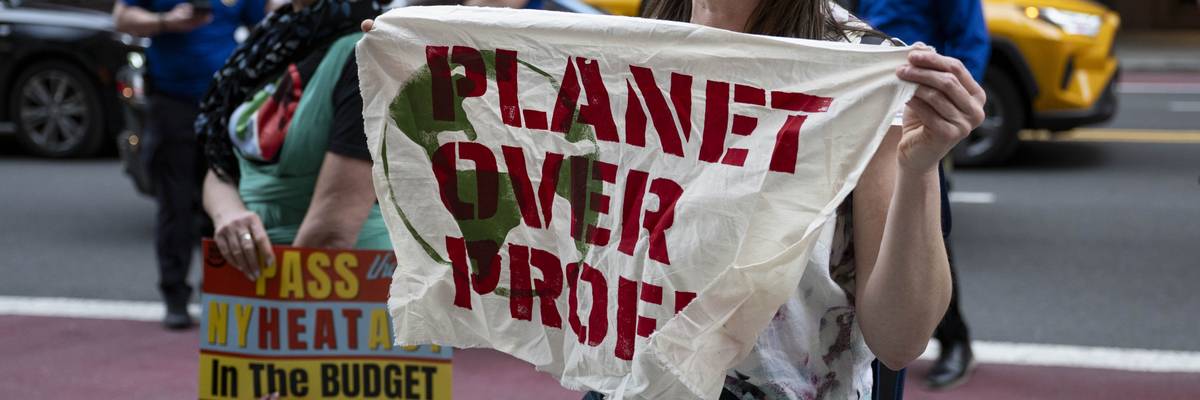
Climate activists hold signs outside U.S. billionaire Bill Ackman’s Manhattan residence during “Bye Bye Billionaires Block Party” protest on Earth Day in New York, U.S. on April 22, 2025.
If we want to make progress on either front, we need to understand just how deeply our climate and democracy crises are connected.
Right now, Americans are rightly alarmed by profound assaults on our democracy. Less in the limelight, but of critical importance, is the substantial backsliding and ongoing procrastination on the climate crisis. While the broader anti-democracy movement and stalling climate policy are both being driven by a highly destructive Trump Administration, too little attention has been devoted to exploring their common roots. Indeed, these issues may seem, at the surface, to be unrelated, or so vast that they require their own solutions.
However, if we want to make progress on either front, we need to understand just how deeply our climate and democracy crises are connected. They not only share roots but also feed into each other.
One of the most impactful threads tying these crises together is the misuse of corporate-led lobbying, Super PAC donations, and dark money groups. The biggest aggressor here is the fossil fuel industry. In 2022, companies including Exxon Mobil and Shell spent $124.4 million on lobbying. In 2023, the Congressional Leadership Fund, a Republican super PAC, received nearly $1 million from oil and gas companies. Plus, organizations like Republican Attorney General Association (RAGA) and other political advocacy groups are funded largely by dark money and corporations. RAGA, for example, received nearly $6 million in donations from gas and oil companies from 2020-2024.
Likewise on the individual level, Kelcy Warren--whose company is behind the Dakota Access Pipeline--donated around $18 million across Trump’s three campaigns. CEO of one the country’s largest oil companies, Timothy Dunn shelled out $5 million to Trump-backed super PACS in 2024.
All this private influence overpowers the will of American voters. Over half of us want a shift to clean energy, with even young Republicans supporting investing in clean energy and funding states to address the climate crisis. Despite this clear consensus, little progress has been made because of our campaign finance laws.
Disinformation is another powerful shared root of our climate and democracy crises. It threatens our democracy: Fake news stories have had real political consequences in our elections. In 2024, for example, we saw how destructive narratives surrounding undocumented immigrants eating pets and receiving hurricane relief funds had real sway on voters.
When it comes to the climate crisis, the same issues persist. A meta-study conducted by the International Panel on the Information Environment found that corporations, conservative politicians, and even national governments have contributed to rampant climate misinformation. It's not news that Trump is a key contributor here, having “called climate science ‘a giant hoax’ and ‘bullshit.’” And, too, it’s well documented that oil companies such as Exxon Mobil have for decades deliberately “led a coordinated effort to spread disinformation to mislead the public and prevent crucial action to address climate change.”
Election and climate disinformation feed off of our declining trust in each other and institutions that serve the common good. A 2025 Partnership for Public Service survey found that only a third of Americans trust the federal government, for example.
We can see the cycle of disinformation and distrust play out among climate change skeptics. A Pew Research Center survey found that many feel apprehensive when faced with “alarmist” facts about the climate. Participants feel suspicious that climate change advocates have a secret agenda—a problem fueled by a lack of trust and disinformation which only further perpetuates the issue. But here’s the kicker: This dynamic has opened the door for fossil fuel companies to control narratives about the climate crisis.
Absent fact-checking tools and coupled with the unregulated rise of generative AI, mis/dis-information will continue to circulate online with significant impact on how people vote and understand of key issues including the climate crisis.
Addressing these deep issues—from money in politics to waning trust—takes work. But he stakes are high and the harm to communities are real, so we must tackle these roots.
It comes as no surprise that climate chaos disproportionately impacts marginalized communities including people of color, low-income communities, children, the elderly, and those who reside in coastal communities. An uneven distribution of resources needed to prepare for climate disasters and recover from them is also a key part of the problem.
It’s no coincidence that the populations most impacted by the climate crisis are the same communities that have been systemically disenfranchised in our democracy. Take the disenfranchisement of Black voters: laws preventing felons from voting are one of many tactics used to stifle the Black vote. Note our prison population is notably disproportionately Black due to decades of discriminatory mass incarceration practices including over policing. This systemic exclusion means that citizens—particularly the most impacted—are denied a voice on the very issues that most harm them.
Clearly the playing field is deeply uneven: Corporate powers wreak havoc on our communities all while undermining the democratic process through campaign financing and misinformation. Meanwhile, as Trump violently deploys ICE agents to wreak havoc in Minneapolis and beyond, he pillages the woods next door (note Congress’s revocation of a 20-year mining moratorium in Minnesota’s boundary waters this January).
There’s no denying that climate chaos and democracy are deeply interrelated. The task at hand is substantial, but by digging to these shared roots, we can form the broad coalitions and solidaristic networks of cross-issue advocates that we need to build a more just and democratic world for all.
Dear Common Dreams reader, It’s been nearly 30 years since I co-founded Common Dreams with my late wife, Lina Newhouser. We had the radical notion that journalism should serve the public good, not corporate profits. It was clear to us from the outset what it would take to build such a project. No paid advertisements. No corporate sponsors. No millionaire publisher telling us what to think or do. Many people said we wouldn't last a year, but we proved those doubters wrong. Together with a tremendous team of journalists and dedicated staff, we built an independent media outlet free from the constraints of profits and corporate control. Our mission has always been simple: To inform. To inspire. To ignite change for the common good. Building Common Dreams was not easy. Our survival was never guaranteed. When you take on the most powerful forces—Wall Street greed, fossil fuel industry destruction, Big Tech lobbyists, and uber-rich oligarchs who have spent billions upon billions rigging the economy and democracy in their favor—the only bulwark you have is supporters who believe in your work. But here’s the urgent message from me today. It's never been this bad out there. And it's never been this hard to keep us going. At the very moment Common Dreams is most needed, the threats we face are intensifying. We need your support now more than ever. We don't accept corporate advertising and never will. We don't have a paywall because we don't think people should be blocked from critical news based on their ability to pay. Everything we do is funded by the donations of readers like you. When everyone does the little they can afford, we are strong. But if that support retreats or dries up, so do we. Will you donate now to make sure Common Dreams not only survives but thrives? —Craig Brown, Co-founder |
Right now, Americans are rightly alarmed by profound assaults on our democracy. Less in the limelight, but of critical importance, is the substantial backsliding and ongoing procrastination on the climate crisis. While the broader anti-democracy movement and stalling climate policy are both being driven by a highly destructive Trump Administration, too little attention has been devoted to exploring their common roots. Indeed, these issues may seem, at the surface, to be unrelated, or so vast that they require their own solutions.
However, if we want to make progress on either front, we need to understand just how deeply our climate and democracy crises are connected. They not only share roots but also feed into each other.
One of the most impactful threads tying these crises together is the misuse of corporate-led lobbying, Super PAC donations, and dark money groups. The biggest aggressor here is the fossil fuel industry. In 2022, companies including Exxon Mobil and Shell spent $124.4 million on lobbying. In 2023, the Congressional Leadership Fund, a Republican super PAC, received nearly $1 million from oil and gas companies. Plus, organizations like Republican Attorney General Association (RAGA) and other political advocacy groups are funded largely by dark money and corporations. RAGA, for example, received nearly $6 million in donations from gas and oil companies from 2020-2024.
Likewise on the individual level, Kelcy Warren--whose company is behind the Dakota Access Pipeline--donated around $18 million across Trump’s three campaigns. CEO of one the country’s largest oil companies, Timothy Dunn shelled out $5 million to Trump-backed super PACS in 2024.
All this private influence overpowers the will of American voters. Over half of us want a shift to clean energy, with even young Republicans supporting investing in clean energy and funding states to address the climate crisis. Despite this clear consensus, little progress has been made because of our campaign finance laws.
Disinformation is another powerful shared root of our climate and democracy crises. It threatens our democracy: Fake news stories have had real political consequences in our elections. In 2024, for example, we saw how destructive narratives surrounding undocumented immigrants eating pets and receiving hurricane relief funds had real sway on voters.
When it comes to the climate crisis, the same issues persist. A meta-study conducted by the International Panel on the Information Environment found that corporations, conservative politicians, and even national governments have contributed to rampant climate misinformation. It's not news that Trump is a key contributor here, having “called climate science ‘a giant hoax’ and ‘bullshit.’” And, too, it’s well documented that oil companies such as Exxon Mobil have for decades deliberately “led a coordinated effort to spread disinformation to mislead the public and prevent crucial action to address climate change.”
Election and climate disinformation feed off of our declining trust in each other and institutions that serve the common good. A 2025 Partnership for Public Service survey found that only a third of Americans trust the federal government, for example.
We can see the cycle of disinformation and distrust play out among climate change skeptics. A Pew Research Center survey found that many feel apprehensive when faced with “alarmist” facts about the climate. Participants feel suspicious that climate change advocates have a secret agenda—a problem fueled by a lack of trust and disinformation which only further perpetuates the issue. But here’s the kicker: This dynamic has opened the door for fossil fuel companies to control narratives about the climate crisis.
Absent fact-checking tools and coupled with the unregulated rise of generative AI, mis/dis-information will continue to circulate online with significant impact on how people vote and understand of key issues including the climate crisis.
Addressing these deep issues—from money in politics to waning trust—takes work. But he stakes are high and the harm to communities are real, so we must tackle these roots.
It comes as no surprise that climate chaos disproportionately impacts marginalized communities including people of color, low-income communities, children, the elderly, and those who reside in coastal communities. An uneven distribution of resources needed to prepare for climate disasters and recover from them is also a key part of the problem.
It’s no coincidence that the populations most impacted by the climate crisis are the same communities that have been systemically disenfranchised in our democracy. Take the disenfranchisement of Black voters: laws preventing felons from voting are one of many tactics used to stifle the Black vote. Note our prison population is notably disproportionately Black due to decades of discriminatory mass incarceration practices including over policing. This systemic exclusion means that citizens—particularly the most impacted—are denied a voice on the very issues that most harm them.
Clearly the playing field is deeply uneven: Corporate powers wreak havoc on our communities all while undermining the democratic process through campaign financing and misinformation. Meanwhile, as Trump violently deploys ICE agents to wreak havoc in Minneapolis and beyond, he pillages the woods next door (note Congress’s revocation of a 20-year mining moratorium in Minnesota’s boundary waters this January).
There’s no denying that climate chaos and democracy are deeply interrelated. The task at hand is substantial, but by digging to these shared roots, we can form the broad coalitions and solidaristic networks of cross-issue advocates that we need to build a more just and democratic world for all.
Right now, Americans are rightly alarmed by profound assaults on our democracy. Less in the limelight, but of critical importance, is the substantial backsliding and ongoing procrastination on the climate crisis. While the broader anti-democracy movement and stalling climate policy are both being driven by a highly destructive Trump Administration, too little attention has been devoted to exploring their common roots. Indeed, these issues may seem, at the surface, to be unrelated, or so vast that they require their own solutions.
However, if we want to make progress on either front, we need to understand just how deeply our climate and democracy crises are connected. They not only share roots but also feed into each other.
One of the most impactful threads tying these crises together is the misuse of corporate-led lobbying, Super PAC donations, and dark money groups. The biggest aggressor here is the fossil fuel industry. In 2022, companies including Exxon Mobil and Shell spent $124.4 million on lobbying. In 2023, the Congressional Leadership Fund, a Republican super PAC, received nearly $1 million from oil and gas companies. Plus, organizations like Republican Attorney General Association (RAGA) and other political advocacy groups are funded largely by dark money and corporations. RAGA, for example, received nearly $6 million in donations from gas and oil companies from 2020-2024.
Likewise on the individual level, Kelcy Warren--whose company is behind the Dakota Access Pipeline--donated around $18 million across Trump’s three campaigns. CEO of one the country’s largest oil companies, Timothy Dunn shelled out $5 million to Trump-backed super PACS in 2024.
All this private influence overpowers the will of American voters. Over half of us want a shift to clean energy, with even young Republicans supporting investing in clean energy and funding states to address the climate crisis. Despite this clear consensus, little progress has been made because of our campaign finance laws.
Disinformation is another powerful shared root of our climate and democracy crises. It threatens our democracy: Fake news stories have had real political consequences in our elections. In 2024, for example, we saw how destructive narratives surrounding undocumented immigrants eating pets and receiving hurricane relief funds had real sway on voters.
When it comes to the climate crisis, the same issues persist. A meta-study conducted by the International Panel on the Information Environment found that corporations, conservative politicians, and even national governments have contributed to rampant climate misinformation. It's not news that Trump is a key contributor here, having “called climate science ‘a giant hoax’ and ‘bullshit.’” And, too, it’s well documented that oil companies such as Exxon Mobil have for decades deliberately “led a coordinated effort to spread disinformation to mislead the public and prevent crucial action to address climate change.”
Election and climate disinformation feed off of our declining trust in each other and institutions that serve the common good. A 2025 Partnership for Public Service survey found that only a third of Americans trust the federal government, for example.
We can see the cycle of disinformation and distrust play out among climate change skeptics. A Pew Research Center survey found that many feel apprehensive when faced with “alarmist” facts about the climate. Participants feel suspicious that climate change advocates have a secret agenda—a problem fueled by a lack of trust and disinformation which only further perpetuates the issue. But here’s the kicker: This dynamic has opened the door for fossil fuel companies to control narratives about the climate crisis.
Absent fact-checking tools and coupled with the unregulated rise of generative AI, mis/dis-information will continue to circulate online with significant impact on how people vote and understand of key issues including the climate crisis.
Addressing these deep issues—from money in politics to waning trust—takes work. But he stakes are high and the harm to communities are real, so we must tackle these roots.
It comes as no surprise that climate chaos disproportionately impacts marginalized communities including people of color, low-income communities, children, the elderly, and those who reside in coastal communities. An uneven distribution of resources needed to prepare for climate disasters and recover from them is also a key part of the problem.
It’s no coincidence that the populations most impacted by the climate crisis are the same communities that have been systemically disenfranchised in our democracy. Take the disenfranchisement of Black voters: laws preventing felons from voting are one of many tactics used to stifle the Black vote. Note our prison population is notably disproportionately Black due to decades of discriminatory mass incarceration practices including over policing. This systemic exclusion means that citizens—particularly the most impacted—are denied a voice on the very issues that most harm them.
Clearly the playing field is deeply uneven: Corporate powers wreak havoc on our communities all while undermining the democratic process through campaign financing and misinformation. Meanwhile, as Trump violently deploys ICE agents to wreak havoc in Minneapolis and beyond, he pillages the woods next door (note Congress’s revocation of a 20-year mining moratorium in Minnesota’s boundary waters this January).
There’s no denying that climate chaos and democracy are deeply interrelated. The task at hand is substantial, but by digging to these shared roots, we can form the broad coalitions and solidaristic networks of cross-issue advocates that we need to build a more just and democratic world for all.