SUBSCRIBE TO OUR FREE NEWSLETTER
Daily news & progressive opinion—funded by the people, not the corporations—delivered straight to your inbox.
5
#000000
#FFFFFF
To donate by check, phone, or other method, see our More Ways to Give page.
Daily news & progressive opinion—funded by the people, not the corporations—delivered straight to your inbox.
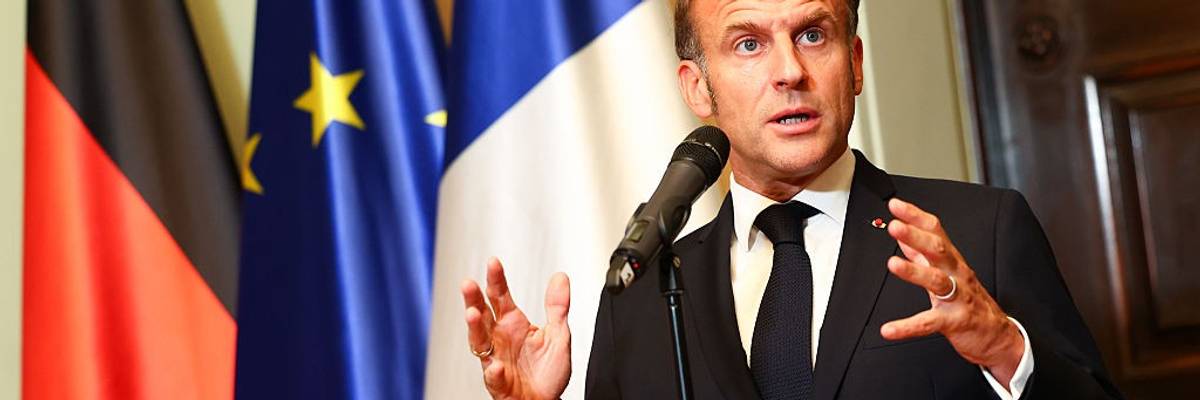
French President Emmanuel Macron talks to media prior to talks with German Chancellor Friedrich Merz at Villa Borsig on July 23, 2025 in Berlin, Germany.
As Macron launches his "green" charm offensive in Nairobi, Africa must move beyond being a passive host.
In a maneuver dripping with historical irony and geopolitical desperation, French President Emmanuel Macron is set to land in Nairobi on May 11. He will be in Kenya to co-host the “Africa Forward Summit: Africa-France Partnership for Innovation and Growth.” To the uninitiated, the title suggests a progressive leap into a shared future.
However, to those who have watched the sun set on Françafrique in the West, the subtext is clear: Having been unceremoniously evicted from its traditional "stomping grounds" in the Sahel, Paris is pitching its tent in East Africa, hunting for new deals to cover the hemorrhaging fortunes of a dying empire. Ahead of his arrival—incidentally on the Ides of March—three French warships docked at the port of Mombasa, carrying with them over 800 military personnel. They were riding on the wave of newfound defense cooperation between the governments of Kenya and France.
The pact focused on maritime security, intelligence cooperation, peacekeeping, humanitarian assistance, disaster relief, and “any other defense or security-related areas of cooperation defined by mutual agreement between parties.” Through this pact, France now has a new hunting ground in East Africa, complete with boots on the ground, sea, and air. Kenya’s 142,400 square kilometers of Exclusive Economic Zone in the Indian Ocean, reputed for riches in fish, oil and gas, is in for a rude shock.
The irony is almost pathological. For over a century, France treated West Africa as a private warehouse. It did not merely colonize; it plundered, looted, and systematically attempted to dismantle the resilient African civilizations that predated its arrival. Its "assimilation" policy remains the most abhorrent, ignoble of colonial concepts; a cultural and political mis-philosophy designed to supplant African languages, customs, and identities with French surrogates.
Africa must stay circumspect. The convergence of military signalling and corporate presence must worry all countries participating in Nairobi. They must watch out for unequal relationships under new language.
When other colonial powers were loosening—however reluctantly—their grip, France was tightening its hold through a web of lopsided financial and military pacts.
With the rising tide of political "wokeness" across the continent, however, France now finds itself sorely ostracized, and endangered. Yet, rather than offering atonement, the French leadership has chosen to grandstand. The mask slipped definitively earlier this year when Macron, frustrated by the anti-French revolts sweeping through former colonies, dropped the pretense of diplomacy. “I think someone forgot to say thank you,” he remarked, with the chilling entitlement of a landlord demanding gratitude for a house he broke into.
Fast forward five months, and this same "savior" is now knocking on East Africa’s door, hat in hand, seeking a "new partnership built on equal ground."
The sudden pivot is driven by a cold reality: France’s "green" future is powered by African minerals. While the lights of Paris stayed bright on the back of Niger’s uranium, Africa remained in the dark.
But as the Nairobi summit approaches, Africa must move beyond being a passive host. If Macron and his European contemporaries truly seek a partnership of equals, they must meet a set of nonnegotiable demands that protect African interests, specifically within the environment and energy sectors.
First, a mandate for local beneficiation and value addition. Africa will no longer be a mere pit stop for raw material extraction. The Nairobi summit must establish a framework where no critical mineral—lithium, cobalt, or uranium—leaves the continent in its raw state.
Africans must demand that French and European companies invest in local processing plants and refineries. If the "Green Transition" requires African minerals, then the "Green Industrialization" must happen on African soil, creating African jobs and keeping the value chain within our borders.
Second, total reform of the financial architecture and the CFA Franc. For a nation that has enforced financial slavery through the CFA Franc since 1945, Macron’s talk of "financial reform" must be met with skepticism.
Africa must demand the total dismantling of the colonial financial umbilical cord. Africa requires a global financial system that does not penalize African nations with "sovereign risk" premiums that make green energy projects three times more expensive here than in Europe. It must demand the unconditional return of foreign reserves held in Paris and a shift toward independent, African-led monetary policies.
Third, energy sovereignty over "green exportation." France proposes to "decarbonize" Africa, yet many of our nations have barely "carbonized" to begin with. African “partners” must demand energy justice. This means the right to achieve universal electrification. Africa must reject a "Green Deal" that forces Africa to export its renewable energy (like green hydrogen) to Europe while her own hospitals and schools remain off the grid.
African energy needs must be met first; European exports come second.
Fourth, technology transfer, not just licensing. True innovation is not found in buying French software; it is found in owning the source code. The Nairobi summit must secure commitments for the unconditional transfer of green technologies. Africa should not be a "market" for European patents; it must be a co-owner of the intellectual property that will define the 21st century.
Fifth, climate reparations and debt cancellation. Already, France is active in "debt-for-development" swaps. Africa must demand that these are not treated as "gifts" but as partial down payments on a century of ecological and economic debt. Africa should also insist on total cancellation of debts that were accrued through colonial-era structures. Climate finance must be provided as grants, not loans that further burden Africa’s children for a climate crisis they did not create.
Sixth, accountability for multinational conglomerates. Total Energies, Orano, and Eramet—over 60 CEOs from French corporations will be attending—must answer tough questions at the summit. They ought to answer for their extractive interests that have historically disadvantaged the continent. Across Africa, communities have borne the environmental, social, and economic costs of such operations, with countries like Mozambique offering stark reminders of the consequences.
The companies must agree to be held to African environmental standards, not just French ones. Africa should pitch for a legal framework that allows communities to sue French corporations in both African and French courts for environmental degradation and human rights abuses.
There can be no "partnership" where companies operate with impunity in the Global South while preaching "environmental and social governance" values in the North.
Seventh, an end to paternalistic "security" pacts. Finally, Africa demands an end to the "policing" of the continent. True peace and security come from economic dignity, not from the over 60 military interventions France has conducted since 1960 to protect its interests. Africa must demand the closure of foreign military bases that serve extractive interests and a shift toward supporting African-led, autonomous security architectures. If partnership means equality, then reciprocity is simple—every French troop granted access and immunity in Africa should be matched by an African troop with the same rights in France
The "New Scramble" is couched in the language of "climate resilience" and "debt-for-development swaps." But beneath these green platitudes lie a hidden quest: to re-establish unfettered access to Africa’s critical minerals.
Africa must stay circumspect. The convergence of military signalling and corporate presence must worry all countries participating in Nairobi. They must watch out for unequal relationships under new language.
What France and its European partners fail to realize is that the "disinherited" continent has found its voice. Africa is no longer interested in being a marginal chapter in a European story, not even with a thousand summits. If President Macron wants a "thank you," he should start by returning what was stolen from Africa and respecting the sovereignty he so arrogantly claimed to have authored. The era of the "political orchestra" directed from Paris is over. The music has changed, and Africa is finally playing its own tune.
Dear Common Dreams reader, It’s been nearly 30 years since I co-founded Common Dreams with my late wife, Lina Newhouser. We had the radical notion that journalism should serve the public good, not corporate profits. It was clear to us from the outset what it would take to build such a project. No paid advertisements. No corporate sponsors. No millionaire publisher telling us what to think or do. Many people said we wouldn't last a year, but we proved those doubters wrong. Together with a tremendous team of journalists and dedicated staff, we built an independent media outlet free from the constraints of profits and corporate control. Our mission has always been simple: To inform. To inspire. To ignite change for the common good. Building Common Dreams was not easy. Our survival was never guaranteed. When you take on the most powerful forces—Wall Street greed, fossil fuel industry destruction, Big Tech lobbyists, and uber-rich oligarchs who have spent billions upon billions rigging the economy and democracy in their favor—the only bulwark you have is supporters who believe in your work. But here’s the urgent message from me today. It's never been this bad out there. And it's never been this hard to keep us going. At the very moment Common Dreams is most needed, the threats we face are intensifying. We need your support now more than ever. We don't accept corporate advertising and never will. We don't have a paywall because we don't think people should be blocked from critical news based on their ability to pay. Everything we do is funded by the donations of readers like you. When everyone does the little they can afford, we are strong. But if that support retreats or dries up, so do we. Will you donate now to make sure Common Dreams not only survives but thrives? —Craig Brown, Co-founder |
In a maneuver dripping with historical irony and geopolitical desperation, French President Emmanuel Macron is set to land in Nairobi on May 11. He will be in Kenya to co-host the “Africa Forward Summit: Africa-France Partnership for Innovation and Growth.” To the uninitiated, the title suggests a progressive leap into a shared future.
However, to those who have watched the sun set on Françafrique in the West, the subtext is clear: Having been unceremoniously evicted from its traditional "stomping grounds" in the Sahel, Paris is pitching its tent in East Africa, hunting for new deals to cover the hemorrhaging fortunes of a dying empire. Ahead of his arrival—incidentally on the Ides of March—three French warships docked at the port of Mombasa, carrying with them over 800 military personnel. They were riding on the wave of newfound defense cooperation between the governments of Kenya and France.
The pact focused on maritime security, intelligence cooperation, peacekeeping, humanitarian assistance, disaster relief, and “any other defense or security-related areas of cooperation defined by mutual agreement between parties.” Through this pact, France now has a new hunting ground in East Africa, complete with boots on the ground, sea, and air. Kenya’s 142,400 square kilometers of Exclusive Economic Zone in the Indian Ocean, reputed for riches in fish, oil and gas, is in for a rude shock.
The irony is almost pathological. For over a century, France treated West Africa as a private warehouse. It did not merely colonize; it plundered, looted, and systematically attempted to dismantle the resilient African civilizations that predated its arrival. Its "assimilation" policy remains the most abhorrent, ignoble of colonial concepts; a cultural and political mis-philosophy designed to supplant African languages, customs, and identities with French surrogates.
Africa must stay circumspect. The convergence of military signalling and corporate presence must worry all countries participating in Nairobi. They must watch out for unequal relationships under new language.
When other colonial powers were loosening—however reluctantly—their grip, France was tightening its hold through a web of lopsided financial and military pacts.
With the rising tide of political "wokeness" across the continent, however, France now finds itself sorely ostracized, and endangered. Yet, rather than offering atonement, the French leadership has chosen to grandstand. The mask slipped definitively earlier this year when Macron, frustrated by the anti-French revolts sweeping through former colonies, dropped the pretense of diplomacy. “I think someone forgot to say thank you,” he remarked, with the chilling entitlement of a landlord demanding gratitude for a house he broke into.
Fast forward five months, and this same "savior" is now knocking on East Africa’s door, hat in hand, seeking a "new partnership built on equal ground."
The sudden pivot is driven by a cold reality: France’s "green" future is powered by African minerals. While the lights of Paris stayed bright on the back of Niger’s uranium, Africa remained in the dark.
But as the Nairobi summit approaches, Africa must move beyond being a passive host. If Macron and his European contemporaries truly seek a partnership of equals, they must meet a set of nonnegotiable demands that protect African interests, specifically within the environment and energy sectors.
First, a mandate for local beneficiation and value addition. Africa will no longer be a mere pit stop for raw material extraction. The Nairobi summit must establish a framework where no critical mineral—lithium, cobalt, or uranium—leaves the continent in its raw state.
Africans must demand that French and European companies invest in local processing plants and refineries. If the "Green Transition" requires African minerals, then the "Green Industrialization" must happen on African soil, creating African jobs and keeping the value chain within our borders.
Second, total reform of the financial architecture and the CFA Franc. For a nation that has enforced financial slavery through the CFA Franc since 1945, Macron’s talk of "financial reform" must be met with skepticism.
Africa must demand the total dismantling of the colonial financial umbilical cord. Africa requires a global financial system that does not penalize African nations with "sovereign risk" premiums that make green energy projects three times more expensive here than in Europe. It must demand the unconditional return of foreign reserves held in Paris and a shift toward independent, African-led monetary policies.
Third, energy sovereignty over "green exportation." France proposes to "decarbonize" Africa, yet many of our nations have barely "carbonized" to begin with. African “partners” must demand energy justice. This means the right to achieve universal electrification. Africa must reject a "Green Deal" that forces Africa to export its renewable energy (like green hydrogen) to Europe while her own hospitals and schools remain off the grid.
African energy needs must be met first; European exports come second.
Fourth, technology transfer, not just licensing. True innovation is not found in buying French software; it is found in owning the source code. The Nairobi summit must secure commitments for the unconditional transfer of green technologies. Africa should not be a "market" for European patents; it must be a co-owner of the intellectual property that will define the 21st century.
Fifth, climate reparations and debt cancellation. Already, France is active in "debt-for-development" swaps. Africa must demand that these are not treated as "gifts" but as partial down payments on a century of ecological and economic debt. Africa should also insist on total cancellation of debts that were accrued through colonial-era structures. Climate finance must be provided as grants, not loans that further burden Africa’s children for a climate crisis they did not create.
Sixth, accountability for multinational conglomerates. Total Energies, Orano, and Eramet—over 60 CEOs from French corporations will be attending—must answer tough questions at the summit. They ought to answer for their extractive interests that have historically disadvantaged the continent. Across Africa, communities have borne the environmental, social, and economic costs of such operations, with countries like Mozambique offering stark reminders of the consequences.
The companies must agree to be held to African environmental standards, not just French ones. Africa should pitch for a legal framework that allows communities to sue French corporations in both African and French courts for environmental degradation and human rights abuses.
There can be no "partnership" where companies operate with impunity in the Global South while preaching "environmental and social governance" values in the North.
Seventh, an end to paternalistic "security" pacts. Finally, Africa demands an end to the "policing" of the continent. True peace and security come from economic dignity, not from the over 60 military interventions France has conducted since 1960 to protect its interests. Africa must demand the closure of foreign military bases that serve extractive interests and a shift toward supporting African-led, autonomous security architectures. If partnership means equality, then reciprocity is simple—every French troop granted access and immunity in Africa should be matched by an African troop with the same rights in France
The "New Scramble" is couched in the language of "climate resilience" and "debt-for-development swaps." But beneath these green platitudes lie a hidden quest: to re-establish unfettered access to Africa’s critical minerals.
Africa must stay circumspect. The convergence of military signalling and corporate presence must worry all countries participating in Nairobi. They must watch out for unequal relationships under new language.
What France and its European partners fail to realize is that the "disinherited" continent has found its voice. Africa is no longer interested in being a marginal chapter in a European story, not even with a thousand summits. If President Macron wants a "thank you," he should start by returning what was stolen from Africa and respecting the sovereignty he so arrogantly claimed to have authored. The era of the "political orchestra" directed from Paris is over. The music has changed, and Africa is finally playing its own tune.
In a maneuver dripping with historical irony and geopolitical desperation, French President Emmanuel Macron is set to land in Nairobi on May 11. He will be in Kenya to co-host the “Africa Forward Summit: Africa-France Partnership for Innovation and Growth.” To the uninitiated, the title suggests a progressive leap into a shared future.
However, to those who have watched the sun set on Françafrique in the West, the subtext is clear: Having been unceremoniously evicted from its traditional "stomping grounds" in the Sahel, Paris is pitching its tent in East Africa, hunting for new deals to cover the hemorrhaging fortunes of a dying empire. Ahead of his arrival—incidentally on the Ides of March—three French warships docked at the port of Mombasa, carrying with them over 800 military personnel. They were riding on the wave of newfound defense cooperation between the governments of Kenya and France.
The pact focused on maritime security, intelligence cooperation, peacekeeping, humanitarian assistance, disaster relief, and “any other defense or security-related areas of cooperation defined by mutual agreement between parties.” Through this pact, France now has a new hunting ground in East Africa, complete with boots on the ground, sea, and air. Kenya’s 142,400 square kilometers of Exclusive Economic Zone in the Indian Ocean, reputed for riches in fish, oil and gas, is in for a rude shock.
The irony is almost pathological. For over a century, France treated West Africa as a private warehouse. It did not merely colonize; it plundered, looted, and systematically attempted to dismantle the resilient African civilizations that predated its arrival. Its "assimilation" policy remains the most abhorrent, ignoble of colonial concepts; a cultural and political mis-philosophy designed to supplant African languages, customs, and identities with French surrogates.
Africa must stay circumspect. The convergence of military signalling and corporate presence must worry all countries participating in Nairobi. They must watch out for unequal relationships under new language.
When other colonial powers were loosening—however reluctantly—their grip, France was tightening its hold through a web of lopsided financial and military pacts.
With the rising tide of political "wokeness" across the continent, however, France now finds itself sorely ostracized, and endangered. Yet, rather than offering atonement, the French leadership has chosen to grandstand. The mask slipped definitively earlier this year when Macron, frustrated by the anti-French revolts sweeping through former colonies, dropped the pretense of diplomacy. “I think someone forgot to say thank you,” he remarked, with the chilling entitlement of a landlord demanding gratitude for a house he broke into.
Fast forward five months, and this same "savior" is now knocking on East Africa’s door, hat in hand, seeking a "new partnership built on equal ground."
The sudden pivot is driven by a cold reality: France’s "green" future is powered by African minerals. While the lights of Paris stayed bright on the back of Niger’s uranium, Africa remained in the dark.
But as the Nairobi summit approaches, Africa must move beyond being a passive host. If Macron and his European contemporaries truly seek a partnership of equals, they must meet a set of nonnegotiable demands that protect African interests, specifically within the environment and energy sectors.
First, a mandate for local beneficiation and value addition. Africa will no longer be a mere pit stop for raw material extraction. The Nairobi summit must establish a framework where no critical mineral—lithium, cobalt, or uranium—leaves the continent in its raw state.
Africans must demand that French and European companies invest in local processing plants and refineries. If the "Green Transition" requires African minerals, then the "Green Industrialization" must happen on African soil, creating African jobs and keeping the value chain within our borders.
Second, total reform of the financial architecture and the CFA Franc. For a nation that has enforced financial slavery through the CFA Franc since 1945, Macron’s talk of "financial reform" must be met with skepticism.
Africa must demand the total dismantling of the colonial financial umbilical cord. Africa requires a global financial system that does not penalize African nations with "sovereign risk" premiums that make green energy projects three times more expensive here than in Europe. It must demand the unconditional return of foreign reserves held in Paris and a shift toward independent, African-led monetary policies.
Third, energy sovereignty over "green exportation." France proposes to "decarbonize" Africa, yet many of our nations have barely "carbonized" to begin with. African “partners” must demand energy justice. This means the right to achieve universal electrification. Africa must reject a "Green Deal" that forces Africa to export its renewable energy (like green hydrogen) to Europe while her own hospitals and schools remain off the grid.
African energy needs must be met first; European exports come second.
Fourth, technology transfer, not just licensing. True innovation is not found in buying French software; it is found in owning the source code. The Nairobi summit must secure commitments for the unconditional transfer of green technologies. Africa should not be a "market" for European patents; it must be a co-owner of the intellectual property that will define the 21st century.
Fifth, climate reparations and debt cancellation. Already, France is active in "debt-for-development" swaps. Africa must demand that these are not treated as "gifts" but as partial down payments on a century of ecological and economic debt. Africa should also insist on total cancellation of debts that were accrued through colonial-era structures. Climate finance must be provided as grants, not loans that further burden Africa’s children for a climate crisis they did not create.
Sixth, accountability for multinational conglomerates. Total Energies, Orano, and Eramet—over 60 CEOs from French corporations will be attending—must answer tough questions at the summit. They ought to answer for their extractive interests that have historically disadvantaged the continent. Across Africa, communities have borne the environmental, social, and economic costs of such operations, with countries like Mozambique offering stark reminders of the consequences.
The companies must agree to be held to African environmental standards, not just French ones. Africa should pitch for a legal framework that allows communities to sue French corporations in both African and French courts for environmental degradation and human rights abuses.
There can be no "partnership" where companies operate with impunity in the Global South while preaching "environmental and social governance" values in the North.
Seventh, an end to paternalistic "security" pacts. Finally, Africa demands an end to the "policing" of the continent. True peace and security come from economic dignity, not from the over 60 military interventions France has conducted since 1960 to protect its interests. Africa must demand the closure of foreign military bases that serve extractive interests and a shift toward supporting African-led, autonomous security architectures. If partnership means equality, then reciprocity is simple—every French troop granted access and immunity in Africa should be matched by an African troop with the same rights in France
The "New Scramble" is couched in the language of "climate resilience" and "debt-for-development swaps." But beneath these green platitudes lie a hidden quest: to re-establish unfettered access to Africa’s critical minerals.
Africa must stay circumspect. The convergence of military signalling and corporate presence must worry all countries participating in Nairobi. They must watch out for unequal relationships under new language.
What France and its European partners fail to realize is that the "disinherited" continent has found its voice. Africa is no longer interested in being a marginal chapter in a European story, not even with a thousand summits. If President Macron wants a "thank you," he should start by returning what was stolen from Africa and respecting the sovereignty he so arrogantly claimed to have authored. The era of the "political orchestra" directed from Paris is over. The music has changed, and Africa is finally playing its own tune.