SUBSCRIBE TO OUR FREE NEWSLETTER
Daily news & progressive opinion—funded by the people, not the corporations—delivered straight to your inbox.
5
#000000
#FFFFFF
To donate by check, phone, or other method, see our More Ways to Give page.
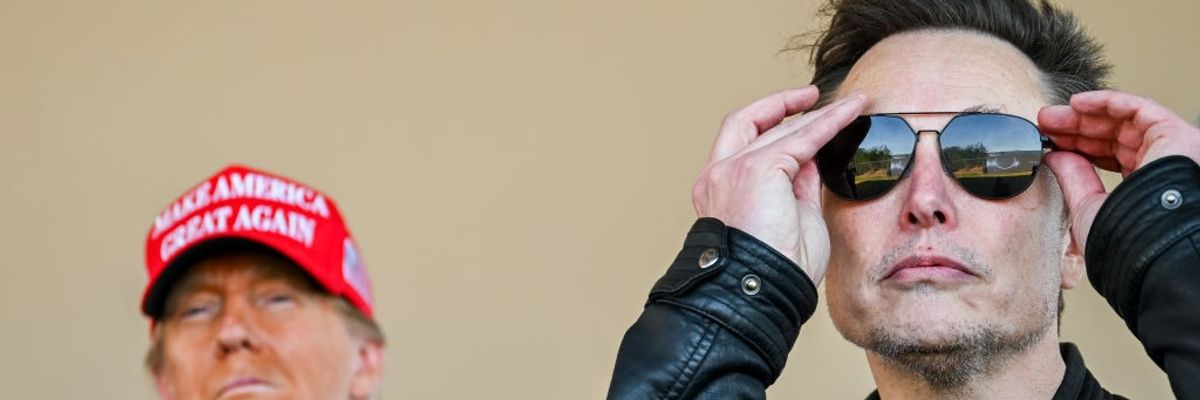
This week, Elon Musk and Vivek Ramaswamy, the co-directors of a non-existent Department of Government Efficiency (or DOGE), authored a Wall Street Journal op-ed outlining their vision for restructuring the entire federal government. The piece, entitled “The DOGE Plan to Reform Government," is notable for the combination of its breadth in scope and utter cluelessness.
As a key point, the duo decries “millions of unelected, unappointed civil servants” within an “ever-growing bureaucracy [which] represents an existential threat to our republic.” In fact, there are currently a total of less than 3 million federal civilian employees. This workforce is smaller than the same total in 1990. It is also smaller than the federal civilian workforce at the end of World War II, some 80 years ago.
Contrary to the impression that federal employment is spiraling out of control, overall, the total federal workforce has remained largely static, despite steady population growth over the decades. In addition, well more than one-third of all federal civilian employees now work in just three agencies: Defense, Veterans Affairs, and Homeland Security. These departments are hardly hotbeds of what they are calling “illicit regulations.”
Their assumption, prior to any analysis, is that thousands of federal workers should be fired. Their thesis does not allow for the possibility that some federal agencies are significantly understaffed. Also unmentioned are government contractor jobs, such as those at Musk’s Space X, estimated to number well more than double the total of all federal civilian employees who are supposed to manage this ever-growing stream of funding with fewer people.
To guide these reductions, they propose that the “number of federal employees to cut should be at least proportionate to the number of federal regulations that are nullified.” What, if anything, does that mean for agencies such as the National Park Service, Social Security Administration, or the State Department—agencies with big workforces but little regulatory footprint?
Contrary to the impression that federal employment is spiraling out of control, overall, the total federal workforce has remained largely static, despite steady population growth over the decades.
Even more striking is that these two themselves concede they do not have any concrete idea of what needs to be changed. That is because, as they profess, they are “entrepreneurs” with no expertise in this field. Instead, this effort will rely upon a yet-to-be-assembled “lean team of small-government crusaders, including some of the sharpest technical and legal minds in America.”
Presumably, these "sharpest minds" will want to be paid a salary commensurate with their market value. Consequently, this hiring spree would be a curious first step in an effort to cut costs and reduce federal payrolls.
Despite pledging to cutback agency staffing, Musk and Ramaswamy say they will be working “with experts embedded in government agencies, aided by advanced technology” to compile a “list of regulations” for President Trump to suspend enforcement or “initiate the process for review and rescission.” Notably, these embedded, apparently otherwise unoccupied “experts” resemble the very people this duo wants to fire on day one.
Moreover, the idea that “advanced technology” would serve as a magic wand to analyze the need for regulations sounds somewhat fanciful. Presumably, in this world of regulation by chatbots, AI would need a detailed orientation before being effectively unleashed government-wide.
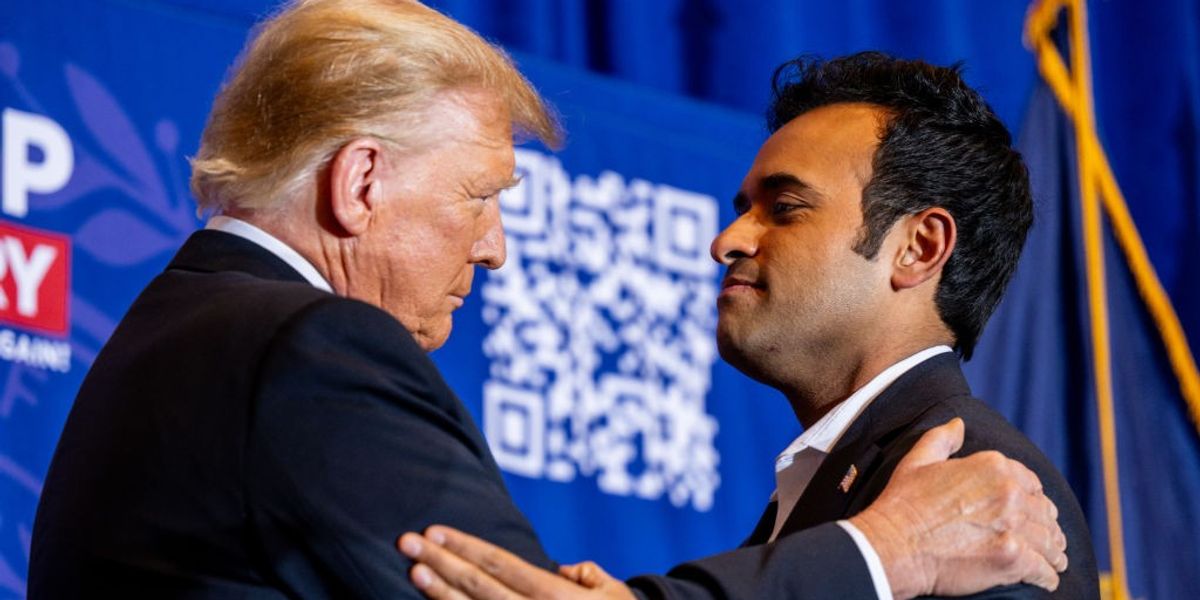 Republican presidential candidate, former U.S. President Donald Trump greets U.S. entrepreneur Vivek Ramaswamy while speaking during a campaign rally at the Atkinson Country Club on January 16, 2024 in Atkinson, New Hampshire. (Photo by Brandon Bell/Getty Image)
Perhaps the most eyebrow-raising part of their essay is their vow to stand up to the “entrenched interests in Washington” who benefit from unjustified government largesse. Yet, one of the most favored special interests, in terms of billions in subsidies consumed, is the oil and gas industry. This is the same industry that Candidate Trump has promised behind closed doors to protect in return for their campaign contributions. This is one promise he can be expected to keep.
In addition, despite portraying themselves as disinterested “volunteers” guided only by the U.S. Constitution as their "North Star," Mr. Musk has substantial business dealings with the federal government. Presumably, the billions NASA spends on Space X contracts will be spared DOGE's harshest scrutiny.
One of the very few specific examples the pair cites is the nearly trillion-dollar Pentagon, which cannot pass an agency-wide audit. However, to manage this fiscal behemoth, President-elect Trump has tapped Pete Hegseth, a person with no discernible management experience whatsoever.
Nor is it a promising sign that the House of Representatives is creating a new subcommittee to liaison with DOGE to be headed by one Marjorie Taylor Greene. This would appear to illustrate the widely held belief that cluelessness is not a quality improved by doubling down.
This week, Elon Musk and Vivek Ramaswamy, the co-directors of a non-existent Department of Government Efficiency (or DOGE), authored a Wall Street Journal op-ed outlining their vision for restructuring the entire federal government. The piece, entitled “The DOGE Plan to Reform Government," is notable for the combination of its breadth in scope and utter cluelessness.
As a key point, the duo decries “millions of unelected, unappointed civil servants” within an “ever-growing bureaucracy [which] represents an existential threat to our republic.” In fact, there are currently a total of less than 3 million federal civilian employees. This workforce is smaller than the same total in 1990. It is also smaller than the federal civilian workforce at the end of World War II, some 80 years ago.
Contrary to the impression that federal employment is spiraling out of control, overall, the total federal workforce has remained largely static, despite steady population growth over the decades. In addition, well more than one-third of all federal civilian employees now work in just three agencies: Defense, Veterans Affairs, and Homeland Security. These departments are hardly hotbeds of what they are calling “illicit regulations.”
Their assumption, prior to any analysis, is that thousands of federal workers should be fired. Their thesis does not allow for the possibility that some federal agencies are significantly understaffed. Also unmentioned are government contractor jobs, such as those at Musk’s Space X, estimated to number well more than double the total of all federal civilian employees who are supposed to manage this ever-growing stream of funding with fewer people.
To guide these reductions, they propose that the “number of federal employees to cut should be at least proportionate to the number of federal regulations that are nullified.” What, if anything, does that mean for agencies such as the National Park Service, Social Security Administration, or the State Department—agencies with big workforces but little regulatory footprint?
Contrary to the impression that federal employment is spiraling out of control, overall, the total federal workforce has remained largely static, despite steady population growth over the decades.
Even more striking is that these two themselves concede they do not have any concrete idea of what needs to be changed. That is because, as they profess, they are “entrepreneurs” with no expertise in this field. Instead, this effort will rely upon a yet-to-be-assembled “lean team of small-government crusaders, including some of the sharpest technical and legal minds in America.”
Presumably, these "sharpest minds" will want to be paid a salary commensurate with their market value. Consequently, this hiring spree would be a curious first step in an effort to cut costs and reduce federal payrolls.
Despite pledging to cutback agency staffing, Musk and Ramaswamy say they will be working “with experts embedded in government agencies, aided by advanced technology” to compile a “list of regulations” for President Trump to suspend enforcement or “initiate the process for review and rescission.” Notably, these embedded, apparently otherwise unoccupied “experts” resemble the very people this duo wants to fire on day one.
Moreover, the idea that “advanced technology” would serve as a magic wand to analyze the need for regulations sounds somewhat fanciful. Presumably, in this world of regulation by chatbots, AI would need a detailed orientation before being effectively unleashed government-wide.
Republican presidential candidate, former U.S. President Donald Trump greets U.S. entrepreneur Vivek Ramaswamy while speaking during a campaign rally at the Atkinson Country Club on January 16, 2024 in Atkinson, New Hampshire. (Photo by Brandon Bell/Getty Image)
Perhaps the most eyebrow-raising part of their essay is their vow to stand up to the “entrenched interests in Washington” who benefit from unjustified government largesse. Yet, one of the most favored special interests, in terms of billions in subsidies consumed, is the oil and gas industry. This is the same industry that Candidate Trump has promised behind closed doors to protect in return for their campaign contributions. This is one promise he can be expected to keep.
In addition, despite portraying themselves as disinterested “volunteers” guided only by the U.S. Constitution as their "North Star," Mr. Musk has substantial business dealings with the federal government. Presumably, the billions NASA spends on Space X contracts will be spared DOGE's harshest scrutiny.
One of the very few specific examples the pair cites is the nearly trillion-dollar Pentagon, which cannot pass an agency-wide audit. However, to manage this fiscal behemoth, President-elect Trump has tapped Pete Hegseth, a person with no discernible management experience whatsoever.
Nor is it a promising sign that the House of Representatives is creating a new subcommittee to liaison with DOGE to be headed by one Marjorie Taylor Greene. This would appear to illustrate the widely held belief that cluelessness is not a quality improved by doubling down.
This week, Elon Musk and Vivek Ramaswamy, the co-directors of a non-existent Department of Government Efficiency (or DOGE), authored a Wall Street Journal op-ed outlining their vision for restructuring the entire federal government. The piece, entitled “The DOGE Plan to Reform Government," is notable for the combination of its breadth in scope and utter cluelessness.
As a key point, the duo decries “millions of unelected, unappointed civil servants” within an “ever-growing bureaucracy [which] represents an existential threat to our republic.” In fact, there are currently a total of less than 3 million federal civilian employees. This workforce is smaller than the same total in 1990. It is also smaller than the federal civilian workforce at the end of World War II, some 80 years ago.
Contrary to the impression that federal employment is spiraling out of control, overall, the total federal workforce has remained largely static, despite steady population growth over the decades. In addition, well more than one-third of all federal civilian employees now work in just three agencies: Defense, Veterans Affairs, and Homeland Security. These departments are hardly hotbeds of what they are calling “illicit regulations.”
Their assumption, prior to any analysis, is that thousands of federal workers should be fired. Their thesis does not allow for the possibility that some federal agencies are significantly understaffed. Also unmentioned are government contractor jobs, such as those at Musk’s Space X, estimated to number well more than double the total of all federal civilian employees who are supposed to manage this ever-growing stream of funding with fewer people.
To guide these reductions, they propose that the “number of federal employees to cut should be at least proportionate to the number of federal regulations that are nullified.” What, if anything, does that mean for agencies such as the National Park Service, Social Security Administration, or the State Department—agencies with big workforces but little regulatory footprint?
Contrary to the impression that federal employment is spiraling out of control, overall, the total federal workforce has remained largely static, despite steady population growth over the decades.
Even more striking is that these two themselves concede they do not have any concrete idea of what needs to be changed. That is because, as they profess, they are “entrepreneurs” with no expertise in this field. Instead, this effort will rely upon a yet-to-be-assembled “lean team of small-government crusaders, including some of the sharpest technical and legal minds in America.”
Presumably, these "sharpest minds" will want to be paid a salary commensurate with their market value. Consequently, this hiring spree would be a curious first step in an effort to cut costs and reduce federal payrolls.
Despite pledging to cutback agency staffing, Musk and Ramaswamy say they will be working “with experts embedded in government agencies, aided by advanced technology” to compile a “list of regulations” for President Trump to suspend enforcement or “initiate the process for review and rescission.” Notably, these embedded, apparently otherwise unoccupied “experts” resemble the very people this duo wants to fire on day one.
Moreover, the idea that “advanced technology” would serve as a magic wand to analyze the need for regulations sounds somewhat fanciful. Presumably, in this world of regulation by chatbots, AI would need a detailed orientation before being effectively unleashed government-wide.
Republican presidential candidate, former U.S. President Donald Trump greets U.S. entrepreneur Vivek Ramaswamy while speaking during a campaign rally at the Atkinson Country Club on January 16, 2024 in Atkinson, New Hampshire. (Photo by Brandon Bell/Getty Image)
Perhaps the most eyebrow-raising part of their essay is their vow to stand up to the “entrenched interests in Washington” who benefit from unjustified government largesse. Yet, one of the most favored special interests, in terms of billions in subsidies consumed, is the oil and gas industry. This is the same industry that Candidate Trump has promised behind closed doors to protect in return for their campaign contributions. This is one promise he can be expected to keep.
In addition, despite portraying themselves as disinterested “volunteers” guided only by the U.S. Constitution as their "North Star," Mr. Musk has substantial business dealings with the federal government. Presumably, the billions NASA spends on Space X contracts will be spared DOGE's harshest scrutiny.
One of the very few specific examples the pair cites is the nearly trillion-dollar Pentagon, which cannot pass an agency-wide audit. However, to manage this fiscal behemoth, President-elect Trump has tapped Pete Hegseth, a person with no discernible management experience whatsoever.
Nor is it a promising sign that the House of Representatives is creating a new subcommittee to liaison with DOGE to be headed by one Marjorie Taylor Greene. This would appear to illustrate the widely held belief that cluelessness is not a quality improved by doubling down.