SUBSCRIBE TO OUR FREE NEWSLETTER
Daily news & progressive opinion—funded by the people, not the corporations—delivered straight to your inbox.
5
#000000
#FFFFFF
To donate by check, phone, or other method, see our More Ways to Give page.
Daily news & progressive opinion—funded by the people, not the corporations—delivered straight to your inbox.
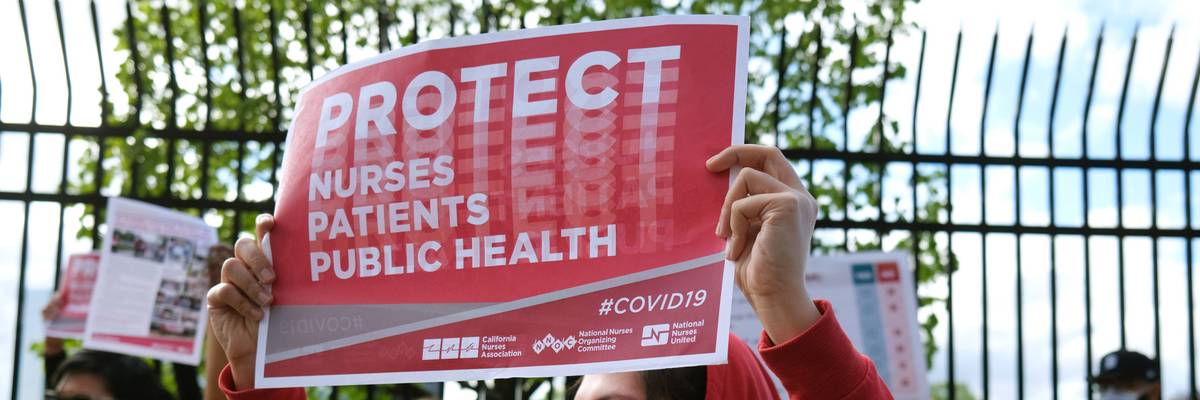
Bronx VA Medical Center nurses hold a demonstration and join other nationwide May Day actions demanding increased Covid-19 protections for nurses and health care workers on May 01, 2020 in New York City.
The workers of Uptown and The Bronx have been making the demand for a better life for over a century but Washington has ignored their demands for too long. I'm running to make sure it finally has an answer.
Uptown wakes up before the rest of New York even opens its eyes. Walk Broadway from 125th to 168th, up through Dyckman, as I have, and you'll see it: The bodega coffee grabbed on the run, the crosstown bus packed before dawn, people clocking into work while downtown is still asleep. These are the people who built our city. Not the CEOs, real estate developers, or the politicians who show up every two to four years with fliers and false promises. The movement fighting for their dignity has always lived here—on these buses and these street corners.
Every May 1, we honor them. May Day, or International Workers' Day, was created from needless state violence. In 1884, American workers went on strike to win an eight-hour workday. As the deadline approached, a protest in Chicago turned deadly, with police firing into the crowd and arresting seven workers who, after a sham trial, were executed. The bosses thought that would be the end of it. They were wrong. Workers fought for and won the right to an eight-hour workday.
Here in Harlem, Washington Heights, and Kingsbridge, May Day isn’t an abstract history lesson, it’s a mirror. This is a day to honor the transit workers, nurses, teachers, laborers, and caregivers who have always refused to accept less than they deserve and risked everything to fight for a better future for the next generation. They show us what's possible when working people come together, across generations, race, gender, and culture, and demand a dignified life.
May Day reminds us of something simple and profound: Uptown is a union town. It always has been.
I want to build power for the people on that crosstown bus before dawn who never get thanked for keeping our city running and are told to be grateful for what little they have.
New York, and Uptown especially, has become a stronghold of union power. It was in Harlem, during the Harlem Renaissance, that A. Philip Randolph founded the Brotherhood of Sleeping Car Porters—the first Black-led labor union in American history. It was in Washington Heights and Spanish Harlem where Dominican and Puerto Rican immigrant women transformed the garment industry, becoming so essential to the International Ladies' Garment Workers' Union that by the 1950s, the union published its paper, Justicia, entirely in Spanish. And it was in the Bronx that Ella Baker and Marvel Cooke exposed the Bronx Slave Market, where domestic workers, most of them Black women, were paid as little as 15 cents an hour and subjected to workplace harassment and abuse. Their conditions were so appalling that it sparked city-wide organizing to protect domestic workers. This is my community’s inheritance.
That tradition is still alive in our streets today. In January 2026, 70 years after 1199 Service Employees International Union's historic 46-day strike at Uptown hospitals, hundreds of unionized NY State Nurses Association (NYSNA) nurses walked off the job at NewYork-Presbyterian on 168th Street and at hospitals across our community. They stood on their picket lines from dawn to dusk, through a brutally cold January, fighting starvation wages and conditions so unsafe that patients were being put at risk. After 41 days of striking and organizing, they won. That's the Uptown way.
From the factory floor to the hospital room to the living room, Uptown is still at the center of the labor movement. I think about this legacy when people ask me why I'm running for Congress. The honest answer is: I'm not sure I had a choice.
When you grow up as the daughter of Dominican immigrants and watch your parents work multiple jobs and come home exhausted, see your neighbors get pushed out, watch politicians blame the vulnerable instead of the corporations robbing them blind, all while sending their tax dollars to drop bombs on babies, you organize and fight back. And eventually, the question stops being why run and starts being how could I not?
Congress was not built for us. It was built to manage us. It was built to keep our labor, our rent checks, and our votes flowing to people who have never had to choose between rent and groceries, all while allowing the people who are the foundation of our city to fall through the cracks. But here's what the establishment never understood about Uptown and The Bronx: We don't wait for permission.
That's the legacy I am fighting to protect in Congress. I am a proud card-carrying United Auto Workers member. I've picketed alongside NYSNA nurses on 168th Street and Mount Sinai Morningside. I've fought with Student Workers of Columbia to protect their peers from harassment by the university and Immigration and Customs Enforcement.
In Congress, I will fight to pass the PRO Act so every worker can organize without fear. I will push to fund public housing, cancel medical debt, and end the forever wars that drain our communities to pad the pockets of defense contractors. I want to build power for the people on that crosstown bus before dawn who never get thanked for keeping our city running and are told to be grateful for what little they have. They built New York and deserve everything it has to offer.
May Day is a call to action. The workers of Uptown and The Bronx have been making the demand for a better life for over a century but Washington has ignored their demands for too long. I'm running to make sure it finally has an answer.
Dear Common Dreams reader, It’s been nearly 30 years since I co-founded Common Dreams with my late wife, Lina Newhouser. We had the radical notion that journalism should serve the public good, not corporate profits. It was clear to us from the outset what it would take to build such a project. No paid advertisements. No corporate sponsors. No millionaire publisher telling us what to think or do. Many people said we wouldn't last a year, but we proved those doubters wrong. Together with a tremendous team of journalists and dedicated staff, we built an independent media outlet free from the constraints of profits and corporate control. Our mission has always been simple: To inform. To inspire. To ignite change for the common good. Building Common Dreams was not easy. Our survival was never guaranteed. When you take on the most powerful forces—Wall Street greed, fossil fuel industry destruction, Big Tech lobbyists, and uber-rich oligarchs who have spent billions upon billions rigging the economy and democracy in their favor—the only bulwark you have is supporters who believe in your work. But here’s the urgent message from me today. It's never been this bad out there. And it's never been this hard to keep us going. At the very moment Common Dreams is most needed, the threats we face are intensifying. We need your support now more than ever. We don't accept corporate advertising and never will. We don't have a paywall because we don't think people should be blocked from critical news based on their ability to pay. Everything we do is funded by the donations of readers like you. When everyone does the little they can afford, we are strong. But if that support retreats or dries up, so do we. Will you donate now to make sure Common Dreams not only survives but thrives? —Craig Brown, Co-founder |
Uptown wakes up before the rest of New York even opens its eyes. Walk Broadway from 125th to 168th, up through Dyckman, as I have, and you'll see it: The bodega coffee grabbed on the run, the crosstown bus packed before dawn, people clocking into work while downtown is still asleep. These are the people who built our city. Not the CEOs, real estate developers, or the politicians who show up every two to four years with fliers and false promises. The movement fighting for their dignity has always lived here—on these buses and these street corners.
Every May 1, we honor them. May Day, or International Workers' Day, was created from needless state violence. In 1884, American workers went on strike to win an eight-hour workday. As the deadline approached, a protest in Chicago turned deadly, with police firing into the crowd and arresting seven workers who, after a sham trial, were executed. The bosses thought that would be the end of it. They were wrong. Workers fought for and won the right to an eight-hour workday.
Here in Harlem, Washington Heights, and Kingsbridge, May Day isn’t an abstract history lesson, it’s a mirror. This is a day to honor the transit workers, nurses, teachers, laborers, and caregivers who have always refused to accept less than they deserve and risked everything to fight for a better future for the next generation. They show us what's possible when working people come together, across generations, race, gender, and culture, and demand a dignified life.
May Day reminds us of something simple and profound: Uptown is a union town. It always has been.
I want to build power for the people on that crosstown bus before dawn who never get thanked for keeping our city running and are told to be grateful for what little they have.
New York, and Uptown especially, has become a stronghold of union power. It was in Harlem, during the Harlem Renaissance, that A. Philip Randolph founded the Brotherhood of Sleeping Car Porters—the first Black-led labor union in American history. It was in Washington Heights and Spanish Harlem where Dominican and Puerto Rican immigrant women transformed the garment industry, becoming so essential to the International Ladies' Garment Workers' Union that by the 1950s, the union published its paper, Justicia, entirely in Spanish. And it was in the Bronx that Ella Baker and Marvel Cooke exposed the Bronx Slave Market, where domestic workers, most of them Black women, were paid as little as 15 cents an hour and subjected to workplace harassment and abuse. Their conditions were so appalling that it sparked city-wide organizing to protect domestic workers. This is my community’s inheritance.
That tradition is still alive in our streets today. In January 2026, 70 years after 1199 Service Employees International Union's historic 46-day strike at Uptown hospitals, hundreds of unionized NY State Nurses Association (NYSNA) nurses walked off the job at NewYork-Presbyterian on 168th Street and at hospitals across our community. They stood on their picket lines from dawn to dusk, through a brutally cold January, fighting starvation wages and conditions so unsafe that patients were being put at risk. After 41 days of striking and organizing, they won. That's the Uptown way.
From the factory floor to the hospital room to the living room, Uptown is still at the center of the labor movement. I think about this legacy when people ask me why I'm running for Congress. The honest answer is: I'm not sure I had a choice.
When you grow up as the daughter of Dominican immigrants and watch your parents work multiple jobs and come home exhausted, see your neighbors get pushed out, watch politicians blame the vulnerable instead of the corporations robbing them blind, all while sending their tax dollars to drop bombs on babies, you organize and fight back. And eventually, the question stops being why run and starts being how could I not?
Congress was not built for us. It was built to manage us. It was built to keep our labor, our rent checks, and our votes flowing to people who have never had to choose between rent and groceries, all while allowing the people who are the foundation of our city to fall through the cracks. But here's what the establishment never understood about Uptown and The Bronx: We don't wait for permission.
That's the legacy I am fighting to protect in Congress. I am a proud card-carrying United Auto Workers member. I've picketed alongside NYSNA nurses on 168th Street and Mount Sinai Morningside. I've fought with Student Workers of Columbia to protect their peers from harassment by the university and Immigration and Customs Enforcement.
In Congress, I will fight to pass the PRO Act so every worker can organize without fear. I will push to fund public housing, cancel medical debt, and end the forever wars that drain our communities to pad the pockets of defense contractors. I want to build power for the people on that crosstown bus before dawn who never get thanked for keeping our city running and are told to be grateful for what little they have. They built New York and deserve everything it has to offer.
May Day is a call to action. The workers of Uptown and The Bronx have been making the demand for a better life for over a century but Washington has ignored their demands for too long. I'm running to make sure it finally has an answer.
Uptown wakes up before the rest of New York even opens its eyes. Walk Broadway from 125th to 168th, up through Dyckman, as I have, and you'll see it: The bodega coffee grabbed on the run, the crosstown bus packed before dawn, people clocking into work while downtown is still asleep. These are the people who built our city. Not the CEOs, real estate developers, or the politicians who show up every two to four years with fliers and false promises. The movement fighting for their dignity has always lived here—on these buses and these street corners.
Every May 1, we honor them. May Day, or International Workers' Day, was created from needless state violence. In 1884, American workers went on strike to win an eight-hour workday. As the deadline approached, a protest in Chicago turned deadly, with police firing into the crowd and arresting seven workers who, after a sham trial, were executed. The bosses thought that would be the end of it. They were wrong. Workers fought for and won the right to an eight-hour workday.
Here in Harlem, Washington Heights, and Kingsbridge, May Day isn’t an abstract history lesson, it’s a mirror. This is a day to honor the transit workers, nurses, teachers, laborers, and caregivers who have always refused to accept less than they deserve and risked everything to fight for a better future for the next generation. They show us what's possible when working people come together, across generations, race, gender, and culture, and demand a dignified life.
May Day reminds us of something simple and profound: Uptown is a union town. It always has been.
I want to build power for the people on that crosstown bus before dawn who never get thanked for keeping our city running and are told to be grateful for what little they have.
New York, and Uptown especially, has become a stronghold of union power. It was in Harlem, during the Harlem Renaissance, that A. Philip Randolph founded the Brotherhood of Sleeping Car Porters—the first Black-led labor union in American history. It was in Washington Heights and Spanish Harlem where Dominican and Puerto Rican immigrant women transformed the garment industry, becoming so essential to the International Ladies' Garment Workers' Union that by the 1950s, the union published its paper, Justicia, entirely in Spanish. And it was in the Bronx that Ella Baker and Marvel Cooke exposed the Bronx Slave Market, where domestic workers, most of them Black women, were paid as little as 15 cents an hour and subjected to workplace harassment and abuse. Their conditions were so appalling that it sparked city-wide organizing to protect domestic workers. This is my community’s inheritance.
That tradition is still alive in our streets today. In January 2026, 70 years after 1199 Service Employees International Union's historic 46-day strike at Uptown hospitals, hundreds of unionized NY State Nurses Association (NYSNA) nurses walked off the job at NewYork-Presbyterian on 168th Street and at hospitals across our community. They stood on their picket lines from dawn to dusk, through a brutally cold January, fighting starvation wages and conditions so unsafe that patients were being put at risk. After 41 days of striking and organizing, they won. That's the Uptown way.
From the factory floor to the hospital room to the living room, Uptown is still at the center of the labor movement. I think about this legacy when people ask me why I'm running for Congress. The honest answer is: I'm not sure I had a choice.
When you grow up as the daughter of Dominican immigrants and watch your parents work multiple jobs and come home exhausted, see your neighbors get pushed out, watch politicians blame the vulnerable instead of the corporations robbing them blind, all while sending their tax dollars to drop bombs on babies, you organize and fight back. And eventually, the question stops being why run and starts being how could I not?
Congress was not built for us. It was built to manage us. It was built to keep our labor, our rent checks, and our votes flowing to people who have never had to choose between rent and groceries, all while allowing the people who are the foundation of our city to fall through the cracks. But here's what the establishment never understood about Uptown and The Bronx: We don't wait for permission.
That's the legacy I am fighting to protect in Congress. I am a proud card-carrying United Auto Workers member. I've picketed alongside NYSNA nurses on 168th Street and Mount Sinai Morningside. I've fought with Student Workers of Columbia to protect their peers from harassment by the university and Immigration and Customs Enforcement.
In Congress, I will fight to pass the PRO Act so every worker can organize without fear. I will push to fund public housing, cancel medical debt, and end the forever wars that drain our communities to pad the pockets of defense contractors. I want to build power for the people on that crosstown bus before dawn who never get thanked for keeping our city running and are told to be grateful for what little they have. They built New York and deserve everything it has to offer.
May Day is a call to action. The workers of Uptown and The Bronx have been making the demand for a better life for over a century but Washington has ignored their demands for too long. I'm running to make sure it finally has an answer.