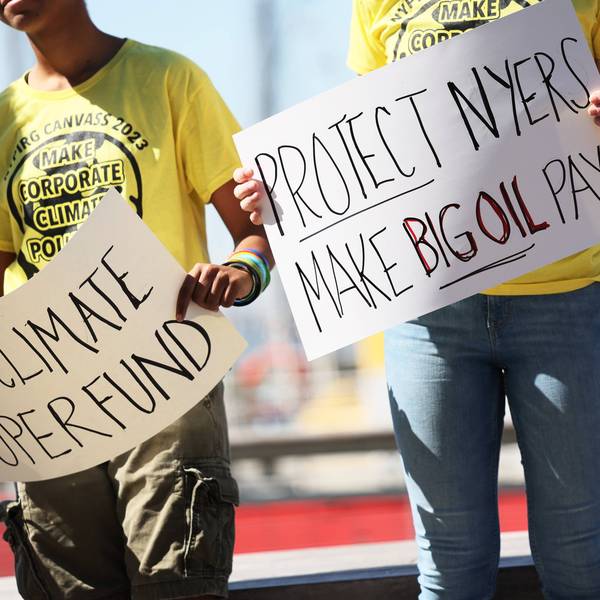
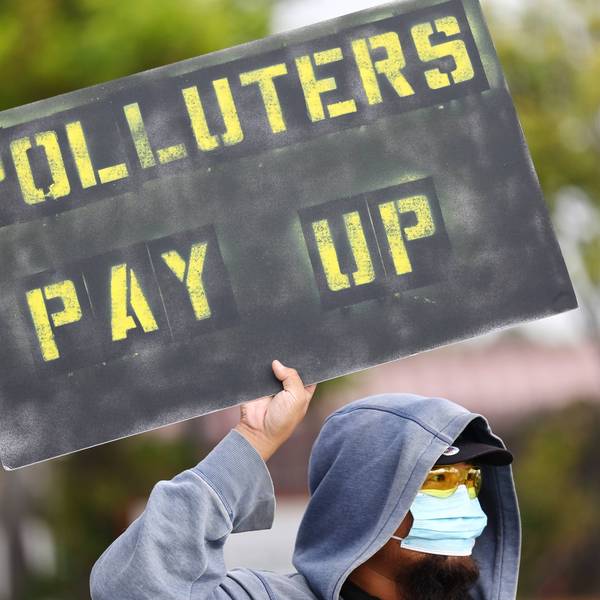
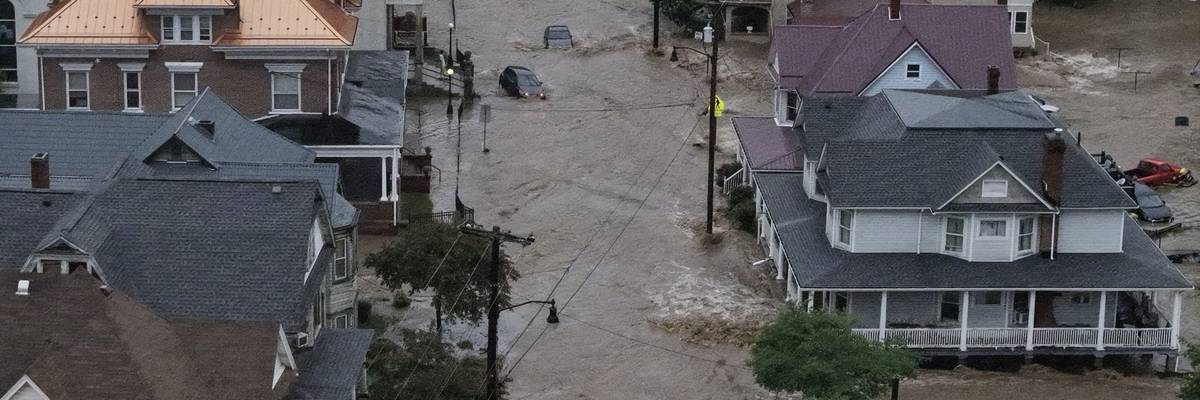
Shown is an aerial photo of the flooded downtown area on May 13, 2025 in Westernport, Maryland.
Join the National Push to Make Polluters Pay
From January 26 to 30, advocates, lawmakers, students, workers, and faith and community leaders across the country are coming together for a week of action to stop the fossil fuel industry from passing the bill for the climate crisis onto the rest of us.
Climate change isn’t looming somewhere down the road. For millions of families, it’s already showing up as higher insurance bills, higher utility costs, flooded roads, closed schools, and budgets stretched past the breaking point. And for others, it’s far worse—lost homes, lasting health impacts, and lives cut short. The damage from the climate crisis isn’t a distant projection. The bill is real, and it’s already due.
The problem is who’s paying it.
Right now, American families and state governments are picking up the tab for climate disasters while the fossil fuel companies that knowingly caused the damage keep raking in record profits. Every storm that wipes out a neighborhood, every heatwave that overwhelms hospitals, every wildfire that shuts down a school adds another line item to public budgets, and another cost pushed onto taxpayers and our families.
That imbalance is why, from January 26 to 30, advocates, lawmakers, students, workers, and faith and community leaders across the country are coming together for a Make Polluters Pay Week of Action. It’s the opening push of the 2026 legislative session and a clear signal that polluter accountability is no longer a fringe idea, but a governing priority.
Big Oil accountability is coming. The only question is how much longer taxpayers will be left holding the bill.
The logic is simple: If you caused the harm, you should help pay for the repair.
This is how we already handle toxic waste, oil spills, and industrial contamination. We don’t send the cleanup bill to families who live nearby. We send it to the companies that made the mess. Climate superfund laws apply that same common-sense principle to the climate crisis, and voters understand it.
In fact, support is growing fast. Recent polling shows that 77% of voters now support making oil and gas companies pay their fair share for climate damages, including majorities of Republicans and Independents. Support has jumped more than 10 points in the past year as the real-world costs of climate damage become impossible to ignore.
In 2024, Vermont and New York became the first states in the nation to pass climate superfund laws, requiring fossil fuel companies to contribute billions toward disaster recovery and climate resilience. In 2025, nearly a dozen more states introduced similar legislation. In 2026, that momentum is only accelerating.
The Week of Action reflects that reality. Across the country, states will introduce new climate bills, hold lobby days and town halls, deliver petitions, publish op-eds, walk out of classrooms, and rally public support—all aimed at starting the year with one message: Taxpayers shouldn’t be the default insurer for fossil fuel pollution anymore.
This push is happening now because delay has a cost. Every year we fail to act, the damage compounds and the bill gets bigger. A recent study found that climate costs to the US economy likely topped $1 trillion in 2025. That’s money coming out of household budgets, local tax bases, and already stretched state services.
This is also happening as federal accountability collapses. Agencies meant to protect communities and prepare us for disasters, including the Federal Emergency Management Agency, the National Oceanic and Atmospheric Administration, and the National Weather Service, are being gutted, with another 1,000 FEMA jobs reportedly on the chopping block just as disasters intensify. At the same time, President Donald Trump is cozying up to fossil fuel executives, helping them dodge accountability and fight efforts to make polluters pay.
Every dollar collected from polluters is a dollar that doesn’t come from taxpayers. Climate superfund funds can build flood protections, harden the grid, prevent wildfires, create lifesaving cooling centers, and keep hospitals and schools functioning during disasters. It also supports good jobs, since rebuilding roads, bridges, and energy systems requires skilled labor. For families, stronger grids mean fewer outages and repairs, and ending fossil fuel subsidies and loopholes can free up billions to lower utility costs, expand clean energy access, and invest in communities instead of corporate giveaways.
The fossil fuel industry wants this conversation to feel radical. It isn’t. What’s radical is a system where companies profit while the public pays, where disasters are treated as unavoidable acts of nature rather than the predictable result of decades of pollution.
Big Oil accountability is coming. The only question is how much longer taxpayers will be left holding the bill. The Make Polluters Pay Week of Action is about answering that question with action. Not someday. Not after the next disaster. Now.
An Urgent Message From Our Co-Founder
Dear Common Dreams reader, It’s been nearly 30 years since I co-founded Common Dreams with my late wife, Lina Newhouser. We had the radical notion that journalism should serve the public good, not corporate profits. It was clear to us from the outset what it would take to build such a project. No paid advertisements. No corporate sponsors. No millionaire publisher telling us what to think or do. Many people said we wouldn't last a year, but we proved those doubters wrong. Together with a tremendous team of journalists and dedicated staff, we built an independent media outlet free from the constraints of profits and corporate control. Our mission has always been simple: To inform. To inspire. To ignite change for the common good. Building Common Dreams was not easy. Our survival was never guaranteed. When you take on the most powerful forces—Wall Street greed, fossil fuel industry destruction, Big Tech lobbyists, and uber-rich oligarchs who have spent billions upon billions rigging the economy and democracy in their favor—the only bulwark you have is supporters who believe in your work. But here’s the urgent message from me today. It's never been this bad out there. And it's never been this hard to keep us going. At the very moment Common Dreams is most needed, the threats we face are intensifying. We need your support now more than ever. We don't accept corporate advertising and never will. We don't have a paywall because we don't think people should be blocked from critical news based on their ability to pay. Everything we do is funded by the donations of readers like you. When everyone does the little they can afford, we are strong. But if that support retreats or dries up, so do we. Will you donate now to make sure Common Dreams not only survives but thrives? —Craig Brown, Co-founder |
Climate change isn’t looming somewhere down the road. For millions of families, it’s already showing up as higher insurance bills, higher utility costs, flooded roads, closed schools, and budgets stretched past the breaking point. And for others, it’s far worse—lost homes, lasting health impacts, and lives cut short. The damage from the climate crisis isn’t a distant projection. The bill is real, and it’s already due.
The problem is who’s paying it.
Right now, American families and state governments are picking up the tab for climate disasters while the fossil fuel companies that knowingly caused the damage keep raking in record profits. Every storm that wipes out a neighborhood, every heatwave that overwhelms hospitals, every wildfire that shuts down a school adds another line item to public budgets, and another cost pushed onto taxpayers and our families.
That imbalance is why, from January 26 to 30, advocates, lawmakers, students, workers, and faith and community leaders across the country are coming together for a Make Polluters Pay Week of Action. It’s the opening push of the 2026 legislative session and a clear signal that polluter accountability is no longer a fringe idea, but a governing priority.
Big Oil accountability is coming. The only question is how much longer taxpayers will be left holding the bill.
The logic is simple: If you caused the harm, you should help pay for the repair.
This is how we already handle toxic waste, oil spills, and industrial contamination. We don’t send the cleanup bill to families who live nearby. We send it to the companies that made the mess. Climate superfund laws apply that same common-sense principle to the climate crisis, and voters understand it.
In fact, support is growing fast. Recent polling shows that 77% of voters now support making oil and gas companies pay their fair share for climate damages, including majorities of Republicans and Independents. Support has jumped more than 10 points in the past year as the real-world costs of climate damage become impossible to ignore.
In 2024, Vermont and New York became the first states in the nation to pass climate superfund laws, requiring fossil fuel companies to contribute billions toward disaster recovery and climate resilience. In 2025, nearly a dozen more states introduced similar legislation. In 2026, that momentum is only accelerating.
The Week of Action reflects that reality. Across the country, states will introduce new climate bills, hold lobby days and town halls, deliver petitions, publish op-eds, walk out of classrooms, and rally public support—all aimed at starting the year with one message: Taxpayers shouldn’t be the default insurer for fossil fuel pollution anymore.
This push is happening now because delay has a cost. Every year we fail to act, the damage compounds and the bill gets bigger. A recent study found that climate costs to the US economy likely topped $1 trillion in 2025. That’s money coming out of household budgets, local tax bases, and already stretched state services.
This is also happening as federal accountability collapses. Agencies meant to protect communities and prepare us for disasters, including the Federal Emergency Management Agency, the National Oceanic and Atmospheric Administration, and the National Weather Service, are being gutted, with another 1,000 FEMA jobs reportedly on the chopping block just as disasters intensify. At the same time, President Donald Trump is cozying up to fossil fuel executives, helping them dodge accountability and fight efforts to make polluters pay.
Every dollar collected from polluters is a dollar that doesn’t come from taxpayers. Climate superfund funds can build flood protections, harden the grid, prevent wildfires, create lifesaving cooling centers, and keep hospitals and schools functioning during disasters. It also supports good jobs, since rebuilding roads, bridges, and energy systems requires skilled labor. For families, stronger grids mean fewer outages and repairs, and ending fossil fuel subsidies and loopholes can free up billions to lower utility costs, expand clean energy access, and invest in communities instead of corporate giveaways.
The fossil fuel industry wants this conversation to feel radical. It isn’t. What’s radical is a system where companies profit while the public pays, where disasters are treated as unavoidable acts of nature rather than the predictable result of decades of pollution.
Big Oil accountability is coming. The only question is how much longer taxpayers will be left holding the bill. The Make Polluters Pay Week of Action is about answering that question with action. Not someday. Not after the next disaster. Now.
- Democrats Introduce Federal Bill to Make Climate Polluters Pay ›
- Who Should Pay for Climate Damage? Majority of the World Agrees: Big Oil ›
- Fossil Free Media Launches Nationwide "Make Polluters Pay" Billboard Campaign ›
- Make Polluters Pay for the Poles and Wires ›
- Helene and Milton Prove It's Time to Make Polluters Pay for Climate Disasters ›
- Endless Stream of Climate Disasters Bolsters Demand to 'Make Polluters Pay' ›
Climate change isn’t looming somewhere down the road. For millions of families, it’s already showing up as higher insurance bills, higher utility costs, flooded roads, closed schools, and budgets stretched past the breaking point. And for others, it’s far worse—lost homes, lasting health impacts, and lives cut short. The damage from the climate crisis isn’t a distant projection. The bill is real, and it’s already due.
The problem is who’s paying it.
Right now, American families and state governments are picking up the tab for climate disasters while the fossil fuel companies that knowingly caused the damage keep raking in record profits. Every storm that wipes out a neighborhood, every heatwave that overwhelms hospitals, every wildfire that shuts down a school adds another line item to public budgets, and another cost pushed onto taxpayers and our families.
That imbalance is why, from January 26 to 30, advocates, lawmakers, students, workers, and faith and community leaders across the country are coming together for a Make Polluters Pay Week of Action. It’s the opening push of the 2026 legislative session and a clear signal that polluter accountability is no longer a fringe idea, but a governing priority.
Big Oil accountability is coming. The only question is how much longer taxpayers will be left holding the bill.
The logic is simple: If you caused the harm, you should help pay for the repair.
This is how we already handle toxic waste, oil spills, and industrial contamination. We don’t send the cleanup bill to families who live nearby. We send it to the companies that made the mess. Climate superfund laws apply that same common-sense principle to the climate crisis, and voters understand it.
In fact, support is growing fast. Recent polling shows that 77% of voters now support making oil and gas companies pay their fair share for climate damages, including majorities of Republicans and Independents. Support has jumped more than 10 points in the past year as the real-world costs of climate damage become impossible to ignore.
In 2024, Vermont and New York became the first states in the nation to pass climate superfund laws, requiring fossil fuel companies to contribute billions toward disaster recovery and climate resilience. In 2025, nearly a dozen more states introduced similar legislation. In 2026, that momentum is only accelerating.
The Week of Action reflects that reality. Across the country, states will introduce new climate bills, hold lobby days and town halls, deliver petitions, publish op-eds, walk out of classrooms, and rally public support—all aimed at starting the year with one message: Taxpayers shouldn’t be the default insurer for fossil fuel pollution anymore.
This push is happening now because delay has a cost. Every year we fail to act, the damage compounds and the bill gets bigger. A recent study found that climate costs to the US economy likely topped $1 trillion in 2025. That’s money coming out of household budgets, local tax bases, and already stretched state services.
This is also happening as federal accountability collapses. Agencies meant to protect communities and prepare us for disasters, including the Federal Emergency Management Agency, the National Oceanic and Atmospheric Administration, and the National Weather Service, are being gutted, with another 1,000 FEMA jobs reportedly on the chopping block just as disasters intensify. At the same time, President Donald Trump is cozying up to fossil fuel executives, helping them dodge accountability and fight efforts to make polluters pay.
Every dollar collected from polluters is a dollar that doesn’t come from taxpayers. Climate superfund funds can build flood protections, harden the grid, prevent wildfires, create lifesaving cooling centers, and keep hospitals and schools functioning during disasters. It also supports good jobs, since rebuilding roads, bridges, and energy systems requires skilled labor. For families, stronger grids mean fewer outages and repairs, and ending fossil fuel subsidies and loopholes can free up billions to lower utility costs, expand clean energy access, and invest in communities instead of corporate giveaways.
The fossil fuel industry wants this conversation to feel radical. It isn’t. What’s radical is a system where companies profit while the public pays, where disasters are treated as unavoidable acts of nature rather than the predictable result of decades of pollution.
Big Oil accountability is coming. The only question is how much longer taxpayers will be left holding the bill. The Make Polluters Pay Week of Action is about answering that question with action. Not someday. Not after the next disaster. Now.
- Democrats Introduce Federal Bill to Make Climate Polluters Pay ›
- Who Should Pay for Climate Damage? Majority of the World Agrees: Big Oil ›
- Fossil Free Media Launches Nationwide "Make Polluters Pay" Billboard Campaign ›
- Make Polluters Pay for the Poles and Wires ›
- Helene and Milton Prove It's Time to Make Polluters Pay for Climate Disasters ›
- Endless Stream of Climate Disasters Bolsters Demand to 'Make Polluters Pay' ›