SUBSCRIBE TO OUR FREE NEWSLETTER
Daily news & progressive opinion—funded by the people, not the corporations—delivered straight to your inbox.
5
#000000
#FFFFFF
To donate by check, phone, or other method, see our More Ways to Give page.
Daily news & progressive opinion—funded by the people, not the corporations—delivered straight to your inbox.
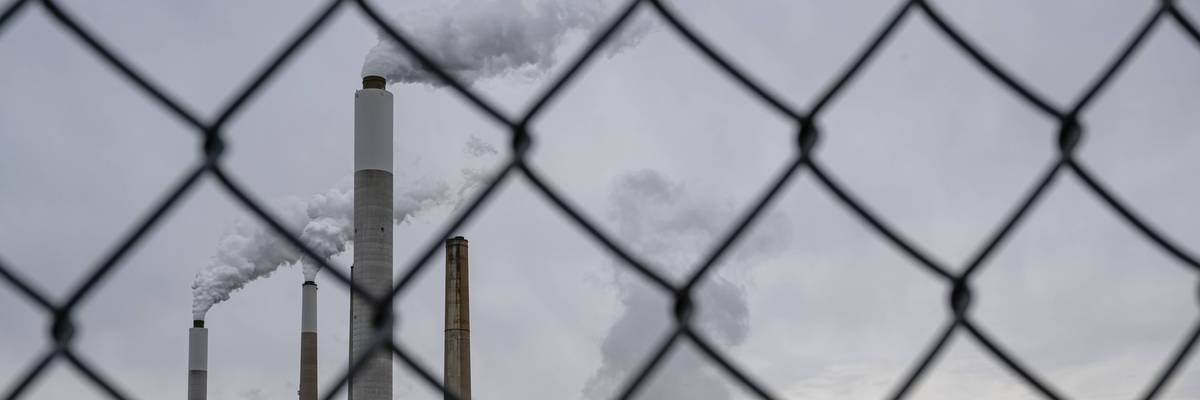
The flue-gas stacks of Mill Creek Generating Station, a coal-fired power plant, are seen from the Valley Village neighborhood on February 14, 2026 in Louisville, Kentucky.
"The only beneficiaries will be polluting industries, many of which are among President Trump’s largest donors,” the lawmakers wrote.
A group of 31 Democratic senators has launched an investigation into a new Trump administration policy that they say allows the Environmental Protection Agency to "disregard" the health impacts of air pollution when passing regulations.
Plans for the policy were first reported on last month by the New York Times, which revealed that the EPA was planning to stop tallying the financial value of health benefits caused by limiting fine particulate matter (PM2.5) and ozone when regulating polluting industries and instead focus exclusively on the costs these regulations pose to industry.
On December 11, the Times reported that the policy change was being justified based on the claim that the exact benefits of curbing these emissions were “uncertain."
"Historically, the EPA’s analytical practices often provided the public with false precision and confidence regarding the monetized impacts of fine particulate matter (PM2.5) and ozone," said an email written by an EPA supervisor to his employees on December 11. “To rectify this error, the EPA is no longer monetizing benefits from PM2.5 and ozone.”
The group of senators, led by Sen. Sheldon Whitehouse (D-RI), rebuked this idea in a letter sent Thursday to EPA Administrator Lee Zeldin.
"EPA’s new policy is irrational. Even where health benefits are 'uncertain,' what is certain is that they are not zero," they said. "It will lead to perverse outcomes in which EPA will reject actions that would impose relatively minor costs on polluting industries while resulting in massive benefits to public health—including in saved lives."
"It is contrary to Congress’s intent and directive as spelled out in the Clean Air Act. It is legally flawed," they continued. "The only beneficiaries will be polluting industries, many of which are among President [Donald] Trump’s largest donors."
Research published in 2023 in the journal Science found that between 1999 and 2020, PM2.5 pollution from coal-fired power plants killed roughly 460,000 people in the United States, making it more than twice as deadly as other kinds of fine particulate emissions.
While this is a staggering loss of life, the senators pointed out that the EPA has also been able to put a dollar value on the loss by noting quantifiable results of increased illness and death—heightened healthcare costs, missed school days, and lost labor productivity, among others.
Pointing to EPA estimates from 2024, they said that by disregarding human health effects, the agency risks costing Americans “between $22 and $46 billion in avoided morbidities and premature deaths in the year 2032."
Comparatively, they said, “the total compliance cost to industry, meanwhile, [would] be $590 million—between one and two one-hundredths of the estimated health benefit value."
They said the plan ran counter to the Clean Air Act's directive to “protect and enhance the quality of the Nation’s air resources so as to promote the public health and welfare,” and to statements made by Zeldin during his confirmation hearing, where he said "the end state of all the conversations that we might have, any regulations that might get passed, any laws that might get passed by Congress” is to “have the cleanest, healthiest air, [and] drinking water.”
The senators requested all documents related to the decision, including any information about cost-benefit modeling and communications with industry representatives.
"That EPA may no longer monetize health benefits when setting new clean air standards does not mean that those health benefits don’t exist," the senators said. "It just means that [EPA] will ignore them and reject safer standards, in favor of protecting corporate interests."
Dear Common Dreams reader, It’s been nearly 30 years since I co-founded Common Dreams with my late wife, Lina Newhouser. We had the radical notion that journalism should serve the public good, not corporate profits. It was clear to us from the outset what it would take to build such a project. No paid advertisements. No corporate sponsors. No millionaire publisher telling us what to think or do. Many people said we wouldn't last a year, but we proved those doubters wrong. Together with a tremendous team of journalists and dedicated staff, we built an independent media outlet free from the constraints of profits and corporate control. Our mission has always been simple: To inform. To inspire. To ignite change for the common good. Building Common Dreams was not easy. Our survival was never guaranteed. When you take on the most powerful forces—Wall Street greed, fossil fuel industry destruction, Big Tech lobbyists, and uber-rich oligarchs who have spent billions upon billions rigging the economy and democracy in their favor—the only bulwark you have is supporters who believe in your work. But here’s the urgent message from me today. It's never been this bad out there. And it's never been this hard to keep us going. At the very moment Common Dreams is most needed, the threats we face are intensifying. We need your support now more than ever. We don't accept corporate advertising and never will. We don't have a paywall because we don't think people should be blocked from critical news based on their ability to pay. Everything we do is funded by the donations of readers like you. When everyone does the little they can afford, we are strong. But if that support retreats or dries up, so do we. Will you donate now to make sure Common Dreams not only survives but thrives? —Craig Brown, Co-founder |
A group of 31 Democratic senators has launched an investigation into a new Trump administration policy that they say allows the Environmental Protection Agency to "disregard" the health impacts of air pollution when passing regulations.
Plans for the policy were first reported on last month by the New York Times, which revealed that the EPA was planning to stop tallying the financial value of health benefits caused by limiting fine particulate matter (PM2.5) and ozone when regulating polluting industries and instead focus exclusively on the costs these regulations pose to industry.
On December 11, the Times reported that the policy change was being justified based on the claim that the exact benefits of curbing these emissions were “uncertain."
"Historically, the EPA’s analytical practices often provided the public with false precision and confidence regarding the monetized impacts of fine particulate matter (PM2.5) and ozone," said an email written by an EPA supervisor to his employees on December 11. “To rectify this error, the EPA is no longer monetizing benefits from PM2.5 and ozone.”
The group of senators, led by Sen. Sheldon Whitehouse (D-RI), rebuked this idea in a letter sent Thursday to EPA Administrator Lee Zeldin.
"EPA’s new policy is irrational. Even where health benefits are 'uncertain,' what is certain is that they are not zero," they said. "It will lead to perverse outcomes in which EPA will reject actions that would impose relatively minor costs on polluting industries while resulting in massive benefits to public health—including in saved lives."
"It is contrary to Congress’s intent and directive as spelled out in the Clean Air Act. It is legally flawed," they continued. "The only beneficiaries will be polluting industries, many of which are among President [Donald] Trump’s largest donors."
Research published in 2023 in the journal Science found that between 1999 and 2020, PM2.5 pollution from coal-fired power plants killed roughly 460,000 people in the United States, making it more than twice as deadly as other kinds of fine particulate emissions.
While this is a staggering loss of life, the senators pointed out that the EPA has also been able to put a dollar value on the loss by noting quantifiable results of increased illness and death—heightened healthcare costs, missed school days, and lost labor productivity, among others.
Pointing to EPA estimates from 2024, they said that by disregarding human health effects, the agency risks costing Americans “between $22 and $46 billion in avoided morbidities and premature deaths in the year 2032."
Comparatively, they said, “the total compliance cost to industry, meanwhile, [would] be $590 million—between one and two one-hundredths of the estimated health benefit value."
They said the plan ran counter to the Clean Air Act's directive to “protect and enhance the quality of the Nation’s air resources so as to promote the public health and welfare,” and to statements made by Zeldin during his confirmation hearing, where he said "the end state of all the conversations that we might have, any regulations that might get passed, any laws that might get passed by Congress” is to “have the cleanest, healthiest air, [and] drinking water.”
The senators requested all documents related to the decision, including any information about cost-benefit modeling and communications with industry representatives.
"That EPA may no longer monetize health benefits when setting new clean air standards does not mean that those health benefits don’t exist," the senators said. "It just means that [EPA] will ignore them and reject safer standards, in favor of protecting corporate interests."
A group of 31 Democratic senators has launched an investigation into a new Trump administration policy that they say allows the Environmental Protection Agency to "disregard" the health impacts of air pollution when passing regulations.
Plans for the policy were first reported on last month by the New York Times, which revealed that the EPA was planning to stop tallying the financial value of health benefits caused by limiting fine particulate matter (PM2.5) and ozone when regulating polluting industries and instead focus exclusively on the costs these regulations pose to industry.
On December 11, the Times reported that the policy change was being justified based on the claim that the exact benefits of curbing these emissions were “uncertain."
"Historically, the EPA’s analytical practices often provided the public with false precision and confidence regarding the monetized impacts of fine particulate matter (PM2.5) and ozone," said an email written by an EPA supervisor to his employees on December 11. “To rectify this error, the EPA is no longer monetizing benefits from PM2.5 and ozone.”
The group of senators, led by Sen. Sheldon Whitehouse (D-RI), rebuked this idea in a letter sent Thursday to EPA Administrator Lee Zeldin.
"EPA’s new policy is irrational. Even where health benefits are 'uncertain,' what is certain is that they are not zero," they said. "It will lead to perverse outcomes in which EPA will reject actions that would impose relatively minor costs on polluting industries while resulting in massive benefits to public health—including in saved lives."
"It is contrary to Congress’s intent and directive as spelled out in the Clean Air Act. It is legally flawed," they continued. "The only beneficiaries will be polluting industries, many of which are among President [Donald] Trump’s largest donors."
Research published in 2023 in the journal Science found that between 1999 and 2020, PM2.5 pollution from coal-fired power plants killed roughly 460,000 people in the United States, making it more than twice as deadly as other kinds of fine particulate emissions.
While this is a staggering loss of life, the senators pointed out that the EPA has also been able to put a dollar value on the loss by noting quantifiable results of increased illness and death—heightened healthcare costs, missed school days, and lost labor productivity, among others.
Pointing to EPA estimates from 2024, they said that by disregarding human health effects, the agency risks costing Americans “between $22 and $46 billion in avoided morbidities and premature deaths in the year 2032."
Comparatively, they said, “the total compliance cost to industry, meanwhile, [would] be $590 million—between one and two one-hundredths of the estimated health benefit value."
They said the plan ran counter to the Clean Air Act's directive to “protect and enhance the quality of the Nation’s air resources so as to promote the public health and welfare,” and to statements made by Zeldin during his confirmation hearing, where he said "the end state of all the conversations that we might have, any regulations that might get passed, any laws that might get passed by Congress” is to “have the cleanest, healthiest air, [and] drinking water.”
The senators requested all documents related to the decision, including any information about cost-benefit modeling and communications with industry representatives.
"That EPA may no longer monetize health benefits when setting new clean air standards does not mean that those health benefits don’t exist," the senators said. "It just means that [EPA] will ignore them and reject safer standards, in favor of protecting corporate interests."