SUBSCRIBE TO OUR FREE NEWSLETTER
Daily news & progressive opinion—funded by the people, not the corporations—delivered straight to your inbox.
5
#000000
#FFFFFF
To donate by check, phone, or other method, see our More Ways to Give page.
Daily news & progressive opinion—funded by the people, not the corporations—delivered straight to your inbox.
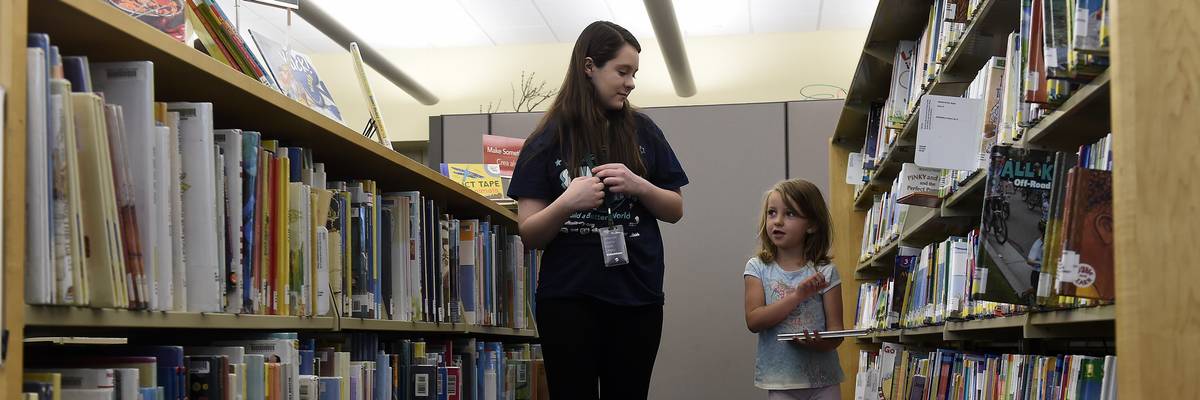
LAKEWOOD, CO - JUNE 6: Emilie Matthews helps Maddison Morgan, 5, pick out a book during the Reading Buddies program at Belmar Library on June 6, 2017, in Lakewood, Colorado.
Libraries are indispensable not only for climate and informational literacy but also as valuable hubs for creating community solutions to our planet’s most pressing problems.
If you’re a parent, caregiver, or family member hoping to save a few bucks this holiday season due to our country’s affordability crisis, you’re not alone.
As a lifelong educator and author who practically grew up in libraries, I can offer you a great tip: Skip the malls this season and take kids to the local library. Within their walls awaits an exciting world of lessons and self-empowerment for your child. They can borrow books or even movies for free. More than that, libraries have become ground zero for climate change education and serve as essential hubs for community resilience and civic engagement.
As a former public school teacher, a professor, and the author of two books on climate change and environmental justice education, public libraries were essential to my success. Growing up, I was that kid who was friends with the librarian. As an introverted student, the public library and school library were places of refuge where I found joy in the world of books. Memories of friendly librarians who encouraged my insatiable curiosity and quest for knowledge are among the many reasons I became an educator.
Here are three ways to get the most out of your local library:
I always tell my students that you don’t need the newest “gadgets” to make a meaningful impact. I know that many parents, caregivers, and families are struggling with inflation and the rising costs of goods, especially as the holidays approach. One of the easiest remedies is to repair rather than replace, which is a climate change solution because it reduces waste sent to landfills.
Instead of buying more, fixing damaged or broken belongings like clothes, furniture, and electronics can teach new skills, foster self-reliance, and build connections with family or the community. For example, some meaningful childhood memories were fixing my toys with my dad and learning how to use tools, which sparked my interest in STEM education and sustainability.
Instead of asking what to buy kids, think about what new information and skills they can be taught.
Many public libraries, makerspaces, and city sustainability offices offer “Repair Cafes,” or “Fix-It Clinics,” that feature hands-on and intergenerational events where people can bring in their broken items, and repair coaches provide instructions on how to fix them. Events have occurred in Los Angeles, Washington, DC, Albuquerque, New York, and San Diego. See if any events are happening in your community. Additionally, if you’re already handy and have repair skills, libraries around the world offer tool lending programs. You can search for a library near you to borrow a kit.
Learners of all ages can take action on climate change and explore their backyard, community, or neighborhood. Libraries also serve as public Earth observatories. To be a neighborhood or backyard scientist, you can also visit a library.
Neighborhood science, also known as Citizen Science or Community Science, comes alive when ordinary people of any age gather scientific information locally and share it with the global scientific community. For example, with a library card, you can check out a citizen science kit that has all of the necessary tools to explore biodiversity, observe cloud patterns, and monitor air quality.
Libraries around the country have citizen science kits, including the Los Angeles Public Library, the Maricopa County Library District, the Pima County Public Library, the Morgantown Public Library System, the Edwardsville Public Library, and the Longwood Public Library. Families and caregivers can even practice their skills and gear up to participate in Audubon’s legendary Christmas Bird Count that occurs every December, and is the nation’s longest-running community science bird count. Libraries have stepped in to fill a critical gap in climate literacy and community resilience during the climate emergency. However, libraries are also being targeted by the Trump administration.
The Trump administration has a clearly established anti-information agenda. The long and expanding list includes book bans and information censorship; attacks on cultural and educational institutions that teach the truth about American history; attempts to eliminate the Institute of Museum and Library Services, which provides significant funding to libraries nationwide; and firing the librarian of Congress, the nation’s top librarian. Librarians at federally operated presidential libraries have been fired, like at the John F. Kennedy Presidential Library and Museum in Boston.
Funding public libraries also helps finance city and county sustainability efforts. Libraries are climate resilience hubs, and libraries across the country serve as community cooling centers amid rising temperatures associated with climate change. Amid the heatwaves that have impacted Los Angeles over the past several years, I’ve visited some Los Angeles Public Library locations for a reprieve from triple-digit heat.
Libraries are also disaster recovery hubs. As a result, climate action groups, fire departments, emergency management agencies, and local businesses can also rally to demonstrate the value of public libraries to the community’s sustainability plans. Advocacy groups can also lobby state and regional representatives. Libraries are indispensable not only for climate and informational literacy but also as valuable hubs for creating community solutions to our planet’s most pressing problems.
Instead of asking what to buy kids, think about what new information and skills they can be taught: The climate crisis needs more innovative, creative, and community-driven solutions, and libraries are primed to help.
Dear Common Dreams reader, It’s been nearly 30 years since I co-founded Common Dreams with my late wife, Lina Newhouser. We had the radical notion that journalism should serve the public good, not corporate profits. It was clear to us from the outset what it would take to build such a project. No paid advertisements. No corporate sponsors. No millionaire publisher telling us what to think or do. Many people said we wouldn't last a year, but we proved those doubters wrong. Together with a tremendous team of journalists and dedicated staff, we built an independent media outlet free from the constraints of profits and corporate control. Our mission has always been simple: To inform. To inspire. To ignite change for the common good. Building Common Dreams was not easy. Our survival was never guaranteed. When you take on the most powerful forces—Wall Street greed, fossil fuel industry destruction, Big Tech lobbyists, and uber-rich oligarchs who have spent billions upon billions rigging the economy and democracy in their favor—the only bulwark you have is supporters who believe in your work. But here’s the urgent message from me today. It's never been this bad out there. And it's never been this hard to keep us going. At the very moment Common Dreams is most needed, the threats we face are intensifying. We need your support now more than ever. We don't accept corporate advertising and never will. We don't have a paywall because we don't think people should be blocked from critical news based on their ability to pay. Everything we do is funded by the donations of readers like you. When everyone does the little they can afford, we are strong. But if that support retreats or dries up, so do we. Will you donate now to make sure Common Dreams not only survives but thrives? —Craig Brown, Co-founder |
If you’re a parent, caregiver, or family member hoping to save a few bucks this holiday season due to our country’s affordability crisis, you’re not alone.
As a lifelong educator and author who practically grew up in libraries, I can offer you a great tip: Skip the malls this season and take kids to the local library. Within their walls awaits an exciting world of lessons and self-empowerment for your child. They can borrow books or even movies for free. More than that, libraries have become ground zero for climate change education and serve as essential hubs for community resilience and civic engagement.
As a former public school teacher, a professor, and the author of two books on climate change and environmental justice education, public libraries were essential to my success. Growing up, I was that kid who was friends with the librarian. As an introverted student, the public library and school library were places of refuge where I found joy in the world of books. Memories of friendly librarians who encouraged my insatiable curiosity and quest for knowledge are among the many reasons I became an educator.
Here are three ways to get the most out of your local library:
I always tell my students that you don’t need the newest “gadgets” to make a meaningful impact. I know that many parents, caregivers, and families are struggling with inflation and the rising costs of goods, especially as the holidays approach. One of the easiest remedies is to repair rather than replace, which is a climate change solution because it reduces waste sent to landfills.
Instead of buying more, fixing damaged or broken belongings like clothes, furniture, and electronics can teach new skills, foster self-reliance, and build connections with family or the community. For example, some meaningful childhood memories were fixing my toys with my dad and learning how to use tools, which sparked my interest in STEM education and sustainability.
Instead of asking what to buy kids, think about what new information and skills they can be taught.
Many public libraries, makerspaces, and city sustainability offices offer “Repair Cafes,” or “Fix-It Clinics,” that feature hands-on and intergenerational events where people can bring in their broken items, and repair coaches provide instructions on how to fix them. Events have occurred in Los Angeles, Washington, DC, Albuquerque, New York, and San Diego. See if any events are happening in your community. Additionally, if you’re already handy and have repair skills, libraries around the world offer tool lending programs. You can search for a library near you to borrow a kit.
Learners of all ages can take action on climate change and explore their backyard, community, or neighborhood. Libraries also serve as public Earth observatories. To be a neighborhood or backyard scientist, you can also visit a library.
Neighborhood science, also known as Citizen Science or Community Science, comes alive when ordinary people of any age gather scientific information locally and share it with the global scientific community. For example, with a library card, you can check out a citizen science kit that has all of the necessary tools to explore biodiversity, observe cloud patterns, and monitor air quality.
Libraries around the country have citizen science kits, including the Los Angeles Public Library, the Maricopa County Library District, the Pima County Public Library, the Morgantown Public Library System, the Edwardsville Public Library, and the Longwood Public Library. Families and caregivers can even practice their skills and gear up to participate in Audubon’s legendary Christmas Bird Count that occurs every December, and is the nation’s longest-running community science bird count. Libraries have stepped in to fill a critical gap in climate literacy and community resilience during the climate emergency. However, libraries are also being targeted by the Trump administration.
The Trump administration has a clearly established anti-information agenda. The long and expanding list includes book bans and information censorship; attacks on cultural and educational institutions that teach the truth about American history; attempts to eliminate the Institute of Museum and Library Services, which provides significant funding to libraries nationwide; and firing the librarian of Congress, the nation’s top librarian. Librarians at federally operated presidential libraries have been fired, like at the John F. Kennedy Presidential Library and Museum in Boston.
Funding public libraries also helps finance city and county sustainability efforts. Libraries are climate resilience hubs, and libraries across the country serve as community cooling centers amid rising temperatures associated with climate change. Amid the heatwaves that have impacted Los Angeles over the past several years, I’ve visited some Los Angeles Public Library locations for a reprieve from triple-digit heat.
Libraries are also disaster recovery hubs. As a result, climate action groups, fire departments, emergency management agencies, and local businesses can also rally to demonstrate the value of public libraries to the community’s sustainability plans. Advocacy groups can also lobby state and regional representatives. Libraries are indispensable not only for climate and informational literacy but also as valuable hubs for creating community solutions to our planet’s most pressing problems.
Instead of asking what to buy kids, think about what new information and skills they can be taught: The climate crisis needs more innovative, creative, and community-driven solutions, and libraries are primed to help.
If you’re a parent, caregiver, or family member hoping to save a few bucks this holiday season due to our country’s affordability crisis, you’re not alone.
As a lifelong educator and author who practically grew up in libraries, I can offer you a great tip: Skip the malls this season and take kids to the local library. Within their walls awaits an exciting world of lessons and self-empowerment for your child. They can borrow books or even movies for free. More than that, libraries have become ground zero for climate change education and serve as essential hubs for community resilience and civic engagement.
As a former public school teacher, a professor, and the author of two books on climate change and environmental justice education, public libraries were essential to my success. Growing up, I was that kid who was friends with the librarian. As an introverted student, the public library and school library were places of refuge where I found joy in the world of books. Memories of friendly librarians who encouraged my insatiable curiosity and quest for knowledge are among the many reasons I became an educator.
Here are three ways to get the most out of your local library:
I always tell my students that you don’t need the newest “gadgets” to make a meaningful impact. I know that many parents, caregivers, and families are struggling with inflation and the rising costs of goods, especially as the holidays approach. One of the easiest remedies is to repair rather than replace, which is a climate change solution because it reduces waste sent to landfills.
Instead of buying more, fixing damaged or broken belongings like clothes, furniture, and electronics can teach new skills, foster self-reliance, and build connections with family or the community. For example, some meaningful childhood memories were fixing my toys with my dad and learning how to use tools, which sparked my interest in STEM education and sustainability.
Instead of asking what to buy kids, think about what new information and skills they can be taught.
Many public libraries, makerspaces, and city sustainability offices offer “Repair Cafes,” or “Fix-It Clinics,” that feature hands-on and intergenerational events where people can bring in their broken items, and repair coaches provide instructions on how to fix them. Events have occurred in Los Angeles, Washington, DC, Albuquerque, New York, and San Diego. See if any events are happening in your community. Additionally, if you’re already handy and have repair skills, libraries around the world offer tool lending programs. You can search for a library near you to borrow a kit.
Learners of all ages can take action on climate change and explore their backyard, community, or neighborhood. Libraries also serve as public Earth observatories. To be a neighborhood or backyard scientist, you can also visit a library.
Neighborhood science, also known as Citizen Science or Community Science, comes alive when ordinary people of any age gather scientific information locally and share it with the global scientific community. For example, with a library card, you can check out a citizen science kit that has all of the necessary tools to explore biodiversity, observe cloud patterns, and monitor air quality.
Libraries around the country have citizen science kits, including the Los Angeles Public Library, the Maricopa County Library District, the Pima County Public Library, the Morgantown Public Library System, the Edwardsville Public Library, and the Longwood Public Library. Families and caregivers can even practice their skills and gear up to participate in Audubon’s legendary Christmas Bird Count that occurs every December, and is the nation’s longest-running community science bird count. Libraries have stepped in to fill a critical gap in climate literacy and community resilience during the climate emergency. However, libraries are also being targeted by the Trump administration.
The Trump administration has a clearly established anti-information agenda. The long and expanding list includes book bans and information censorship; attacks on cultural and educational institutions that teach the truth about American history; attempts to eliminate the Institute of Museum and Library Services, which provides significant funding to libraries nationwide; and firing the librarian of Congress, the nation’s top librarian. Librarians at federally operated presidential libraries have been fired, like at the John F. Kennedy Presidential Library and Museum in Boston.
Funding public libraries also helps finance city and county sustainability efforts. Libraries are climate resilience hubs, and libraries across the country serve as community cooling centers amid rising temperatures associated with climate change. Amid the heatwaves that have impacted Los Angeles over the past several years, I’ve visited some Los Angeles Public Library locations for a reprieve from triple-digit heat.
Libraries are also disaster recovery hubs. As a result, climate action groups, fire departments, emergency management agencies, and local businesses can also rally to demonstrate the value of public libraries to the community’s sustainability plans. Advocacy groups can also lobby state and regional representatives. Libraries are indispensable not only for climate and informational literacy but also as valuable hubs for creating community solutions to our planet’s most pressing problems.
Instead of asking what to buy kids, think about what new information and skills they can be taught: The climate crisis needs more innovative, creative, and community-driven solutions, and libraries are primed to help.