SUBSCRIBE TO OUR FREE NEWSLETTER
Daily news & progressive opinion—funded by the people, not the corporations—delivered straight to your inbox.
5
#000000
#FFFFFF
To donate by check, phone, or other method, see our More Ways to Give page.
Daily news & progressive opinion—funded by the people, not the corporations—delivered straight to your inbox.
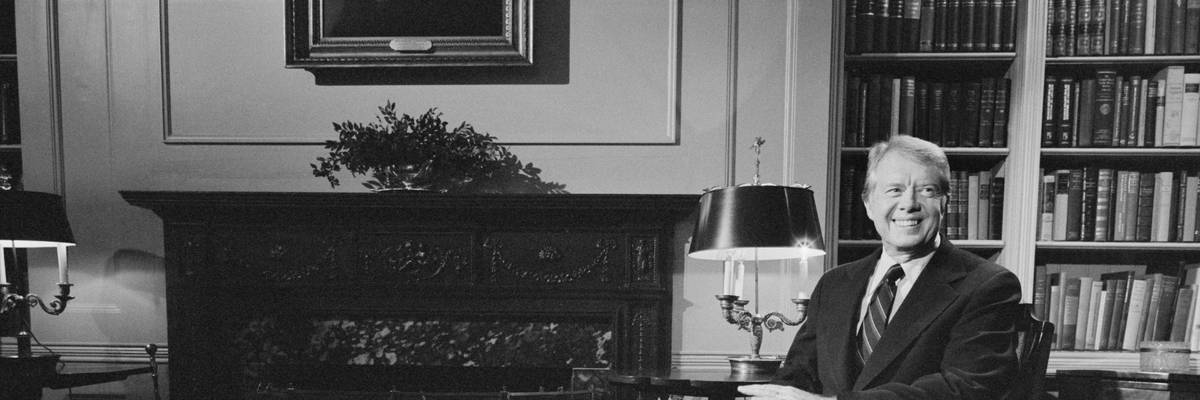
U.S. President Jimmy Carter at the White House during a fireside chat.
The myth and reality of our 39th president.
Friends,
I’m honoring Presidents’ Day by sharing with you some thoughts about Jimmy Carter, who is now in hospice care.
Carter’s administration marked the end of 45 years of democratic capitalism, whose goal had been to harness the private sector for the common good.
It’s important to understand what happened and why.
For years, the rap on President Carter has been that his presidency failed yet his post-presidency was the best in modern history.
This is way too simplistic.
Carter’s life after his presidency was exemplary for the same reason he was elected president after the disasters of Richard Nixon and Nixon’s vice president, Gerald Ford (who unconditionally pardoned Nixon for any crimes he may have committed): Carter’s modesty, decency, and humanity.
Not only were these traits the opposite of Nixon’s, but they would shine even brighter 40 years later in contrast to the loathsome Donald Trump.
One-term presidents are always presumed failures because voters didn’t reelect them. But Carter lost his reelection bid (as would George H.W. Bush 12 years later) not because his presidency failed but because the Federal Reserve Board hiked interest rates so high as to bring on a recession. Recessions do not just choke off inflation; they also choke off presidencies.
During Carter’s term of office, the OPEC oil cartel raised oil prices from $13 a barrel to over $34, resulting in double-digit price increases across the economy. Paul Volcker, Carter’s appointee as Fed chair, was determined to “break the back of inflation” by hiking interest rates to nearly 20 percent by 1981, bringing on a deep recession and causing millions of people to lose their jobs — including Carter.
It was not Carter’s fault that democratic capitalism ended with him. To the contrary, he appointed many consumer, labor, and environmental advocates to his administration.
Full disclosure: I was a Carter appointee, but met him only twice, once at a Rose Garden ceremony and years later at a dinner party at the home of Sen. Dianne Feinstein. (He was uncharacteristically late for dinner but made a surprise entry, coming down the stairs from a bedroom where he had taken a nap. He apologized profusely, making two un-Trump-like concessions in a single sentence: “I’m getting old and need my nap,” he said with a self-effacing grin, “but I should have told someone I was heading upstairs.”)
Many of his initiatives — ending funding for the B-1 bomber, seeking a comprehensive consumer-protection bill, proposing broad-based tax reform, opposing traditional “pork barrel” spending, establishing a “superfund” to clean up toxic waste sites, and deregulating the airline, trucking, and railroad industries (resulting in lower transportation costs for industry and consumers) — were commendable.
But much of what he did seemed to justify Lewis Powell’s warning to corporate America in a 1971 memo to the U.S. Chamber of Commerce that corporations must bulk up their lobbying muscle in Washington or suffer political defeat.
The untold story of the Carter years is the vast increase in corporate political firepower during this time. Trade associations, law firms, lobbying firms, political operatives, and public-relations specialists swarmed Washington, offering executives so much money that most retiring members of Congress also became lobbyists.
The city went from being a sleepy if not seedy backwater to the hub of America’s political wealth — replete with tony restaurants, upscale hotels, expensive bistros, and 25-bedroom mansions (one of them now owned by Jeff Bezos), and bordered by two of the richest counties in the nation.
With the defeat of Carter’s consumer protection legislation in 1978 at the hands of corporate lobbyists, Richard Lesher, then president of the U.S. Chamber of Commerce, presciently boasted that: “30 to 40 years from now people will look back and say ‘These were the years when the transition took place.’ … We're waking up. And big business is going to be in the forefront of this drive.”
Perhaps Carter could have staved this off had he been more politically cunning, but I doubt it. After 45 years playing defense, corporate America was eager to grab back the reins of power. Despite his best efforts, Carter paved the way for Ronald Reagan — and America’s return to the corporate capitalism that had dominated the nation before the Great Depression and Franklin D. Roosevelt.
Dear Common Dreams reader, It’s been nearly 30 years since I co-founded Common Dreams with my late wife, Lina Newhouser. We had the radical notion that journalism should serve the public good, not corporate profits. It was clear to us from the outset what it would take to build such a project. No paid advertisements. No corporate sponsors. No millionaire publisher telling us what to think or do. Many people said we wouldn't last a year, but we proved those doubters wrong. Together with a tremendous team of journalists and dedicated staff, we built an independent media outlet free from the constraints of profits and corporate control. Our mission has always been simple: To inform. To inspire. To ignite change for the common good. Building Common Dreams was not easy. Our survival was never guaranteed. When you take on the most powerful forces—Wall Street greed, fossil fuel industry destruction, Big Tech lobbyists, and uber-rich oligarchs who have spent billions upon billions rigging the economy and democracy in their favor—the only bulwark you have is supporters who believe in your work. But here’s the urgent message from me today. It's never been this bad out there. And it's never been this hard to keep us going. At the very moment Common Dreams is most needed, the threats we face are intensifying. We need your support now more than ever. We don't accept corporate advertising and never will. We don't have a paywall because we don't think people should be blocked from critical news based on their ability to pay. Everything we do is funded by the donations of readers like you. When everyone does the little they can afford, we are strong. But if that support retreats or dries up, so do we. Will you donate now to make sure Common Dreams not only survives but thrives? —Craig Brown, Co-founder |
Friends,
I’m honoring Presidents’ Day by sharing with you some thoughts about Jimmy Carter, who is now in hospice care.
Carter’s administration marked the end of 45 years of democratic capitalism, whose goal had been to harness the private sector for the common good.
It’s important to understand what happened and why.
For years, the rap on President Carter has been that his presidency failed yet his post-presidency was the best in modern history.
This is way too simplistic.
Carter’s life after his presidency was exemplary for the same reason he was elected president after the disasters of Richard Nixon and Nixon’s vice president, Gerald Ford (who unconditionally pardoned Nixon for any crimes he may have committed): Carter’s modesty, decency, and humanity.
Not only were these traits the opposite of Nixon’s, but they would shine even brighter 40 years later in contrast to the loathsome Donald Trump.
One-term presidents are always presumed failures because voters didn’t reelect them. But Carter lost his reelection bid (as would George H.W. Bush 12 years later) not because his presidency failed but because the Federal Reserve Board hiked interest rates so high as to bring on a recession. Recessions do not just choke off inflation; they also choke off presidencies.
During Carter’s term of office, the OPEC oil cartel raised oil prices from $13 a barrel to over $34, resulting in double-digit price increases across the economy. Paul Volcker, Carter’s appointee as Fed chair, was determined to “break the back of inflation” by hiking interest rates to nearly 20 percent by 1981, bringing on a deep recession and causing millions of people to lose their jobs — including Carter.
It was not Carter’s fault that democratic capitalism ended with him. To the contrary, he appointed many consumer, labor, and environmental advocates to his administration.
Full disclosure: I was a Carter appointee, but met him only twice, once at a Rose Garden ceremony and years later at a dinner party at the home of Sen. Dianne Feinstein. (He was uncharacteristically late for dinner but made a surprise entry, coming down the stairs from a bedroom where he had taken a nap. He apologized profusely, making two un-Trump-like concessions in a single sentence: “I’m getting old and need my nap,” he said with a self-effacing grin, “but I should have told someone I was heading upstairs.”)
Many of his initiatives — ending funding for the B-1 bomber, seeking a comprehensive consumer-protection bill, proposing broad-based tax reform, opposing traditional “pork barrel” spending, establishing a “superfund” to clean up toxic waste sites, and deregulating the airline, trucking, and railroad industries (resulting in lower transportation costs for industry and consumers) — were commendable.
But much of what he did seemed to justify Lewis Powell’s warning to corporate America in a 1971 memo to the U.S. Chamber of Commerce that corporations must bulk up their lobbying muscle in Washington or suffer political defeat.
The untold story of the Carter years is the vast increase in corporate political firepower during this time. Trade associations, law firms, lobbying firms, political operatives, and public-relations specialists swarmed Washington, offering executives so much money that most retiring members of Congress also became lobbyists.
The city went from being a sleepy if not seedy backwater to the hub of America’s political wealth — replete with tony restaurants, upscale hotels, expensive bistros, and 25-bedroom mansions (one of them now owned by Jeff Bezos), and bordered by two of the richest counties in the nation.
With the defeat of Carter’s consumer protection legislation in 1978 at the hands of corporate lobbyists, Richard Lesher, then president of the U.S. Chamber of Commerce, presciently boasted that: “30 to 40 years from now people will look back and say ‘These were the years when the transition took place.’ … We're waking up. And big business is going to be in the forefront of this drive.”
Perhaps Carter could have staved this off had he been more politically cunning, but I doubt it. After 45 years playing defense, corporate America was eager to grab back the reins of power. Despite his best efforts, Carter paved the way for Ronald Reagan — and America’s return to the corporate capitalism that had dominated the nation before the Great Depression and Franklin D. Roosevelt.
Friends,
I’m honoring Presidents’ Day by sharing with you some thoughts about Jimmy Carter, who is now in hospice care.
Carter’s administration marked the end of 45 years of democratic capitalism, whose goal had been to harness the private sector for the common good.
It’s important to understand what happened and why.
For years, the rap on President Carter has been that his presidency failed yet his post-presidency was the best in modern history.
This is way too simplistic.
Carter’s life after his presidency was exemplary for the same reason he was elected president after the disasters of Richard Nixon and Nixon’s vice president, Gerald Ford (who unconditionally pardoned Nixon for any crimes he may have committed): Carter’s modesty, decency, and humanity.
Not only were these traits the opposite of Nixon’s, but they would shine even brighter 40 years later in contrast to the loathsome Donald Trump.
One-term presidents are always presumed failures because voters didn’t reelect them. But Carter lost his reelection bid (as would George H.W. Bush 12 years later) not because his presidency failed but because the Federal Reserve Board hiked interest rates so high as to bring on a recession. Recessions do not just choke off inflation; they also choke off presidencies.
During Carter’s term of office, the OPEC oil cartel raised oil prices from $13 a barrel to over $34, resulting in double-digit price increases across the economy. Paul Volcker, Carter’s appointee as Fed chair, was determined to “break the back of inflation” by hiking interest rates to nearly 20 percent by 1981, bringing on a deep recession and causing millions of people to lose their jobs — including Carter.
It was not Carter’s fault that democratic capitalism ended with him. To the contrary, he appointed many consumer, labor, and environmental advocates to his administration.
Full disclosure: I was a Carter appointee, but met him only twice, once at a Rose Garden ceremony and years later at a dinner party at the home of Sen. Dianne Feinstein. (He was uncharacteristically late for dinner but made a surprise entry, coming down the stairs from a bedroom where he had taken a nap. He apologized profusely, making two un-Trump-like concessions in a single sentence: “I’m getting old and need my nap,” he said with a self-effacing grin, “but I should have told someone I was heading upstairs.”)
Many of his initiatives — ending funding for the B-1 bomber, seeking a comprehensive consumer-protection bill, proposing broad-based tax reform, opposing traditional “pork barrel” spending, establishing a “superfund” to clean up toxic waste sites, and deregulating the airline, trucking, and railroad industries (resulting in lower transportation costs for industry and consumers) — were commendable.
But much of what he did seemed to justify Lewis Powell’s warning to corporate America in a 1971 memo to the U.S. Chamber of Commerce that corporations must bulk up their lobbying muscle in Washington or suffer political defeat.
The untold story of the Carter years is the vast increase in corporate political firepower during this time. Trade associations, law firms, lobbying firms, political operatives, and public-relations specialists swarmed Washington, offering executives so much money that most retiring members of Congress also became lobbyists.
The city went from being a sleepy if not seedy backwater to the hub of America’s political wealth — replete with tony restaurants, upscale hotels, expensive bistros, and 25-bedroom mansions (one of them now owned by Jeff Bezos), and bordered by two of the richest counties in the nation.
With the defeat of Carter’s consumer protection legislation in 1978 at the hands of corporate lobbyists, Richard Lesher, then president of the U.S. Chamber of Commerce, presciently boasted that: “30 to 40 years from now people will look back and say ‘These were the years when the transition took place.’ … We're waking up. And big business is going to be in the forefront of this drive.”
Perhaps Carter could have staved this off had he been more politically cunning, but I doubt it. After 45 years playing defense, corporate America was eager to grab back the reins of power. Despite his best efforts, Carter paved the way for Ronald Reagan — and America’s return to the corporate capitalism that had dominated the nation before the Great Depression and Franklin D. Roosevelt.