SUBSCRIBE TO OUR FREE NEWSLETTER
Daily news & progressive opinion—funded by the people, not the corporations—delivered straight to your inbox.
5
#000000
#FFFFFF
To donate by check, phone, or other method, see our More Ways to Give page.
Daily news & progressive opinion—funded by the people, not the corporations—delivered straight to your inbox.
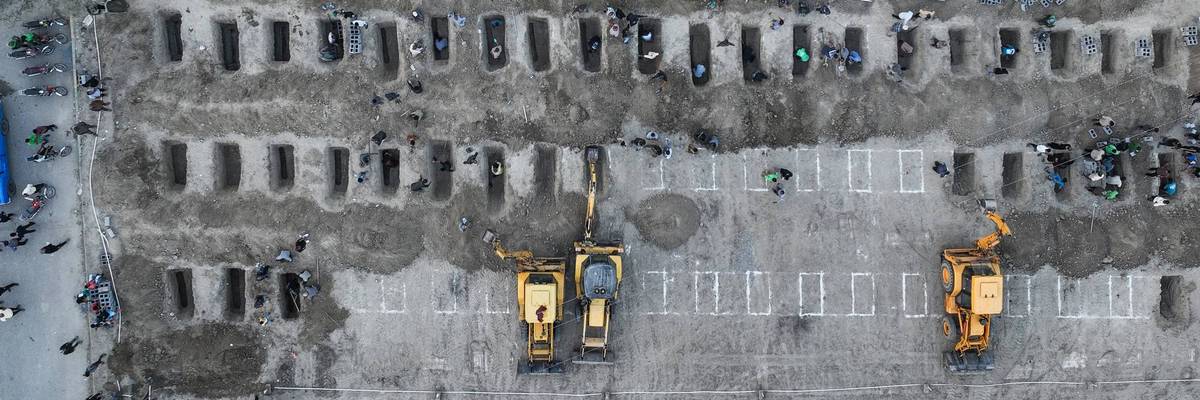
In this aerial handout picture released by the Iranian Press Center, mourners dig graves during the funeral for children killed in a reported strike on a primary school in Iran's Hormozgan province in Minab on March 3, 2026.
My country bombed a girl's elementary school. My country killed around 160 girls in an instant. Then, we all go to work on Monday—like nothing ever happened.
"To act is to be committed, and to be committed is to be in danger." —James Baldwin
An aerial photo shows rectangular tracings etched into dirt, one rectangle after the other, creating a grid across the land. A yellow excavator pulls piles of earth out from within the rectangular lines until each rectangle is six feet deep, then it moves onto the next. Men jump into the graves and shovel out what the excavator couldn’t reach. We don’t know if these men are the ones burying their own daughters, or if they knew the girls at all. But in my mind, I think they do—maybe they’re the uncles or the older brothers, and I hope to God it isn’t their fathers having to do something so devastating.
Wars have existed throughout all of human history, and this isn’t the first time hundreds of graves have been dug at once. I do wonder, though, if I were born in another time, if I would have seen such an image. The only thing I can be sure of is the reason why I saw the picture in the first place.
My country bombed a girl's elementary school. My country killed around 160 girls in an instant. My country is the reason that the men and women who loved those little girls have to pull their severed, bloody limbs from the rubble; find their backpacks covered in blood; and bury them forever. Then people like Karoline Leavitt, who will be remembered forever for being the spokeswoman for the human meat grinder, will refer to the mass slaughter as “propaganda” when asked about it. Then, we all go to work on Monday instead of setting the world on fire—like nothing ever happened. Like 160 girls’ lives weren’t extinguished while neocons and liberals alike justify regime change on the basis of state-sanctioned violence against women. Have we not all been here before?
When people are being gunned down in the street for resisting immigration raids, and environmental activists are shot execution style in the woods—to be committed is to be in danger.
This carnage is not new to anyone who’s been paying attention. The protests in response to President Donald Trump’s war on Iran were small, and I would be lying if I said it didn’t depress me. Have we all gotten so used to this? Did seeing the videos of children broken to pieces in grocery bags or hanging from their own intestines from the sides of destroyed buildings in Gaza wear down our nerve endings? As time goes on, and the depravity continues, are we more content with our lives if we ignore our own humanity?
Ultimately, and this may be for my own sanity, I’ve come to the conclusion that it’s not because Americans do not care about the slaughter being carried out in their name. James Baldwin wrote in a letter to his nephew about racism, explaining why white people don’t act differently, even if they know racism is wrong, he says:
Many of them, indeed, know better, but, as you will discover, people find it very difficult to act on what they know. To act is to be committed, and to be committed is to be in danger.
He goes on to describe that if white people were to accept that they weren’t superior to Black people, it would turn their whole world upside down. It would be uncomfortable, for an undefined amount of time to live in a world where everything you “knew” to be true wasn’t anymore.
It would take an exhaustive amount of time to describe how life would change in the United States if people within the country decided that war wasn’t the answer to all of our problems—which has been our country’s fundamental “truth” for decades and decades. Our economy which is so centered around creating weapons and selling them, would need to be restructured completely. We would have to have a government that cannot act against the will of its people.
We would have to accept the “consequences” of not being able to plunder the Earth to its core and take over any country to seize its resources that we happen to need to fulfill the fantasy of endless growth and endless comfort. Eventually, the purpose of life wouldn’t be to have better and better things and be more and more convenient. The purpose of life would be to live, and live with dignity, and live with care. All of this, though, would come later.
The first hurdle in our way is the obvious repression that the pedophile warmongers in the White House can and will put us through if we collectively decide that we aren’t okay with them killing kids anymore. When people are being gunned down in the street for resisting immigration raids, and environmental activists are shot execution style in the woods—to be committed is to be in danger. That repression and that violence are just the tip of the iceberg. If history has taught us anything, it’s that the danger is worth it, that the “truth” we had before is nothing compared to the freedom we will have later. I hope we can all see that clearly, and I hope we’ve sat with it long enough to act, and act seriously.
In the coming weeks, how do we collectively decide to be brave instead of comfortable?
Dear Common Dreams reader, It’s been nearly 30 years since I co-founded Common Dreams with my late wife, Lina Newhouser. We had the radical notion that journalism should serve the public good, not corporate profits. It was clear to us from the outset what it would take to build such a project. No paid advertisements. No corporate sponsors. No millionaire publisher telling us what to think or do. Many people said we wouldn't last a year, but we proved those doubters wrong. Together with a tremendous team of journalists and dedicated staff, we built an independent media outlet free from the constraints of profits and corporate control. Our mission has always been simple: To inform. To inspire. To ignite change for the common good. Building Common Dreams was not easy. Our survival was never guaranteed. When you take on the most powerful forces—Wall Street greed, fossil fuel industry destruction, Big Tech lobbyists, and uber-rich oligarchs who have spent billions upon billions rigging the economy and democracy in their favor—the only bulwark you have is supporters who believe in your work. But here’s the urgent message from me today. It's never been this bad out there. And it's never been this hard to keep us going. At the very moment Common Dreams is most needed, the threats we face are intensifying. We need your support now more than ever. We don't accept corporate advertising and never will. We don't have a paywall because we don't think people should be blocked from critical news based on their ability to pay. Everything we do is funded by the donations of readers like you. When everyone does the little they can afford, we are strong. But if that support retreats or dries up, so do we. Will you donate now to make sure Common Dreams not only survives but thrives? —Craig Brown, Co-founder |
"To act is to be committed, and to be committed is to be in danger." —James Baldwin
An aerial photo shows rectangular tracings etched into dirt, one rectangle after the other, creating a grid across the land. A yellow excavator pulls piles of earth out from within the rectangular lines until each rectangle is six feet deep, then it moves onto the next. Men jump into the graves and shovel out what the excavator couldn’t reach. We don’t know if these men are the ones burying their own daughters, or if they knew the girls at all. But in my mind, I think they do—maybe they’re the uncles or the older brothers, and I hope to God it isn’t their fathers having to do something so devastating.
Wars have existed throughout all of human history, and this isn’t the first time hundreds of graves have been dug at once. I do wonder, though, if I were born in another time, if I would have seen such an image. The only thing I can be sure of is the reason why I saw the picture in the first place.
My country bombed a girl's elementary school. My country killed around 160 girls in an instant. My country is the reason that the men and women who loved those little girls have to pull their severed, bloody limbs from the rubble; find their backpacks covered in blood; and bury them forever. Then people like Karoline Leavitt, who will be remembered forever for being the spokeswoman for the human meat grinder, will refer to the mass slaughter as “propaganda” when asked about it. Then, we all go to work on Monday instead of setting the world on fire—like nothing ever happened. Like 160 girls’ lives weren’t extinguished while neocons and liberals alike justify regime change on the basis of state-sanctioned violence against women. Have we not all been here before?
When people are being gunned down in the street for resisting immigration raids, and environmental activists are shot execution style in the woods—to be committed is to be in danger.
This carnage is not new to anyone who’s been paying attention. The protests in response to President Donald Trump’s war on Iran were small, and I would be lying if I said it didn’t depress me. Have we all gotten so used to this? Did seeing the videos of children broken to pieces in grocery bags or hanging from their own intestines from the sides of destroyed buildings in Gaza wear down our nerve endings? As time goes on, and the depravity continues, are we more content with our lives if we ignore our own humanity?
Ultimately, and this may be for my own sanity, I’ve come to the conclusion that it’s not because Americans do not care about the slaughter being carried out in their name. James Baldwin wrote in a letter to his nephew about racism, explaining why white people don’t act differently, even if they know racism is wrong, he says:
Many of them, indeed, know better, but, as you will discover, people find it very difficult to act on what they know. To act is to be committed, and to be committed is to be in danger.
He goes on to describe that if white people were to accept that they weren’t superior to Black people, it would turn their whole world upside down. It would be uncomfortable, for an undefined amount of time to live in a world where everything you “knew” to be true wasn’t anymore.
It would take an exhaustive amount of time to describe how life would change in the United States if people within the country decided that war wasn’t the answer to all of our problems—which has been our country’s fundamental “truth” for decades and decades. Our economy which is so centered around creating weapons and selling them, would need to be restructured completely. We would have to have a government that cannot act against the will of its people.
We would have to accept the “consequences” of not being able to plunder the Earth to its core and take over any country to seize its resources that we happen to need to fulfill the fantasy of endless growth and endless comfort. Eventually, the purpose of life wouldn’t be to have better and better things and be more and more convenient. The purpose of life would be to live, and live with dignity, and live with care. All of this, though, would come later.
The first hurdle in our way is the obvious repression that the pedophile warmongers in the White House can and will put us through if we collectively decide that we aren’t okay with them killing kids anymore. When people are being gunned down in the street for resisting immigration raids, and environmental activists are shot execution style in the woods—to be committed is to be in danger. That repression and that violence are just the tip of the iceberg. If history has taught us anything, it’s that the danger is worth it, that the “truth” we had before is nothing compared to the freedom we will have later. I hope we can all see that clearly, and I hope we’ve sat with it long enough to act, and act seriously.
In the coming weeks, how do we collectively decide to be brave instead of comfortable?
"To act is to be committed, and to be committed is to be in danger." —James Baldwin
An aerial photo shows rectangular tracings etched into dirt, one rectangle after the other, creating a grid across the land. A yellow excavator pulls piles of earth out from within the rectangular lines until each rectangle is six feet deep, then it moves onto the next. Men jump into the graves and shovel out what the excavator couldn’t reach. We don’t know if these men are the ones burying their own daughters, or if they knew the girls at all. But in my mind, I think they do—maybe they’re the uncles or the older brothers, and I hope to God it isn’t their fathers having to do something so devastating.
Wars have existed throughout all of human history, and this isn’t the first time hundreds of graves have been dug at once. I do wonder, though, if I were born in another time, if I would have seen such an image. The only thing I can be sure of is the reason why I saw the picture in the first place.
My country bombed a girl's elementary school. My country killed around 160 girls in an instant. My country is the reason that the men and women who loved those little girls have to pull their severed, bloody limbs from the rubble; find their backpacks covered in blood; and bury them forever. Then people like Karoline Leavitt, who will be remembered forever for being the spokeswoman for the human meat grinder, will refer to the mass slaughter as “propaganda” when asked about it. Then, we all go to work on Monday instead of setting the world on fire—like nothing ever happened. Like 160 girls’ lives weren’t extinguished while neocons and liberals alike justify regime change on the basis of state-sanctioned violence against women. Have we not all been here before?
When people are being gunned down in the street for resisting immigration raids, and environmental activists are shot execution style in the woods—to be committed is to be in danger.
This carnage is not new to anyone who’s been paying attention. The protests in response to President Donald Trump’s war on Iran were small, and I would be lying if I said it didn’t depress me. Have we all gotten so used to this? Did seeing the videos of children broken to pieces in grocery bags or hanging from their own intestines from the sides of destroyed buildings in Gaza wear down our nerve endings? As time goes on, and the depravity continues, are we more content with our lives if we ignore our own humanity?
Ultimately, and this may be for my own sanity, I’ve come to the conclusion that it’s not because Americans do not care about the slaughter being carried out in their name. James Baldwin wrote in a letter to his nephew about racism, explaining why white people don’t act differently, even if they know racism is wrong, he says:
Many of them, indeed, know better, but, as you will discover, people find it very difficult to act on what they know. To act is to be committed, and to be committed is to be in danger.
He goes on to describe that if white people were to accept that they weren’t superior to Black people, it would turn their whole world upside down. It would be uncomfortable, for an undefined amount of time to live in a world where everything you “knew” to be true wasn’t anymore.
It would take an exhaustive amount of time to describe how life would change in the United States if people within the country decided that war wasn’t the answer to all of our problems—which has been our country’s fundamental “truth” for decades and decades. Our economy which is so centered around creating weapons and selling them, would need to be restructured completely. We would have to have a government that cannot act against the will of its people.
We would have to accept the “consequences” of not being able to plunder the Earth to its core and take over any country to seize its resources that we happen to need to fulfill the fantasy of endless growth and endless comfort. Eventually, the purpose of life wouldn’t be to have better and better things and be more and more convenient. The purpose of life would be to live, and live with dignity, and live with care. All of this, though, would come later.
The first hurdle in our way is the obvious repression that the pedophile warmongers in the White House can and will put us through if we collectively decide that we aren’t okay with them killing kids anymore. When people are being gunned down in the street for resisting immigration raids, and environmental activists are shot execution style in the woods—to be committed is to be in danger. That repression and that violence are just the tip of the iceberg. If history has taught us anything, it’s that the danger is worth it, that the “truth” we had before is nothing compared to the freedom we will have later. I hope we can all see that clearly, and I hope we’ve sat with it long enough to act, and act seriously.
In the coming weeks, how do we collectively decide to be brave instead of comfortable?