SUBSCRIBE TO OUR FREE NEWSLETTER
Daily news & progressive opinion—funded by the people, not the corporations—delivered straight to your inbox.
5
#000000
#FFFFFF
To donate by check, phone, or other method, see our More Ways to Give page.
Daily news & progressive opinion—funded by the people, not the corporations—delivered straight to your inbox.
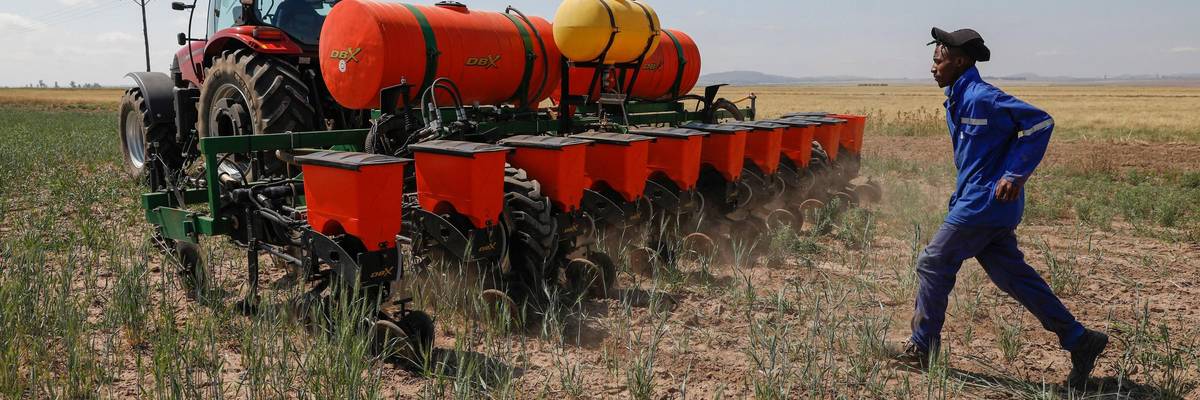
A farm worker walks next to the planter while planting soy beans in a field on a farm in Balfour, South Africa, on October 20, 2021.
In the last two years, food corporations paid shareholders $53.5bn while millions went hungry.
Imagine being able to provide food, shelter, medicine and clean drinking water for the 230 million most vulnerable people on Earth, and still having a cool $2bn in spare change. That’s the equivalent of the entire economic output of Gambia rattling around in your pocket.
The reason for this unlikely thought experiment is a new analysis showing that 20 of the world’s biggest food corporations – the largest in the grain, fertiliser, meat and dairy sectors – returned a total of $53.5bn to their shareholders in the last two financial years.
To put that into perspective, the UN estimates that it needs $51.5bn to provide life-saving support to 230 million people deemed most at risk worldwide. You get the idea.
What’s more, the corporations ‘earned’ these profits during a period of unprecedented turmoil – a global pandemic and full-scale war in Ukraine – when global supply chains were disrupted and millions of people went hungry.
While readers in wealthier countries may have noticed higher prices for the weekly shop, the impact in developing countries has been devastating. Food prices rose by between 3% and 4.5% in the UK, Canada and the US in the first few months of the pandemic – but by 47% in Venezuela.
The World Food Programme estimates that the number of people facing acute food insecurity more than doubled from 135 million people before the pandemic to 345 million. Countries in the Horn of Africa as well as Afghanistan and Yemen have been particularly badly hit.
Owning the market
So how were 20 companies able to get their hands on this amount of money amid two major crises?
By literally owning the market. The new report from Greenpeace International shows how this small group of companies are able to wield wildly disproportionate control, not only over the supply chains for food itself, but over information about those supplies.
When supply chains were disrupted and food prices rose, the profits rolled in. Cash dividends and shareholder buyback programmes allowed them to transfer an astronomical amount of money to their shareholders, while further amplifying their power over the sector’s industry and governments.
A systemic failure of public policy has allowed a select group to record huge profits, enriching the individuals that own and operate them and transferring wealth to shareholders, most of whom are in the Global North.
Let’s take one example from the report: Russia’s latest invasion of Ukraine last year also resulted in steep price rises for agricultural commodities such as wheat, maize, sunflower oil and some fertilisers, of which Ukraine and Russia are major exporters.
Just four companies – Archer-Daniels Midland, Bunge, Cargill and Dreyfus – control up to 90% of the world’s grain trade. They are under no obligation to disclose what they know about global markets, including their own grain stocks. This lack of transparency means that these companies withhold information that can shape grain prices according to their needs – not even hedge funds can get information except directly from them.
Our report finds that following Russia’s invasion of Ukraine, opacity around the true amounts of grain in storage was a factor in the development of a speculative bubble that led to grain prices rising around the world. In the last two financial years, these four companies paid out a total of $2.7bn in cash dividends, and at least $3.3m in share buybacks, though the true figure is likely much higher because not all of them report on their finances in detail.
If we want to see a world without hunger, the most impactful structural change we can make to the global food system is to bring about food sovereignty. This means policymakers empowering consumers and food producers through policies that benefit local food production, the environment and workers’ rights.
For years, food sovereignty movements have sought to return autonomy to food producers, shortening and strengthening supply chains to reverse the damage done by unsustainable farming. It is not just wishful thinking: from Papua New Guinea to Brazil to Mexico and many other countries, there are deep structural movements working to bring food to everyone’s plate.
But there must also be policies to loosen the grip of corporate control on the global food system – measures such as regulations to ensure greater transparency, an ambitious and sector-wide windfall tax, and significant taxation on dividend payouts as well as on income from dividends.
Achieving zero hunger is the second of the Sustainable Development Goals that UN member states committed to reach by 2030. Recent UN conferences, such as COP27 and COP15, have highlighted industrial agriculture as an important driver of greenhouse gas emissions and biodiversity loss.
It is time for food to be seen as what it is: a basic human need that has to be available to us all, and not another commodity to be exploited and traded for the profit of the few.
Dear Common Dreams reader, It’s been nearly 30 years since I co-founded Common Dreams with my late wife, Lina Newhouser. We had the radical notion that journalism should serve the public good, not corporate profits. It was clear to us from the outset what it would take to build such a project. No paid advertisements. No corporate sponsors. No millionaire publisher telling us what to think or do. Many people said we wouldn't last a year, but we proved those doubters wrong. Together with a tremendous team of journalists and dedicated staff, we built an independent media outlet free from the constraints of profits and corporate control. Our mission has always been simple: To inform. To inspire. To ignite change for the common good. Building Common Dreams was not easy. Our survival was never guaranteed. When you take on the most powerful forces—Wall Street greed, fossil fuel industry destruction, Big Tech lobbyists, and uber-rich oligarchs who have spent billions upon billions rigging the economy and democracy in their favor—the only bulwark you have is supporters who believe in your work. But here’s the urgent message from me today. It's never been this bad out there. And it's never been this hard to keep us going. At the very moment Common Dreams is most needed, the threats we face are intensifying. We need your support now more than ever. We don't accept corporate advertising and never will. We don't have a paywall because we don't think people should be blocked from critical news based on their ability to pay. Everything we do is funded by the donations of readers like you. When everyone does the little they can afford, we are strong. But if that support retreats or dries up, so do we. Will you donate now to make sure Common Dreams not only survives but thrives? —Craig Brown, Co-founder |
Imagine being able to provide food, shelter, medicine and clean drinking water for the 230 million most vulnerable people on Earth, and still having a cool $2bn in spare change. That’s the equivalent of the entire economic output of Gambia rattling around in your pocket.
The reason for this unlikely thought experiment is a new analysis showing that 20 of the world’s biggest food corporations – the largest in the grain, fertiliser, meat and dairy sectors – returned a total of $53.5bn to their shareholders in the last two financial years.
To put that into perspective, the UN estimates that it needs $51.5bn to provide life-saving support to 230 million people deemed most at risk worldwide. You get the idea.
What’s more, the corporations ‘earned’ these profits during a period of unprecedented turmoil – a global pandemic and full-scale war in Ukraine – when global supply chains were disrupted and millions of people went hungry.
While readers in wealthier countries may have noticed higher prices for the weekly shop, the impact in developing countries has been devastating. Food prices rose by between 3% and 4.5% in the UK, Canada and the US in the first few months of the pandemic – but by 47% in Venezuela.
The World Food Programme estimates that the number of people facing acute food insecurity more than doubled from 135 million people before the pandemic to 345 million. Countries in the Horn of Africa as well as Afghanistan and Yemen have been particularly badly hit.
Owning the market
So how were 20 companies able to get their hands on this amount of money amid two major crises?
By literally owning the market. The new report from Greenpeace International shows how this small group of companies are able to wield wildly disproportionate control, not only over the supply chains for food itself, but over information about those supplies.
When supply chains were disrupted and food prices rose, the profits rolled in. Cash dividends and shareholder buyback programmes allowed them to transfer an astronomical amount of money to their shareholders, while further amplifying their power over the sector’s industry and governments.
A systemic failure of public policy has allowed a select group to record huge profits, enriching the individuals that own and operate them and transferring wealth to shareholders, most of whom are in the Global North.
Let’s take one example from the report: Russia’s latest invasion of Ukraine last year also resulted in steep price rises for agricultural commodities such as wheat, maize, sunflower oil and some fertilisers, of which Ukraine and Russia are major exporters.
Just four companies – Archer-Daniels Midland, Bunge, Cargill and Dreyfus – control up to 90% of the world’s grain trade. They are under no obligation to disclose what they know about global markets, including their own grain stocks. This lack of transparency means that these companies withhold information that can shape grain prices according to their needs – not even hedge funds can get information except directly from them.
Our report finds that following Russia’s invasion of Ukraine, opacity around the true amounts of grain in storage was a factor in the development of a speculative bubble that led to grain prices rising around the world. In the last two financial years, these four companies paid out a total of $2.7bn in cash dividends, and at least $3.3m in share buybacks, though the true figure is likely much higher because not all of them report on their finances in detail.
If we want to see a world without hunger, the most impactful structural change we can make to the global food system is to bring about food sovereignty. This means policymakers empowering consumers and food producers through policies that benefit local food production, the environment and workers’ rights.
For years, food sovereignty movements have sought to return autonomy to food producers, shortening and strengthening supply chains to reverse the damage done by unsustainable farming. It is not just wishful thinking: from Papua New Guinea to Brazil to Mexico and many other countries, there are deep structural movements working to bring food to everyone’s plate.
But there must also be policies to loosen the grip of corporate control on the global food system – measures such as regulations to ensure greater transparency, an ambitious and sector-wide windfall tax, and significant taxation on dividend payouts as well as on income from dividends.
Achieving zero hunger is the second of the Sustainable Development Goals that UN member states committed to reach by 2030. Recent UN conferences, such as COP27 and COP15, have highlighted industrial agriculture as an important driver of greenhouse gas emissions and biodiversity loss.
It is time for food to be seen as what it is: a basic human need that has to be available to us all, and not another commodity to be exploited and traded for the profit of the few.
Imagine being able to provide food, shelter, medicine and clean drinking water for the 230 million most vulnerable people on Earth, and still having a cool $2bn in spare change. That’s the equivalent of the entire economic output of Gambia rattling around in your pocket.
The reason for this unlikely thought experiment is a new analysis showing that 20 of the world’s biggest food corporations – the largest in the grain, fertiliser, meat and dairy sectors – returned a total of $53.5bn to their shareholders in the last two financial years.
To put that into perspective, the UN estimates that it needs $51.5bn to provide life-saving support to 230 million people deemed most at risk worldwide. You get the idea.
What’s more, the corporations ‘earned’ these profits during a period of unprecedented turmoil – a global pandemic and full-scale war in Ukraine – when global supply chains were disrupted and millions of people went hungry.
While readers in wealthier countries may have noticed higher prices for the weekly shop, the impact in developing countries has been devastating. Food prices rose by between 3% and 4.5% in the UK, Canada and the US in the first few months of the pandemic – but by 47% in Venezuela.
The World Food Programme estimates that the number of people facing acute food insecurity more than doubled from 135 million people before the pandemic to 345 million. Countries in the Horn of Africa as well as Afghanistan and Yemen have been particularly badly hit.
Owning the market
So how were 20 companies able to get their hands on this amount of money amid two major crises?
By literally owning the market. The new report from Greenpeace International shows how this small group of companies are able to wield wildly disproportionate control, not only over the supply chains for food itself, but over information about those supplies.
When supply chains were disrupted and food prices rose, the profits rolled in. Cash dividends and shareholder buyback programmes allowed them to transfer an astronomical amount of money to their shareholders, while further amplifying their power over the sector’s industry and governments.
A systemic failure of public policy has allowed a select group to record huge profits, enriching the individuals that own and operate them and transferring wealth to shareholders, most of whom are in the Global North.
Let’s take one example from the report: Russia’s latest invasion of Ukraine last year also resulted in steep price rises for agricultural commodities such as wheat, maize, sunflower oil and some fertilisers, of which Ukraine and Russia are major exporters.
Just four companies – Archer-Daniels Midland, Bunge, Cargill and Dreyfus – control up to 90% of the world’s grain trade. They are under no obligation to disclose what they know about global markets, including their own grain stocks. This lack of transparency means that these companies withhold information that can shape grain prices according to their needs – not even hedge funds can get information except directly from them.
Our report finds that following Russia’s invasion of Ukraine, opacity around the true amounts of grain in storage was a factor in the development of a speculative bubble that led to grain prices rising around the world. In the last two financial years, these four companies paid out a total of $2.7bn in cash dividends, and at least $3.3m in share buybacks, though the true figure is likely much higher because not all of them report on their finances in detail.
If we want to see a world without hunger, the most impactful structural change we can make to the global food system is to bring about food sovereignty. This means policymakers empowering consumers and food producers through policies that benefit local food production, the environment and workers’ rights.
For years, food sovereignty movements have sought to return autonomy to food producers, shortening and strengthening supply chains to reverse the damage done by unsustainable farming. It is not just wishful thinking: from Papua New Guinea to Brazil to Mexico and many other countries, there are deep structural movements working to bring food to everyone’s plate.
But there must also be policies to loosen the grip of corporate control on the global food system – measures such as regulations to ensure greater transparency, an ambitious and sector-wide windfall tax, and significant taxation on dividend payouts as well as on income from dividends.
Achieving zero hunger is the second of the Sustainable Development Goals that UN member states committed to reach by 2030. Recent UN conferences, such as COP27 and COP15, have highlighted industrial agriculture as an important driver of greenhouse gas emissions and biodiversity loss.
It is time for food to be seen as what it is: a basic human need that has to be available to us all, and not another commodity to be exploited and traded for the profit of the few.