Trump’s Interference Destroys Trust of Election Results in Honduras
While Washington’s aversion to foreign interference in its domestic elections verges on paranoia, the gross hypocrisy that runs through its foreign policy leaves it free of any compunction when meddling in other countries’ elections.
An extraordinary catalog of US interference—amounting to an electoral coup—may have destroyed what was already a struggling democracy in Honduras. Trump has succeeded in closing the door to progressive government and in all likelihood his preferred neoliberal candidate—previously trailing in many opinion polls—will be declared president when the count eventually finishes.
While Washington’s aversion to foreign interference in its domestic elections verges on paranoia, the gross hypocrisy that runs through its foreign policy leaves it free of any compunction when meddling in other countries’ elections, especially in Latin America. Perhaps no country has greater recent experience of this than Honduras. Although most accounts of this meddling begin in 2009 with the ousting by army officers of its democratically elected president, Mel Zelaya, in truth, US dominance of the country has a much longer history, as I described at the time.
The US refused to designate Zelaya’s toppling as a “military coup” or to back international calls for his rapid return to office. Washington then backed all the post-coup governments, including those established by Juan Orlando Hernández when his National Party “won” two highly manipulated elections. Rampant corruption by him and his predecessors ensured that Honduras became a “narcostate.” Nevertheless, US administrations embraced Hernández as a prime ally in the war on drugs up until the point when he left office, was extradited, and committed to 45 years in a US prison. Only the large majority won by the Libre party’s Xiomara Castro in the 2021 election, and the fact that Hernández had become a liability, temporarily frustrated Washington’s customary ability to get the Honduran president that best suited its interests.
Castro’s government only partly fulfilled its progressive aims, not least because of the continuing power wielded by Honduras’s often corrupt elite, a judicial and security system still strongly subject to US influence, and social media campaigns which often originated in Washington. Opinion polls showed that Castro’s chosen successor as Libre Party candidate, Rixi Moncada, would be in a close race with the right-wing candidates of the two traditional parties, the Liberals’ Salvador Nasralla and the National Party’s Nasry Asfura. Trump favored Asfura, effectively the successor to Juan Orlando Hernández, as the candidate most attuned to his policies.
The fact that the November 30 election took place at the height of the US military build-up in the Caribbean was itself a crucial ingredient in determining the outcome. Both right-wing candidates were able to warn Hondurans that a vote for Libre would be an invitation to the US military to turn its guns on them. Trump emboldened them by asking on Truth Social, “Will Maduro and his Narcoterrorists take over another country as they have taken over Cuba, Nicaragua, and Venezuela?” According to him, a vote for Asfura would ensure that Honduras did not face the same potential fate as Venezuela. “Tito and I can work together to fight the Narcocommunists,” he added. “I cannot work with Moncada and the Communists.” Nor, apparently, could he even trust Nasralla, whom he described as “borderline communist.”
The president then trumped this statement by declaring that only if Asfura won would US aid for Honduras continue. “If he doesn’t win, the United States will not be throwing good money after bad,” he said. When Nasralla appeared to have edged ahead of Asfura, in a close count, Trump said that it “looks like Honduras is trying to change the results of their Presidential Election,” adding, “If they do, there will be hell to pay!” Then, in a night “marked by technical failures and tension in the results system,” the count suddenly gave the lead to Asfura. The International Observation Mission of the American Association of Jurists asserted that Trump’s intervention "has placed the legitimacy of the democratic process in crisis."
In an even more extraordinary move, Trump announced that he would be pardoning the disgraced former president Hernández, who has indeed since walked free from prison. A move that might have harmed the National Party appears instead to have been an astute boost to Asfura’s campaign, given that many of his supporters still idolize Hernández and regard Asfura as an inferior leader. However, Mike Vigil, a former senior official in the US Drug Enforcement Agency, told the Guardian that pardoning Hernández “shows that the entire counter-drug effort of Donald Trump is a charade.” Activist and author Dana Frank told the Guardian that “his repressive, thieving, dictatorial history, backed by the United States year after year, has evaporated from the story.”
Another, very effective but little publicized intervention appears to have taken place, if Rixi Moncada’s claim in an interview with Telesur is correct. According to her, huge numbers of the 2.5 million Hondurans who receive remittances from family members in the US were warned that, if Libre won, they would not receive their December payments. The magnitude of the threat (whether or not it could have been carried out in practice) is indicated by the fact that remittances account for a quarter of Honduras’s GDP. It seems possible that many poor households’ votes, which might have gone to Libre, didn’t, because of text messages sent directly to their phones.
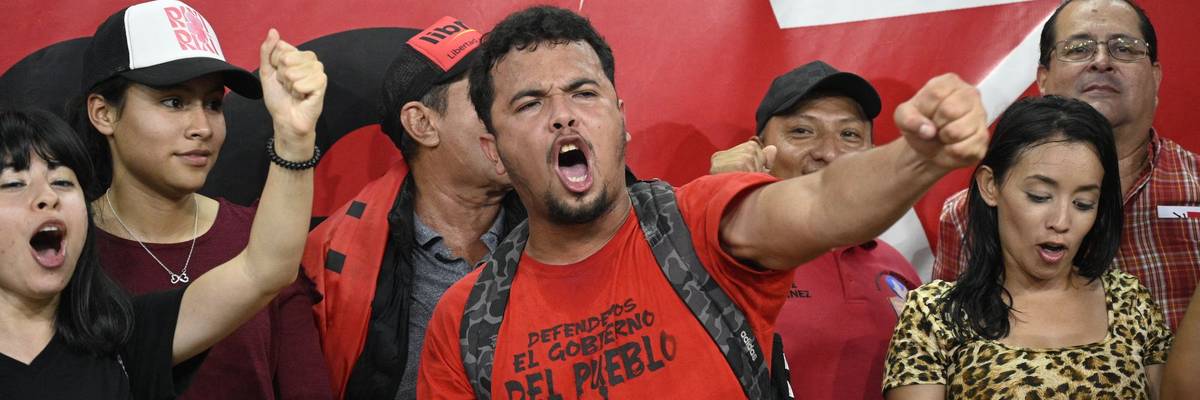
That electoral fraud would again favor the US-supported candidate was indicated in the run-up to November 30 by leaked audios implicating the National Party’s representative on the national election council. The council’s Libre representative, Marlon Ochoa, who denounced that planned fraud, has now published a detailed account of irregularities since counting started, which he claims invalidate 86 per cent of polling returns. Indeed, at the time of writing, following a week of technical problems in vote counting, there is still no official winner.
Rixi Moncada harshly questioned the silence of the electoral observation missions from the Organization of American States and the European Union, which she accused of deliberately omitting any reference to Trump’s interference in their bulletins on the conduct of the election. "So far they have not commented on the intervention of the U.S. president in their reports," Moncada claimed, noting their attitude "borders on complacency." New York Times interviews with Hondurans showed clearly that Trump’s comments influenced their votes. Mark Weisbrot, of the US Center for Economic and Policy Research, pointed out that his interventions were “a violation of Article 19 of the Charter of the Organization of American States, to which the United States is a signatory.”
Emboldened by his apparent success in defeating “communism,” even if (at the time of writing) he may not yet have secured the victory of his preferred neoliberal candidate, Trump has gone on to publish his own “corollary” to the century-old Monroe Doctrine, endorsing its claims to a unique US sphere of influence covering the whole region. Echoing the 1904 corollary to the doctrine issued by President Roosevelt, which declared that the US would be a "hemispheric police power," Trump says he is “proudly reasserting” control over “our hemisphere,” guarding the American continents “against communism, fascism, and foreign infringement.”
Nothing could be a clearer manifestation of what has been called the “Donroe Doctrine” than the military build-up in the Caribbean, which provided the threatening backdrop to the final weeks of the Honduran election campaign. As Roger Harris and I noted in a recent article, the deployment of one-fifth of US maritime power is aimed not just at Venezuela, but at starting a wider domino effect in the Caribbean basin. In the aftermath of November’s election night in Honduras, the first domino appears to have fallen.
We are at a crossroads
This country and this world are at a monumental crossroads. In a few short weeks, US voters will have an opportunity to beat back the forces of fascism and confront the billionaires who are rigging the economy, our media system, and our democracy, making it increasingly impossible for ordinary people to get by. We’re not just talking about the election. We’re talking about what must be done once these fascist elements are vanquished from power. We need a bolder set of solutions than what either major party has so far been willing to offer and a working-class movement ready to fight like hell for it. Trump didn't emerge from nowhere. The conditions that fueled MAGA authoritarianism were created by decades of radical neoliberal economic policies and a corrupt political system dominated by corporate interests. They slashed taxes on the super-rich, promising that the benefits would trickle down. They said giveaways to the corporate titans would make life more affordable for the rest of us. It was all bullshit. And when a bitter, betrayed populace searches for someone to blame, right-wing demagogues have little trouble finding scapegoats. People know when they're being lied to, but you won't hear any of this from the corporate media. Only independent journalism—powered and funded by people who believe in building a better world—can deliver truly trustworthy daily news. Our Fall Campaign is underway, and we need your help. To power our newsroom through the rest of the year, we need to raise $125,000 by midnight on October 31. So if you share our vision, please contribute whatever you can to sustain our work. |
An extraordinary catalog of US interference—amounting to an electoral coup—may have destroyed what was already a struggling democracy in Honduras. Trump has succeeded in closing the door to progressive government and in all likelihood his preferred neoliberal candidate—previously trailing in many opinion polls—will be declared president when the count eventually finishes.
While Washington’s aversion to foreign interference in its domestic elections verges on paranoia, the gross hypocrisy that runs through its foreign policy leaves it free of any compunction when meddling in other countries’ elections, especially in Latin America. Perhaps no country has greater recent experience of this than Honduras. Although most accounts of this meddling begin in 2009 with the ousting by army officers of its democratically elected president, Mel Zelaya, in truth, US dominance of the country has a much longer history, as I described at the time.
The US refused to designate Zelaya’s toppling as a “military coup” or to back international calls for his rapid return to office. Washington then backed all the post-coup governments, including those established by Juan Orlando Hernández when his National Party “won” two highly manipulated elections. Rampant corruption by him and his predecessors ensured that Honduras became a “narcostate.” Nevertheless, US administrations embraced Hernández as a prime ally in the war on drugs up until the point when he left office, was extradited, and committed to 45 years in a US prison. Only the large majority won by the Libre party’s Xiomara Castro in the 2021 election, and the fact that Hernández had become a liability, temporarily frustrated Washington’s customary ability to get the Honduran president that best suited its interests.
Castro’s government only partly fulfilled its progressive aims, not least because of the continuing power wielded by Honduras’s often corrupt elite, a judicial and security system still strongly subject to US influence, and social media campaigns which often originated in Washington. Opinion polls showed that Castro’s chosen successor as Libre Party candidate, Rixi Moncada, would be in a close race with the right-wing candidates of the two traditional parties, the Liberals’ Salvador Nasralla and the National Party’s Nasry Asfura. Trump favored Asfura, effectively the successor to Juan Orlando Hernández, as the candidate most attuned to his policies.
The fact that the November 30 election took place at the height of the US military build-up in the Caribbean was itself a crucial ingredient in determining the outcome. Both right-wing candidates were able to warn Hondurans that a vote for Libre would be an invitation to the US military to turn its guns on them. Trump emboldened them by asking on Truth Social, “Will Maduro and his Narcoterrorists take over another country as they have taken over Cuba, Nicaragua, and Venezuela?” According to him, a vote for Asfura would ensure that Honduras did not face the same potential fate as Venezuela. “Tito and I can work together to fight the Narcocommunists,” he added. “I cannot work with Moncada and the Communists.” Nor, apparently, could he even trust Nasralla, whom he described as “borderline communist.”
The president then trumped this statement by declaring that only if Asfura won would US aid for Honduras continue. “If he doesn’t win, the United States will not be throwing good money after bad,” he said. When Nasralla appeared to have edged ahead of Asfura, in a close count, Trump said that it “looks like Honduras is trying to change the results of their Presidential Election,” adding, “If they do, there will be hell to pay!” Then, in a night “marked by technical failures and tension in the results system,” the count suddenly gave the lead to Asfura. The International Observation Mission of the American Association of Jurists asserted that Trump’s intervention "has placed the legitimacy of the democratic process in crisis."
In an even more extraordinary move, Trump announced that he would be pardoning the disgraced former president Hernández, who has indeed since walked free from prison. A move that might have harmed the National Party appears instead to have been an astute boost to Asfura’s campaign, given that many of his supporters still idolize Hernández and regard Asfura as an inferior leader. However, Mike Vigil, a former senior official in the US Drug Enforcement Agency, told the Guardian that pardoning Hernández “shows that the entire counter-drug effort of Donald Trump is a charade.” Activist and author Dana Frank told the Guardian that “his repressive, thieving, dictatorial history, backed by the United States year after year, has evaporated from the story.”
Another, very effective but little publicized intervention appears to have taken place, if Rixi Moncada’s claim in an interview with Telesur is correct. According to her, huge numbers of the 2.5 million Hondurans who receive remittances from family members in the US were warned that, if Libre won, they would not receive their December payments. The magnitude of the threat (whether or not it could have been carried out in practice) is indicated by the fact that remittances account for a quarter of Honduras’s GDP. It seems possible that many poor households’ votes, which might have gone to Libre, didn’t, because of text messages sent directly to their phones.
That electoral fraud would again favor the US-supported candidate was indicated in the run-up to November 30 by leaked audios implicating the National Party’s representative on the national election council. The council’s Libre representative, Marlon Ochoa, who denounced that planned fraud, has now published a detailed account of irregularities since counting started, which he claims invalidate 86 per cent of polling returns. Indeed, at the time of writing, following a week of technical problems in vote counting, there is still no official winner.
Rixi Moncada harshly questioned the silence of the electoral observation missions from the Organization of American States and the European Union, which she accused of deliberately omitting any reference to Trump’s interference in their bulletins on the conduct of the election. "So far they have not commented on the intervention of the U.S. president in their reports," Moncada claimed, noting their attitude "borders on complacency." New York Times interviews with Hondurans showed clearly that Trump’s comments influenced their votes. Mark Weisbrot, of the US Center for Economic and Policy Research, pointed out that his interventions were “a violation of Article 19 of the Charter of the Organization of American States, to which the United States is a signatory.”
Emboldened by his apparent success in defeating “communism,” even if (at the time of writing) he may not yet have secured the victory of his preferred neoliberal candidate, Trump has gone on to publish his own “corollary” to the century-old Monroe Doctrine, endorsing its claims to a unique US sphere of influence covering the whole region. Echoing the 1904 corollary to the doctrine issued by President Roosevelt, which declared that the US would be a "hemispheric police power," Trump says he is “proudly reasserting” control over “our hemisphere,” guarding the American continents “against communism, fascism, and foreign infringement.”
Nothing could be a clearer manifestation of what has been called the “Donroe Doctrine” than the military build-up in the Caribbean, which provided the threatening backdrop to the final weeks of the Honduran election campaign. As Roger Harris and I noted in a recent article, the deployment of one-fifth of US maritime power is aimed not just at Venezuela, but at starting a wider domino effect in the Caribbean basin. In the aftermath of November’s election night in Honduras, the first domino appears to have fallen.
An extraordinary catalog of US interference—amounting to an electoral coup—may have destroyed what was already a struggling democracy in Honduras. Trump has succeeded in closing the door to progressive government and in all likelihood his preferred neoliberal candidate—previously trailing in many opinion polls—will be declared president when the count eventually finishes.
While Washington’s aversion to foreign interference in its domestic elections verges on paranoia, the gross hypocrisy that runs through its foreign policy leaves it free of any compunction when meddling in other countries’ elections, especially in Latin America. Perhaps no country has greater recent experience of this than Honduras. Although most accounts of this meddling begin in 2009 with the ousting by army officers of its democratically elected president, Mel Zelaya, in truth, US dominance of the country has a much longer history, as I described at the time.
The US refused to designate Zelaya’s toppling as a “military coup” or to back international calls for his rapid return to office. Washington then backed all the post-coup governments, including those established by Juan Orlando Hernández when his National Party “won” two highly manipulated elections. Rampant corruption by him and his predecessors ensured that Honduras became a “narcostate.” Nevertheless, US administrations embraced Hernández as a prime ally in the war on drugs up until the point when he left office, was extradited, and committed to 45 years in a US prison. Only the large majority won by the Libre party’s Xiomara Castro in the 2021 election, and the fact that Hernández had become a liability, temporarily frustrated Washington’s customary ability to get the Honduran president that best suited its interests.
Castro’s government only partly fulfilled its progressive aims, not least because of the continuing power wielded by Honduras’s often corrupt elite, a judicial and security system still strongly subject to US influence, and social media campaigns which often originated in Washington. Opinion polls showed that Castro’s chosen successor as Libre Party candidate, Rixi Moncada, would be in a close race with the right-wing candidates of the two traditional parties, the Liberals’ Salvador Nasralla and the National Party’s Nasry Asfura. Trump favored Asfura, effectively the successor to Juan Orlando Hernández, as the candidate most attuned to his policies.
The fact that the November 30 election took place at the height of the US military build-up in the Caribbean was itself a crucial ingredient in determining the outcome. Both right-wing candidates were able to warn Hondurans that a vote for Libre would be an invitation to the US military to turn its guns on them. Trump emboldened them by asking on Truth Social, “Will Maduro and his Narcoterrorists take over another country as they have taken over Cuba, Nicaragua, and Venezuela?” According to him, a vote for Asfura would ensure that Honduras did not face the same potential fate as Venezuela. “Tito and I can work together to fight the Narcocommunists,” he added. “I cannot work with Moncada and the Communists.” Nor, apparently, could he even trust Nasralla, whom he described as “borderline communist.”
The president then trumped this statement by declaring that only if Asfura won would US aid for Honduras continue. “If he doesn’t win, the United States will not be throwing good money after bad,” he said. When Nasralla appeared to have edged ahead of Asfura, in a close count, Trump said that it “looks like Honduras is trying to change the results of their Presidential Election,” adding, “If they do, there will be hell to pay!” Then, in a night “marked by technical failures and tension in the results system,” the count suddenly gave the lead to Asfura. The International Observation Mission of the American Association of Jurists asserted that Trump’s intervention "has placed the legitimacy of the democratic process in crisis."
In an even more extraordinary move, Trump announced that he would be pardoning the disgraced former president Hernández, who has indeed since walked free from prison. A move that might have harmed the National Party appears instead to have been an astute boost to Asfura’s campaign, given that many of his supporters still idolize Hernández and regard Asfura as an inferior leader. However, Mike Vigil, a former senior official in the US Drug Enforcement Agency, told the Guardian that pardoning Hernández “shows that the entire counter-drug effort of Donald Trump is a charade.” Activist and author Dana Frank told the Guardian that “his repressive, thieving, dictatorial history, backed by the United States year after year, has evaporated from the story.”
Another, very effective but little publicized intervention appears to have taken place, if Rixi Moncada’s claim in an interview with Telesur is correct. According to her, huge numbers of the 2.5 million Hondurans who receive remittances from family members in the US were warned that, if Libre won, they would not receive their December payments. The magnitude of the threat (whether or not it could have been carried out in practice) is indicated by the fact that remittances account for a quarter of Honduras’s GDP. It seems possible that many poor households’ votes, which might have gone to Libre, didn’t, because of text messages sent directly to their phones.
That electoral fraud would again favor the US-supported candidate was indicated in the run-up to November 30 by leaked audios implicating the National Party’s representative on the national election council. The council’s Libre representative, Marlon Ochoa, who denounced that planned fraud, has now published a detailed account of irregularities since counting started, which he claims invalidate 86 per cent of polling returns. Indeed, at the time of writing, following a week of technical problems in vote counting, there is still no official winner.
Rixi Moncada harshly questioned the silence of the electoral observation missions from the Organization of American States and the European Union, which she accused of deliberately omitting any reference to Trump’s interference in their bulletins on the conduct of the election. "So far they have not commented on the intervention of the U.S. president in their reports," Moncada claimed, noting their attitude "borders on complacency." New York Times interviews with Hondurans showed clearly that Trump’s comments influenced their votes. Mark Weisbrot, of the US Center for Economic and Policy Research, pointed out that his interventions were “a violation of Article 19 of the Charter of the Organization of American States, to which the United States is a signatory.”
Emboldened by his apparent success in defeating “communism,” even if (at the time of writing) he may not yet have secured the victory of his preferred neoliberal candidate, Trump has gone on to publish his own “corollary” to the century-old Monroe Doctrine, endorsing its claims to a unique US sphere of influence covering the whole region. Echoing the 1904 corollary to the doctrine issued by President Roosevelt, which declared that the US would be a "hemispheric police power," Trump says he is “proudly reasserting” control over “our hemisphere,” guarding the American continents “against communism, fascism, and foreign infringement.”
Nothing could be a clearer manifestation of what has been called the “Donroe Doctrine” than the military build-up in the Caribbean, which provided the threatening backdrop to the final weeks of the Honduran election campaign. As Roger Harris and I noted in a recent article, the deployment of one-fifth of US maritime power is aimed not just at Venezuela, but at starting a wider domino effect in the Caribbean basin. In the aftermath of November’s election night in Honduras, the first domino appears to have fallen.