SUBSCRIBE TO OUR FREE NEWSLETTER
Daily news & progressive opinion—funded by the people, not the corporations—delivered straight to your inbox.
5
#000000
#FFFFFF
To donate by check, phone, or other method, see our More Ways to Give page.
Daily news & progressive opinion—funded by the people, not the corporations—delivered straight to your inbox.
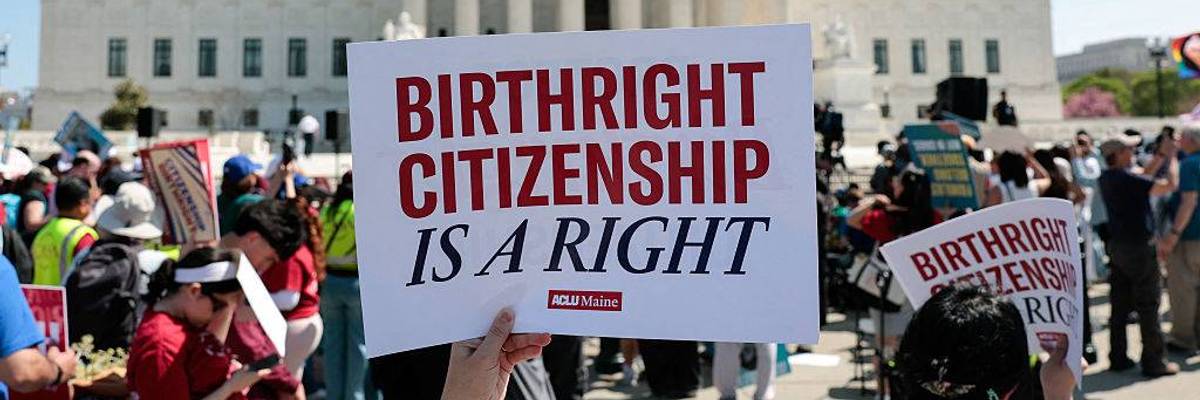
Demonstrators rally in support of birthright citizenship outside the US Supreme Court in Washington, DC on April 1, 2026.
From the courageous radicalism of Thaddeus Stevens to the tragic depths Donald Trump has brought us, our nation has become horribly lost on what it means to be a citizen and why this democratic republican was created in the first.
On May 6, 1866, exactly one hundred and sixty years ago today, Thaddeus Stevens, US Congressman from Pennsylvania and the leading Radical Republican in the House of Representatives, rose to introduce the Fourteenth Amendment of the US Constitution on the floor of the. Stevens, chair of the powerful House Ways and Means Committee, was also co-chair of the Joint Committee on Reconstruction set up by Congress, in late 1865, to promote a radical Reconstruction, a program advanced over the consistent objections of President Andrew Johnson.
Here is how Stevens introduced the Amendment:
Congress tasked the committee with reconstructing the nation and setting new constitutional baselines for post-Civil War America; this is difficult work; above all, we are trying to write the Declaration of Independence’s promise of freedom and equality into the Constitution. But I beg gentlemen to consider the magnitude of the task which was imposed upon the committee. They were expected to suggest a plan for rebuilding a shattered nation—a nation which though not dissevered was yet shaken and riven by the gigantic and persistent efforts of six million able and ardent men; of bitter rebels striving through four years of bloody war. It cannot be denied that this terrible struggle sprang from the vicious principles incorporated into the institutions of our country. Our fathers had been compelled to postpone the principles of their great Declaration, and wait for the full establishment till a more propitious time. That time ought to be present now. But the public mind has been educated in error for a century. How difficult in a day to unlearn it. In rebuilding, it is necessary to clear away the rotten and defective portions of the old foundations, and to sink deep and found the repaired edifice upon the firm foundation of eternal justice. If, perchance, the accumulated quicksands render it impossible to reach in every part so firm a basis, then it becomes our duty to drive deep and solid the substituted piles on which to build. It would not be wise to prevent the raising of the structure because some corner of it might be founded upon materials subject to the inevitable laws of mortal decay. It were better to shelter the household and trust to the advancing progress of a higher morality and a purer and more intelligent principle to underpin the defective corner.
The Amendment passed in the House on June 13, by a vote of 138 in favor and 36 opposed, having passed in the Senate five days earlier, on June 8, by a vote of 33 in favor and 11 opposed. In other words, roughly a quarter of US Representatives and Senators, serving in houses of Congress that did not include representatives from the seceded Confederate states, voted against the amendment.
It is tempting to imagine that the establishment of egalitarian citizenship in the aftermath of a bloody Civil War fought in its name proceeded as a matter of course. But it did not. It was bitterly contested, by everyone aligned with the Confederacy, but also by many Northern Democrats, who rallied behind Andrew Johnson’s efforts to quickly reincorporate the eleven defeated Southern states without substantially empowering emancipated formerly enslaved people or enforcing any form of retributive justice. And it is been bitterly contested ever since.
Stevens and his Radical Republican allies in Congress understood the strength of the opposition to their vision of a multi-racial and non-racist democracy, and they fought a decade-long battle on its behalf, centered on both enforceable legal and civic equality and land reform designed to empower formerly-enslaved agricultural laborers. They succeeded in many ways, passing numerous bills designed to support the civil rights and economic opportunities of emancipated Blacks, and securing passage of the 13th, 14th, and 15th Amendments to the Constitution. Yet the gains were short-lived, betrayed by the infamous Compromise of 1877 that placed Republican Rutherford Hayes in the White House and ending the final remnants of the Union’s military occupation of the South, leading in short order to the reinstitution of Black subordination via the new Jim Crow system of racial segregation and extortionate share-cropping. (While there have been many fine histories of this period, to my mind the best is Eric Foner’s award-winning Reconstruction: America’s Unfinished Revolution, 1863-1877.)
The Fourteenth Amendment was the cornerstone of the effort to truly reconstruct the postwar nation on the foundations of non-racial citizenship. In the words of historian T.J. Stiles, it was “The Constitutional Amendment That Reinvented Freedom”: “It established birthright citizenship, required ‘due process’ and ‘equal protection’ of the law for everyone, and put the federal government in the business of policing liberty. It removed race and ethnicity from the legal definition of American identity.”
Stevens was one of the principal legislative proponents of the Amendment. And, as President Johnson consistently sought to obstruct such efforts, he was one of the ring leaders of the 1868 effort to impeach Johnson. Indeed, he succeeded in this effort—Johnson was famously impeached by the House on February 24, 1868, by a vote of 126-47-- though Johnson was eventually acquitted in the Senate by the narrow margin of 35-19, one short of the 2/3 majority necessary to convict.
As Bruce Levine notes in his terrific 2021 political biography, Thaddeus Stevens: Civil War Revolutionary, Fighter for Racial Justice, Stevens was reviled and calumnied by opponents of Reconstruction, both in his lifetime and long into the 20th century. William A. Dunning, the dean of “Lost Cause” historians, described Stevens in 1907 as “truculent, vindictive, and cynical.” Writing in 1931, James Truslow Adams called Stevens “the most despicable, malevolent and morally deformed character who has ever risen to power in America.” James G, Randall, writing in his influential 1937 The Civil War and Reconstruction, similarly described him as “filled with ‘vindictive ugliness, unfairness, intolerance, and hatefulness,’” a view carried over into the 1969 edition of the book, co-edited with David Donald, the textbook assigned in the Civil War class I took at Queens College in 1976. The most enduring image of Stevens was produced not in a book but in a film, D.W. Griffith’s 1915 “Birth of a Nation,” one of whose chief protagonists, Austin Stoneman—an ugly, club-footed, lecherous hypocrite—was clearly modeled on Stevens.
Woodrow Wilson was only slightly less harsh, writing on “The Reconstruction of the Southern States” in The Atlantic in 1901: “He had no timidity, no scruples about keeping to constitutional lines of policy, no regard or thought for the sensibilities of the minority, — being rough-hewn and without embarrassing sensibilities himself, — an ideal radical for the service of the moment.”
It is true that Stevens seemed to have little timidity, and appears to have been something of a pit bull in his refusal to let the cause of Reconstruction go. It is also true that he had “no scruples about keeping to constitutional lines of policy,” but only in this sense: he sought, with his colleagues, to revolutionize the “constitutional lines of policy” that had already been decimated by a Civil War, and to use the Constitution’s own Article V process to amend the Constitution. Stevens was a constitutional revolutionary—the point of Levine’s brilliant book--and thus “an ideal radical for the service of the moment.”
Like everything about the Constitution, the Fourteenth Amendment was hardly self-enforcing. This was understood by its drafters, which is why they included the language of Section 5: “Congress shall have power to enforce, by appropriate legislation, the provisions of this article” (both the Thirteen and the Fifteenth Amendments contain similar language). Every aspect of the Amendment remained hotly contested for a century after its passage. But in the 1960’s, after decades of intense struggle by a civil rights movement that faced daily attacks on life and limb, Congress finally passed two pieces of legislation designed to enforce the 14th and the 15th Amendments—the Civil Rights Act of 1964 and the Voting Rights Act of 1965. Like the above-mentioned amendments, these landmark pieces of legislation faced strong opposition, and did not pass without legislative battle. The first passed in the House by a vote of 290-130 and in the Senate by a vote of 73-27; the second passed the House by a vote of 328-74 and the Senate by a vote of 79-18. And as is well known, the passage of these laws helped to generate a powerful backlash against any form of racial liberalism.
That said, both the basic intent behind the acts, and the federal bureaucracies established to enforce them, became more or less settled features of US law for the past half-century—until now.
To be fair, the Voting Rights Act has been besieged ever since the Supreme Court’s 2013 Shelby v. Holder decision. The Court’s 6-3 decision this week in Louisiana v. Callais further eviscerated the Act.
At the same time, we are currently witnessing a wholesale assault on the 14th Amendment, and the entire legal system established to enforce it, by the Trump administration. The examples are loud and clear: the outright attack on birthright citizenship, which is currently before the Court; the obvious suspension of due process by the DHS-ICE regime of arrest, detention, and deportation that in the past year has swept up well over 500,000 Americans; and the use of the Justice Department—first established in 1870 to oversee the rule of law in the formerly-Confederate states—to threaten and punish “political enemies.”
Perhaps nothing better symbolizes this Trumpist rejection of the 14th Amendment than the second Trump presidency itself. We should not forget that very powerful arguments were advanced, by numerous reputable conservative legal scholars, including J. Michael Luttig, to justify keeping Trump off several state ballots in 2024, on the grounds that his incitement of the January 6, 2021 insurrection violated the 14th Amendment’s Section 3. In spite of these arguments, the Supreme Court ruled against such moves in March 2024, holding that only Congress could attempt such a maneuver. Trump, his candidacy bolstered, went on to win the 2024 election, and then proceeded, on day one of his second term, to pardon or commute the sentences of every one of the over 1200 people who had been convicted of crimes on for their role in the January 6 insurrection.
Under Trump 20.0, even the barest lip service to the notion of equal justice under the law has been abandoned with contempt.
It is a sad irony of history that this is all happening as the nation prepares to celebrate the 250th anniversary of the Declaration of Independence, and that Trump goes about the task of destroying constitutional democracy even as he makes extravagant plans to celebrate “America 250.”
And it is simply sad, and outrageous, that 160 years after Thaddeus Stevens announced the intention “to write the Declaration of Independence’s promise of freedom and equality into the Constitution,” Donald Trump is doing his best to trample on the Declaration, the Constitution, and the very idea of liberal democracy.
Dear Common Dreams reader, It’s been nearly 30 years since I co-founded Common Dreams with my late wife, Lina Newhouser. We had the radical notion that journalism should serve the public good, not corporate profits. It was clear to us from the outset what it would take to build such a project. No paid advertisements. No corporate sponsors. No millionaire publisher telling us what to think or do. Many people said we wouldn't last a year, but we proved those doubters wrong. Together with a tremendous team of journalists and dedicated staff, we built an independent media outlet free from the constraints of profits and corporate control. Our mission has always been simple: To inform. To inspire. To ignite change for the common good. Building Common Dreams was not easy. Our survival was never guaranteed. When you take on the most powerful forces—Wall Street greed, fossil fuel industry destruction, Big Tech lobbyists, and uber-rich oligarchs who have spent billions upon billions rigging the economy and democracy in their favor—the only bulwark you have is supporters who believe in your work. But here’s the urgent message from me today. It's never been this bad out there. And it's never been this hard to keep us going. At the very moment Common Dreams is most needed, the threats we face are intensifying. We need your support now more than ever. We don't accept corporate advertising and never will. We don't have a paywall because we don't think people should be blocked from critical news based on their ability to pay. Everything we do is funded by the donations of readers like you. When everyone does the little they can afford, we are strong. But if that support retreats or dries up, so do we. Will you donate now to make sure Common Dreams not only survives but thrives? —Craig Brown, Co-founder |
On May 6, 1866, exactly one hundred and sixty years ago today, Thaddeus Stevens, US Congressman from Pennsylvania and the leading Radical Republican in the House of Representatives, rose to introduce the Fourteenth Amendment of the US Constitution on the floor of the. Stevens, chair of the powerful House Ways and Means Committee, was also co-chair of the Joint Committee on Reconstruction set up by Congress, in late 1865, to promote a radical Reconstruction, a program advanced over the consistent objections of President Andrew Johnson.
Here is how Stevens introduced the Amendment:
Congress tasked the committee with reconstructing the nation and setting new constitutional baselines for post-Civil War America; this is difficult work; above all, we are trying to write the Declaration of Independence’s promise of freedom and equality into the Constitution. But I beg gentlemen to consider the magnitude of the task which was imposed upon the committee. They were expected to suggest a plan for rebuilding a shattered nation—a nation which though not dissevered was yet shaken and riven by the gigantic and persistent efforts of six million able and ardent men; of bitter rebels striving through four years of bloody war. It cannot be denied that this terrible struggle sprang from the vicious principles incorporated into the institutions of our country. Our fathers had been compelled to postpone the principles of their great Declaration, and wait for the full establishment till a more propitious time. That time ought to be present now. But the public mind has been educated in error for a century. How difficult in a day to unlearn it. In rebuilding, it is necessary to clear away the rotten and defective portions of the old foundations, and to sink deep and found the repaired edifice upon the firm foundation of eternal justice. If, perchance, the accumulated quicksands render it impossible to reach in every part so firm a basis, then it becomes our duty to drive deep and solid the substituted piles on which to build. It would not be wise to prevent the raising of the structure because some corner of it might be founded upon materials subject to the inevitable laws of mortal decay. It were better to shelter the household and trust to the advancing progress of a higher morality and a purer and more intelligent principle to underpin the defective corner.
The Amendment passed in the House on June 13, by a vote of 138 in favor and 36 opposed, having passed in the Senate five days earlier, on June 8, by a vote of 33 in favor and 11 opposed. In other words, roughly a quarter of US Representatives and Senators, serving in houses of Congress that did not include representatives from the seceded Confederate states, voted against the amendment.
It is tempting to imagine that the establishment of egalitarian citizenship in the aftermath of a bloody Civil War fought in its name proceeded as a matter of course. But it did not. It was bitterly contested, by everyone aligned with the Confederacy, but also by many Northern Democrats, who rallied behind Andrew Johnson’s efforts to quickly reincorporate the eleven defeated Southern states without substantially empowering emancipated formerly enslaved people or enforcing any form of retributive justice. And it is been bitterly contested ever since.
Stevens and his Radical Republican allies in Congress understood the strength of the opposition to their vision of a multi-racial and non-racist democracy, and they fought a decade-long battle on its behalf, centered on both enforceable legal and civic equality and land reform designed to empower formerly-enslaved agricultural laborers. They succeeded in many ways, passing numerous bills designed to support the civil rights and economic opportunities of emancipated Blacks, and securing passage of the 13th, 14th, and 15th Amendments to the Constitution. Yet the gains were short-lived, betrayed by the infamous Compromise of 1877 that placed Republican Rutherford Hayes in the White House and ending the final remnants of the Union’s military occupation of the South, leading in short order to the reinstitution of Black subordination via the new Jim Crow system of racial segregation and extortionate share-cropping. (While there have been many fine histories of this period, to my mind the best is Eric Foner’s award-winning Reconstruction: America’s Unfinished Revolution, 1863-1877.)
The Fourteenth Amendment was the cornerstone of the effort to truly reconstruct the postwar nation on the foundations of non-racial citizenship. In the words of historian T.J. Stiles, it was “The Constitutional Amendment That Reinvented Freedom”: “It established birthright citizenship, required ‘due process’ and ‘equal protection’ of the law for everyone, and put the federal government in the business of policing liberty. It removed race and ethnicity from the legal definition of American identity.”
Stevens was one of the principal legislative proponents of the Amendment. And, as President Johnson consistently sought to obstruct such efforts, he was one of the ring leaders of the 1868 effort to impeach Johnson. Indeed, he succeeded in this effort—Johnson was famously impeached by the House on February 24, 1868, by a vote of 126-47-- though Johnson was eventually acquitted in the Senate by the narrow margin of 35-19, one short of the 2/3 majority necessary to convict.
As Bruce Levine notes in his terrific 2021 political biography, Thaddeus Stevens: Civil War Revolutionary, Fighter for Racial Justice, Stevens was reviled and calumnied by opponents of Reconstruction, both in his lifetime and long into the 20th century. William A. Dunning, the dean of “Lost Cause” historians, described Stevens in 1907 as “truculent, vindictive, and cynical.” Writing in 1931, James Truslow Adams called Stevens “the most despicable, malevolent and morally deformed character who has ever risen to power in America.” James G, Randall, writing in his influential 1937 The Civil War and Reconstruction, similarly described him as “filled with ‘vindictive ugliness, unfairness, intolerance, and hatefulness,’” a view carried over into the 1969 edition of the book, co-edited with David Donald, the textbook assigned in the Civil War class I took at Queens College in 1976. The most enduring image of Stevens was produced not in a book but in a film, D.W. Griffith’s 1915 “Birth of a Nation,” one of whose chief protagonists, Austin Stoneman—an ugly, club-footed, lecherous hypocrite—was clearly modeled on Stevens.
Woodrow Wilson was only slightly less harsh, writing on “The Reconstruction of the Southern States” in The Atlantic in 1901: “He had no timidity, no scruples about keeping to constitutional lines of policy, no regard or thought for the sensibilities of the minority, — being rough-hewn and without embarrassing sensibilities himself, — an ideal radical for the service of the moment.”
It is true that Stevens seemed to have little timidity, and appears to have been something of a pit bull in his refusal to let the cause of Reconstruction go. It is also true that he had “no scruples about keeping to constitutional lines of policy,” but only in this sense: he sought, with his colleagues, to revolutionize the “constitutional lines of policy” that had already been decimated by a Civil War, and to use the Constitution’s own Article V process to amend the Constitution. Stevens was a constitutional revolutionary—the point of Levine’s brilliant book--and thus “an ideal radical for the service of the moment.”
Like everything about the Constitution, the Fourteenth Amendment was hardly self-enforcing. This was understood by its drafters, which is why they included the language of Section 5: “Congress shall have power to enforce, by appropriate legislation, the provisions of this article” (both the Thirteen and the Fifteenth Amendments contain similar language). Every aspect of the Amendment remained hotly contested for a century after its passage. But in the 1960’s, after decades of intense struggle by a civil rights movement that faced daily attacks on life and limb, Congress finally passed two pieces of legislation designed to enforce the 14th and the 15th Amendments—the Civil Rights Act of 1964 and the Voting Rights Act of 1965. Like the above-mentioned amendments, these landmark pieces of legislation faced strong opposition, and did not pass without legislative battle. The first passed in the House by a vote of 290-130 and in the Senate by a vote of 73-27; the second passed the House by a vote of 328-74 and the Senate by a vote of 79-18. And as is well known, the passage of these laws helped to generate a powerful backlash against any form of racial liberalism.
That said, both the basic intent behind the acts, and the federal bureaucracies established to enforce them, became more or less settled features of US law for the past half-century—until now.
To be fair, the Voting Rights Act has been besieged ever since the Supreme Court’s 2013 Shelby v. Holder decision. The Court’s 6-3 decision this week in Louisiana v. Callais further eviscerated the Act.
At the same time, we are currently witnessing a wholesale assault on the 14th Amendment, and the entire legal system established to enforce it, by the Trump administration. The examples are loud and clear: the outright attack on birthright citizenship, which is currently before the Court; the obvious suspension of due process by the DHS-ICE regime of arrest, detention, and deportation that in the past year has swept up well over 500,000 Americans; and the use of the Justice Department—first established in 1870 to oversee the rule of law in the formerly-Confederate states—to threaten and punish “political enemies.”
Perhaps nothing better symbolizes this Trumpist rejection of the 14th Amendment than the second Trump presidency itself. We should not forget that very powerful arguments were advanced, by numerous reputable conservative legal scholars, including J. Michael Luttig, to justify keeping Trump off several state ballots in 2024, on the grounds that his incitement of the January 6, 2021 insurrection violated the 14th Amendment’s Section 3. In spite of these arguments, the Supreme Court ruled against such moves in March 2024, holding that only Congress could attempt such a maneuver. Trump, his candidacy bolstered, went on to win the 2024 election, and then proceeded, on day one of his second term, to pardon or commute the sentences of every one of the over 1200 people who had been convicted of crimes on for their role in the January 6 insurrection.
Under Trump 20.0, even the barest lip service to the notion of equal justice under the law has been abandoned with contempt.
It is a sad irony of history that this is all happening as the nation prepares to celebrate the 250th anniversary of the Declaration of Independence, and that Trump goes about the task of destroying constitutional democracy even as he makes extravagant plans to celebrate “America 250.”
And it is simply sad, and outrageous, that 160 years after Thaddeus Stevens announced the intention “to write the Declaration of Independence’s promise of freedom and equality into the Constitution,” Donald Trump is doing his best to trample on the Declaration, the Constitution, and the very idea of liberal democracy.
On May 6, 1866, exactly one hundred and sixty years ago today, Thaddeus Stevens, US Congressman from Pennsylvania and the leading Radical Republican in the House of Representatives, rose to introduce the Fourteenth Amendment of the US Constitution on the floor of the. Stevens, chair of the powerful House Ways and Means Committee, was also co-chair of the Joint Committee on Reconstruction set up by Congress, in late 1865, to promote a radical Reconstruction, a program advanced over the consistent objections of President Andrew Johnson.
Here is how Stevens introduced the Amendment:
Congress tasked the committee with reconstructing the nation and setting new constitutional baselines for post-Civil War America; this is difficult work; above all, we are trying to write the Declaration of Independence’s promise of freedom and equality into the Constitution. But I beg gentlemen to consider the magnitude of the task which was imposed upon the committee. They were expected to suggest a plan for rebuilding a shattered nation—a nation which though not dissevered was yet shaken and riven by the gigantic and persistent efforts of six million able and ardent men; of bitter rebels striving through four years of bloody war. It cannot be denied that this terrible struggle sprang from the vicious principles incorporated into the institutions of our country. Our fathers had been compelled to postpone the principles of their great Declaration, and wait for the full establishment till a more propitious time. That time ought to be present now. But the public mind has been educated in error for a century. How difficult in a day to unlearn it. In rebuilding, it is necessary to clear away the rotten and defective portions of the old foundations, and to sink deep and found the repaired edifice upon the firm foundation of eternal justice. If, perchance, the accumulated quicksands render it impossible to reach in every part so firm a basis, then it becomes our duty to drive deep and solid the substituted piles on which to build. It would not be wise to prevent the raising of the structure because some corner of it might be founded upon materials subject to the inevitable laws of mortal decay. It were better to shelter the household and trust to the advancing progress of a higher morality and a purer and more intelligent principle to underpin the defective corner.
The Amendment passed in the House on June 13, by a vote of 138 in favor and 36 opposed, having passed in the Senate five days earlier, on June 8, by a vote of 33 in favor and 11 opposed. In other words, roughly a quarter of US Representatives and Senators, serving in houses of Congress that did not include representatives from the seceded Confederate states, voted against the amendment.
It is tempting to imagine that the establishment of egalitarian citizenship in the aftermath of a bloody Civil War fought in its name proceeded as a matter of course. But it did not. It was bitterly contested, by everyone aligned with the Confederacy, but also by many Northern Democrats, who rallied behind Andrew Johnson’s efforts to quickly reincorporate the eleven defeated Southern states without substantially empowering emancipated formerly enslaved people or enforcing any form of retributive justice. And it is been bitterly contested ever since.
Stevens and his Radical Republican allies in Congress understood the strength of the opposition to their vision of a multi-racial and non-racist democracy, and they fought a decade-long battle on its behalf, centered on both enforceable legal and civic equality and land reform designed to empower formerly-enslaved agricultural laborers. They succeeded in many ways, passing numerous bills designed to support the civil rights and economic opportunities of emancipated Blacks, and securing passage of the 13th, 14th, and 15th Amendments to the Constitution. Yet the gains were short-lived, betrayed by the infamous Compromise of 1877 that placed Republican Rutherford Hayes in the White House and ending the final remnants of the Union’s military occupation of the South, leading in short order to the reinstitution of Black subordination via the new Jim Crow system of racial segregation and extortionate share-cropping. (While there have been many fine histories of this period, to my mind the best is Eric Foner’s award-winning Reconstruction: America’s Unfinished Revolution, 1863-1877.)
The Fourteenth Amendment was the cornerstone of the effort to truly reconstruct the postwar nation on the foundations of non-racial citizenship. In the words of historian T.J. Stiles, it was “The Constitutional Amendment That Reinvented Freedom”: “It established birthright citizenship, required ‘due process’ and ‘equal protection’ of the law for everyone, and put the federal government in the business of policing liberty. It removed race and ethnicity from the legal definition of American identity.”
Stevens was one of the principal legislative proponents of the Amendment. And, as President Johnson consistently sought to obstruct such efforts, he was one of the ring leaders of the 1868 effort to impeach Johnson. Indeed, he succeeded in this effort—Johnson was famously impeached by the House on February 24, 1868, by a vote of 126-47-- though Johnson was eventually acquitted in the Senate by the narrow margin of 35-19, one short of the 2/3 majority necessary to convict.
As Bruce Levine notes in his terrific 2021 political biography, Thaddeus Stevens: Civil War Revolutionary, Fighter for Racial Justice, Stevens was reviled and calumnied by opponents of Reconstruction, both in his lifetime and long into the 20th century. William A. Dunning, the dean of “Lost Cause” historians, described Stevens in 1907 as “truculent, vindictive, and cynical.” Writing in 1931, James Truslow Adams called Stevens “the most despicable, malevolent and morally deformed character who has ever risen to power in America.” James G, Randall, writing in his influential 1937 The Civil War and Reconstruction, similarly described him as “filled with ‘vindictive ugliness, unfairness, intolerance, and hatefulness,’” a view carried over into the 1969 edition of the book, co-edited with David Donald, the textbook assigned in the Civil War class I took at Queens College in 1976. The most enduring image of Stevens was produced not in a book but in a film, D.W. Griffith’s 1915 “Birth of a Nation,” one of whose chief protagonists, Austin Stoneman—an ugly, club-footed, lecherous hypocrite—was clearly modeled on Stevens.
Woodrow Wilson was only slightly less harsh, writing on “The Reconstruction of the Southern States” in The Atlantic in 1901: “He had no timidity, no scruples about keeping to constitutional lines of policy, no regard or thought for the sensibilities of the minority, — being rough-hewn and without embarrassing sensibilities himself, — an ideal radical for the service of the moment.”
It is true that Stevens seemed to have little timidity, and appears to have been something of a pit bull in his refusal to let the cause of Reconstruction go. It is also true that he had “no scruples about keeping to constitutional lines of policy,” but only in this sense: he sought, with his colleagues, to revolutionize the “constitutional lines of policy” that had already been decimated by a Civil War, and to use the Constitution’s own Article V process to amend the Constitution. Stevens was a constitutional revolutionary—the point of Levine’s brilliant book--and thus “an ideal radical for the service of the moment.”
Like everything about the Constitution, the Fourteenth Amendment was hardly self-enforcing. This was understood by its drafters, which is why they included the language of Section 5: “Congress shall have power to enforce, by appropriate legislation, the provisions of this article” (both the Thirteen and the Fifteenth Amendments contain similar language). Every aspect of the Amendment remained hotly contested for a century after its passage. But in the 1960’s, after decades of intense struggle by a civil rights movement that faced daily attacks on life and limb, Congress finally passed two pieces of legislation designed to enforce the 14th and the 15th Amendments—the Civil Rights Act of 1964 and the Voting Rights Act of 1965. Like the above-mentioned amendments, these landmark pieces of legislation faced strong opposition, and did not pass without legislative battle. The first passed in the House by a vote of 290-130 and in the Senate by a vote of 73-27; the second passed the House by a vote of 328-74 and the Senate by a vote of 79-18. And as is well known, the passage of these laws helped to generate a powerful backlash against any form of racial liberalism.
That said, both the basic intent behind the acts, and the federal bureaucracies established to enforce them, became more or less settled features of US law for the past half-century—until now.
To be fair, the Voting Rights Act has been besieged ever since the Supreme Court’s 2013 Shelby v. Holder decision. The Court’s 6-3 decision this week in Louisiana v. Callais further eviscerated the Act.
At the same time, we are currently witnessing a wholesale assault on the 14th Amendment, and the entire legal system established to enforce it, by the Trump administration. The examples are loud and clear: the outright attack on birthright citizenship, which is currently before the Court; the obvious suspension of due process by the DHS-ICE regime of arrest, detention, and deportation that in the past year has swept up well over 500,000 Americans; and the use of the Justice Department—first established in 1870 to oversee the rule of law in the formerly-Confederate states—to threaten and punish “political enemies.”
Perhaps nothing better symbolizes this Trumpist rejection of the 14th Amendment than the second Trump presidency itself. We should not forget that very powerful arguments were advanced, by numerous reputable conservative legal scholars, including J. Michael Luttig, to justify keeping Trump off several state ballots in 2024, on the grounds that his incitement of the January 6, 2021 insurrection violated the 14th Amendment’s Section 3. In spite of these arguments, the Supreme Court ruled against such moves in March 2024, holding that only Congress could attempt such a maneuver. Trump, his candidacy bolstered, went on to win the 2024 election, and then proceeded, on day one of his second term, to pardon or commute the sentences of every one of the over 1200 people who had been convicted of crimes on for their role in the January 6 insurrection.
Under Trump 20.0, even the barest lip service to the notion of equal justice under the law has been abandoned with contempt.
It is a sad irony of history that this is all happening as the nation prepares to celebrate the 250th anniversary of the Declaration of Independence, and that Trump goes about the task of destroying constitutional democracy even as he makes extravagant plans to celebrate “America 250.”
And it is simply sad, and outrageous, that 160 years after Thaddeus Stevens announced the intention “to write the Declaration of Independence’s promise of freedom and equality into the Constitution,” Donald Trump is doing his best to trample on the Declaration, the Constitution, and the very idea of liberal democracy.