SUBSCRIBE TO OUR FREE NEWSLETTER
Daily news & progressive opinion—funded by the people, not the corporations—delivered straight to your inbox.
5
#000000
#FFFFFF
To donate by check, phone, or other method, see our More Ways to Give page.
Daily news & progressive opinion—funded by the people, not the corporations—delivered straight to your inbox.
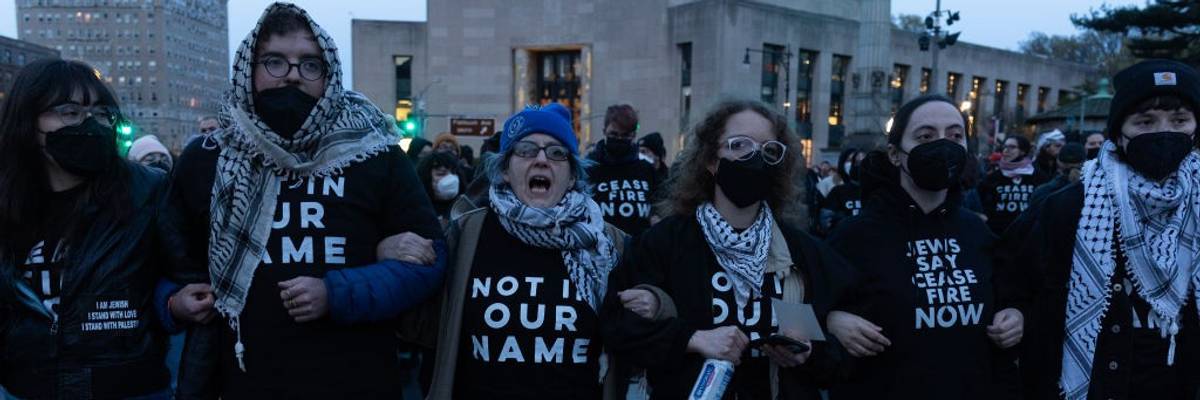
Jews and supporters hold a Passover Seder to protest the war in Gaza on April 23, 2024 in the Brooklyn borough of New York City.
In a historical moment where Jewish identity is facing political and moral division, the inquisitive nature of the Four Children can inspire a new generation of Jewish families to question what we have been told about Palestinians in Gaza.
During the Passover seder, Jewish families recall our cultural yearning for freedom and liberation through storytelling and asking questions. This week, families across the Jewish world will gather to retell an ancient story, connecting with ancestors who passed on to us a generations-old struggle for justice and peace.
But what makes this night different from all other nights? This Passover, Jewish communities will continue to witness a rupture over Israel’s actions in Gaza, while Israel’s attacks on Iran and Lebanon will surely generate new questions. But, unlike the Four Children, or the child reciting, “Mah Nishtana,” many Jewish children will have their questions left unanswered.
By exploring what the Four Children might ask in this moment, and offering answers aligned to our Jewish values, we honor rather than shy away from the Jewish tradition of asking questions.
The wise one, what does he say? “What are the testimonies, the statutes, and the laws which the LORD, our God, has commanded you?” And you shall tell him the laws of Pesach.
If we truly want to honor our traditions and values, we must not shy away from difficult questions.
The wise child asks, “What are the testimonies of Palestinians in Gaza? What are the international laws that nations follow? What are the Jewish ethics which our ancestors have passed to us?”
When the wise child asks for testimony, you must share the countless firsthand accounts of Palestinians in Gaza who have endured deteriorating conditions and cruelty at the hands of the Israeli military.
When the child asks for statutes, you must guide them to United Nations reports, International Court of Justice cases, and International Criminal Court investigations that provide evidence of war crimes and genocide.
When the wise child asks for laws, you must show how our Jewish texts instruct us to value all life, command us against standing “idly by the blood of another,” and teach us to honor each soul as a universe.
The wicked one, what does he say? “What is this service to you?” He says, “to you,” but not to him. By thus excluding himself from the community he has denied that which is fundamental.
The wicked child asks, “Why do they deserve this?” “They,” the child says, and not Palestinians, not families, not human beings. When the child excludes others from humanity, they exclude themself. You must call them in and say, “we must stand with Palestinians facing genocide in Gaza.” “We,” and not, “I,” for our safety is intertwined.
The simple one, what does he say? “What is this?”
The simple child asks, “What is this?” What is the truth about Gaza?” He hears opposing narratives in the news, on his phone, and in his Jewish community. He hears Zionists describe the people who live in Gaza as terrorists, animals, and other dehumanizing labels justifying collective punishment. He sees another reality, a mosaic of humanity–children, doctors, journalists, and families– experiencing profound grief and suffering.
The simple child is confused, and we must direct him to seek truth and act in alignment with his Jewish values: Never again means never again for anyone.
As for the one who does not know how to ask, you must open [the story] for him [...]
And for the child who doesn’t know how to ask, you must open a path for them to question the narratives that Zionists tell of Palestinians in Gaza, just as Jewish culture teaches us to question, challenge, and debate our traditions and worldviews.
Passover is a testament to the power of retelling stories that resonate across generations. The Four Children, a key part of the Passover haggadah, have always acted as archetypes of Jewish engagement. In a historical moment where Jewish identity is facing political and moral division, the inquisitive nature of the Four Children can inspire a new generation of Jewish families to question what we have been told about Palestinians in Gaza.
If we truly want to honor our traditions and values, we must not shy away from difficult questions. Nor should our answers ignore the parts of our tradition that teach us to prioritize life, to love the stranger, and to challenge our worldviews. Our children deserve nothing less.
Dear Common Dreams reader, It’s been nearly 30 years since I co-founded Common Dreams with my late wife, Lina Newhouser. We had the radical notion that journalism should serve the public good, not corporate profits. It was clear to us from the outset what it would take to build such a project. No paid advertisements. No corporate sponsors. No millionaire publisher telling us what to think or do. Many people said we wouldn't last a year, but we proved those doubters wrong. Together with a tremendous team of journalists and dedicated staff, we built an independent media outlet free from the constraints of profits and corporate control. Our mission has always been simple: To inform. To inspire. To ignite change for the common good. Building Common Dreams was not easy. Our survival was never guaranteed. When you take on the most powerful forces—Wall Street greed, fossil fuel industry destruction, Big Tech lobbyists, and uber-rich oligarchs who have spent billions upon billions rigging the economy and democracy in their favor—the only bulwark you have is supporters who believe in your work. But here’s the urgent message from me today. It's never been this bad out there. And it's never been this hard to keep us going. At the very moment Common Dreams is most needed, the threats we face are intensifying. We need your support now more than ever. We don't accept corporate advertising and never will. We don't have a paywall because we don't think people should be blocked from critical news based on their ability to pay. Everything we do is funded by the donations of readers like you. When everyone does the little they can afford, we are strong. But if that support retreats or dries up, so do we. Will you donate now to make sure Common Dreams not only survives but thrives? —Craig Brown, Co-founder |
During the Passover seder, Jewish families recall our cultural yearning for freedom and liberation through storytelling and asking questions. This week, families across the Jewish world will gather to retell an ancient story, connecting with ancestors who passed on to us a generations-old struggle for justice and peace.
But what makes this night different from all other nights? This Passover, Jewish communities will continue to witness a rupture over Israel’s actions in Gaza, while Israel’s attacks on Iran and Lebanon will surely generate new questions. But, unlike the Four Children, or the child reciting, “Mah Nishtana,” many Jewish children will have their questions left unanswered.
By exploring what the Four Children might ask in this moment, and offering answers aligned to our Jewish values, we honor rather than shy away from the Jewish tradition of asking questions.
The wise one, what does he say? “What are the testimonies, the statutes, and the laws which the LORD, our God, has commanded you?” And you shall tell him the laws of Pesach.
If we truly want to honor our traditions and values, we must not shy away from difficult questions.
The wise child asks, “What are the testimonies of Palestinians in Gaza? What are the international laws that nations follow? What are the Jewish ethics which our ancestors have passed to us?”
When the wise child asks for testimony, you must share the countless firsthand accounts of Palestinians in Gaza who have endured deteriorating conditions and cruelty at the hands of the Israeli military.
When the child asks for statutes, you must guide them to United Nations reports, International Court of Justice cases, and International Criminal Court investigations that provide evidence of war crimes and genocide.
When the wise child asks for laws, you must show how our Jewish texts instruct us to value all life, command us against standing “idly by the blood of another,” and teach us to honor each soul as a universe.
The wicked one, what does he say? “What is this service to you?” He says, “to you,” but not to him. By thus excluding himself from the community he has denied that which is fundamental.
The wicked child asks, “Why do they deserve this?” “They,” the child says, and not Palestinians, not families, not human beings. When the child excludes others from humanity, they exclude themself. You must call them in and say, “we must stand with Palestinians facing genocide in Gaza.” “We,” and not, “I,” for our safety is intertwined.
The simple one, what does he say? “What is this?”
The simple child asks, “What is this?” What is the truth about Gaza?” He hears opposing narratives in the news, on his phone, and in his Jewish community. He hears Zionists describe the people who live in Gaza as terrorists, animals, and other dehumanizing labels justifying collective punishment. He sees another reality, a mosaic of humanity–children, doctors, journalists, and families– experiencing profound grief and suffering.
The simple child is confused, and we must direct him to seek truth and act in alignment with his Jewish values: Never again means never again for anyone.
As for the one who does not know how to ask, you must open [the story] for him [...]
And for the child who doesn’t know how to ask, you must open a path for them to question the narratives that Zionists tell of Palestinians in Gaza, just as Jewish culture teaches us to question, challenge, and debate our traditions and worldviews.
Passover is a testament to the power of retelling stories that resonate across generations. The Four Children, a key part of the Passover haggadah, have always acted as archetypes of Jewish engagement. In a historical moment where Jewish identity is facing political and moral division, the inquisitive nature of the Four Children can inspire a new generation of Jewish families to question what we have been told about Palestinians in Gaza.
If we truly want to honor our traditions and values, we must not shy away from difficult questions. Nor should our answers ignore the parts of our tradition that teach us to prioritize life, to love the stranger, and to challenge our worldviews. Our children deserve nothing less.
During the Passover seder, Jewish families recall our cultural yearning for freedom and liberation through storytelling and asking questions. This week, families across the Jewish world will gather to retell an ancient story, connecting with ancestors who passed on to us a generations-old struggle for justice and peace.
But what makes this night different from all other nights? This Passover, Jewish communities will continue to witness a rupture over Israel’s actions in Gaza, while Israel’s attacks on Iran and Lebanon will surely generate new questions. But, unlike the Four Children, or the child reciting, “Mah Nishtana,” many Jewish children will have their questions left unanswered.
By exploring what the Four Children might ask in this moment, and offering answers aligned to our Jewish values, we honor rather than shy away from the Jewish tradition of asking questions.
The wise one, what does he say? “What are the testimonies, the statutes, and the laws which the LORD, our God, has commanded you?” And you shall tell him the laws of Pesach.
If we truly want to honor our traditions and values, we must not shy away from difficult questions.
The wise child asks, “What are the testimonies of Palestinians in Gaza? What are the international laws that nations follow? What are the Jewish ethics which our ancestors have passed to us?”
When the wise child asks for testimony, you must share the countless firsthand accounts of Palestinians in Gaza who have endured deteriorating conditions and cruelty at the hands of the Israeli military.
When the child asks for statutes, you must guide them to United Nations reports, International Court of Justice cases, and International Criminal Court investigations that provide evidence of war crimes and genocide.
When the wise child asks for laws, you must show how our Jewish texts instruct us to value all life, command us against standing “idly by the blood of another,” and teach us to honor each soul as a universe.
The wicked one, what does he say? “What is this service to you?” He says, “to you,” but not to him. By thus excluding himself from the community he has denied that which is fundamental.
The wicked child asks, “Why do they deserve this?” “They,” the child says, and not Palestinians, not families, not human beings. When the child excludes others from humanity, they exclude themself. You must call them in and say, “we must stand with Palestinians facing genocide in Gaza.” “We,” and not, “I,” for our safety is intertwined.
The simple one, what does he say? “What is this?”
The simple child asks, “What is this?” What is the truth about Gaza?” He hears opposing narratives in the news, on his phone, and in his Jewish community. He hears Zionists describe the people who live in Gaza as terrorists, animals, and other dehumanizing labels justifying collective punishment. He sees another reality, a mosaic of humanity–children, doctors, journalists, and families– experiencing profound grief and suffering.
The simple child is confused, and we must direct him to seek truth and act in alignment with his Jewish values: Never again means never again for anyone.
As for the one who does not know how to ask, you must open [the story] for him [...]
And for the child who doesn’t know how to ask, you must open a path for them to question the narratives that Zionists tell of Palestinians in Gaza, just as Jewish culture teaches us to question, challenge, and debate our traditions and worldviews.
Passover is a testament to the power of retelling stories that resonate across generations. The Four Children, a key part of the Passover haggadah, have always acted as archetypes of Jewish engagement. In a historical moment where Jewish identity is facing political and moral division, the inquisitive nature of the Four Children can inspire a new generation of Jewish families to question what we have been told about Palestinians in Gaza.
If we truly want to honor our traditions and values, we must not shy away from difficult questions. Nor should our answers ignore the parts of our tradition that teach us to prioritize life, to love the stranger, and to challenge our worldviews. Our children deserve nothing less.