SUBSCRIBE TO OUR FREE NEWSLETTER
Daily news & progressive opinion—funded by the people, not the corporations—delivered straight to your inbox.
5
#000000
#FFFFFF
To donate by check, phone, or other method, see our More Ways to Give page.
Daily news & progressive opinion—funded by the people, not the corporations—delivered straight to your inbox.
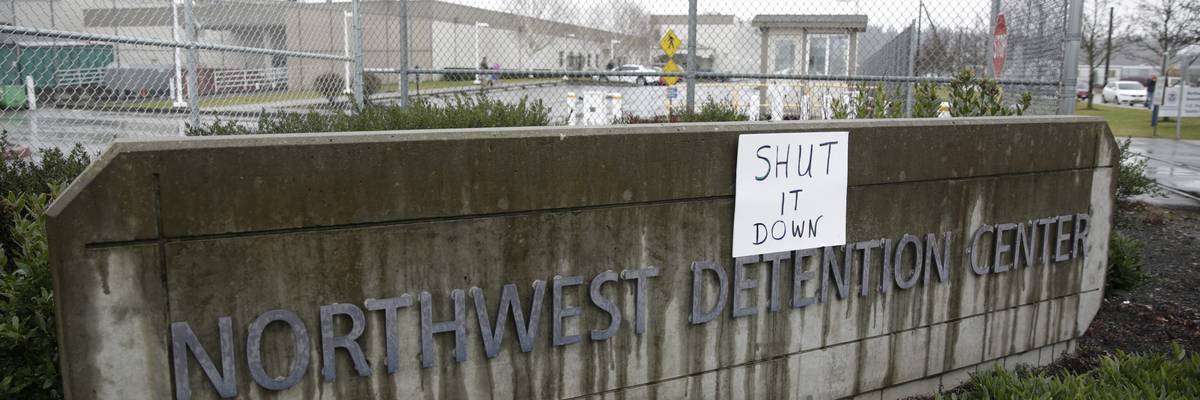
A sign that reads "shut it down" is pictured at the Northwest Detention Center as people attend the Peoples Tribunal Against the Detention Center event in Tacoma, Washington on February 26, 2017.
The best way to resist enforcement activities, we learned under the first Trump administration, is for citizens and noncitizens to claim one another as fellow community members, and then work together.
Throughout his 2024 campaign, Donald Trump promised mass deportations of the more than 11 million unauthorized immigrants in the United States. Those of us on the ground who work with immigrants are apprehensive about what that will look like and how we can respond.
During the first Trump administration, I was part of local organizations working on issues of migrant detention and deportation defense in Washington state and writing my dissertation on interior immigration enforcement. I was also active with migrant justice efforts during the Obama presidency.
Some of what happened during these periods involved large-scale raids that made national news. Such operations are expensive to plan and orchestrate, are highly disruptive to the communities where they occur, and provoke opposition. This can happen again. However, much more immigration enforcement took place quietly, through the intensive targeting of specific locations such as workplaces, highway stretches, bus stations, and apartment complexes where Immigration and Customs Enforcement (ICE) agents believed there may be undocumented people.
Most sanctuary ordinances remain in place, but locals need to organize to make sure these ordinances have popular support and are upheld.
At any point, ICE could round up those immigrants under remote surveillance, through GPS devices and mobile phone apps, who now number 181,000 people. ICE agents also capture people as they are being transferred from police custody, jail, or prison. Traffic stops, domestic disputes, and altercations with neighbors lead to deportation. This kind of enforcement is the most efficient for ICE; it has made up more than 90% of ICE arrests under President Joe Biden and will likely happen even more aggressively under Trump.
The Trump campaign drummed up support through scapegoating “migrant crime.” This is a pretext for mass deportations. There is no evidence of a crime wave related to immigration, but tying together the criminal justice system and immigration system becomes a way to ensnare people in the deportation dragnet.
The best way to resist these kinds of enforcement activities, we learned under the first Trump administration, is for citizens and noncitizens to claim one another as fellow community members, and then work together. Much of this work happens at the local level.
For example, Pacific County Immigrant Support was formed in 2018 in a rural county in Washington state that has voted for Trump for the past three election cycles. Citizen and noncitizen community members tracked ICE arrests and organized community protection.
Group members accompanied immigrants to ICE appointments and court dates, raised funds for immigration attorneys and bonds, and provided know-your-rights training to immigrants and employers of immigrants. They also sat down with the local sheriff to ensure that he wasn’t collaborating with ICE.
What is needed now is a blossoming of local-level efforts to defend immigrants. In Washington state this includes the Washington Immigration Solidarity Network hotline for reporting deportation events and connecting people who are facing enforcement with resources. The Fair Fight Bond Fund provides bonds to immigrants in detention while going through their proceedings in Washington, as does the National Detention Bond Fund at the national level.
Washington’s Shut Down the NWDC (Northwest Detention Center) campaign in Tacoma, and other campaigns nationwide coordinated through the Detention Watch Network, have exposed deadly and inhumane conditions in migrant detention centers, gathered support for people to survive detention, and strategized to shut down the detention infrastructure.
There is evidence that shutting down detention centers is an effective strategy for restraining immigration enforcement. There is also evidence that ICE enforcement was not able to function as smoothly in jurisdictions regulated by sanctuary ordinances. Most sanctuary ordinances remain in place, but locals need to organize to make sure these ordinances have popular support and are upheld.
The first Trump administration was vengeful towards those who thwarted its restrictionist agenda. Trump revoked some federal funding to sanctuary cities. As I have documented in my scholarship, ICE agents also targeted activists, community organizers, journalists, and artists who spoke out against them.
The Biden administration refused to place restraints on ICE’s capacity to repress activist immigrants. Also during the Biden administration, the revanchist mantle was passed to state governments, like Texas, which bused asylum seekers to sanctuary cities, prosecuted immigrants for trespassing, and punished border humanitarian organizations. We can expect more of this kind of thing.
That is why it is crucial that we build solidarity within our local communities and get ready to defend against the coming attacks.
Dear Common Dreams reader, It’s been nearly 30 years since I co-founded Common Dreams with my late wife, Lina Newhouser. We had the radical notion that journalism should serve the public good, not corporate profits. It was clear to us from the outset what it would take to build such a project. No paid advertisements. No corporate sponsors. No millionaire publisher telling us what to think or do. Many people said we wouldn't last a year, but we proved those doubters wrong. Together with a tremendous team of journalists and dedicated staff, we built an independent media outlet free from the constraints of profits and corporate control. Our mission has always been simple: To inform. To inspire. To ignite change for the common good. Building Common Dreams was not easy. Our survival was never guaranteed. When you take on the most powerful forces—Wall Street greed, fossil fuel industry destruction, Big Tech lobbyists, and uber-rich oligarchs who have spent billions upon billions rigging the economy and democracy in their favor—the only bulwark you have is supporters who believe in your work. But here’s the urgent message from me today. It's never been this bad out there. And it's never been this hard to keep us going. At the very moment Common Dreams is most needed, the threats we face are intensifying. We need your support now more than ever. We don't accept corporate advertising and never will. We don't have a paywall because we don't think people should be blocked from critical news based on their ability to pay. Everything we do is funded by the donations of readers like you. When everyone does the little they can afford, we are strong. But if that support retreats or dries up, so do we. Will you donate now to make sure Common Dreams not only survives but thrives? —Craig Brown, Co-founder |
Throughout his 2024 campaign, Donald Trump promised mass deportations of the more than 11 million unauthorized immigrants in the United States. Those of us on the ground who work with immigrants are apprehensive about what that will look like and how we can respond.
During the first Trump administration, I was part of local organizations working on issues of migrant detention and deportation defense in Washington state and writing my dissertation on interior immigration enforcement. I was also active with migrant justice efforts during the Obama presidency.
Some of what happened during these periods involved large-scale raids that made national news. Such operations are expensive to plan and orchestrate, are highly disruptive to the communities where they occur, and provoke opposition. This can happen again. However, much more immigration enforcement took place quietly, through the intensive targeting of specific locations such as workplaces, highway stretches, bus stations, and apartment complexes where Immigration and Customs Enforcement (ICE) agents believed there may be undocumented people.
Most sanctuary ordinances remain in place, but locals need to organize to make sure these ordinances have popular support and are upheld.
At any point, ICE could round up those immigrants under remote surveillance, through GPS devices and mobile phone apps, who now number 181,000 people. ICE agents also capture people as they are being transferred from police custody, jail, or prison. Traffic stops, domestic disputes, and altercations with neighbors lead to deportation. This kind of enforcement is the most efficient for ICE; it has made up more than 90% of ICE arrests under President Joe Biden and will likely happen even more aggressively under Trump.
The Trump campaign drummed up support through scapegoating “migrant crime.” This is a pretext for mass deportations. There is no evidence of a crime wave related to immigration, but tying together the criminal justice system and immigration system becomes a way to ensnare people in the deportation dragnet.
The best way to resist these kinds of enforcement activities, we learned under the first Trump administration, is for citizens and noncitizens to claim one another as fellow community members, and then work together. Much of this work happens at the local level.
For example, Pacific County Immigrant Support was formed in 2018 in a rural county in Washington state that has voted for Trump for the past three election cycles. Citizen and noncitizen community members tracked ICE arrests and organized community protection.
Group members accompanied immigrants to ICE appointments and court dates, raised funds for immigration attorneys and bonds, and provided know-your-rights training to immigrants and employers of immigrants. They also sat down with the local sheriff to ensure that he wasn’t collaborating with ICE.
What is needed now is a blossoming of local-level efforts to defend immigrants. In Washington state this includes the Washington Immigration Solidarity Network hotline for reporting deportation events and connecting people who are facing enforcement with resources. The Fair Fight Bond Fund provides bonds to immigrants in detention while going through their proceedings in Washington, as does the National Detention Bond Fund at the national level.
Washington’s Shut Down the NWDC (Northwest Detention Center) campaign in Tacoma, and other campaigns nationwide coordinated through the Detention Watch Network, have exposed deadly and inhumane conditions in migrant detention centers, gathered support for people to survive detention, and strategized to shut down the detention infrastructure.
There is evidence that shutting down detention centers is an effective strategy for restraining immigration enforcement. There is also evidence that ICE enforcement was not able to function as smoothly in jurisdictions regulated by sanctuary ordinances. Most sanctuary ordinances remain in place, but locals need to organize to make sure these ordinances have popular support and are upheld.
The first Trump administration was vengeful towards those who thwarted its restrictionist agenda. Trump revoked some federal funding to sanctuary cities. As I have documented in my scholarship, ICE agents also targeted activists, community organizers, journalists, and artists who spoke out against them.
The Biden administration refused to place restraints on ICE’s capacity to repress activist immigrants. Also during the Biden administration, the revanchist mantle was passed to state governments, like Texas, which bused asylum seekers to sanctuary cities, prosecuted immigrants for trespassing, and punished border humanitarian organizations. We can expect more of this kind of thing.
That is why it is crucial that we build solidarity within our local communities and get ready to defend against the coming attacks.
Throughout his 2024 campaign, Donald Trump promised mass deportations of the more than 11 million unauthorized immigrants in the United States. Those of us on the ground who work with immigrants are apprehensive about what that will look like and how we can respond.
During the first Trump administration, I was part of local organizations working on issues of migrant detention and deportation defense in Washington state and writing my dissertation on interior immigration enforcement. I was also active with migrant justice efforts during the Obama presidency.
Some of what happened during these periods involved large-scale raids that made national news. Such operations are expensive to plan and orchestrate, are highly disruptive to the communities where they occur, and provoke opposition. This can happen again. However, much more immigration enforcement took place quietly, through the intensive targeting of specific locations such as workplaces, highway stretches, bus stations, and apartment complexes where Immigration and Customs Enforcement (ICE) agents believed there may be undocumented people.
Most sanctuary ordinances remain in place, but locals need to organize to make sure these ordinances have popular support and are upheld.
At any point, ICE could round up those immigrants under remote surveillance, through GPS devices and mobile phone apps, who now number 181,000 people. ICE agents also capture people as they are being transferred from police custody, jail, or prison. Traffic stops, domestic disputes, and altercations with neighbors lead to deportation. This kind of enforcement is the most efficient for ICE; it has made up more than 90% of ICE arrests under President Joe Biden and will likely happen even more aggressively under Trump.
The Trump campaign drummed up support through scapegoating “migrant crime.” This is a pretext for mass deportations. There is no evidence of a crime wave related to immigration, but tying together the criminal justice system and immigration system becomes a way to ensnare people in the deportation dragnet.
The best way to resist these kinds of enforcement activities, we learned under the first Trump administration, is for citizens and noncitizens to claim one another as fellow community members, and then work together. Much of this work happens at the local level.
For example, Pacific County Immigrant Support was formed in 2018 in a rural county in Washington state that has voted for Trump for the past three election cycles. Citizen and noncitizen community members tracked ICE arrests and organized community protection.
Group members accompanied immigrants to ICE appointments and court dates, raised funds for immigration attorneys and bonds, and provided know-your-rights training to immigrants and employers of immigrants. They also sat down with the local sheriff to ensure that he wasn’t collaborating with ICE.
What is needed now is a blossoming of local-level efforts to defend immigrants. In Washington state this includes the Washington Immigration Solidarity Network hotline for reporting deportation events and connecting people who are facing enforcement with resources. The Fair Fight Bond Fund provides bonds to immigrants in detention while going through their proceedings in Washington, as does the National Detention Bond Fund at the national level.
Washington’s Shut Down the NWDC (Northwest Detention Center) campaign in Tacoma, and other campaigns nationwide coordinated through the Detention Watch Network, have exposed deadly and inhumane conditions in migrant detention centers, gathered support for people to survive detention, and strategized to shut down the detention infrastructure.
There is evidence that shutting down detention centers is an effective strategy for restraining immigration enforcement. There is also evidence that ICE enforcement was not able to function as smoothly in jurisdictions regulated by sanctuary ordinances. Most sanctuary ordinances remain in place, but locals need to organize to make sure these ordinances have popular support and are upheld.
The first Trump administration was vengeful towards those who thwarted its restrictionist agenda. Trump revoked some federal funding to sanctuary cities. As I have documented in my scholarship, ICE agents also targeted activists, community organizers, journalists, and artists who spoke out against them.
The Biden administration refused to place restraints on ICE’s capacity to repress activist immigrants. Also during the Biden administration, the revanchist mantle was passed to state governments, like Texas, which bused asylum seekers to sanctuary cities, prosecuted immigrants for trespassing, and punished border humanitarian organizations. We can expect more of this kind of thing.
That is why it is crucial that we build solidarity within our local communities and get ready to defend against the coming attacks.