SUBSCRIBE TO OUR FREE NEWSLETTER
Daily news & progressive opinion—funded by the people, not the corporations—delivered straight to your inbox.
5
#000000
#FFFFFF
To donate by check, phone, or other method, see our More Ways to Give page.
Daily news & progressive opinion—funded by the people, not the corporations—delivered straight to your inbox.
If a government can pressure a global sports institution into legitimizing its leader under the banner of peace, then global civil society must be capable of compelling that same institution to correct its course.
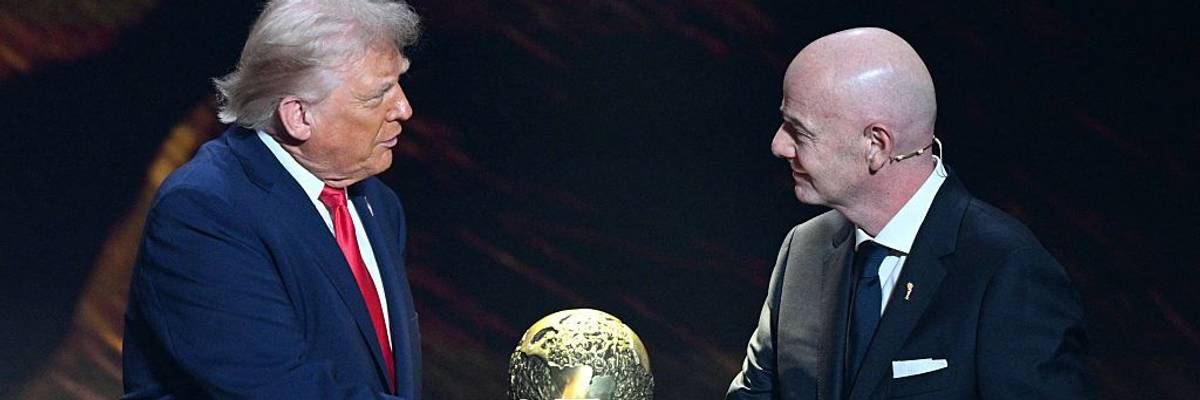
In December, US President Donald Trump was awarded FIFA’s newly created “FIFA Peace Prize–Football Unites the World” by FIFA President Gianni Infantino. The decision immediately sparked disbelief and criticism worldwide, raising a fundamental question: What does FIFA mean by peace?
If football is truly meant to unite the world, then this prize—and the process that produced it—must be seriously reconsidered.
The awarding of the Peace Prize did not emerge from a transparent or democratic process. It reflects a broader pattern in which the Trump administration has exerted political and diplomatic pressure on international institutions to secure legitimacy and public endorsement. In other words, bullying. FIFA, despite its claims of neutrality and independence, appears to have yielded to that pressure.
But power imposed through coercion can be reversed through organized, collective, nonviolent action. If a government can pressure a global sports institution into legitimizing its leader under the banner of peace, then global civil society must be capable of compelling that same institution to correct its course. It is not about punishment or humiliation. It is about legitimacy.
The United States’ current posture toward the rest of the world—marked by sanctions, coercive diplomacy, military threats, and disregard for international norms—stands in open contradiction to the values the Peace Prize claims to represent. One cannot credibly speak the language of peace while practicing domination.
Revoking this prize would send a clear message: Peace is not a public-relations exercise, nor a political trophy extracted through pressure.
When intimidation succeeds without challenge, it becomes precedent. When it is challenged collectively and nonviolently, it becomes brittle.
Revoking this prize would send a clear message: Peace is not a public-relations exercise, nor a political trophy extracted through pressure.
This controversy unfolds as the 2026 FIFA World Cup approaches. Scheduled from June 11 to July 19, it will be the first-ever 48-team tournament, with 104 matches across 16 cities, 11 of them in the United States, the others in Canada and Mexico.
International fans, activists, and political figures are questioning whether the current US political climate—particularly immigration enforcement practices, travel restrictions, and border policies—makes the country a safe and welcoming host for a global celebration meant to unite humanity.
Calls to boycott the 2026 World Cup are spreading across social media, as supporters report canceled travel plans; withdrawn ticket purchases; and growing fears of arbitrary detention, visa denials, and hostile treatment at borders. Human rights organizations have repeatedly warned about detention practices and the erosion of civil liberties—concerns that take on heightened urgency when millions are expected to cross borders for a global event.
If there is one nonviolent action in 2026 with the potential to shift global consciousness, it is an international campaign demanding accountability from FIFA itself.
Such a campaign could call for:
FIFA is not a neutral body floating above politics. It is a global institution with 211 member associations, whose decisions reflect values, alliances, and power relations. What FIFA chooses to reward—and whom it chooses to honor—sends a message to billions.
One of the most powerful nonviolent levers lies beyond stadiums and borders: broadcasting. The World Cup exists not only as a sporting event, but as a global media product. Television networks and streaming platforms pay billions in licensing fees that finance FIFA’s operations. Without those fees—and without audiences—the tournament loses its economic foundation.
A coordinated nonviolent campaign could therefore call on broadcasters to:
This action would not target players, fans, or workers. It would target the financial and symbolic infrastructure that allows FIFA to operate without accountability. This is not censorship—it is ethical refusal.
For such a campaign to succeed, it must be global, visible, and coordinated. That is why social media is not secondary—it is essential. Social media platforms are today’s nonviolent infrastructure. They allow millions of people to act together across borders, languages, and cultures without centralized control. When used strategically, they transform isolated actions into universal pressure.
A global campaign could:
This is how nonviolent movements grow: through visibility, participation, and persistence—until silence becomes impossible.
In order to succeed, however, this must be more than a media moment. It must become a grassroots nonviolent movement.
Football clubs, supporters’ associations, players, national federations, and fans everywhere should be called upon to stand—not against the sport, but for human dignity. This is about withdrawing consent from illegitimacy and restoring meaning to the game. Football has always been more than a game. It reflects who we are—and who we choose to become.
After all, people are not football fans first. They are human beings first.
The question now is simple: Will FIFA continue to serve power—or will it revoke the Peace Prize and reclaim the game for humanity?
This article was first published in English on Pressenza and is now available in: Spanish.
Dear Common Dreams reader, It’s been nearly 30 years since I co-founded Common Dreams with my late wife, Lina Newhouser. We had the radical notion that journalism should serve the public good, not corporate profits. It was clear to us from the outset what it would take to build such a project. No paid advertisements. No corporate sponsors. No millionaire publisher telling us what to think or do. Many people said we wouldn't last a year, but we proved those doubters wrong. Together with a tremendous team of journalists and dedicated staff, we built an independent media outlet free from the constraints of profits and corporate control. Our mission has always been simple: To inform. To inspire. To ignite change for the common good. Building Common Dreams was not easy. Our survival was never guaranteed. When you take on the most powerful forces—Wall Street greed, fossil fuel industry destruction, Big Tech lobbyists, and uber-rich oligarchs who have spent billions upon billions rigging the economy and democracy in their favor—the only bulwark you have is supporters who believe in your work. But here’s the urgent message from me today. It's never been this bad out there. And it's never been this hard to keep us going. At the very moment Common Dreams is most needed, the threats we face are intensifying. We need your support now more than ever. We don't accept corporate advertising and never will. We don't have a paywall because we don't think people should be blocked from critical news based on their ability to pay. Everything we do is funded by the donations of readers like you. When everyone does the little they can afford, we are strong. But if that support retreats or dries up, so do we. Will you donate now to make sure Common Dreams not only survives but thrives? —Craig Brown, Co-founder |
In December, US President Donald Trump was awarded FIFA’s newly created “FIFA Peace Prize–Football Unites the World” by FIFA President Gianni Infantino. The decision immediately sparked disbelief and criticism worldwide, raising a fundamental question: What does FIFA mean by peace?
If football is truly meant to unite the world, then this prize—and the process that produced it—must be seriously reconsidered.
The awarding of the Peace Prize did not emerge from a transparent or democratic process. It reflects a broader pattern in which the Trump administration has exerted political and diplomatic pressure on international institutions to secure legitimacy and public endorsement. In other words, bullying. FIFA, despite its claims of neutrality and independence, appears to have yielded to that pressure.
But power imposed through coercion can be reversed through organized, collective, nonviolent action. If a government can pressure a global sports institution into legitimizing its leader under the banner of peace, then global civil society must be capable of compelling that same institution to correct its course. It is not about punishment or humiliation. It is about legitimacy.
The United States’ current posture toward the rest of the world—marked by sanctions, coercive diplomacy, military threats, and disregard for international norms—stands in open contradiction to the values the Peace Prize claims to represent. One cannot credibly speak the language of peace while practicing domination.
Revoking this prize would send a clear message: Peace is not a public-relations exercise, nor a political trophy extracted through pressure.
When intimidation succeeds without challenge, it becomes precedent. When it is challenged collectively and nonviolently, it becomes brittle.
Revoking this prize would send a clear message: Peace is not a public-relations exercise, nor a political trophy extracted through pressure.
This controversy unfolds as the 2026 FIFA World Cup approaches. Scheduled from June 11 to July 19, it will be the first-ever 48-team tournament, with 104 matches across 16 cities, 11 of them in the United States, the others in Canada and Mexico.
International fans, activists, and political figures are questioning whether the current US political climate—particularly immigration enforcement practices, travel restrictions, and border policies—makes the country a safe and welcoming host for a global celebration meant to unite humanity.
Calls to boycott the 2026 World Cup are spreading across social media, as supporters report canceled travel plans; withdrawn ticket purchases; and growing fears of arbitrary detention, visa denials, and hostile treatment at borders. Human rights organizations have repeatedly warned about detention practices and the erosion of civil liberties—concerns that take on heightened urgency when millions are expected to cross borders for a global event.
If there is one nonviolent action in 2026 with the potential to shift global consciousness, it is an international campaign demanding accountability from FIFA itself.
Such a campaign could call for:
FIFA is not a neutral body floating above politics. It is a global institution with 211 member associations, whose decisions reflect values, alliances, and power relations. What FIFA chooses to reward—and whom it chooses to honor—sends a message to billions.
One of the most powerful nonviolent levers lies beyond stadiums and borders: broadcasting. The World Cup exists not only as a sporting event, but as a global media product. Television networks and streaming platforms pay billions in licensing fees that finance FIFA’s operations. Without those fees—and without audiences—the tournament loses its economic foundation.
A coordinated nonviolent campaign could therefore call on broadcasters to:
This action would not target players, fans, or workers. It would target the financial and symbolic infrastructure that allows FIFA to operate without accountability. This is not censorship—it is ethical refusal.
For such a campaign to succeed, it must be global, visible, and coordinated. That is why social media is not secondary—it is essential. Social media platforms are today’s nonviolent infrastructure. They allow millions of people to act together across borders, languages, and cultures without centralized control. When used strategically, they transform isolated actions into universal pressure.
A global campaign could:
This is how nonviolent movements grow: through visibility, participation, and persistence—until silence becomes impossible.
In order to succeed, however, this must be more than a media moment. It must become a grassroots nonviolent movement.
Football clubs, supporters’ associations, players, national federations, and fans everywhere should be called upon to stand—not against the sport, but for human dignity. This is about withdrawing consent from illegitimacy and restoring meaning to the game. Football has always been more than a game. It reflects who we are—and who we choose to become.
After all, people are not football fans first. They are human beings first.
The question now is simple: Will FIFA continue to serve power—or will it revoke the Peace Prize and reclaim the game for humanity?
This article was first published in English on Pressenza and is now available in: Spanish.
In December, US President Donald Trump was awarded FIFA’s newly created “FIFA Peace Prize–Football Unites the World” by FIFA President Gianni Infantino. The decision immediately sparked disbelief and criticism worldwide, raising a fundamental question: What does FIFA mean by peace?
If football is truly meant to unite the world, then this prize—and the process that produced it—must be seriously reconsidered.
The awarding of the Peace Prize did not emerge from a transparent or democratic process. It reflects a broader pattern in which the Trump administration has exerted political and diplomatic pressure on international institutions to secure legitimacy and public endorsement. In other words, bullying. FIFA, despite its claims of neutrality and independence, appears to have yielded to that pressure.
But power imposed through coercion can be reversed through organized, collective, nonviolent action. If a government can pressure a global sports institution into legitimizing its leader under the banner of peace, then global civil society must be capable of compelling that same institution to correct its course. It is not about punishment or humiliation. It is about legitimacy.
The United States’ current posture toward the rest of the world—marked by sanctions, coercive diplomacy, military threats, and disregard for international norms—stands in open contradiction to the values the Peace Prize claims to represent. One cannot credibly speak the language of peace while practicing domination.
Revoking this prize would send a clear message: Peace is not a public-relations exercise, nor a political trophy extracted through pressure.
When intimidation succeeds without challenge, it becomes precedent. When it is challenged collectively and nonviolently, it becomes brittle.
Revoking this prize would send a clear message: Peace is not a public-relations exercise, nor a political trophy extracted through pressure.
This controversy unfolds as the 2026 FIFA World Cup approaches. Scheduled from June 11 to July 19, it will be the first-ever 48-team tournament, with 104 matches across 16 cities, 11 of them in the United States, the others in Canada and Mexico.
International fans, activists, and political figures are questioning whether the current US political climate—particularly immigration enforcement practices, travel restrictions, and border policies—makes the country a safe and welcoming host for a global celebration meant to unite humanity.
Calls to boycott the 2026 World Cup are spreading across social media, as supporters report canceled travel plans; withdrawn ticket purchases; and growing fears of arbitrary detention, visa denials, and hostile treatment at borders. Human rights organizations have repeatedly warned about detention practices and the erosion of civil liberties—concerns that take on heightened urgency when millions are expected to cross borders for a global event.
If there is one nonviolent action in 2026 with the potential to shift global consciousness, it is an international campaign demanding accountability from FIFA itself.
Such a campaign could call for:
FIFA is not a neutral body floating above politics. It is a global institution with 211 member associations, whose decisions reflect values, alliances, and power relations. What FIFA chooses to reward—and whom it chooses to honor—sends a message to billions.
One of the most powerful nonviolent levers lies beyond stadiums and borders: broadcasting. The World Cup exists not only as a sporting event, but as a global media product. Television networks and streaming platforms pay billions in licensing fees that finance FIFA’s operations. Without those fees—and without audiences—the tournament loses its economic foundation.
A coordinated nonviolent campaign could therefore call on broadcasters to:
This action would not target players, fans, or workers. It would target the financial and symbolic infrastructure that allows FIFA to operate without accountability. This is not censorship—it is ethical refusal.
For such a campaign to succeed, it must be global, visible, and coordinated. That is why social media is not secondary—it is essential. Social media platforms are today’s nonviolent infrastructure. They allow millions of people to act together across borders, languages, and cultures without centralized control. When used strategically, they transform isolated actions into universal pressure.
A global campaign could:
This is how nonviolent movements grow: through visibility, participation, and persistence—until silence becomes impossible.
In order to succeed, however, this must be more than a media moment. It must become a grassroots nonviolent movement.
Football clubs, supporters’ associations, players, national federations, and fans everywhere should be called upon to stand—not against the sport, but for human dignity. This is about withdrawing consent from illegitimacy and restoring meaning to the game. Football has always been more than a game. It reflects who we are—and who we choose to become.
After all, people are not football fans first. They are human beings first.
The question now is simple: Will FIFA continue to serve power—or will it revoke the Peace Prize and reclaim the game for humanity?
This article was first published in English on Pressenza and is now available in: Spanish.