SUBSCRIBE TO OUR FREE NEWSLETTER
Daily news & progressive opinion—funded by the people, not the corporations—delivered straight to your inbox.
5
#000000
#FFFFFF
To donate by check, phone, or other method, see our More Ways to Give page.
Daily news & progressive opinion—funded by the people, not the corporations—delivered straight to your inbox.
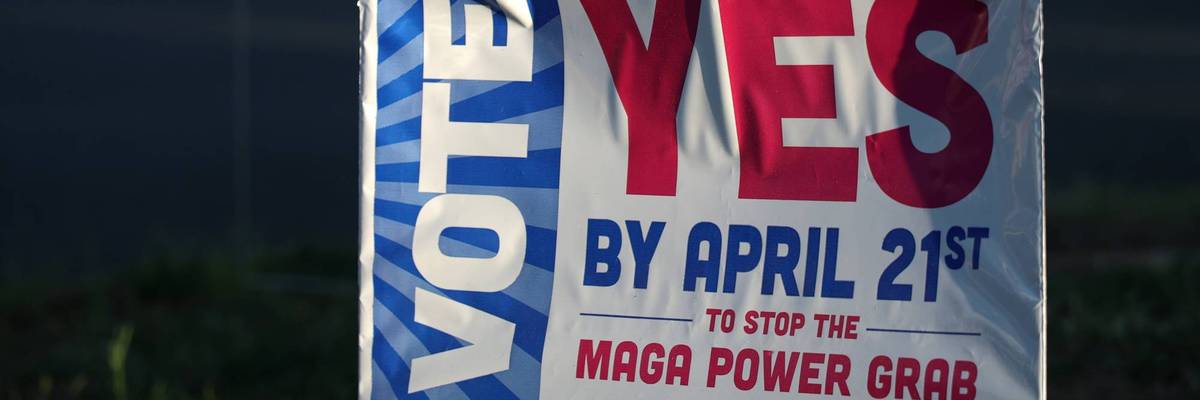
Campaign signs are seen at a polling place on April 17, 2026 in Burke, Virginia.
There is an important lesson to be learned here and that is that there is no advantage for Democrats in not being fully anti-Trump.
By roughly three percentage points, voters in Virginia voted for a redistricting plan that will heavily tilt the congressional playing field toward the Democrats. With some votes still to be counted, yes took 51.5% of the vote to 48.5% for the no campaign. The new map will give the Democrats a good chance at winning 10 out of 11 Virginia congressional districts—a big shift from the current 6 Democrats, 5 Republicans in the delegation. The measure still faces legal challenges before it can go into effect.
Turnout for the referendum was roughly 89% of those who voted in the 2025 gubernatorial election. So, the overall turnout rate for the referendum was around 49%. While this is disappointing in that less than half of eligible voters went to the polls, it is a high turnout rate for a special election.
Unfortunately, there are no exit polls for the Virginia referendum, so the best we can do is look at the voting data and see what conclusions we can draw. Among the very Hispanic-Asian election districts in Northern Virginia (Fairfax, Loudoun, and Manassas Park) the pro-referendum forces did about 16 percentage points better than Kamala Harris in 2024. A strong performance among Black voters in Richmond and Hampton Roads helped put the referendum over the top. According to The Washington Post, counties that were at least 25% Black supported the measure by a 14-point margin, after backing Gov. Abigail Spanberger last November by 24 points.
The pro-referendum forces also fared well in high-income parts of the commonwealth. Opposition to the referendum was concentrated in southwestern Virginia. In many of these counties, the no campaign was able to improve on President Donald Trump’s 2024 performance.
Tuesday’s vote in Virginia will mean more Democratic representatives in Congress.
Are there lessons that the Democrats can take away from the Virginia redistricting campaign? First of all, it is important to note that a win is a win. However, there is an important lesson to be learned here and that is that there is no advantage for Democrats in not being fully anti-Trump.
When the referendum campaign began, the yes forces were portraying the vote as part of a broad effort to level the congressional playing field. The New York Times reports that:
In the first six weeks of the campaign, the “Yes” side spent $13.5 million on advertising compared with the “No” campaign’s $640,000, according to data from AdImpact, a media tracking firm. But over that time period, “Yes” did not gain ground in private polling, according to multiple people briefed on the data.
Based on the media that I saw, in the closing days of the campaign, the yes forces retooled their messaging and presented the campaign as a way to stop Trump and the MAGA forces.
Why did the pro-redistricting forces not immediately embrace a full-on anti-Trump message? We can only make educated guesses. The first is newly elected Spanberger, who had run as a middle-of-the-road Democratic centrist. Her role in the redistricting is ambiguous. Unlike Gov. Gavin Newsom in California, Spanberger did not get out in front of the campaign. This is understandable. After all, Virginia, unlike California, is a purple state. Spanberger also needs to get her legislative agenda through in Richmond.
The best symbol of Spanberger’s attitude toward the referendum is the fact that she made an ad in support of a yes vote but the ad never showed. In her statements about the referendum, the governor was uncomfortable.
Democrats also seemed to have been unprepared for the no forces’ very clever use of statements by President Barack Obama opposing gerrymandering, which created confusion in the electorate. In response, the Democrats responded with ads featuring President Obama. In an interesting twist, Obama not Trump was the president most featured in the media outreach on the referendum.
So, in the end the redistricting referendum passed by less than Spanberger won last November. While the Republicans may be able to claim some sort of a moral victory, a win is still a win. Tuesday’s vote in Virginia will mean more Democratic representatives in Congress.
Democrats have reasons to celebrate. However, they should learn the lesson from the referendum: There is nothing to gain politically by soft-pedaling their opposition to Trump.
Dear Common Dreams reader, It’s been nearly 30 years since I co-founded Common Dreams with my late wife, Lina Newhouser. We had the radical notion that journalism should serve the public good, not corporate profits. It was clear to us from the outset what it would take to build such a project. No paid advertisements. No corporate sponsors. No millionaire publisher telling us what to think or do. Many people said we wouldn't last a year, but we proved those doubters wrong. Together with a tremendous team of journalists and dedicated staff, we built an independent media outlet free from the constraints of profits and corporate control. Our mission has always been simple: To inform. To inspire. To ignite change for the common good. Building Common Dreams was not easy. Our survival was never guaranteed. When you take on the most powerful forces—Wall Street greed, fossil fuel industry destruction, Big Tech lobbyists, and uber-rich oligarchs who have spent billions upon billions rigging the economy and democracy in their favor—the only bulwark you have is supporters who believe in your work. But here’s the urgent message from me today. It's never been this bad out there. And it's never been this hard to keep us going. At the very moment Common Dreams is most needed, the threats we face are intensifying. We need your support now more than ever. We don't accept corporate advertising and never will. We don't have a paywall because we don't think people should be blocked from critical news based on their ability to pay. Everything we do is funded by the donations of readers like you. When everyone does the little they can afford, we are strong. But if that support retreats or dries up, so do we. Will you donate now to make sure Common Dreams not only survives but thrives? —Craig Brown, Co-founder |
By roughly three percentage points, voters in Virginia voted for a redistricting plan that will heavily tilt the congressional playing field toward the Democrats. With some votes still to be counted, yes took 51.5% of the vote to 48.5% for the no campaign. The new map will give the Democrats a good chance at winning 10 out of 11 Virginia congressional districts—a big shift from the current 6 Democrats, 5 Republicans in the delegation. The measure still faces legal challenges before it can go into effect.
Turnout for the referendum was roughly 89% of those who voted in the 2025 gubernatorial election. So, the overall turnout rate for the referendum was around 49%. While this is disappointing in that less than half of eligible voters went to the polls, it is a high turnout rate for a special election.
Unfortunately, there are no exit polls for the Virginia referendum, so the best we can do is look at the voting data and see what conclusions we can draw. Among the very Hispanic-Asian election districts in Northern Virginia (Fairfax, Loudoun, and Manassas Park) the pro-referendum forces did about 16 percentage points better than Kamala Harris in 2024. A strong performance among Black voters in Richmond and Hampton Roads helped put the referendum over the top. According to The Washington Post, counties that were at least 25% Black supported the measure by a 14-point margin, after backing Gov. Abigail Spanberger last November by 24 points.
The pro-referendum forces also fared well in high-income parts of the commonwealth. Opposition to the referendum was concentrated in southwestern Virginia. In many of these counties, the no campaign was able to improve on President Donald Trump’s 2024 performance.
Tuesday’s vote in Virginia will mean more Democratic representatives in Congress.
Are there lessons that the Democrats can take away from the Virginia redistricting campaign? First of all, it is important to note that a win is a win. However, there is an important lesson to be learned here and that is that there is no advantage for Democrats in not being fully anti-Trump.
When the referendum campaign began, the yes forces were portraying the vote as part of a broad effort to level the congressional playing field. The New York Times reports that:
In the first six weeks of the campaign, the “Yes” side spent $13.5 million on advertising compared with the “No” campaign’s $640,000, according to data from AdImpact, a media tracking firm. But over that time period, “Yes” did not gain ground in private polling, according to multiple people briefed on the data.
Based on the media that I saw, in the closing days of the campaign, the yes forces retooled their messaging and presented the campaign as a way to stop Trump and the MAGA forces.
Why did the pro-redistricting forces not immediately embrace a full-on anti-Trump message? We can only make educated guesses. The first is newly elected Spanberger, who had run as a middle-of-the-road Democratic centrist. Her role in the redistricting is ambiguous. Unlike Gov. Gavin Newsom in California, Spanberger did not get out in front of the campaign. This is understandable. After all, Virginia, unlike California, is a purple state. Spanberger also needs to get her legislative agenda through in Richmond.
The best symbol of Spanberger’s attitude toward the referendum is the fact that she made an ad in support of a yes vote but the ad never showed. In her statements about the referendum, the governor was uncomfortable.
Democrats also seemed to have been unprepared for the no forces’ very clever use of statements by President Barack Obama opposing gerrymandering, which created confusion in the electorate. In response, the Democrats responded with ads featuring President Obama. In an interesting twist, Obama not Trump was the president most featured in the media outreach on the referendum.
So, in the end the redistricting referendum passed by less than Spanberger won last November. While the Republicans may be able to claim some sort of a moral victory, a win is still a win. Tuesday’s vote in Virginia will mean more Democratic representatives in Congress.
Democrats have reasons to celebrate. However, they should learn the lesson from the referendum: There is nothing to gain politically by soft-pedaling their opposition to Trump.
By roughly three percentage points, voters in Virginia voted for a redistricting plan that will heavily tilt the congressional playing field toward the Democrats. With some votes still to be counted, yes took 51.5% of the vote to 48.5% for the no campaign. The new map will give the Democrats a good chance at winning 10 out of 11 Virginia congressional districts—a big shift from the current 6 Democrats, 5 Republicans in the delegation. The measure still faces legal challenges before it can go into effect.
Turnout for the referendum was roughly 89% of those who voted in the 2025 gubernatorial election. So, the overall turnout rate for the referendum was around 49%. While this is disappointing in that less than half of eligible voters went to the polls, it is a high turnout rate for a special election.
Unfortunately, there are no exit polls for the Virginia referendum, so the best we can do is look at the voting data and see what conclusions we can draw. Among the very Hispanic-Asian election districts in Northern Virginia (Fairfax, Loudoun, and Manassas Park) the pro-referendum forces did about 16 percentage points better than Kamala Harris in 2024. A strong performance among Black voters in Richmond and Hampton Roads helped put the referendum over the top. According to The Washington Post, counties that were at least 25% Black supported the measure by a 14-point margin, after backing Gov. Abigail Spanberger last November by 24 points.
The pro-referendum forces also fared well in high-income parts of the commonwealth. Opposition to the referendum was concentrated in southwestern Virginia. In many of these counties, the no campaign was able to improve on President Donald Trump’s 2024 performance.
Tuesday’s vote in Virginia will mean more Democratic representatives in Congress.
Are there lessons that the Democrats can take away from the Virginia redistricting campaign? First of all, it is important to note that a win is a win. However, there is an important lesson to be learned here and that is that there is no advantage for Democrats in not being fully anti-Trump.
When the referendum campaign began, the yes forces were portraying the vote as part of a broad effort to level the congressional playing field. The New York Times reports that:
In the first six weeks of the campaign, the “Yes” side spent $13.5 million on advertising compared with the “No” campaign’s $640,000, according to data from AdImpact, a media tracking firm. But over that time period, “Yes” did not gain ground in private polling, according to multiple people briefed on the data.
Based on the media that I saw, in the closing days of the campaign, the yes forces retooled their messaging and presented the campaign as a way to stop Trump and the MAGA forces.
Why did the pro-redistricting forces not immediately embrace a full-on anti-Trump message? We can only make educated guesses. The first is newly elected Spanberger, who had run as a middle-of-the-road Democratic centrist. Her role in the redistricting is ambiguous. Unlike Gov. Gavin Newsom in California, Spanberger did not get out in front of the campaign. This is understandable. After all, Virginia, unlike California, is a purple state. Spanberger also needs to get her legislative agenda through in Richmond.
The best symbol of Spanberger’s attitude toward the referendum is the fact that she made an ad in support of a yes vote but the ad never showed. In her statements about the referendum, the governor was uncomfortable.
Democrats also seemed to have been unprepared for the no forces’ very clever use of statements by President Barack Obama opposing gerrymandering, which created confusion in the electorate. In response, the Democrats responded with ads featuring President Obama. In an interesting twist, Obama not Trump was the president most featured in the media outreach on the referendum.
So, in the end the redistricting referendum passed by less than Spanberger won last November. While the Republicans may be able to claim some sort of a moral victory, a win is still a win. Tuesday’s vote in Virginia will mean more Democratic representatives in Congress.
Democrats have reasons to celebrate. However, they should learn the lesson from the referendum: There is nothing to gain politically by soft-pedaling their opposition to Trump.