SUBSCRIBE TO OUR FREE NEWSLETTER
Daily news & progressive opinion—funded by the people, not the corporations—delivered straight to your inbox.
5
#000000
#FFFFFF
To donate by check, phone, or other method, see our More Ways to Give page.
Daily news & progressive opinion—funded by the people, not the corporations—delivered straight to your inbox.
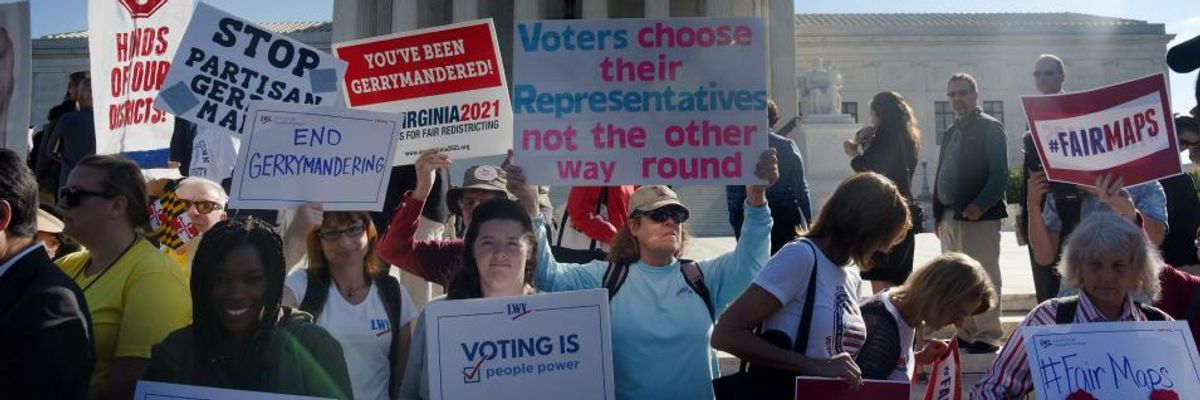
Demonstrators gather outside of the U.S. Supreme Court during an oral arguments in Gill v. Whitford to call for an end to partisan gerrymandering on Oct. 3, 2017 in Washington, D.C. (Photo: Olivier Douliery/Getty Images)
Voting rights advocates celebrated the U.S. Supreme Court's Monday ruling on a racial gerrymandering case that, as Common Cause put it, "means Virginia voters are finally getting #fairmaps!"
"Today's ruling from the Supreme Court is an important victory for African Americans in Virginia who have been forced since 2011 to vote in racially gerrymandered districts that unfairly diluted their power," former U.S. Attorney General Eric Holder, chairman of the National Democratic Redistricting Committee (NDRC), said in a statement Monday.
"With a new, fair map in place, all Virginians will now--finally--have the opportunity this fall to elect a House of Delegates that actually represents the will of the people," added Holder. An NDRC affiliate, the National Redistricting Foundation, supported voters in the case.
In a 5-4 decision (pdf), the justices dismissed a challenge to a 2018 ruling (pdf) by a panel of federal judges from the Eastern District of Virginia which determined that 11 state legislative districts drawn after the 2010 census were racially gerrymandered by Republicans and must be redrawn by a nonpartisan expert for the 2019 election.
Because of the Supreme Court's move on Monday, the new districts--which were used for state primaries last week--will remain in effect, which could benefit Democratic candidates for Virginia legislative seats and ultimately change the power dynamics in both chambers of the state's General Assembly.
One analysis found that the new districts "could shift six seats to the Democrats," voting rights expert Ari Berman noted in a piece for Mother Jones Monday. "Democrats are currently only one seat away from taking control of the state house and senate, which would give them control over the redistricting process in 2021, when new lines are drawn."
"All 140 seats in the legislature are on the ballot this fall," The Washington Post reported. "Democrats have been hoping that a wave of success in recent Virginia elections will propel them to control of the legislature for the first time since 1995."
The challenge to the lower court's ruling was brought by the GOP-controlled Virginia House of Delegates, without backing from the Republican-held state senate or Democratic state Attorney General Mark Herring. That, according to five justices, invalidated the case.
"The House, we hold, lacks authority to displace Virginia's attorney general as representative of the state," Justice Ruth Bader Ginberg wrote in the majority opinion. "We further hold that the House, as a single chamber of a bicameral legislature, has no standing to appeal the invalidation of the redistricting plan separately from the state of which it is a part."
Ginsberg was joined by liberal justices Elena Kagan and Sonia Sotomayor as well as Republican-appointed Neil Gorsuch and Clarence Thomas. Justice Stephen Breyer along with the remaining right-wing justices--Samuel Alito, Brett Kavanaugh, and John Roberts--dissented.
The high court's ruling was welcomed by Virginia House Democrats, who described it as "a major win for voting rights and civil rights in our commonwealth."
Herring concurred, calling it a "big win for democracy in Virginia."
"It's unfortunate that House Republicans wasted millions of taxpayer dollars and months of litigation in a futile effort to protect racially gerrymandered districts," he added. "[B]ut the good news is that this fall's elections will take place in constitutionally drawn districts."
While voting rights advocates and Democrats in Virginia praised the court's ruling Monday, experts cautioned that because of the unusual split of justices and the majority's explanation for its decision, the development does not necessarily foreshadow similar conclusions for upcoming rulings in other gerrymandering cases.
North Carolina attorney Aylett Colston explained in a Twitter thread that because the justices ruled on standing rather than the merits of the case, "it is hard to say" what this decision could mean for others, including one that focuses on her state. However, she said, the Monday ruling suggests the court could decide the North Carolina case "on a very specific fact-based technicality, thus side-stepping a ruling that would unequivocally declare a standard for unconstitutional partisan [gerrymandering] (which is my guess)."
Dear Common Dreams reader, It’s been nearly 30 years since I co-founded Common Dreams with my late wife, Lina Newhouser. We had the radical notion that journalism should serve the public good, not corporate profits. It was clear to us from the outset what it would take to build such a project. No paid advertisements. No corporate sponsors. No millionaire publisher telling us what to think or do. Many people said we wouldn't last a year, but we proved those doubters wrong. Together with a tremendous team of journalists and dedicated staff, we built an independent media outlet free from the constraints of profits and corporate control. Our mission has always been simple: To inform. To inspire. To ignite change for the common good. Building Common Dreams was not easy. Our survival was never guaranteed. When you take on the most powerful forces—Wall Street greed, fossil fuel industry destruction, Big Tech lobbyists, and uber-rich oligarchs who have spent billions upon billions rigging the economy and democracy in their favor—the only bulwark you have is supporters who believe in your work. But here’s the urgent message from me today. It's never been this bad out there. And it's never been this hard to keep us going. At the very moment Common Dreams is most needed, the threats we face are intensifying. We need your support now more than ever. We don't accept corporate advertising and never will. We don't have a paywall because we don't think people should be blocked from critical news based on their ability to pay. Everything we do is funded by the donations of readers like you. When everyone does the little they can afford, we are strong. But if that support retreats or dries up, so do we. Will you donate now to make sure Common Dreams not only survives but thrives? —Craig Brown, Co-founder |
Voting rights advocates celebrated the U.S. Supreme Court's Monday ruling on a racial gerrymandering case that, as Common Cause put it, "means Virginia voters are finally getting #fairmaps!"
"Today's ruling from the Supreme Court is an important victory for African Americans in Virginia who have been forced since 2011 to vote in racially gerrymandered districts that unfairly diluted their power," former U.S. Attorney General Eric Holder, chairman of the National Democratic Redistricting Committee (NDRC), said in a statement Monday.
"With a new, fair map in place, all Virginians will now--finally--have the opportunity this fall to elect a House of Delegates that actually represents the will of the people," added Holder. An NDRC affiliate, the National Redistricting Foundation, supported voters in the case.
In a 5-4 decision (pdf), the justices dismissed a challenge to a 2018 ruling (pdf) by a panel of federal judges from the Eastern District of Virginia which determined that 11 state legislative districts drawn after the 2010 census were racially gerrymandered by Republicans and must be redrawn by a nonpartisan expert for the 2019 election.
Because of the Supreme Court's move on Monday, the new districts--which were used for state primaries last week--will remain in effect, which could benefit Democratic candidates for Virginia legislative seats and ultimately change the power dynamics in both chambers of the state's General Assembly.
One analysis found that the new districts "could shift six seats to the Democrats," voting rights expert Ari Berman noted in a piece for Mother Jones Monday. "Democrats are currently only one seat away from taking control of the state house and senate, which would give them control over the redistricting process in 2021, when new lines are drawn."
"All 140 seats in the legislature are on the ballot this fall," The Washington Post reported. "Democrats have been hoping that a wave of success in recent Virginia elections will propel them to control of the legislature for the first time since 1995."
The challenge to the lower court's ruling was brought by the GOP-controlled Virginia House of Delegates, without backing from the Republican-held state senate or Democratic state Attorney General Mark Herring. That, according to five justices, invalidated the case.
"The House, we hold, lacks authority to displace Virginia's attorney general as representative of the state," Justice Ruth Bader Ginberg wrote in the majority opinion. "We further hold that the House, as a single chamber of a bicameral legislature, has no standing to appeal the invalidation of the redistricting plan separately from the state of which it is a part."
Ginsberg was joined by liberal justices Elena Kagan and Sonia Sotomayor as well as Republican-appointed Neil Gorsuch and Clarence Thomas. Justice Stephen Breyer along with the remaining right-wing justices--Samuel Alito, Brett Kavanaugh, and John Roberts--dissented.
The high court's ruling was welcomed by Virginia House Democrats, who described it as "a major win for voting rights and civil rights in our commonwealth."
Herring concurred, calling it a "big win for democracy in Virginia."
"It's unfortunate that House Republicans wasted millions of taxpayer dollars and months of litigation in a futile effort to protect racially gerrymandered districts," he added. "[B]ut the good news is that this fall's elections will take place in constitutionally drawn districts."
While voting rights advocates and Democrats in Virginia praised the court's ruling Monday, experts cautioned that because of the unusual split of justices and the majority's explanation for its decision, the development does not necessarily foreshadow similar conclusions for upcoming rulings in other gerrymandering cases.
North Carolina attorney Aylett Colston explained in a Twitter thread that because the justices ruled on standing rather than the merits of the case, "it is hard to say" what this decision could mean for others, including one that focuses on her state. However, she said, the Monday ruling suggests the court could decide the North Carolina case "on a very specific fact-based technicality, thus side-stepping a ruling that would unequivocally declare a standard for unconstitutional partisan [gerrymandering] (which is my guess)."
Voting rights advocates celebrated the U.S. Supreme Court's Monday ruling on a racial gerrymandering case that, as Common Cause put it, "means Virginia voters are finally getting #fairmaps!"
"Today's ruling from the Supreme Court is an important victory for African Americans in Virginia who have been forced since 2011 to vote in racially gerrymandered districts that unfairly diluted their power," former U.S. Attorney General Eric Holder, chairman of the National Democratic Redistricting Committee (NDRC), said in a statement Monday.
"With a new, fair map in place, all Virginians will now--finally--have the opportunity this fall to elect a House of Delegates that actually represents the will of the people," added Holder. An NDRC affiliate, the National Redistricting Foundation, supported voters in the case.
In a 5-4 decision (pdf), the justices dismissed a challenge to a 2018 ruling (pdf) by a panel of federal judges from the Eastern District of Virginia which determined that 11 state legislative districts drawn after the 2010 census were racially gerrymandered by Republicans and must be redrawn by a nonpartisan expert for the 2019 election.
Because of the Supreme Court's move on Monday, the new districts--which were used for state primaries last week--will remain in effect, which could benefit Democratic candidates for Virginia legislative seats and ultimately change the power dynamics in both chambers of the state's General Assembly.
One analysis found that the new districts "could shift six seats to the Democrats," voting rights expert Ari Berman noted in a piece for Mother Jones Monday. "Democrats are currently only one seat away from taking control of the state house and senate, which would give them control over the redistricting process in 2021, when new lines are drawn."
"All 140 seats in the legislature are on the ballot this fall," The Washington Post reported. "Democrats have been hoping that a wave of success in recent Virginia elections will propel them to control of the legislature for the first time since 1995."
The challenge to the lower court's ruling was brought by the GOP-controlled Virginia House of Delegates, without backing from the Republican-held state senate or Democratic state Attorney General Mark Herring. That, according to five justices, invalidated the case.
"The House, we hold, lacks authority to displace Virginia's attorney general as representative of the state," Justice Ruth Bader Ginberg wrote in the majority opinion. "We further hold that the House, as a single chamber of a bicameral legislature, has no standing to appeal the invalidation of the redistricting plan separately from the state of which it is a part."
Ginsberg was joined by liberal justices Elena Kagan and Sonia Sotomayor as well as Republican-appointed Neil Gorsuch and Clarence Thomas. Justice Stephen Breyer along with the remaining right-wing justices--Samuel Alito, Brett Kavanaugh, and John Roberts--dissented.
The high court's ruling was welcomed by Virginia House Democrats, who described it as "a major win for voting rights and civil rights in our commonwealth."
Herring concurred, calling it a "big win for democracy in Virginia."
"It's unfortunate that House Republicans wasted millions of taxpayer dollars and months of litigation in a futile effort to protect racially gerrymandered districts," he added. "[B]ut the good news is that this fall's elections will take place in constitutionally drawn districts."
While voting rights advocates and Democrats in Virginia praised the court's ruling Monday, experts cautioned that because of the unusual split of justices and the majority's explanation for its decision, the development does not necessarily foreshadow similar conclusions for upcoming rulings in other gerrymandering cases.
North Carolina attorney Aylett Colston explained in a Twitter thread that because the justices ruled on standing rather than the merits of the case, "it is hard to say" what this decision could mean for others, including one that focuses on her state. However, she said, the Monday ruling suggests the court could decide the North Carolina case "on a very specific fact-based technicality, thus side-stepping a ruling that would unequivocally declare a standard for unconstitutional partisan [gerrymandering] (which is my guess)."