SUBSCRIBE TO OUR FREE NEWSLETTER
Daily news & progressive opinion—funded by the people, not the corporations—delivered straight to your inbox.
5
#000000
#FFFFFF
To donate by check, phone, or other method, see our More Ways to Give page.
Daily news & progressive opinion—funded by the people, not the corporations—delivered straight to your inbox.
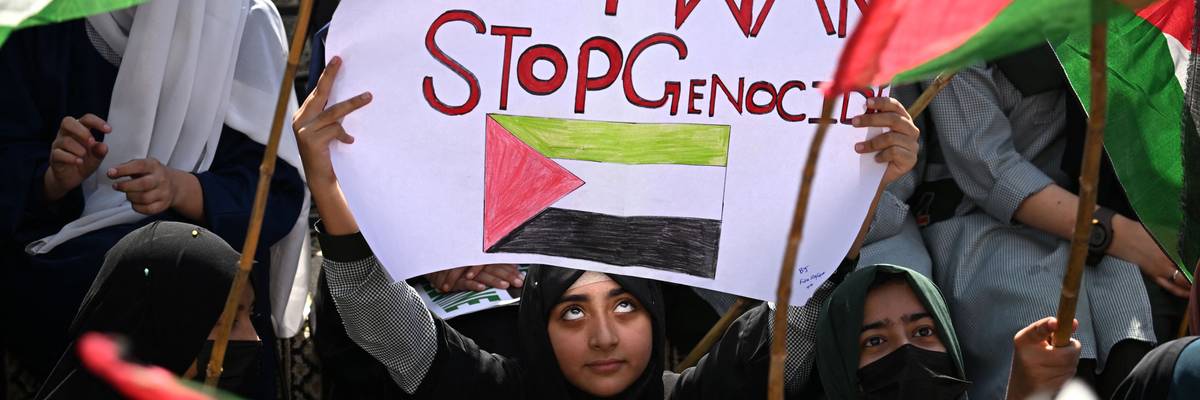
Students and supporters of the Jamaat-e-Islami political party gather to express their solidarity with the Palestinians during an anti-Israel protest in Islamabad on October 9, 2025.
Both what is similar and what is different about the agreements orchestrated by the Trump administration have lessons to teach us about these conflicts.
In the span of a week, the Trump administration succeeded in passing a United Nations Security Council resolution on Gaza (based on its earlier 20-point plan to end the conflict) and also released a 28-point peace plan for Ukraine. Commentators and critics have noted some similarities between the two initiatives. There are also profound differences that are important to note.
In the first place, the intention of both plans appears to be driven by the simple and commendable goal of ending the ongoing violence in Gaza and Ukraine. While trying to do this, however, critics note that aggressors have been given undo deference. In the case of Ukraine, it was deemed that the way forward was in awarding Russia’s land grab in eastern and southern Ukraine. In the case of Gaza, no attention was paid to Israel’s genocidal crimes against Palestinians with the assumption that the victims should make do with aid and some form of recovery—even though it appears from the plan that their future remains indeterminate and subject to the will of others.
The problems with both plans owe to the fact that they were initially drafted without the input of either the Palestinians or Ukrainians. The exact origins of the Gaza plan remain somewhat murky, but what’s clear is the absence of Palestinian participation. The UN resolution’s only mention of the Palestinian Authority is a reference to their possible future involvement should they meet unspecified reforms, at which point the PA “may” be allowed to assume a role in Gaza on terms approved by Israel and the international bodies the resolution has established to govern Gaza controlling the funds and making the plans to help Gaza recover.
The Ukraine plan’s origins have been a subject of some controversy. At first the US claimed it had been developed with the Russians, based on a Russian draft. Then they denied any US involvement, only later to “clarify” that it had been a joint US-Russian effort. After push back from Europeans and some Republican senators, the US engaged with the Ukrainians, making some changes which may or may not be acceptable to the Russian side.
Herein lies one of the differences between the two plans. Ukraine is recognized as a sovereign entity, despite the draft plan’s allowing for violations of Ukraine’s sovereignty. The plan for Gaza, on the other hand, not only doesn’t acknowledge Palestinian sovereignty, but also goes to great lengths to erase it. It subjects Palestinians to the whims of Israel and the international bodies—led by the US—which will be positioned to serve as sovereigns over decisions that will shape the future of the Palestinian people.
There are, to be sure, what appear to be feints toward Palestinian sovereignty—a “tip of the hat” to the Saudi-French Proposal, references to a Palestinian police force, and the idea that a reformed PA “may” be involved in the future. But these are conditioned on terms established by others, rather than as rights. All of this seems to pour cold water on the giddiness accompanying the Special Session on Palestine that preceded the opening of this year’s General Assembly when a number of states recognized Palestinian statehood.
Especially concerning in this slighting of the PA is the lack of acknowledgement or understanding by the Gaza plan’s architects that Israel has, for three decades, done its best to ensure the PA’s failure. From the first years after Oslo, Israel denied Palestinians the freedom to develop an independent economy, guaranteeing the Palestinians would remain dependent on Israel. Israel circumscribed the areas in which the PA could govern, frequently violating even that by invading areas nominally under PA control. Israel also continued to build Jewish-only settlements and infrastructure, and played games with Hamas in Gaza, often elevating their stature at the expense of the PA. Today, the PA, while still conceptually representing the promise of Palestinian statehood, is increasingly seen in the West Bank more as a subordinate acting on behalf of Israel than as an independent self-governing entity representing Palestinian aspirations.
While it’s clear that Hamas has fallen into great disfavor among Palestinians in Gaza, the PA polls well behind Hamas in the West Bank. So when the Gaza plan insists that the PA reform, the questions that must be asked are: “What exactly are these reforms?” “Can the PA implement reforms under continuing Israeli domination of the West Bank?” and “With Israel as one of the parties designated to establish the metrics of reform, after meeting Israel’s criteria, will the PA have the credibility it needs to govern or will it be seen as the agent of the true sovereign, Israel?”
Finally, while the initial version of the Ukraine plan does include some constraints on Russia—even before recent reports of still unseen Ukrainian modifications—there are no such constraints imposed on Israel in the UN Gaza plan. Even the agreed-upon “ceasefire” remains elusive, with Israel acting with impunity as the ceasefire’s sole enforcer. Since Israel still controls access and egress to the less than half of Gaza from which they have withdrawn, Palestinians remain largely without adequate shelter, food, and medical services as winter approaches.
Months remain before the UN plan for Gaza can begin to be fully implemented. Most likely it will not be, as Israel and the US are obsessive about the unrealistic precondition that Hamas be fully disarmed and dismantled before any forward movement can occur. What appears to be in the offing is a US-Israel plan to develop housing projects for Palestinians in the Gaza areas under Israeli control. This effort to lure some desperate Palestinians to move into the Israeli region would mean abandoning those who remain under Hamas control to an uncertain future. This actually meets the definition of genocidal intent.
One decisive difference in the development of the two plans has been the roles played by external forces. Ukraine has the backing of a near-unified European bloc, coupled with support from Republicans driven by anti-Russian animus. This tempered even the initial US 28-point plan. While the Gaza plan had its origins in an Arab draft, and while Arab states and others were able to insert some language in the UN resolution on Gaza, by the time the US and Israel had finished stripping it down and President Trump had put his imprimatur on it bullying it through the UN process, Palestinian rights were gone.
It’s not too late for Arabs to demand better terms, for Palestinians to put their house in order creating a unified national plan of governance for the West Bank and Gaza, and for Arabs and Palestinians to insist that those nations who have recognized Palestinian statehood call for reopening the debate on Palestine’s future. If changes aren’t made, in short order, we will tragically be right back where we started.
Dear Common Dreams reader, It’s been nearly 30 years since I co-founded Common Dreams with my late wife, Lina Newhouser. We had the radical notion that journalism should serve the public good, not corporate profits. It was clear to us from the outset what it would take to build such a project. No paid advertisements. No corporate sponsors. No millionaire publisher telling us what to think or do. Many people said we wouldn't last a year, but we proved those doubters wrong. Together with a tremendous team of journalists and dedicated staff, we built an independent media outlet free from the constraints of profits and corporate control. Our mission has always been simple: To inform. To inspire. To ignite change for the common good. Building Common Dreams was not easy. Our survival was never guaranteed. When you take on the most powerful forces—Wall Street greed, fossil fuel industry destruction, Big Tech lobbyists, and uber-rich oligarchs who have spent billions upon billions rigging the economy and democracy in their favor—the only bulwark you have is supporters who believe in your work. But here’s the urgent message from me today. It's never been this bad out there. And it's never been this hard to keep us going. At the very moment Common Dreams is most needed, the threats we face are intensifying. We need your support now more than ever. We don't accept corporate advertising and never will. We don't have a paywall because we don't think people should be blocked from critical news based on their ability to pay. Everything we do is funded by the donations of readers like you. When everyone does the little they can afford, we are strong. But if that support retreats or dries up, so do we. Will you donate now to make sure Common Dreams not only survives but thrives? —Craig Brown, Co-founder |
In the span of a week, the Trump administration succeeded in passing a United Nations Security Council resolution on Gaza (based on its earlier 20-point plan to end the conflict) and also released a 28-point peace plan for Ukraine. Commentators and critics have noted some similarities between the two initiatives. There are also profound differences that are important to note.
In the first place, the intention of both plans appears to be driven by the simple and commendable goal of ending the ongoing violence in Gaza and Ukraine. While trying to do this, however, critics note that aggressors have been given undo deference. In the case of Ukraine, it was deemed that the way forward was in awarding Russia’s land grab in eastern and southern Ukraine. In the case of Gaza, no attention was paid to Israel’s genocidal crimes against Palestinians with the assumption that the victims should make do with aid and some form of recovery—even though it appears from the plan that their future remains indeterminate and subject to the will of others.
The problems with both plans owe to the fact that they were initially drafted without the input of either the Palestinians or Ukrainians. The exact origins of the Gaza plan remain somewhat murky, but what’s clear is the absence of Palestinian participation. The UN resolution’s only mention of the Palestinian Authority is a reference to their possible future involvement should they meet unspecified reforms, at which point the PA “may” be allowed to assume a role in Gaza on terms approved by Israel and the international bodies the resolution has established to govern Gaza controlling the funds and making the plans to help Gaza recover.
The Ukraine plan’s origins have been a subject of some controversy. At first the US claimed it had been developed with the Russians, based on a Russian draft. Then they denied any US involvement, only later to “clarify” that it had been a joint US-Russian effort. After push back from Europeans and some Republican senators, the US engaged with the Ukrainians, making some changes which may or may not be acceptable to the Russian side.
Herein lies one of the differences between the two plans. Ukraine is recognized as a sovereign entity, despite the draft plan’s allowing for violations of Ukraine’s sovereignty. The plan for Gaza, on the other hand, not only doesn’t acknowledge Palestinian sovereignty, but also goes to great lengths to erase it. It subjects Palestinians to the whims of Israel and the international bodies—led by the US—which will be positioned to serve as sovereigns over decisions that will shape the future of the Palestinian people.
There are, to be sure, what appear to be feints toward Palestinian sovereignty—a “tip of the hat” to the Saudi-French Proposal, references to a Palestinian police force, and the idea that a reformed PA “may” be involved in the future. But these are conditioned on terms established by others, rather than as rights. All of this seems to pour cold water on the giddiness accompanying the Special Session on Palestine that preceded the opening of this year’s General Assembly when a number of states recognized Palestinian statehood.
Especially concerning in this slighting of the PA is the lack of acknowledgement or understanding by the Gaza plan’s architects that Israel has, for three decades, done its best to ensure the PA’s failure. From the first years after Oslo, Israel denied Palestinians the freedom to develop an independent economy, guaranteeing the Palestinians would remain dependent on Israel. Israel circumscribed the areas in which the PA could govern, frequently violating even that by invading areas nominally under PA control. Israel also continued to build Jewish-only settlements and infrastructure, and played games with Hamas in Gaza, often elevating their stature at the expense of the PA. Today, the PA, while still conceptually representing the promise of Palestinian statehood, is increasingly seen in the West Bank more as a subordinate acting on behalf of Israel than as an independent self-governing entity representing Palestinian aspirations.
While it’s clear that Hamas has fallen into great disfavor among Palestinians in Gaza, the PA polls well behind Hamas in the West Bank. So when the Gaza plan insists that the PA reform, the questions that must be asked are: “What exactly are these reforms?” “Can the PA implement reforms under continuing Israeli domination of the West Bank?” and “With Israel as one of the parties designated to establish the metrics of reform, after meeting Israel’s criteria, will the PA have the credibility it needs to govern or will it be seen as the agent of the true sovereign, Israel?”
Finally, while the initial version of the Ukraine plan does include some constraints on Russia—even before recent reports of still unseen Ukrainian modifications—there are no such constraints imposed on Israel in the UN Gaza plan. Even the agreed-upon “ceasefire” remains elusive, with Israel acting with impunity as the ceasefire’s sole enforcer. Since Israel still controls access and egress to the less than half of Gaza from which they have withdrawn, Palestinians remain largely without adequate shelter, food, and medical services as winter approaches.
Months remain before the UN plan for Gaza can begin to be fully implemented. Most likely it will not be, as Israel and the US are obsessive about the unrealistic precondition that Hamas be fully disarmed and dismantled before any forward movement can occur. What appears to be in the offing is a US-Israel plan to develop housing projects for Palestinians in the Gaza areas under Israeli control. This effort to lure some desperate Palestinians to move into the Israeli region would mean abandoning those who remain under Hamas control to an uncertain future. This actually meets the definition of genocidal intent.
One decisive difference in the development of the two plans has been the roles played by external forces. Ukraine has the backing of a near-unified European bloc, coupled with support from Republicans driven by anti-Russian animus. This tempered even the initial US 28-point plan. While the Gaza plan had its origins in an Arab draft, and while Arab states and others were able to insert some language in the UN resolution on Gaza, by the time the US and Israel had finished stripping it down and President Trump had put his imprimatur on it bullying it through the UN process, Palestinian rights were gone.
It’s not too late for Arabs to demand better terms, for Palestinians to put their house in order creating a unified national plan of governance for the West Bank and Gaza, and for Arabs and Palestinians to insist that those nations who have recognized Palestinian statehood call for reopening the debate on Palestine’s future. If changes aren’t made, in short order, we will tragically be right back where we started.
In the span of a week, the Trump administration succeeded in passing a United Nations Security Council resolution on Gaza (based on its earlier 20-point plan to end the conflict) and also released a 28-point peace plan for Ukraine. Commentators and critics have noted some similarities between the two initiatives. There are also profound differences that are important to note.
In the first place, the intention of both plans appears to be driven by the simple and commendable goal of ending the ongoing violence in Gaza and Ukraine. While trying to do this, however, critics note that aggressors have been given undo deference. In the case of Ukraine, it was deemed that the way forward was in awarding Russia’s land grab in eastern and southern Ukraine. In the case of Gaza, no attention was paid to Israel’s genocidal crimes against Palestinians with the assumption that the victims should make do with aid and some form of recovery—even though it appears from the plan that their future remains indeterminate and subject to the will of others.
The problems with both plans owe to the fact that they were initially drafted without the input of either the Palestinians or Ukrainians. The exact origins of the Gaza plan remain somewhat murky, but what’s clear is the absence of Palestinian participation. The UN resolution’s only mention of the Palestinian Authority is a reference to their possible future involvement should they meet unspecified reforms, at which point the PA “may” be allowed to assume a role in Gaza on terms approved by Israel and the international bodies the resolution has established to govern Gaza controlling the funds and making the plans to help Gaza recover.
The Ukraine plan’s origins have been a subject of some controversy. At first the US claimed it had been developed with the Russians, based on a Russian draft. Then they denied any US involvement, only later to “clarify” that it had been a joint US-Russian effort. After push back from Europeans and some Republican senators, the US engaged with the Ukrainians, making some changes which may or may not be acceptable to the Russian side.
Herein lies one of the differences between the two plans. Ukraine is recognized as a sovereign entity, despite the draft plan’s allowing for violations of Ukraine’s sovereignty. The plan for Gaza, on the other hand, not only doesn’t acknowledge Palestinian sovereignty, but also goes to great lengths to erase it. It subjects Palestinians to the whims of Israel and the international bodies—led by the US—which will be positioned to serve as sovereigns over decisions that will shape the future of the Palestinian people.
There are, to be sure, what appear to be feints toward Palestinian sovereignty—a “tip of the hat” to the Saudi-French Proposal, references to a Palestinian police force, and the idea that a reformed PA “may” be involved in the future. But these are conditioned on terms established by others, rather than as rights. All of this seems to pour cold water on the giddiness accompanying the Special Session on Palestine that preceded the opening of this year’s General Assembly when a number of states recognized Palestinian statehood.
Especially concerning in this slighting of the PA is the lack of acknowledgement or understanding by the Gaza plan’s architects that Israel has, for three decades, done its best to ensure the PA’s failure. From the first years after Oslo, Israel denied Palestinians the freedom to develop an independent economy, guaranteeing the Palestinians would remain dependent on Israel. Israel circumscribed the areas in which the PA could govern, frequently violating even that by invading areas nominally under PA control. Israel also continued to build Jewish-only settlements and infrastructure, and played games with Hamas in Gaza, often elevating their stature at the expense of the PA. Today, the PA, while still conceptually representing the promise of Palestinian statehood, is increasingly seen in the West Bank more as a subordinate acting on behalf of Israel than as an independent self-governing entity representing Palestinian aspirations.
While it’s clear that Hamas has fallen into great disfavor among Palestinians in Gaza, the PA polls well behind Hamas in the West Bank. So when the Gaza plan insists that the PA reform, the questions that must be asked are: “What exactly are these reforms?” “Can the PA implement reforms under continuing Israeli domination of the West Bank?” and “With Israel as one of the parties designated to establish the metrics of reform, after meeting Israel’s criteria, will the PA have the credibility it needs to govern or will it be seen as the agent of the true sovereign, Israel?”
Finally, while the initial version of the Ukraine plan does include some constraints on Russia—even before recent reports of still unseen Ukrainian modifications—there are no such constraints imposed on Israel in the UN Gaza plan. Even the agreed-upon “ceasefire” remains elusive, with Israel acting with impunity as the ceasefire’s sole enforcer. Since Israel still controls access and egress to the less than half of Gaza from which they have withdrawn, Palestinians remain largely without adequate shelter, food, and medical services as winter approaches.
Months remain before the UN plan for Gaza can begin to be fully implemented. Most likely it will not be, as Israel and the US are obsessive about the unrealistic precondition that Hamas be fully disarmed and dismantled before any forward movement can occur. What appears to be in the offing is a US-Israel plan to develop housing projects for Palestinians in the Gaza areas under Israeli control. This effort to lure some desperate Palestinians to move into the Israeli region would mean abandoning those who remain under Hamas control to an uncertain future. This actually meets the definition of genocidal intent.
One decisive difference in the development of the two plans has been the roles played by external forces. Ukraine has the backing of a near-unified European bloc, coupled with support from Republicans driven by anti-Russian animus. This tempered even the initial US 28-point plan. While the Gaza plan had its origins in an Arab draft, and while Arab states and others were able to insert some language in the UN resolution on Gaza, by the time the US and Israel had finished stripping it down and President Trump had put his imprimatur on it bullying it through the UN process, Palestinian rights were gone.
It’s not too late for Arabs to demand better terms, for Palestinians to put their house in order creating a unified national plan of governance for the West Bank and Gaza, and for Arabs and Palestinians to insist that those nations who have recognized Palestinian statehood call for reopening the debate on Palestine’s future. If changes aren’t made, in short order, we will tragically be right back where we started.