SUBSCRIBE TO OUR FREE NEWSLETTER
Daily news & progressive opinion—funded by the people, not the corporations—delivered straight to your inbox.
5
#000000
#FFFFFF
To donate by check, phone, or other method, see our More Ways to Give page.
Daily news & progressive opinion—funded by the people, not the corporations—delivered straight to your inbox.
The strikes are more than tactical operations; they are a test of national character: What kind of country do we want to be?
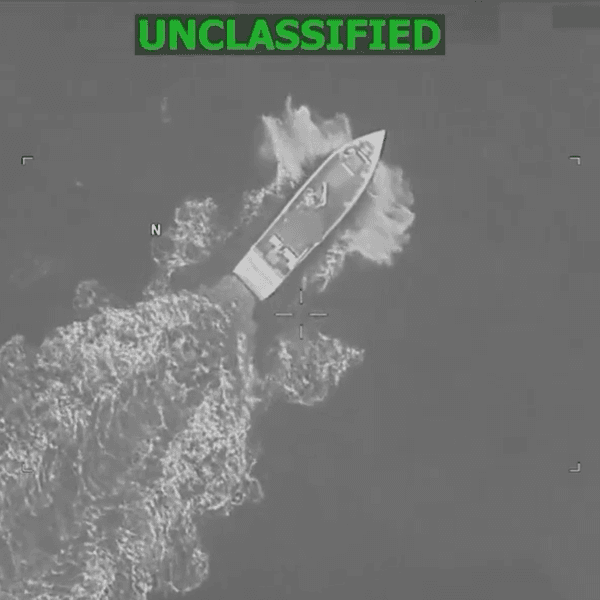
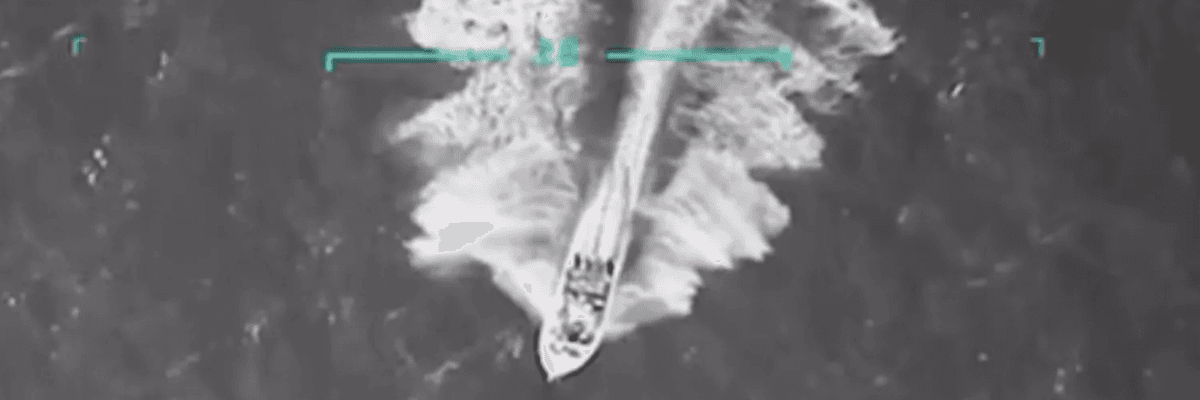
Two blasts split the water. A burning hull drifted. Survivors clawed at debris, then vanished under a second strike.
That was the opening image delivered by the Pentagon in early September: a tightly edited video of a US military aircraft obliterating an alleged drug-smuggling boat in the Caribbean. It was released with cinematic timing, framed as a bold success in the Trump administration’s newly intensified campaign against “narco-terrorists.” But the more Americans have learned about what followed—the killing of two dazed, shipwrecked survivors in a second strike—the more the narrative has begun to disintegrate.
For many, the scene forces a reckoning: What happens when “national security” becomes a blank check for lethal power?
Maybe it’s miscalculation, maybe it’s panic, but the fearmongering is falling flat. Most Americans do not view drugs as a national security threat, let alone see suspected smugglers—if that’s even what they were—as enemy combatants. The War on Drugs was always more metaphor than strategy, and it collapsed once the theatrics stopped working. People were ready for it to end.
Venezuela, with its vast oil reserves, political volatility, and deepening ties to Russia and China, is a convenient adversary through which to project American power in a 21st-century Monroe Doctrine dressed in counter-narcotics language.
So when a military aircraft fired on a burning, disabled boat with survivors clinging to wreckage, the public reaction was visceral. The disproportionality was impossible to ignore. As Peter Baker noted, it’s like a police department deciding to drop a bomb on a suspected drug house, an assault on basic intuition about force and justice in a democracy.
Then came the explanation that stunned nearly everyone. Admiral Frank “Mitch” Bradley, the mission’s commanding officer, justified the second strike by claiming the survivors could have climbed back into the boat and finished delivering the drugs. It stands out as one of the most baffling and grotesquely flimsy justifications ever offered by a US military officer, an argument that collapses under the slightest scrutiny, reducing human lives to loose ends in a bad action script.
Sen. Tammy Duckworth (D-Ill.), a former Black Hawk pilot and combat veteran, called it plainly: “essentially murder.” On CNN, she pushed back forcefully against Secretary of Defense Pete Hegseth’s comparison of the operation to counterterrorism missions in Iraq and Afghanistan. “There was actually a vote by Congress to put us at war,” she reminded. “There was no such vote, no such debate here. They have not been authorized to be at war.” The individuals on that boat, she noted, “were not even aimed at the United States.”
Sen. Adam Schiff (D-Calif.) went further. On "Meet the Press," he labeled the second strike “unlawful,” “unconstitutional,” and “morally repugnant.” If Hegseth and the Pentagon are so proud of what they’ve done, he asked, why not release the second video?
That question has no satisfying answer. The Pentagon refuses to release footage of the strike that killed the survivors. No independent forensic record of the weapons used, target selection, or post-strike assessment exists. Outside observers have been told only that a “kinetic strike” occurred—an evasive term that obscures more than it reveals. This opacity doesn’t just raise red flags; it detonates them. Without transparency, there is no meaningful way to assess proportionality, necessity, or compliance with international law.
Equally disturbing is the chain of command. Secretary Hegseth now says he did not personally witness any survivors after the first strike because he left the operation midstream to attend another meeting, invoking the “fog of war.” Leaving mid-operation, while survivors were still alive, forces unavoidable questions about intent, responsibility, and moral judgment. Whether his absence reflects indifference, incompetence, or a deliberate desire not to witness the killing that followed, the effect is the same: a lethal decision made without full accountability.
Admiral Bradley has denied reports that he received any “no quarter” order from Hegseth. He insists the operation was both lawful and carefully overseen by a judge advocate general officer. Sen. Tom Cotton (R-Ark.) echoes this defense, arguing that dozens of personnel, including military lawyers, observed the mission and found no legal issue. But checking a legal box does not absolve the moral weight of killing defenseless men.
And the legal backdrop leaves little room for interpretation. International law is unequivocal: Shipwrecked individuals are protected persons. They cannot be targeted. They cannot be executed. They cannot be left without aid. This is not an arcane debate about gray zones, this is the bedrock of maritime and humanitarian law.
Yet the administration continues to frame the dead as “narco-terrorists,” insisting the strikes were a necessary step to protect the American public from deadly drugs. The rhetoric is familiar: broad, sensational, and strategically vague. It casts an ever-widening circle of potential targets, relying on fear to justify violence.
Which brings us to Venezuela.
We need to be asking: Why release the footage when they did, why concentrate so much attention on Venezuela, and why execute an operation that ensured no one survived to contradict the official story? Increasingly, the pattern resembles a manufactured pretext, an incident shaped with emotional precision to lock in public perception before alternative facts can surface. Venezuela, with its vast oil reserves, political volatility, and deepening ties to Russia and China, is a convenient adversary through which to project American power in a 21st-century Monroe Doctrine dressed in counter-narcotics language.
In this reading, the strike is not an isolated tragedy but an early move in a broader geopolitical campaign. Admiral Bradley may believe he is acting in alignment with national security goals; from the outside, the connection between a half-sunk fishing boat and great-power strategy looks tenuous at best. But that is the disturbing part: not just what happened, but what the public is being prepared to accept next.
The choreography echoes the Gulf of Tonkin playbook—ambiguity weaponized, narrative locked in, consequences sealed before the public can blink.
And it leads to a deeper question: What kind of country do we want to be?
The Caribbean strikes are more than tactical operations; they are a test of national character. When influence becomes the ultimate measure of safety, morality becomes the first casualty. Without public scrutiny and full transparency, legality, proportionality, and human cost become negotiable, reshaped to match strategic objectives.
History will judge the strikes. But it will also judge the ethical lines we allowed to fade in their wake.Dear Common Dreams reader, It’s been nearly 30 years since I co-founded Common Dreams with my late wife, Lina Newhouser. We had the radical notion that journalism should serve the public good, not corporate profits. It was clear to us from the outset what it would take to build such a project. No paid advertisements. No corporate sponsors. No millionaire publisher telling us what to think or do. Many people said we wouldn't last a year, but we proved those doubters wrong. Together with a tremendous team of journalists and dedicated staff, we built an independent media outlet free from the constraints of profits and corporate control. Our mission has always been simple: To inform. To inspire. To ignite change for the common good. Building Common Dreams was not easy. Our survival was never guaranteed. When you take on the most powerful forces—Wall Street greed, fossil fuel industry destruction, Big Tech lobbyists, and uber-rich oligarchs who have spent billions upon billions rigging the economy and democracy in their favor—the only bulwark you have is supporters who believe in your work. But here’s the urgent message from me today. It's never been this bad out there. And it's never been this hard to keep us going. At the very moment Common Dreams is most needed, the threats we face are intensifying. We need your support now more than ever. We don't accept corporate advertising and never will. We don't have a paywall because we don't think people should be blocked from critical news based on their ability to pay. Everything we do is funded by the donations of readers like you. When everyone does the little they can afford, we are strong. But if that support retreats or dries up, so do we. Will you donate now to make sure Common Dreams not only survives but thrives? —Craig Brown, Co-founder |
Two blasts split the water. A burning hull drifted. Survivors clawed at debris, then vanished under a second strike.
That was the opening image delivered by the Pentagon in early September: a tightly edited video of a US military aircraft obliterating an alleged drug-smuggling boat in the Caribbean. It was released with cinematic timing, framed as a bold success in the Trump administration’s newly intensified campaign against “narco-terrorists.” But the more Americans have learned about what followed—the killing of two dazed, shipwrecked survivors in a second strike—the more the narrative has begun to disintegrate.
For many, the scene forces a reckoning: What happens when “national security” becomes a blank check for lethal power?
Maybe it’s miscalculation, maybe it’s panic, but the fearmongering is falling flat. Most Americans do not view drugs as a national security threat, let alone see suspected smugglers—if that’s even what they were—as enemy combatants. The War on Drugs was always more metaphor than strategy, and it collapsed once the theatrics stopped working. People were ready for it to end.
Venezuela, with its vast oil reserves, political volatility, and deepening ties to Russia and China, is a convenient adversary through which to project American power in a 21st-century Monroe Doctrine dressed in counter-narcotics language.
So when a military aircraft fired on a burning, disabled boat with survivors clinging to wreckage, the public reaction was visceral. The disproportionality was impossible to ignore. As Peter Baker noted, it’s like a police department deciding to drop a bomb on a suspected drug house, an assault on basic intuition about force and justice in a democracy.
Then came the explanation that stunned nearly everyone. Admiral Frank “Mitch” Bradley, the mission’s commanding officer, justified the second strike by claiming the survivors could have climbed back into the boat and finished delivering the drugs. It stands out as one of the most baffling and grotesquely flimsy justifications ever offered by a US military officer, an argument that collapses under the slightest scrutiny, reducing human lives to loose ends in a bad action script.
Sen. Tammy Duckworth (D-Ill.), a former Black Hawk pilot and combat veteran, called it plainly: “essentially murder.” On CNN, she pushed back forcefully against Secretary of Defense Pete Hegseth’s comparison of the operation to counterterrorism missions in Iraq and Afghanistan. “There was actually a vote by Congress to put us at war,” she reminded. “There was no such vote, no such debate here. They have not been authorized to be at war.” The individuals on that boat, she noted, “were not even aimed at the United States.”
Sen. Adam Schiff (D-Calif.) went further. On "Meet the Press," he labeled the second strike “unlawful,” “unconstitutional,” and “morally repugnant.” If Hegseth and the Pentagon are so proud of what they’ve done, he asked, why not release the second video?
That question has no satisfying answer. The Pentagon refuses to release footage of the strike that killed the survivors. No independent forensic record of the weapons used, target selection, or post-strike assessment exists. Outside observers have been told only that a “kinetic strike” occurred—an evasive term that obscures more than it reveals. This opacity doesn’t just raise red flags; it detonates them. Without transparency, there is no meaningful way to assess proportionality, necessity, or compliance with international law.
Equally disturbing is the chain of command. Secretary Hegseth now says he did not personally witness any survivors after the first strike because he left the operation midstream to attend another meeting, invoking the “fog of war.” Leaving mid-operation, while survivors were still alive, forces unavoidable questions about intent, responsibility, and moral judgment. Whether his absence reflects indifference, incompetence, or a deliberate desire not to witness the killing that followed, the effect is the same: a lethal decision made without full accountability.
Admiral Bradley has denied reports that he received any “no quarter” order from Hegseth. He insists the operation was both lawful and carefully overseen by a judge advocate general officer. Sen. Tom Cotton (R-Ark.) echoes this defense, arguing that dozens of personnel, including military lawyers, observed the mission and found no legal issue. But checking a legal box does not absolve the moral weight of killing defenseless men.
And the legal backdrop leaves little room for interpretation. International law is unequivocal: Shipwrecked individuals are protected persons. They cannot be targeted. They cannot be executed. They cannot be left without aid. This is not an arcane debate about gray zones, this is the bedrock of maritime and humanitarian law.
Yet the administration continues to frame the dead as “narco-terrorists,” insisting the strikes were a necessary step to protect the American public from deadly drugs. The rhetoric is familiar: broad, sensational, and strategically vague. It casts an ever-widening circle of potential targets, relying on fear to justify violence.
Which brings us to Venezuela.
We need to be asking: Why release the footage when they did, why concentrate so much attention on Venezuela, and why execute an operation that ensured no one survived to contradict the official story? Increasingly, the pattern resembles a manufactured pretext, an incident shaped with emotional precision to lock in public perception before alternative facts can surface. Venezuela, with its vast oil reserves, political volatility, and deepening ties to Russia and China, is a convenient adversary through which to project American power in a 21st-century Monroe Doctrine dressed in counter-narcotics language.
In this reading, the strike is not an isolated tragedy but an early move in a broader geopolitical campaign. Admiral Bradley may believe he is acting in alignment with national security goals; from the outside, the connection between a half-sunk fishing boat and great-power strategy looks tenuous at best. But that is the disturbing part: not just what happened, but what the public is being prepared to accept next.
The choreography echoes the Gulf of Tonkin playbook—ambiguity weaponized, narrative locked in, consequences sealed before the public can blink.
And it leads to a deeper question: What kind of country do we want to be?
The Caribbean strikes are more than tactical operations; they are a test of national character. When influence becomes the ultimate measure of safety, morality becomes the first casualty. Without public scrutiny and full transparency, legality, proportionality, and human cost become negotiable, reshaped to match strategic objectives.
History will judge the strikes. But it will also judge the ethical lines we allowed to fade in their wake.Two blasts split the water. A burning hull drifted. Survivors clawed at debris, then vanished under a second strike.
That was the opening image delivered by the Pentagon in early September: a tightly edited video of a US military aircraft obliterating an alleged drug-smuggling boat in the Caribbean. It was released with cinematic timing, framed as a bold success in the Trump administration’s newly intensified campaign against “narco-terrorists.” But the more Americans have learned about what followed—the killing of two dazed, shipwrecked survivors in a second strike—the more the narrative has begun to disintegrate.
For many, the scene forces a reckoning: What happens when “national security” becomes a blank check for lethal power?
Maybe it’s miscalculation, maybe it’s panic, but the fearmongering is falling flat. Most Americans do not view drugs as a national security threat, let alone see suspected smugglers—if that’s even what they were—as enemy combatants. The War on Drugs was always more metaphor than strategy, and it collapsed once the theatrics stopped working. People were ready for it to end.
Venezuela, with its vast oil reserves, political volatility, and deepening ties to Russia and China, is a convenient adversary through which to project American power in a 21st-century Monroe Doctrine dressed in counter-narcotics language.
So when a military aircraft fired on a burning, disabled boat with survivors clinging to wreckage, the public reaction was visceral. The disproportionality was impossible to ignore. As Peter Baker noted, it’s like a police department deciding to drop a bomb on a suspected drug house, an assault on basic intuition about force and justice in a democracy.
Then came the explanation that stunned nearly everyone. Admiral Frank “Mitch” Bradley, the mission’s commanding officer, justified the second strike by claiming the survivors could have climbed back into the boat and finished delivering the drugs. It stands out as one of the most baffling and grotesquely flimsy justifications ever offered by a US military officer, an argument that collapses under the slightest scrutiny, reducing human lives to loose ends in a bad action script.
Sen. Tammy Duckworth (D-Ill.), a former Black Hawk pilot and combat veteran, called it plainly: “essentially murder.” On CNN, she pushed back forcefully against Secretary of Defense Pete Hegseth’s comparison of the operation to counterterrorism missions in Iraq and Afghanistan. “There was actually a vote by Congress to put us at war,” she reminded. “There was no such vote, no such debate here. They have not been authorized to be at war.” The individuals on that boat, she noted, “were not even aimed at the United States.”
Sen. Adam Schiff (D-Calif.) went further. On "Meet the Press," he labeled the second strike “unlawful,” “unconstitutional,” and “morally repugnant.” If Hegseth and the Pentagon are so proud of what they’ve done, he asked, why not release the second video?
That question has no satisfying answer. The Pentagon refuses to release footage of the strike that killed the survivors. No independent forensic record of the weapons used, target selection, or post-strike assessment exists. Outside observers have been told only that a “kinetic strike” occurred—an evasive term that obscures more than it reveals. This opacity doesn’t just raise red flags; it detonates them. Without transparency, there is no meaningful way to assess proportionality, necessity, or compliance with international law.
Equally disturbing is the chain of command. Secretary Hegseth now says he did not personally witness any survivors after the first strike because he left the operation midstream to attend another meeting, invoking the “fog of war.” Leaving mid-operation, while survivors were still alive, forces unavoidable questions about intent, responsibility, and moral judgment. Whether his absence reflects indifference, incompetence, or a deliberate desire not to witness the killing that followed, the effect is the same: a lethal decision made without full accountability.
Admiral Bradley has denied reports that he received any “no quarter” order from Hegseth. He insists the operation was both lawful and carefully overseen by a judge advocate general officer. Sen. Tom Cotton (R-Ark.) echoes this defense, arguing that dozens of personnel, including military lawyers, observed the mission and found no legal issue. But checking a legal box does not absolve the moral weight of killing defenseless men.
And the legal backdrop leaves little room for interpretation. International law is unequivocal: Shipwrecked individuals are protected persons. They cannot be targeted. They cannot be executed. They cannot be left without aid. This is not an arcane debate about gray zones, this is the bedrock of maritime and humanitarian law.
Yet the administration continues to frame the dead as “narco-terrorists,” insisting the strikes were a necessary step to protect the American public from deadly drugs. The rhetoric is familiar: broad, sensational, and strategically vague. It casts an ever-widening circle of potential targets, relying on fear to justify violence.
Which brings us to Venezuela.
We need to be asking: Why release the footage when they did, why concentrate so much attention on Venezuela, and why execute an operation that ensured no one survived to contradict the official story? Increasingly, the pattern resembles a manufactured pretext, an incident shaped with emotional precision to lock in public perception before alternative facts can surface. Venezuela, with its vast oil reserves, political volatility, and deepening ties to Russia and China, is a convenient adversary through which to project American power in a 21st-century Monroe Doctrine dressed in counter-narcotics language.
In this reading, the strike is not an isolated tragedy but an early move in a broader geopolitical campaign. Admiral Bradley may believe he is acting in alignment with national security goals; from the outside, the connection between a half-sunk fishing boat and great-power strategy looks tenuous at best. But that is the disturbing part: not just what happened, but what the public is being prepared to accept next.
The choreography echoes the Gulf of Tonkin playbook—ambiguity weaponized, narrative locked in, consequences sealed before the public can blink.
And it leads to a deeper question: What kind of country do we want to be?
The Caribbean strikes are more than tactical operations; they are a test of national character. When influence becomes the ultimate measure of safety, morality becomes the first casualty. Without public scrutiny and full transparency, legality, proportionality, and human cost become negotiable, reshaped to match strategic objectives.
History will judge the strikes. But it will also judge the ethical lines we allowed to fade in their wake.