SUBSCRIBE TO OUR FREE NEWSLETTER
Daily news & progressive opinion—funded by the people, not the corporations—delivered straight to your inbox.
5
#000000
#FFFFFF
To donate by check, phone, or other method, see our More Ways to Give page.
Daily news & progressive opinion—funded by the people, not the corporations—delivered straight to your inbox.
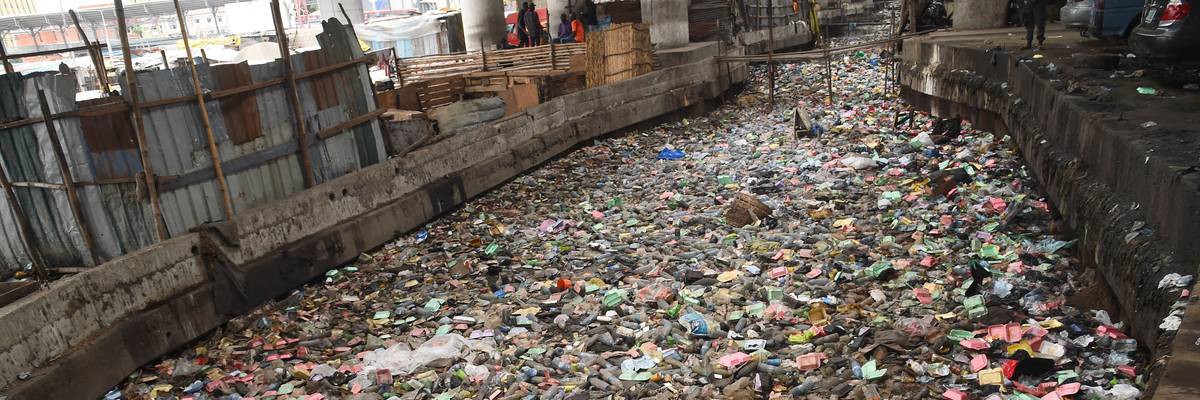
A picture shows plastic waste and used sachets of basic necessities discharged into drainage canals and lagoons, a major cause of the city's flooding and the spread of waterborne disease, at Obalende in Lagos, Nigeria's commercial hub, on July 29, 2022.
To protect their markets, the petrochemical companies began a decades-long, coordinated effort to sell the public on plastic recycling—despite their knowledge that it was neither technically nor economically viable.
We’re all living in a world—and in bodies—more polluted with plastic than the one our parents grew up in. And with global plastic production increasing by 3-3.5% annually and expected to double by 2040 or 2050, our children, and their children, will inherit even more plastic particles in everything from their food systems to their internal organs.
Two new pieces of media shine a light on the enormous harm that these invasive plastics are causing to our health across generations—and how Big Oil and the plastics industry have not only caused this crisis but also are bent on continuing it with no end in sight.
The Netflix documentary Plastics Detox details how the endocrine-disrupting chemicals from plastics contaminate three generations: the mother, the fetus, and the fetus' developing reproductive cells—“a toxic trespass," according to an expert interviewed by the film’s producers. Following environmental and reproductive epidemiologist Dr. Shanna Swan as she strives to help couples struggling with infertility, the film shows how chemicals found in plastic are identified as major endocrine disruptors, significantly contributing to hormone dysfunction, lower sperm quality, and falling fertility rates.
Just as viewers begin to wonder, how did we even get here? How is there so much plastic in… well, everything? California Attorney General Rob Bonta appears on screen, succinctly explaining that “the entire plastics industry is built on a lie”—that we can simply recycle our way out of the problem. “The only reason that plastics today are ubiquitous is because the people were told that this product can be recycled,” Bonta explains. Investigations from the Center for Climate Integrity and others have revealed that the major fossil fuel and petrochemical companies that produce and sell plastics have long known recycling was not a technically or economically viable solution to plastic waste.
Attorney General Bonta has the right idea—we need to bring an end to the fossil fuel and petrochemical industry lies.
On behalf of California, Bonta has filed a first-of-its-kind lawsuit against ExxonMobil that seeks to hold the oil giant, and the world’s biggest producer of the polymers used in single-use plastics, accountable for helping to create and push that myth.
A new book by journalist Beth Gardiner, Plastics Inc.: The Secret History and Shocking Future of Big Oil’s Biggest Bet, details the more than 100-year evolution of the plastics industry, including the industry’s deliberate efforts to reshape our society from one that, coming out of the Great Depression and World War II, reduced and reused its materials to one that simply disposed of them. Disposability equals profitability to the industry. Gardiner details how plastics’ inability to be reused or recycled was not a bug, but a feature. As one industry leader put it at the 1956 Society of Plastics Industry conference, “The future of plastics is in the trash can.” To actualize plastics’ true selling potential, the industry would have to “teach people how to waste.”
From there, the world’s leading petrochemical companies, with their ethos of single-use disposability, went on to create the plastic waste crisis. The American public, though, quickly became wary of plastic pollution and began to push back. In response, the industry first promoted landfilling and incineration to hide the plastic from view. But it quickly became clear that these disposal options would not placate a public frustrated by a flood of disposable plastics. People did not want more landfills, did not want incineration, and did not want plastic in the environment. This public outcry led to calls for bans on single-use plastics. To protect their markets, the petrochemical companies began a decades-long, coordinated effort to sell the public on plastic recycling—despite their knowledge that it was neither technically nor economically viable.
No amount of effort, investment, public education, or consumer diligence can overcome a material that resists recycling at a molecular level. Plastic’s intrinsic structure creates technical and economic barriers that make successful, safe, and scalable plastic recycling impossible—barriers that plastics producers identified in their own internal assessments as early as the 1970s. Rather than acknowledging these limitations, the industry has embarked on a nearly half-century long campaign to ensure the public never learned about them.
Now the world’s largest plastics producers make public commitments to expand the use and capacity of chemical (or “advanced”) recycling, even in the face of overwhelming evidence demonstrating that major economic and technical limitations remain unresolved. Chemical recycling operations continue to flounder as a result of predictable issues, including many of the same factors that industry insiders identified decades ago, while companies quietly retreat from their heavily publicized commitments once their public relations value has expired.
We are now awash in plastic. It is literally everywhere, quietly changing our human existence. Attorney General Bonta has the right idea—we need to bring an end to the fossil fuel and petrochemical industry lies. Consumers are legally entitled to make informed decisions. Corporations cannot be given unfettered license to continue to sell us baseless false solution after baseless false solution. They must be held accountable.
Dear Common Dreams reader, It’s been nearly 30 years since I co-founded Common Dreams with my late wife, Lina Newhouser. We had the radical notion that journalism should serve the public good, not corporate profits. It was clear to us from the outset what it would take to build such a project. No paid advertisements. No corporate sponsors. No millionaire publisher telling us what to think or do. Many people said we wouldn't last a year, but we proved those doubters wrong. Together with a tremendous team of journalists and dedicated staff, we built an independent media outlet free from the constraints of profits and corporate control. Our mission has always been simple: To inform. To inspire. To ignite change for the common good. Building Common Dreams was not easy. Our survival was never guaranteed. When you take on the most powerful forces—Wall Street greed, fossil fuel industry destruction, Big Tech lobbyists, and uber-rich oligarchs who have spent billions upon billions rigging the economy and democracy in their favor—the only bulwark you have is supporters who believe in your work. But here’s the urgent message from me today. It's never been this bad out there. And it's never been this hard to keep us going. At the very moment Common Dreams is most needed, the threats we face are intensifying. We need your support now more than ever. We don't accept corporate advertising and never will. We don't have a paywall because we don't think people should be blocked from critical news based on their ability to pay. Everything we do is funded by the donations of readers like you. When everyone does the little they can afford, we are strong. But if that support retreats or dries up, so do we. Will you donate now to make sure Common Dreams not only survives but thrives? —Craig Brown, Co-founder |
We’re all living in a world—and in bodies—more polluted with plastic than the one our parents grew up in. And with global plastic production increasing by 3-3.5% annually and expected to double by 2040 or 2050, our children, and their children, will inherit even more plastic particles in everything from their food systems to their internal organs.
Two new pieces of media shine a light on the enormous harm that these invasive plastics are causing to our health across generations—and how Big Oil and the plastics industry have not only caused this crisis but also are bent on continuing it with no end in sight.
The Netflix documentary Plastics Detox details how the endocrine-disrupting chemicals from plastics contaminate three generations: the mother, the fetus, and the fetus' developing reproductive cells—“a toxic trespass," according to an expert interviewed by the film’s producers. Following environmental and reproductive epidemiologist Dr. Shanna Swan as she strives to help couples struggling with infertility, the film shows how chemicals found in plastic are identified as major endocrine disruptors, significantly contributing to hormone dysfunction, lower sperm quality, and falling fertility rates.
Just as viewers begin to wonder, how did we even get here? How is there so much plastic in… well, everything? California Attorney General Rob Bonta appears on screen, succinctly explaining that “the entire plastics industry is built on a lie”—that we can simply recycle our way out of the problem. “The only reason that plastics today are ubiquitous is because the people were told that this product can be recycled,” Bonta explains. Investigations from the Center for Climate Integrity and others have revealed that the major fossil fuel and petrochemical companies that produce and sell plastics have long known recycling was not a technically or economically viable solution to plastic waste.
Attorney General Bonta has the right idea—we need to bring an end to the fossil fuel and petrochemical industry lies.
On behalf of California, Bonta has filed a first-of-its-kind lawsuit against ExxonMobil that seeks to hold the oil giant, and the world’s biggest producer of the polymers used in single-use plastics, accountable for helping to create and push that myth.
A new book by journalist Beth Gardiner, Plastics Inc.: The Secret History and Shocking Future of Big Oil’s Biggest Bet, details the more than 100-year evolution of the plastics industry, including the industry’s deliberate efforts to reshape our society from one that, coming out of the Great Depression and World War II, reduced and reused its materials to one that simply disposed of them. Disposability equals profitability to the industry. Gardiner details how plastics’ inability to be reused or recycled was not a bug, but a feature. As one industry leader put it at the 1956 Society of Plastics Industry conference, “The future of plastics is in the trash can.” To actualize plastics’ true selling potential, the industry would have to “teach people how to waste.”
From there, the world’s leading petrochemical companies, with their ethos of single-use disposability, went on to create the plastic waste crisis. The American public, though, quickly became wary of plastic pollution and began to push back. In response, the industry first promoted landfilling and incineration to hide the plastic from view. But it quickly became clear that these disposal options would not placate a public frustrated by a flood of disposable plastics. People did not want more landfills, did not want incineration, and did not want plastic in the environment. This public outcry led to calls for bans on single-use plastics. To protect their markets, the petrochemical companies began a decades-long, coordinated effort to sell the public on plastic recycling—despite their knowledge that it was neither technically nor economically viable.
No amount of effort, investment, public education, or consumer diligence can overcome a material that resists recycling at a molecular level. Plastic’s intrinsic structure creates technical and economic barriers that make successful, safe, and scalable plastic recycling impossible—barriers that plastics producers identified in their own internal assessments as early as the 1970s. Rather than acknowledging these limitations, the industry has embarked on a nearly half-century long campaign to ensure the public never learned about them.
Now the world’s largest plastics producers make public commitments to expand the use and capacity of chemical (or “advanced”) recycling, even in the face of overwhelming evidence demonstrating that major economic and technical limitations remain unresolved. Chemical recycling operations continue to flounder as a result of predictable issues, including many of the same factors that industry insiders identified decades ago, while companies quietly retreat from their heavily publicized commitments once their public relations value has expired.
We are now awash in plastic. It is literally everywhere, quietly changing our human existence. Attorney General Bonta has the right idea—we need to bring an end to the fossil fuel and petrochemical industry lies. Consumers are legally entitled to make informed decisions. Corporations cannot be given unfettered license to continue to sell us baseless false solution after baseless false solution. They must be held accountable.
We’re all living in a world—and in bodies—more polluted with plastic than the one our parents grew up in. And with global plastic production increasing by 3-3.5% annually and expected to double by 2040 or 2050, our children, and their children, will inherit even more plastic particles in everything from their food systems to their internal organs.
Two new pieces of media shine a light on the enormous harm that these invasive plastics are causing to our health across generations—and how Big Oil and the plastics industry have not only caused this crisis but also are bent on continuing it with no end in sight.
The Netflix documentary Plastics Detox details how the endocrine-disrupting chemicals from plastics contaminate three generations: the mother, the fetus, and the fetus' developing reproductive cells—“a toxic trespass," according to an expert interviewed by the film’s producers. Following environmental and reproductive epidemiologist Dr. Shanna Swan as she strives to help couples struggling with infertility, the film shows how chemicals found in plastic are identified as major endocrine disruptors, significantly contributing to hormone dysfunction, lower sperm quality, and falling fertility rates.
Just as viewers begin to wonder, how did we even get here? How is there so much plastic in… well, everything? California Attorney General Rob Bonta appears on screen, succinctly explaining that “the entire plastics industry is built on a lie”—that we can simply recycle our way out of the problem. “The only reason that plastics today are ubiquitous is because the people were told that this product can be recycled,” Bonta explains. Investigations from the Center for Climate Integrity and others have revealed that the major fossil fuel and petrochemical companies that produce and sell plastics have long known recycling was not a technically or economically viable solution to plastic waste.
Attorney General Bonta has the right idea—we need to bring an end to the fossil fuel and petrochemical industry lies.
On behalf of California, Bonta has filed a first-of-its-kind lawsuit against ExxonMobil that seeks to hold the oil giant, and the world’s biggest producer of the polymers used in single-use plastics, accountable for helping to create and push that myth.
A new book by journalist Beth Gardiner, Plastics Inc.: The Secret History and Shocking Future of Big Oil’s Biggest Bet, details the more than 100-year evolution of the plastics industry, including the industry’s deliberate efforts to reshape our society from one that, coming out of the Great Depression and World War II, reduced and reused its materials to one that simply disposed of them. Disposability equals profitability to the industry. Gardiner details how plastics’ inability to be reused or recycled was not a bug, but a feature. As one industry leader put it at the 1956 Society of Plastics Industry conference, “The future of plastics is in the trash can.” To actualize plastics’ true selling potential, the industry would have to “teach people how to waste.”
From there, the world’s leading petrochemical companies, with their ethos of single-use disposability, went on to create the plastic waste crisis. The American public, though, quickly became wary of plastic pollution and began to push back. In response, the industry first promoted landfilling and incineration to hide the plastic from view. But it quickly became clear that these disposal options would not placate a public frustrated by a flood of disposable plastics. People did not want more landfills, did not want incineration, and did not want plastic in the environment. This public outcry led to calls for bans on single-use plastics. To protect their markets, the petrochemical companies began a decades-long, coordinated effort to sell the public on plastic recycling—despite their knowledge that it was neither technically nor economically viable.
No amount of effort, investment, public education, or consumer diligence can overcome a material that resists recycling at a molecular level. Plastic’s intrinsic structure creates technical and economic barriers that make successful, safe, and scalable plastic recycling impossible—barriers that plastics producers identified in their own internal assessments as early as the 1970s. Rather than acknowledging these limitations, the industry has embarked on a nearly half-century long campaign to ensure the public never learned about them.
Now the world’s largest plastics producers make public commitments to expand the use and capacity of chemical (or “advanced”) recycling, even in the face of overwhelming evidence demonstrating that major economic and technical limitations remain unresolved. Chemical recycling operations continue to flounder as a result of predictable issues, including many of the same factors that industry insiders identified decades ago, while companies quietly retreat from their heavily publicized commitments once their public relations value has expired.
We are now awash in plastic. It is literally everywhere, quietly changing our human existence. Attorney General Bonta has the right idea—we need to bring an end to the fossil fuel and petrochemical industry lies. Consumers are legally entitled to make informed decisions. Corporations cannot be given unfettered license to continue to sell us baseless false solution after baseless false solution. They must be held accountable.