SUBSCRIBE TO OUR FREE NEWSLETTER
Daily news & progressive opinion—funded by the people, not the corporations—delivered straight to your inbox.
5
#000000
#FFFFFF
To donate by check, phone, or other method, see our More Ways to Give page.
Daily news & progressive opinion—funded by the people, not the corporations—delivered straight to your inbox.
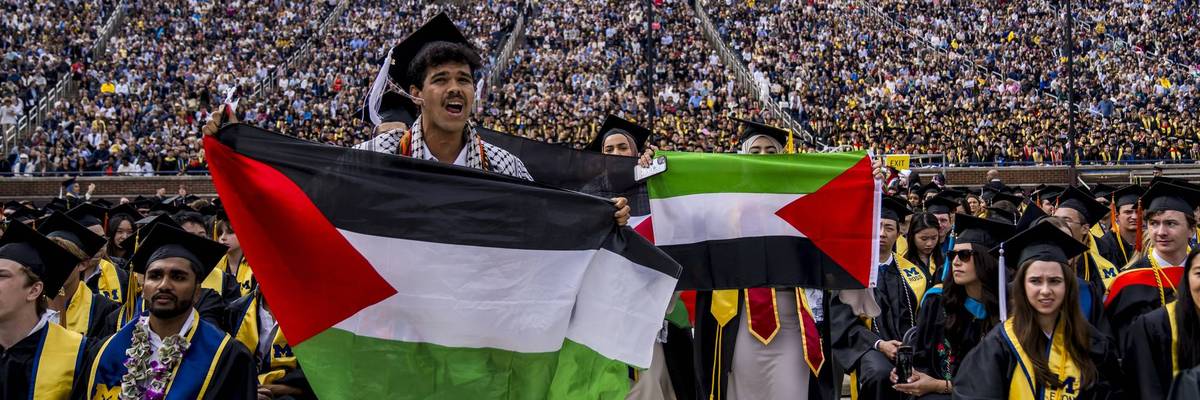
Students protest in support of Palestine during the University of Michigan's Spring Commencement ceremony on May 4, 2024 at Michigan Stadium in Ann Arbor, Michigan.
It posits that Israel represents all Jews and therefore criticism of Israel becomes criticism of the Jewish people and it denies the victims of Israel’s behaviors their legitimate right to speak of their pain.
Is it antisemitic to say that Israel is committing genocide in Gaza? More generally, is it “hurtful and insensitive” for someone to acknowledge the suffering that Israel has inflicted on the Palestinian people? In recent weeks, actions by two different institutions of higher learning brought these two questions to the forefront.
On April 15, a group of faculty and student organizations at Le Moyne College in Syracuse, New York, hosted celebrated Pulitzer Prize-winning writer Mosab Abu Toha to speak at the campus. During his appearance, to set the stage for the poems he was to read, Abu Toha shared his experiences living in Gaza during the start of the Israeli assault. He told of the members of his and his wife’s families who had been killed in Israel’s bombing campaigns. Entire families erased, neighborhoods laid waste, memories eradicated. It was, he stated, a genocide.
Days after event, Le Moyne’s president issued a statement apologizing for the discomfort that Abu Toha’s remarks may have created for some in the college community. The letter noted that his use of the word genocide in connection with the state of Israel caused “real hurt” and was leaving “some members of our community to feel unwelcome.” The president concluded by affirming that “antisemitism, along with all forms of bigotry and hate, has no place at Le Moyne.”
Abu Toha responded to the president’s letter with an “open letter” of his own, rejecting the implication that using the word genocide to describe Israel’s actions could be termed antisemitic.
It is worth noting that the assumption underlying this assertion fits hand-in-glove with the claim of real antisemites who argue that the consequences of Israel’s bad behaviors can legitimately be visited on all Jews.
“Seriously?” he asked. “Are the crimes of the Israeli state representative of all Jewish people? I personally refuse to believe that is the case… I never used the word ‘Jewish’ during the entire event; I refuse to conflate the faith of Judaism with the actions of Israel.”
He concluded: “If anyone told you they felt ‘hurt’ because I used the word genocide, then I ask you: How should I feel? How should my wife feel after losing her father? How should my three children feel after losing their grandfather?”
And then, this past weekend, the University of Michigan held its commencement ceremonies. One of the speakers was the president of the faculty senate. He began his short but eloquent remarks by noting that while the university celebrates its athletes and their accomplishments, there are other heroes who should also be celebrated—those who challenged the stale and unjust status quo of the university by opening the doors to inclusion and understanding.
He began by mentioning a young woman who in 1858 challenged the school’s opposition to enrolling women as students. He went on to note the first Jewish faculty member and the Black Action Movement that pressed the university to expand their curriculum to honor the black experience, and closed by recognizing the “student activists… who sacrificed much to open our hearts to the injustices happening in Gaza.”
His remarks were so beautifully constructed and presented that they elicited a roar of approval from those in attendance. The video of the event appearing on the university’s website shows his colleagues and administrators applauding the speech.
Within a few days, the same university president who is seen applauding issued a letter denouncing the professor’s speech as “hurtful and insensitive” and “inappropriate.”
(To avoid “further controversy” the university removed the video of the event—in which the president is seen applauding the speech—from the website).
The question that must be asked, in addition to those noted above, is what is the logic behind this claim that the remarks of both Abu Toha and the faculty senate president were hurtful to the point of being antisemitic?
The place to begin is by asking: “What is antisemitism?” The simplest and clearest definition is that antisemitism is hatred of, stereotyping of, or discrimination against Jewish people because they are Jews. Like other forms of bigotry, it claims that there are inherent characteristics or behaviors that are shared by all Jews, simply because they are Jewish.
Given this, the only way that criticism of Israeli actions can constitute antisemitism is if the critic implies that Israel does what it does because it is Jewish and “that’s the way Jews are,” or if the person making the claim of antisemitism maintains that because Israel says it is a Jewish state that whatever it does represents all Jews and therefore criticism of Israeli policies is the same as criticism of the Jewish people.
This latter position has long been propagated by pro-Israel organizations. Until recently, this proposition was mostly rejected, but it has now come to gain acceptance. It is dangerous precisely because it posits that Israel represents all Jews and therefore criticism of Israel becomes criticism of the Jewish people. It is worth noting that the assumption underlying this assertion fits hand-in-glove with the claim of real antisemites who argue that the consequences of Israel’s bad behaviors can legitimately be visited on all Jews. Interestingly, this is the same logic that has long plagued Arab Americans who have been victims of hate crimes because it was claimed that their ethnicity or religion made them legitimate targets in response to the actions of some Arab groups in the Middle East.
The other consequence is that, as Abu Toha correctly notes, it denies the victims of Israel’s behaviors their legitimate right to speak of their pain and call out, with specificity, the agent who caused it because of the hurt that might cause those who support Israel—or in the case of the University of Michigan, to deny the right of students to empathize with and demand that Palestinian victims be heard, because acknowledging Palestinian pain might also cause hurt feelings.
Dear Common Dreams reader, It’s been nearly 30 years since I co-founded Common Dreams with my late wife, Lina Newhouser. We had the radical notion that journalism should serve the public good, not corporate profits. It was clear to us from the outset what it would take to build such a project. No paid advertisements. No corporate sponsors. No millionaire publisher telling us what to think or do. Many people said we wouldn't last a year, but we proved those doubters wrong. Together with a tremendous team of journalists and dedicated staff, we built an independent media outlet free from the constraints of profits and corporate control. Our mission has always been simple: To inform. To inspire. To ignite change for the common good. Building Common Dreams was not easy. Our survival was never guaranteed. When you take on the most powerful forces—Wall Street greed, fossil fuel industry destruction, Big Tech lobbyists, and uber-rich oligarchs who have spent billions upon billions rigging the economy and democracy in their favor—the only bulwark you have is supporters who believe in your work. But here’s the urgent message from me today. It's never been this bad out there. And it's never been this hard to keep us going. At the very moment Common Dreams is most needed, the threats we face are intensifying. We need your support now more than ever. We don't accept corporate advertising and never will. We don't have a paywall because we don't think people should be blocked from critical news based on their ability to pay. Everything we do is funded by the donations of readers like you. When everyone does the little they can afford, we are strong. But if that support retreats or dries up, so do we. Will you donate now to make sure Common Dreams not only survives but thrives? —Craig Brown, Co-founder |
Is it antisemitic to say that Israel is committing genocide in Gaza? More generally, is it “hurtful and insensitive” for someone to acknowledge the suffering that Israel has inflicted on the Palestinian people? In recent weeks, actions by two different institutions of higher learning brought these two questions to the forefront.
On April 15, a group of faculty and student organizations at Le Moyne College in Syracuse, New York, hosted celebrated Pulitzer Prize-winning writer Mosab Abu Toha to speak at the campus. During his appearance, to set the stage for the poems he was to read, Abu Toha shared his experiences living in Gaza during the start of the Israeli assault. He told of the members of his and his wife’s families who had been killed in Israel’s bombing campaigns. Entire families erased, neighborhoods laid waste, memories eradicated. It was, he stated, a genocide.
Days after event, Le Moyne’s president issued a statement apologizing for the discomfort that Abu Toha’s remarks may have created for some in the college community. The letter noted that his use of the word genocide in connection with the state of Israel caused “real hurt” and was leaving “some members of our community to feel unwelcome.” The president concluded by affirming that “antisemitism, along with all forms of bigotry and hate, has no place at Le Moyne.”
Abu Toha responded to the president’s letter with an “open letter” of his own, rejecting the implication that using the word genocide to describe Israel’s actions could be termed antisemitic.
It is worth noting that the assumption underlying this assertion fits hand-in-glove with the claim of real antisemites who argue that the consequences of Israel’s bad behaviors can legitimately be visited on all Jews.
“Seriously?” he asked. “Are the crimes of the Israeli state representative of all Jewish people? I personally refuse to believe that is the case… I never used the word ‘Jewish’ during the entire event; I refuse to conflate the faith of Judaism with the actions of Israel.”
He concluded: “If anyone told you they felt ‘hurt’ because I used the word genocide, then I ask you: How should I feel? How should my wife feel after losing her father? How should my three children feel after losing their grandfather?”
And then, this past weekend, the University of Michigan held its commencement ceremonies. One of the speakers was the president of the faculty senate. He began his short but eloquent remarks by noting that while the university celebrates its athletes and their accomplishments, there are other heroes who should also be celebrated—those who challenged the stale and unjust status quo of the university by opening the doors to inclusion and understanding.
He began by mentioning a young woman who in 1858 challenged the school’s opposition to enrolling women as students. He went on to note the first Jewish faculty member and the Black Action Movement that pressed the university to expand their curriculum to honor the black experience, and closed by recognizing the “student activists… who sacrificed much to open our hearts to the injustices happening in Gaza.”
His remarks were so beautifully constructed and presented that they elicited a roar of approval from those in attendance. The video of the event appearing on the university’s website shows his colleagues and administrators applauding the speech.
Within a few days, the same university president who is seen applauding issued a letter denouncing the professor’s speech as “hurtful and insensitive” and “inappropriate.”
(To avoid “further controversy” the university removed the video of the event—in which the president is seen applauding the speech—from the website).
The question that must be asked, in addition to those noted above, is what is the logic behind this claim that the remarks of both Abu Toha and the faculty senate president were hurtful to the point of being antisemitic?
The place to begin is by asking: “What is antisemitism?” The simplest and clearest definition is that antisemitism is hatred of, stereotyping of, or discrimination against Jewish people because they are Jews. Like other forms of bigotry, it claims that there are inherent characteristics or behaviors that are shared by all Jews, simply because they are Jewish.
Given this, the only way that criticism of Israeli actions can constitute antisemitism is if the critic implies that Israel does what it does because it is Jewish and “that’s the way Jews are,” or if the person making the claim of antisemitism maintains that because Israel says it is a Jewish state that whatever it does represents all Jews and therefore criticism of Israeli policies is the same as criticism of the Jewish people.
This latter position has long been propagated by pro-Israel organizations. Until recently, this proposition was mostly rejected, but it has now come to gain acceptance. It is dangerous precisely because it posits that Israel represents all Jews and therefore criticism of Israel becomes criticism of the Jewish people. It is worth noting that the assumption underlying this assertion fits hand-in-glove with the claim of real antisemites who argue that the consequences of Israel’s bad behaviors can legitimately be visited on all Jews. Interestingly, this is the same logic that has long plagued Arab Americans who have been victims of hate crimes because it was claimed that their ethnicity or religion made them legitimate targets in response to the actions of some Arab groups in the Middle East.
The other consequence is that, as Abu Toha correctly notes, it denies the victims of Israel’s behaviors their legitimate right to speak of their pain and call out, with specificity, the agent who caused it because of the hurt that might cause those who support Israel—or in the case of the University of Michigan, to deny the right of students to empathize with and demand that Palestinian victims be heard, because acknowledging Palestinian pain might also cause hurt feelings.
Is it antisemitic to say that Israel is committing genocide in Gaza? More generally, is it “hurtful and insensitive” for someone to acknowledge the suffering that Israel has inflicted on the Palestinian people? In recent weeks, actions by two different institutions of higher learning brought these two questions to the forefront.
On April 15, a group of faculty and student organizations at Le Moyne College in Syracuse, New York, hosted celebrated Pulitzer Prize-winning writer Mosab Abu Toha to speak at the campus. During his appearance, to set the stage for the poems he was to read, Abu Toha shared his experiences living in Gaza during the start of the Israeli assault. He told of the members of his and his wife’s families who had been killed in Israel’s bombing campaigns. Entire families erased, neighborhoods laid waste, memories eradicated. It was, he stated, a genocide.
Days after event, Le Moyne’s president issued a statement apologizing for the discomfort that Abu Toha’s remarks may have created for some in the college community. The letter noted that his use of the word genocide in connection with the state of Israel caused “real hurt” and was leaving “some members of our community to feel unwelcome.” The president concluded by affirming that “antisemitism, along with all forms of bigotry and hate, has no place at Le Moyne.”
Abu Toha responded to the president’s letter with an “open letter” of his own, rejecting the implication that using the word genocide to describe Israel’s actions could be termed antisemitic.
It is worth noting that the assumption underlying this assertion fits hand-in-glove with the claim of real antisemites who argue that the consequences of Israel’s bad behaviors can legitimately be visited on all Jews.
“Seriously?” he asked. “Are the crimes of the Israeli state representative of all Jewish people? I personally refuse to believe that is the case… I never used the word ‘Jewish’ during the entire event; I refuse to conflate the faith of Judaism with the actions of Israel.”
He concluded: “If anyone told you they felt ‘hurt’ because I used the word genocide, then I ask you: How should I feel? How should my wife feel after losing her father? How should my three children feel after losing their grandfather?”
And then, this past weekend, the University of Michigan held its commencement ceremonies. One of the speakers was the president of the faculty senate. He began his short but eloquent remarks by noting that while the university celebrates its athletes and their accomplishments, there are other heroes who should also be celebrated—those who challenged the stale and unjust status quo of the university by opening the doors to inclusion and understanding.
He began by mentioning a young woman who in 1858 challenged the school’s opposition to enrolling women as students. He went on to note the first Jewish faculty member and the Black Action Movement that pressed the university to expand their curriculum to honor the black experience, and closed by recognizing the “student activists… who sacrificed much to open our hearts to the injustices happening in Gaza.”
His remarks were so beautifully constructed and presented that they elicited a roar of approval from those in attendance. The video of the event appearing on the university’s website shows his colleagues and administrators applauding the speech.
Within a few days, the same university president who is seen applauding issued a letter denouncing the professor’s speech as “hurtful and insensitive” and “inappropriate.”
(To avoid “further controversy” the university removed the video of the event—in which the president is seen applauding the speech—from the website).
The question that must be asked, in addition to those noted above, is what is the logic behind this claim that the remarks of both Abu Toha and the faculty senate president were hurtful to the point of being antisemitic?
The place to begin is by asking: “What is antisemitism?” The simplest and clearest definition is that antisemitism is hatred of, stereotyping of, or discrimination against Jewish people because they are Jews. Like other forms of bigotry, it claims that there are inherent characteristics or behaviors that are shared by all Jews, simply because they are Jewish.
Given this, the only way that criticism of Israeli actions can constitute antisemitism is if the critic implies that Israel does what it does because it is Jewish and “that’s the way Jews are,” or if the person making the claim of antisemitism maintains that because Israel says it is a Jewish state that whatever it does represents all Jews and therefore criticism of Israeli policies is the same as criticism of the Jewish people.
This latter position has long been propagated by pro-Israel organizations. Until recently, this proposition was mostly rejected, but it has now come to gain acceptance. It is dangerous precisely because it posits that Israel represents all Jews and therefore criticism of Israel becomes criticism of the Jewish people. It is worth noting that the assumption underlying this assertion fits hand-in-glove with the claim of real antisemites who argue that the consequences of Israel’s bad behaviors can legitimately be visited on all Jews. Interestingly, this is the same logic that has long plagued Arab Americans who have been victims of hate crimes because it was claimed that their ethnicity or religion made them legitimate targets in response to the actions of some Arab groups in the Middle East.
The other consequence is that, as Abu Toha correctly notes, it denies the victims of Israel’s behaviors their legitimate right to speak of their pain and call out, with specificity, the agent who caused it because of the hurt that might cause those who support Israel—or in the case of the University of Michigan, to deny the right of students to empathize with and demand that Palestinian victims be heard, because acknowledging Palestinian pain might also cause hurt feelings.