SUBSCRIBE TO OUR FREE NEWSLETTER
Daily news & progressive opinion—funded by the people, not the corporations—delivered straight to your inbox.
5
#000000
#FFFFFF
To donate by check, phone, or other method, see our More Ways to Give page.
Daily news & progressive opinion—funded by the people, not the corporations—delivered straight to your inbox.
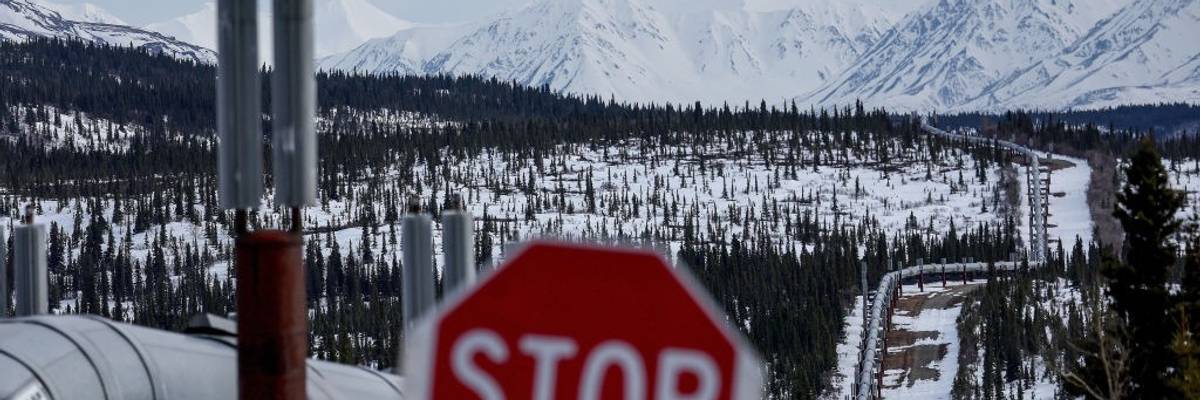
A part of the Trans Alaska Pipeline System runs through boreal forest past Alaska Range mountains on May 5, 2023 near Delta Junction, Alaska.
The allure of quick profits from resource extraction often comes at the expense of long-term sustainability, not just for the environment but for taxpayers too.
Alaska's vast wilderness and abundant natural resources have long been a source of pride and a cornerstone of its economy, supporting sustainable industries like fishing and tourism and resource development like logging, mining, and drilling. With large swaths of open lands and waters, spectacular views, abundant wildlife, and unique geological elements like volcanos and glaciers, Alaska holds an almost mythical allure for Americans. There is a perception of endless opportunity, but these riches also come with responsibility—both for Alaskans and for the rest of the nation.
Recently, U.S. President Donald Trump signed a sweeping executive order titled "Unleashing Alaska's Extraordinary Resource Potential," aiming to boost oil and gas drilling, mining, and logging in the state by rolling back numerous protective actions implemented by the Biden administration. While this move has been met with enthusiasm by some state leaders, others urge caution considering the environmental and fiscal responsibilities that would ensue if its intentions were realized.
Alaska is unlike any other state when it comes to natural resources. About 61% of Alaska's land is owned by the federal government, meaning what happens in Alaska is not only a local matter, it is also a national one. The executive order impacts public lands that belong to all Americans and some that are sacred to Indigenous peoples. Protecting Alaska's wild lands and resources isn't just Alaska's responsibility; it's a shared duty for all of us.
President Trump's executive orders may promise economic growth, but they fail to account for the real costs of overextending our natural and financial resources.
And yet the push to exploit these lands often rests on flimsy economic premises that fail to stand the test of time. Take the North Slope Gasline; For 15 years, the state-owned Alaska Gasline Development Corporation (AGDC) has promoted this project as a game-changer, spending nearly half a billion dollars of public money. Despite this significant public investment, no tangible progress has been made. A new report, Alaska's Pipe Dream: The Economic Folly of the North Slope Gasline, released by a coalition of groups, reveals what many already suspected: AGDC continues to spend millions on a gasline that's no closer to fruition than when it was first proposed in 2008.
The numbers are grim. The latest version of the proposed 800-mile gasline for LNG export is projected to cost a staggering $44 billion, while global market trends are rapidly shifting away from fossil fuels toward renewable energy sources. Meanwhile, Alaska continues to write checks—nearly $500 million so far—hoping for a miracle that seems increasingly unlikely.
Imagine what could have been done with that money: better schools, improved healthcare, resilient infrastructure, or renewable energy investments that would genuinely prepare Alaska for the future. Instead, the state continues to sink public dollars into a project that doesn't pencil out, hoping it will magically deliver economic salvation.
In addition to being an economic bust, the gasline would exacerbate global warming, locking in extensive fossil fuel use for decades into the future. With its effects on warming 80 times greater than carbon dioxide on a short-term basis, addressing methane emissions is crucial in efforts to combat climate change and mitigate its impacts.
This is a cautionary tale for all Americans. The allure of quick profits from resource extraction often comes at the expense of long-term sustainability, not just for the environment but for taxpayers too. President Trump's executive orders may promise economic growth, but they fail to account for the real costs of overextending our natural and financial resources.
Alaska can't afford to be reckless with its land, money, or reputation. Whether it's the AGDC's pipe dream or new drilling and mining projects, we need to ask tougher questions about who would benefit and at what cost. Rushing into poorly planned developments risks leaving future generations to clean up the mess—financially and environmentally.
For those who dream of traveling to Alaska to view bears, moose, caribou, eagles, whales, and sea otters in their natural habitats, this matters. For those who seek exceptional fishing, hiking, camping, kayaking, heli-skiing, and cultural experiences, this matters.
For those who cherish the idea of public lands remaining pristine and accessible, this matters. Alaska's resources belong to all Americans, and so does the responsibility of ensuring they're managed wisely.
Leaders in Alaska—and across the country—should learn from the past and make decisions that reflect the realities of today's economy and tomorrow's environmental needs. As an initial step, efforts to build the North Slope gasline should be abandoned. It's time to pull the plug on this ill-conceived venture and look to renewables to meet our current and future energy needs.
Dear Common Dreams reader, It’s been nearly 30 years since I co-founded Common Dreams with my late wife, Lina Newhouser. We had the radical notion that journalism should serve the public good, not corporate profits. It was clear to us from the outset what it would take to build such a project. No paid advertisements. No corporate sponsors. No millionaire publisher telling us what to think or do. Many people said we wouldn't last a year, but we proved those doubters wrong. Together with a tremendous team of journalists and dedicated staff, we built an independent media outlet free from the constraints of profits and corporate control. Our mission has always been simple: To inform. To inspire. To ignite change for the common good. Building Common Dreams was not easy. Our survival was never guaranteed. When you take on the most powerful forces—Wall Street greed, fossil fuel industry destruction, Big Tech lobbyists, and uber-rich oligarchs who have spent billions upon billions rigging the economy and democracy in their favor—the only bulwark you have is supporters who believe in your work. But here’s the urgent message from me today. It's never been this bad out there. And it's never been this hard to keep us going. At the very moment Common Dreams is most needed, the threats we face are intensifying. We need your support now more than ever. We don't accept corporate advertising and never will. We don't have a paywall because we don't think people should be blocked from critical news based on their ability to pay. Everything we do is funded by the donations of readers like you. When everyone does the little they can afford, we are strong. But if that support retreats or dries up, so do we. Will you donate now to make sure Common Dreams not only survives but thrives? —Craig Brown, Co-founder |
Alaska's vast wilderness and abundant natural resources have long been a source of pride and a cornerstone of its economy, supporting sustainable industries like fishing and tourism and resource development like logging, mining, and drilling. With large swaths of open lands and waters, spectacular views, abundant wildlife, and unique geological elements like volcanos and glaciers, Alaska holds an almost mythical allure for Americans. There is a perception of endless opportunity, but these riches also come with responsibility—both for Alaskans and for the rest of the nation.
Recently, U.S. President Donald Trump signed a sweeping executive order titled "Unleashing Alaska's Extraordinary Resource Potential," aiming to boost oil and gas drilling, mining, and logging in the state by rolling back numerous protective actions implemented by the Biden administration. While this move has been met with enthusiasm by some state leaders, others urge caution considering the environmental and fiscal responsibilities that would ensue if its intentions were realized.
Alaska is unlike any other state when it comes to natural resources. About 61% of Alaska's land is owned by the federal government, meaning what happens in Alaska is not only a local matter, it is also a national one. The executive order impacts public lands that belong to all Americans and some that are sacred to Indigenous peoples. Protecting Alaska's wild lands and resources isn't just Alaska's responsibility; it's a shared duty for all of us.
President Trump's executive orders may promise economic growth, but they fail to account for the real costs of overextending our natural and financial resources.
And yet the push to exploit these lands often rests on flimsy economic premises that fail to stand the test of time. Take the North Slope Gasline; For 15 years, the state-owned Alaska Gasline Development Corporation (AGDC) has promoted this project as a game-changer, spending nearly half a billion dollars of public money. Despite this significant public investment, no tangible progress has been made. A new report, Alaska's Pipe Dream: The Economic Folly of the North Slope Gasline, released by a coalition of groups, reveals what many already suspected: AGDC continues to spend millions on a gasline that's no closer to fruition than when it was first proposed in 2008.
The numbers are grim. The latest version of the proposed 800-mile gasline for LNG export is projected to cost a staggering $44 billion, while global market trends are rapidly shifting away from fossil fuels toward renewable energy sources. Meanwhile, Alaska continues to write checks—nearly $500 million so far—hoping for a miracle that seems increasingly unlikely.
Imagine what could have been done with that money: better schools, improved healthcare, resilient infrastructure, or renewable energy investments that would genuinely prepare Alaska for the future. Instead, the state continues to sink public dollars into a project that doesn't pencil out, hoping it will magically deliver economic salvation.
In addition to being an economic bust, the gasline would exacerbate global warming, locking in extensive fossil fuel use for decades into the future. With its effects on warming 80 times greater than carbon dioxide on a short-term basis, addressing methane emissions is crucial in efforts to combat climate change and mitigate its impacts.
This is a cautionary tale for all Americans. The allure of quick profits from resource extraction often comes at the expense of long-term sustainability, not just for the environment but for taxpayers too. President Trump's executive orders may promise economic growth, but they fail to account for the real costs of overextending our natural and financial resources.
Alaska can't afford to be reckless with its land, money, or reputation. Whether it's the AGDC's pipe dream or new drilling and mining projects, we need to ask tougher questions about who would benefit and at what cost. Rushing into poorly planned developments risks leaving future generations to clean up the mess—financially and environmentally.
For those who dream of traveling to Alaska to view bears, moose, caribou, eagles, whales, and sea otters in their natural habitats, this matters. For those who seek exceptional fishing, hiking, camping, kayaking, heli-skiing, and cultural experiences, this matters.
For those who cherish the idea of public lands remaining pristine and accessible, this matters. Alaska's resources belong to all Americans, and so does the responsibility of ensuring they're managed wisely.
Leaders in Alaska—and across the country—should learn from the past and make decisions that reflect the realities of today's economy and tomorrow's environmental needs. As an initial step, efforts to build the North Slope gasline should be abandoned. It's time to pull the plug on this ill-conceived venture and look to renewables to meet our current and future energy needs.
Alaska's vast wilderness and abundant natural resources have long been a source of pride and a cornerstone of its economy, supporting sustainable industries like fishing and tourism and resource development like logging, mining, and drilling. With large swaths of open lands and waters, spectacular views, abundant wildlife, and unique geological elements like volcanos and glaciers, Alaska holds an almost mythical allure for Americans. There is a perception of endless opportunity, but these riches also come with responsibility—both for Alaskans and for the rest of the nation.
Recently, U.S. President Donald Trump signed a sweeping executive order titled "Unleashing Alaska's Extraordinary Resource Potential," aiming to boost oil and gas drilling, mining, and logging in the state by rolling back numerous protective actions implemented by the Biden administration. While this move has been met with enthusiasm by some state leaders, others urge caution considering the environmental and fiscal responsibilities that would ensue if its intentions were realized.
Alaska is unlike any other state when it comes to natural resources. About 61% of Alaska's land is owned by the federal government, meaning what happens in Alaska is not only a local matter, it is also a national one. The executive order impacts public lands that belong to all Americans and some that are sacred to Indigenous peoples. Protecting Alaska's wild lands and resources isn't just Alaska's responsibility; it's a shared duty for all of us.
President Trump's executive orders may promise economic growth, but they fail to account for the real costs of overextending our natural and financial resources.
And yet the push to exploit these lands often rests on flimsy economic premises that fail to stand the test of time. Take the North Slope Gasline; For 15 years, the state-owned Alaska Gasline Development Corporation (AGDC) has promoted this project as a game-changer, spending nearly half a billion dollars of public money. Despite this significant public investment, no tangible progress has been made. A new report, Alaska's Pipe Dream: The Economic Folly of the North Slope Gasline, released by a coalition of groups, reveals what many already suspected: AGDC continues to spend millions on a gasline that's no closer to fruition than when it was first proposed in 2008.
The numbers are grim. The latest version of the proposed 800-mile gasline for LNG export is projected to cost a staggering $44 billion, while global market trends are rapidly shifting away from fossil fuels toward renewable energy sources. Meanwhile, Alaska continues to write checks—nearly $500 million so far—hoping for a miracle that seems increasingly unlikely.
Imagine what could have been done with that money: better schools, improved healthcare, resilient infrastructure, or renewable energy investments that would genuinely prepare Alaska for the future. Instead, the state continues to sink public dollars into a project that doesn't pencil out, hoping it will magically deliver economic salvation.
In addition to being an economic bust, the gasline would exacerbate global warming, locking in extensive fossil fuel use for decades into the future. With its effects on warming 80 times greater than carbon dioxide on a short-term basis, addressing methane emissions is crucial in efforts to combat climate change and mitigate its impacts.
This is a cautionary tale for all Americans. The allure of quick profits from resource extraction often comes at the expense of long-term sustainability, not just for the environment but for taxpayers too. President Trump's executive orders may promise economic growth, but they fail to account for the real costs of overextending our natural and financial resources.
Alaska can't afford to be reckless with its land, money, or reputation. Whether it's the AGDC's pipe dream or new drilling and mining projects, we need to ask tougher questions about who would benefit and at what cost. Rushing into poorly planned developments risks leaving future generations to clean up the mess—financially and environmentally.
For those who dream of traveling to Alaska to view bears, moose, caribou, eagles, whales, and sea otters in their natural habitats, this matters. For those who seek exceptional fishing, hiking, camping, kayaking, heli-skiing, and cultural experiences, this matters.
For those who cherish the idea of public lands remaining pristine and accessible, this matters. Alaska's resources belong to all Americans, and so does the responsibility of ensuring they're managed wisely.
Leaders in Alaska—and across the country—should learn from the past and make decisions that reflect the realities of today's economy and tomorrow's environmental needs. As an initial step, efforts to build the North Slope gasline should be abandoned. It's time to pull the plug on this ill-conceived venture and look to renewables to meet our current and future energy needs.