SUBSCRIBE TO OUR FREE NEWSLETTER
Daily news & progressive opinion—funded by the people, not the corporations—delivered straight to your inbox.
5
#000000
#FFFFFF
To donate by check, phone, or other method, see our More Ways to Give page.


Daily news & progressive opinion—funded by the people, not the corporations—delivered straight to your inbox.

US District Judge Thomas Griesa ordered "hold-out" investors on Thursday to explain why various sanctions on Argentina should not be lifted. The court order comes in light of Argentina proposing a $6.5 billion settlement to the groups popularly known as "vulture funds."
"Judge Griesa is appropriately pushing the funds to take the deal," said Eric LeCompte, the head of Jubilee USA and a UN debt expert who tracked the case for six years. "The hold-out funds won and should let Argentina return to the markets. I'm surprised they haven't taken a deal that results in such massive profits."
Argentina requested the order after it made the offer to the remaining investors last week. The deal constitutes a value of 75% of the original value of the defaulted debt. Two funds, Dart Management and Montreux Equity Partners, accepted the deal. However the deal can't move forward until four other principle funds accept it. The remaining hold-outs are Elliott Management, Aurelius Capital Management, Davidson Kempner Capital Management and Bracebridge Capital.
"These funds are poised to make a 1000% profit after buying the debt for pennies on the dollar," said LeCompte. "It's baffling why they wouldn't accept such a deal and Judge Griesa is starting to push them to take it."
According to Reuters who reviewed court papers, Argentina's lawyers are asking the judge to vacate injunctions that would let Argentina access capital markets to fund the settlements and force the remaining "hold-outs" to accept "reasonable terms."
The $6.5 billion offer must be approved by the remaining hedge funds involved in the dispute and then gain approval from a US judge and Argentina's legislature.
The dispute stems from Argentina's 2001 debt default. Afterwards, 92% of Argentina's investors accepted a settlement offer that restructured the South American country's debt. Among the groups that rejected the deal were a group of hedge funds that had bought Argentina's debt cheaply after the default. They sued Argentina in US courts and eventually won a ruling ordering Argentina not to pay the majority of its investors until it paid the "hold-outs" in full. During that legal dispute, the US government, International Monetary Fund and United Nations expressed opposition to the hold-outs' actions.
"On the downside, Argentina's settlement represents a validation of a predatory business model," noted LeCompte, whose organization filed a 2014 brief to the Supreme Court because it was concerned how the precedent could impact other countries. "We need financial structures in place to protect countries from this kind of behavior."
Read a timeline of Argentina's debt crisis
Read Jubilee USA's Amicus Brief to the Supreme Court
Jubilee USA Network is an interfaith, non-profit alliance of religious, development and advocacy organizations. We are 75 U.S. institutions and more than 750 faith groups working across the United States and around the globe. We address the structural causes of poverty and inequality in our communities and countries around the world.
(202) 783-3566"Obviously, they have issues with what is in that video, and that’s why they don’t want everybody to see it," Sen. Mark Kelly said of administration officials after the meeting.
US Defense Secretary Pete Hegseth said Tuesday that the Pentagon will not release unedited video footage of a September airstrike that killed two men who survived an initial strike on a boat allegedly carrying drugs in the Caribbean Sea, a move that followed a briefing with congressional lawmakers described by one Democrat as an "exercise in futility" and by another as "a joke."
Hegseth said that members of the House and Senate Armed Services committees would be given a chance to view video of the September 2 "double-tap" strike, which experts said was illegal like all the other boat bombings. The secretary did not say whether all congressional lawmakers would be provided access to the footage.
“Of course we’re not going to release a top secret, full, unedited video of that to the general public,” Hegseth told reporters following a closed-door briefing during which he and Secretary of State Marco Rubio fielded questions from lawmakers.
As with a similar briefing earlier this month, Tuesday's meeting left some Democrat attendees with more questions than answers.
“The administration came to this briefing empty-handed,” Senate Minority Leader Chuck Schumer (D-NY) told reporters. “If they can’t be transparent on this, how can you trust their transparency on all the other issues swirling about in the Caribbean?”
That includes preparations for a possible attack on oil-rich Venezuela, which include the deployment of US warships and thousands of troops to the region and the authorization of covert action aimed at toppling the government of longtime Venezuelan President Nicolás Maduro.
Tuesday's briefing came as House lawmakers prepare to vote this week on a pair of war powers resolutions aimed at preventing President Donald Trump from waging war on Venezuela. A similar bipartisan resolution recently failed in the Senate.
Rep. Gregory Meeks (D-NY), the ranking member of the House Foreign Affairs Committee and co-author of one of the new war powers resolution, said in a statement: “Today’s briefing from Secretaries Rubio and Hegseth was an exercise in futility. It did nothing to address the serious legal, strategic, and moral concerns surrounding the administration’s unprecedented use of US military force in the Caribbean and Pacific."
"As of today, the administration has already carried out 25 such strikes over three months, extrajudicially killing 95 people," Meeks noted. "That this briefing to members of Congress only occurred more than three months since the strikes began—despite numerous requests for classified and public briefings—further proves these operations are unable to withstand scrutiny and lack a defensible legal rationale."
Briefing attendee Sen. Mark Kelly (D-Ariz.)—who is in the administration's crosshairs for reminding US troops that military rules and international law require them to disobey illegal orders—said of Trump officials, "Obviously, they have issues with what is in that video, and that’s why they don’t want everybody to see it."
Defending Hegseth's decision to not make the boat strike video public, Sen. Markwayne Mullin (R-Okla.) argued that “there’s a lot of members that’s gonna walk out there and that’s gonna leak classified information and there’s gonna be certain ones that you hold accountable."
Mullin singled out Rep. Ilhan Omar (D-Minn.), who, along with the Somalian American community at large, has been the target of mounting Islamophobic and racist abuse by Trump and his supporters.
“Not everybody can go through the same background checks that need to be cleared on this,” he said. “Do you think Omar needs all this information? I will say no.”
Rejecting GOP arguments against releasing the video, Sen. Adam Schiff (D-Calif.) said after attending Tuesday's briefing: “I found the legal explanations and the strategic explanations incoherent, but I think the American people should see this video. And all members of Congress should have that opportunity. I certainly want it for myself.”
"This administration's racist cruelty knows no limits, expanding their travel ban to include even more African and Muslim-majority countries, even Palestinians fleeing a genocide," said Rep. Rashida Tlaib.
President Donald Trump faced sharp criticism on Tuesday after further expanding his travel ban—an effort the US leader launched during his first term, reinstated upon returning to office in January, and previously ramped up in June.
The Republican's new proclamation maintains full restrictions for people from Afghanistan, Burma, Chad, the Republic of the Congo, Equatorial Guinea, Eritrea, Haiti, Iran, Libya, Somalia, Sudan, and Yemen, and introduces them for travelers from Laos and Sierra Leone, who previously faced partial limitations.
Trump also added Burkina Faso, Mali, Niger, South Sudan, and Syria to that list, just days after he vowed to "retaliate" for an Islamic State gunman killing three Americans, including two service members, and wounding three others in Syria. Journalist James Stout warned that "expanding the travel ban to Syria leaves few options for the people who fought and defeated the Islamic State and are being increasingly threatened by the Syrian state."
While the US government does not recognize Palestine as a state—and has backed Israel's genocidal assault on the Gaza Strip—the president also imposed full restrictions on individuals holding travel documents issued by the Palestinian Authority.
"The harm isn't theoretical," stressed Etan Nechin, a New York-based reporter for the Israeli newspaper Haaretz. Pointing to Palestinian peace activist Awdah Hathaleen, who earlier this year was denied entry at San Francisco International Airport, deported, and then murdered by an Israeli settler in the West Bank, the journalist suggested that Trump and his allies know the consequences of the travel ban, and "they don't care."
As Common Dreams reported earlier Tuesday, Sudan, Palestine, and South Sudan topped the International Rescue Committee's annual humanitarian crisis forecast.
Trump's latest proclamation continues partial restrictions for Burundi, Cuba, Togo, and Venezuela, and adds such limitations for Angola, Antigua and Barbuda, Benin, Cote d'Ivoire, Dominica, Gabon, Gambia, Malawi, Mauritania, Nigeria, Senegal, Tanzania, Tonga, Zambia, and Zimbabwe.
It also lifts a ban on nonimmigrant visas for people from Turkmenistan but maintains the suspension of entry for them as immigrants, with a White House fact sheet stating the country "has engaged productively with the United States and demonstrated significant progress."
Writer Mark Chadbourn said, "It's a white nationalist list—mainly Africa, some Middle East, plus Haiti and Cuba."
Here is a map of the affected countries (excluding Tonga), to give you a sense of how much this new ban restricts immigration from Africa in particular.Of the newly-added country, Nigeria faces the largest impact, with tens of thousands of visas issued every year to Nigerians.
[image or embed]
— Aaron Reichlin-Melnick (@reichlinmelnick.bsky.social) December 16, 2025 at 3:58 PM
US Rep. Rashida Tlaib (D-Mich.), the only Palestinian American in Congress, said that "this administration's racist cruelty knows no limits, expanding their travel ban to include even more African and Muslim-majority countries, even Palestinians fleeing a genocide."
Tlaib also accused the president, along with his deputy chief of staff for policy and homeland security adviser, of wanting the United States to resemble a Ku Klux Klan event, declaring that "Trump and Stephen Miller won't be satisfied until our country has the demographics of a klan rally."
As the Associated Press noted:
The administration suggested it would expand the restrictions after the arrest of an Afghan national suspect in the shooting of two National Guard troops over Thanksgiving weekend...
The Afghan man accused of shooting the two National Guard troops near the White House has pleaded not guilty to murder and assault charges. In the aftermath of that incident, the administration announced a flurry of immigration restrictions, including further restrictions on people from those initial 19 countries who were already in the US.
Laurie Ball Cooper, vice president of US Legal Programs at the International Refugee Assistance Project, said in a statement that "IRAP condemns the Trump administration's escalating crackdown on immigrants from Muslim-majority and nonwhite countries. This expanded ban is not about national security but instead is another shameful attempt to demonize people simply for where they are from."
"Subjecting more people to this policy is especially harmful given the administration's recent invocation of the travel ban to prevent immigrants already living in the United States from accessing basic immigration benefits, including pulling them out of line at citizenship ceremonies," she continued.
"The expanded proclamation notably includes Palestinians and eliminates some exceptions to the original ban," she added. "This racist and xenophobic ban will keep families apart, but we are prepared to defend our clients, their communities, and the American values of welcome, justice, and dignity for all."
"This must stop," the United Nations agency for Palestinian refugees said in response to the ongoing Israeli blockade. "Aid must be allowed in at scale, now."
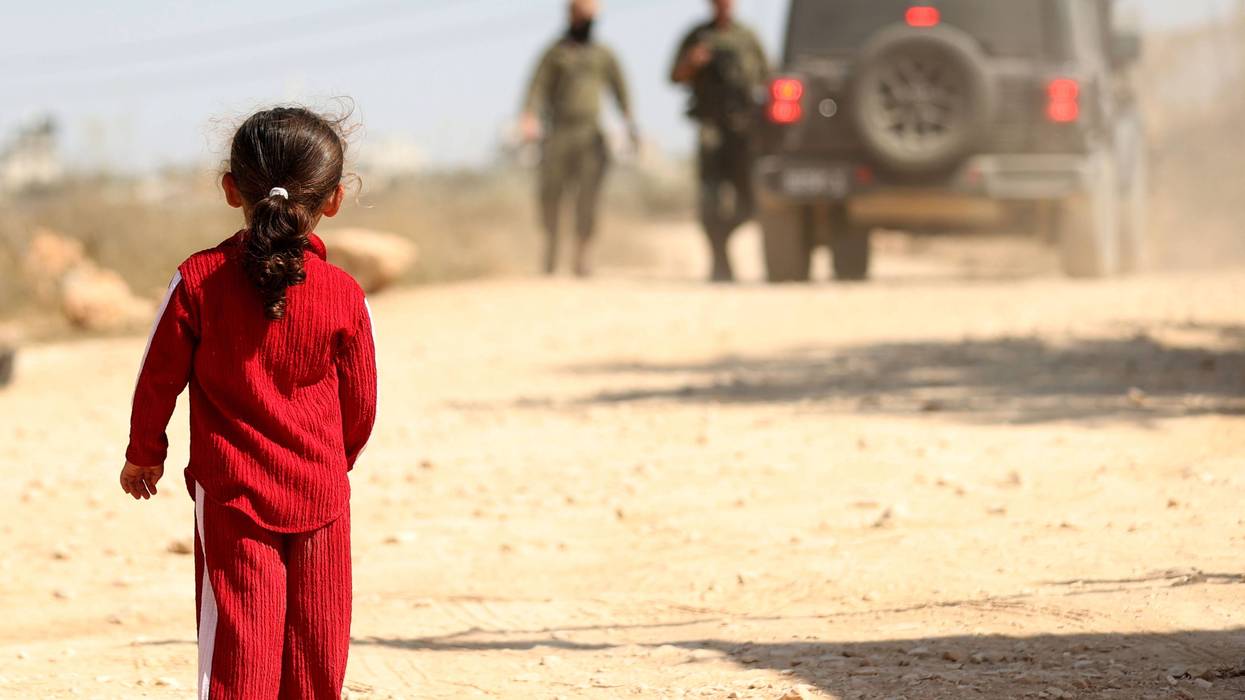
Yet another infant has died from hypothermia in Gaza as winter rain and wind continued to lash the embattled Palestinian exclave on Tuesday amid Israel's blockage of tents and other essential goods from the coastal strip.
Gaza's Health Ministry announced the death of 2-week-old Mohammed Khalil Abu al-Khair, who died Monday after his body temperature plummeted due to exposure as cold, heavy rains, and fierce winds continued to batter the strip. Storm conditions have exacerbated the suffering of residents already weakened by more than two years of Israeli bombardment, invasion, and siege.
The ministry said that al-Khair was one of at least 13 Palestinian children who have died in recent days due to Storm Byron and subsequent rains. Confirmed victims include Rahaf Abu Jazar, age 8 months; Hadeel al-Masri, age 9; and Taim al-Khawaja, an infant whose precise age is unclear.
The renewed hypothermia deaths follow those of more than a dozen Palestinians—most of them infants and children—who died from exposure during the first two winters of the Gaza genocide. While the strip does not experience severe winters, experts have noted that hypothermia can be deadly at temperatures over 60°F (15°C) in overexposed conditions such as those in Gaza.
Israel has imposed a crippling blockade on Gaza since 2007, which it tightened even further following the Hamas-led October 7, 2023 attack. This "complete siege" remains in place despite some loosening during the current tenuous truce, and has contributed to widespread starvation and sickness in the strip.
Since October 2023, Israeli forces have killed at least 70,667 Palestinians in Gaza, although experts contend the actual toll is likely far higher. More than 170,000 Palestinians have been wounded and approximately 9,500 others are missing and presumed dead and buried beneath rubble. Meanwhile, the overwhelmingly majority of Gaza's more than 2 million people have been forcibly displaced, usually more than once.
Noting the official death toll, the United Nations Office of the High Commissioner for Human Rights (OHCHR) said Tuesday that "94% of Gaza’s hospitals have been damaged or destroyed, leaving pregnant women and newborns without essential care."
“The Israeli blockade has also prevented the entry of objects indispensable to the survival of civilians, including medical supplies and nutrients required to sustain pregnancies and ensure safe childbirth,” the agency added.
Storm Byron is worsening the already dire living conditions of thousands of people living in tents or damaged shelters.While #UNRWAworks to support displaced families, the Israeli Authorities have been blocking UNRWA from directly bringing aid into #Gaza for months.Aid must be allowed in at scale.
[image or embed]
— UNRWA (@unrwa.org) December 16, 2025 at 9:02 AM
United Nations Children's Fund (UNICEF) communications chief Jonathan Crickx on Tuesday described a visit to one displaced persons camp in Gaza.
“Everything was completely damp... The mattresses were wet; the children’s clothes were wet," he recounted. "It’s extremely difficult to live in those conditions.”
“With the very poor hygiene conditions and very limited sanitation system available, we are extremely concerned to see the spreading of waterborne diseases," Crickx added.
Hunger remains a serious issue as well, with OHCHR citing the at least 463 Palestinians—including 157 children—who have died from malnutrition since October 2023 in what experts say is a deliberately planned Israeli starvation campaign.
The arrest warrants issued last year by the International Criminal Court accuse Israeli Prime Minister Benjamin Netanyahu and former Defense Minister Yoav Gallant of crimes against humanity and war crimes, including forced starvation and murder.