April, 19 2012, 09:05am EDT
For Immediate Release
Contact:
Tel: +44 (0) 20 7413 5566,After hours: +44 7778 472 126,Email:,press@amnesty.org
NTC must investigate death of another Tawargha man under torture
The Libyan National Transitional Council (NTC) must act immediately to investigate and prosecute abuses against the Tawargha community of black Libyans, Amnesty International said today, after another Tawargha man was tortured to death in a Misratah detention centre.
The body of 44-year-old father of two Barnous Bous'a was delivered to his family on 16 April. It was covered with bruises and cuts, including an open wound to the back of the head.
WASHINGTON
The Libyan National Transitional Council (NTC) must act immediately to investigate and prosecute abuses against the Tawargha community of black Libyans, Amnesty International said today, after another Tawargha man was tortured to death in a Misratah detention centre.
The body of 44-year-old father of two Barnous Bous'a was delivered to his family on 16 April. It was covered with bruises and cuts, including an open wound to the back of the head.
Barnous Bous'a was a civilian who fled his home in Kararim in western Libya during the armed conflict, settling in Sirte.
After his arrest by Misratah militias in October 2011 while fleeing further fighting in Sirte, he was reportedly held at a detention facility under the control of Misratah's Security Committee, a committee created under the Misratah local council.
"This brutal death highlights the continuing dangers to detainees in the new Libya," said Hassiba Hadj Sahraoui, Middle East and North Africa Deputy Director at Amnesty International. "How many more victims will die from torture until the authorities realize the gravity of the situation, and deliver on their promises of investigating, prosecuting and putting an end to such crimes?"
Amnesty International has documented more than a dozen deaths in custody at the hands of armed militias since September 2011, amid widespread torture of suspected al-Gaddafi loyalists and soldiers. A high proportion of the victims were Tawarghas.
The entire population of the city of Tawargha, some 30,000 people, has suffered abuses at the hands of armed militias in revenge to for their town's perceived loyalty to the former government, and for crimes some Tawargha are accused of having committed during the siege and shelling of the neighbouring city of Misratah by al-Gaddafi forces.
Militias from Misratah drove out the entire population of Tawargha in August 2011, looting and burning down their homes. Since then, armed militias from Misratah have been hunting down Tawarghas across Libya, snatching Tawargha men from camps for displaced people, homes, checkpoints and even hospitals.
Those abducted are brought back to detention centres in Misratah, where they are routinely tortured, in some cases to death. Hundreds of Tawarghas are believed to be detained in Misratah with fresh arrests reported to Amnesty International this week.
At least two Tawargha men have been taken from Tripoli since 12 April: one was arrested shortly after he left an IDP camp and the other was captured near his workplace. Their relatives have not been able to locate their exact whereabouts, but heard that both had been transferred to Misratah. There, they are at serious risk of torture and even death.
One relative pleaded to Amnesty International: "We are so afraid for the safety of all Tawarghas once they are taken to Misratah. We cannot bear to hear more bad news...We are not safe anywhere, we can't leave home, we are trapped. If we go out, we risk arrest too. We can't even leave and search for our relatives."
On Monday, Misratah's local leadership denied widespread reports of torture and other abuses committed by the city's militias, signalling that "reconciliation between the two towns [Misratah and Tawargha] was probably impossible at the moment" and that "some alternative solution for the Tawargha people" was needed.
"The leadership in Misratah is turning a blind eye to the mounting evidence of abuses committed at the hands of Misratah militias, arguing that only 'individual mistakes' take place," said Hassiba Hadj Sahraoui.
"It is imperative that the NTC now reins in these militias, investigates all abuses and prosecutes those responsible - on all sides - in accordance with international law. Only then will Libya begin to turn the page on decades of systematic human rights violations."
Amnesty International is a worldwide movement of people who campaign for internationally recognized human rights for all. Our supporters are outraged by human rights abuses but inspired by hope for a better world - so we work to improve human rights through campaigning and international solidarity. We have more than 2.2 million members and subscribers in more than 150 countries and regions and we coordinate this support to act for justice on a wide range of issues.
LATEST NEWS
'More Horrific Death and Destruction Will Come,' Warns Tlaib as Israeli Strike Kills Dozens of Iranian Kids
"These acts of war threaten to ignite a catastrophic regional war that will make no one safer while unleashing unconscionable suffering," said US Rep. Rashida Tlaib.
Feb 28, 2026
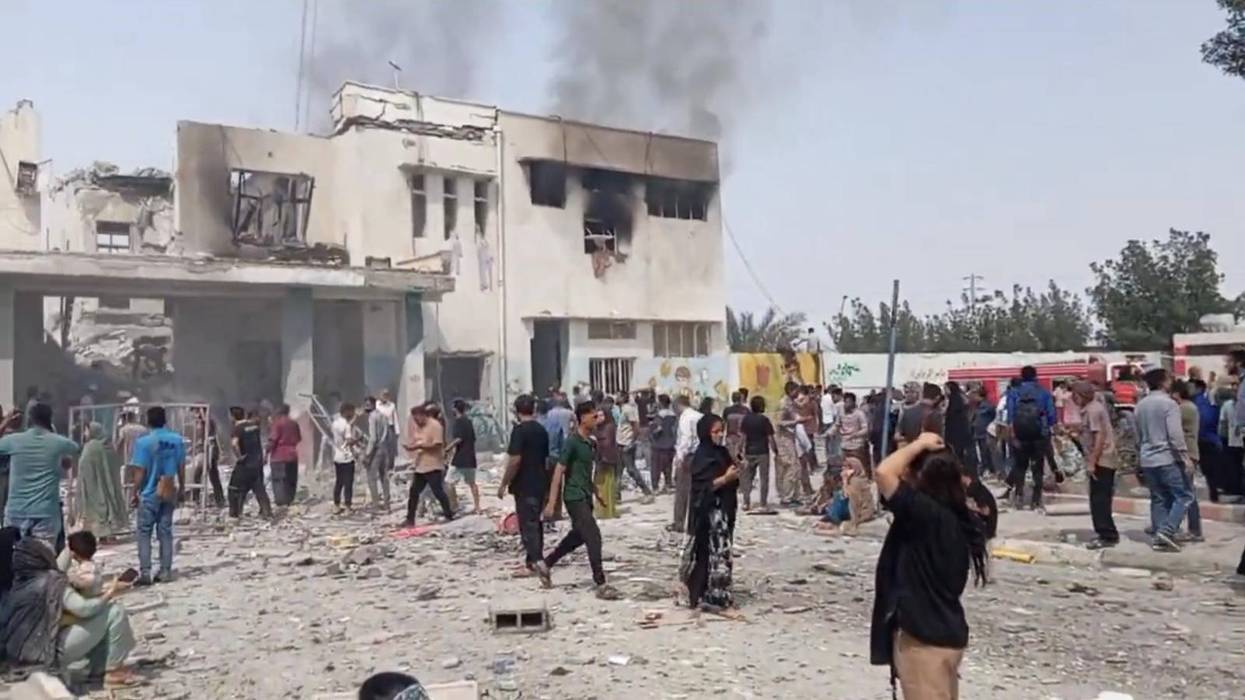
More than 50 young children were reportedly killed Saturday by an Israeli airstrike on southern Iran as the US and Israel carried out joint attacks across the country. A local official told Iranian state media that "an Israeli missile attack" hit a girls' elementary school in Minab.
Saturday is a school day in Iran. A school staff member told Middle East Eye that "you could hear the sound of children crying and screaming" following the strike.
“We still don’t know how many are under the rubble," said the unnamed staffer. "Some are even saying more than 100. Some of these small children are severely injured. Their parents have come to the school, and this place has turned into a house of mourning.”
Iranian media now report 40 killed and 48 students injured following the strike on a girls’ elementary school in Minab, as rescue and recovery efforts continue. https://t.co/kCR6Gagvip pic.twitter.com/faBFkgFn3D
— Ali Hashem علي هاشم (@Alihashem) February 28, 2026
Iranian Foreign Minister Abbas Araghchi wrote on social media that the school "was bombed in broad daylight, when packed with young pupils."
"Dozens of innocent children have been murdered at this site alone," he added. "These crimes against the Iranian people will not go unanswered."
Al Jazeera noted that "separately, Iran’s Mehr news agency reported that at least two students were killed by another Israeli attack that hit a school east of the capital, Tehran."
“Every war is a war on children," said Inger Ashing, CEO of the global humanitarian group Save the Children. "All children have the right to access a safe education, and schools should always be a haven for children—not a battlefield."
In a statement, US Rep. Rashida Tlaib (D-Mich.) alluded to the Minab school bombing as she condemned President Donald Trump for "acting on the violent fantasies of the American political elite and the Israeli apartheid government, ignoring the vast majority of Americans who say loud and clear: No More Wars."
"The Trump administration and Israeli regime’s illegal war of aggression on Iran has already killed dozens of children, and more horrific death and destruction will come," Tlaib warned. "These acts of war threaten to ignite a catastrophic regional war that will make no one safer while unleashing unconscionable suffering."
“President Trump will pretend this is about democracy and the rights of the Iranian people," she continued. "Don’t be fooled, Trump does not care about the Iranian people. The Iranian people are not pawns for the interests of foreign powers. Our government has imposed brutal sanctions that have destroyed the Iranian economy and the lives and livelihoods of millions of people. You cannot ‘free’ people by killing them and destroying their country."
Tlaib issued her statement shortly after Trump declared in a Washington Post interview that he decided to wage war on Iran to secure "freedom for the people." As of this writing, the White House has not responded to the Minab school massacre.
"I want a safe nation, and that’s what we’re going to have," Trump said as the US-Israeli onslaught hurled the Middle East into chaos.
Tlaib said in her statement that the US Congress "must stop the bloodshed by immediately reconvening to exert its war powers and stop this deranged president."
"But let’s be clear: Warmongering politicians from both parties support this illegal war, and it will take a mass anti-war movement to stop it," she added.
Keep ReadingShow Less
Demanding Action From Congress, Khanna Says 'The American People Are Tired of Regime Change Wars'
"We don't want to be at war with a country of 90 million people in the Middle East," said Democratic US Rep. Ro Khanna.
Feb 28, 2026
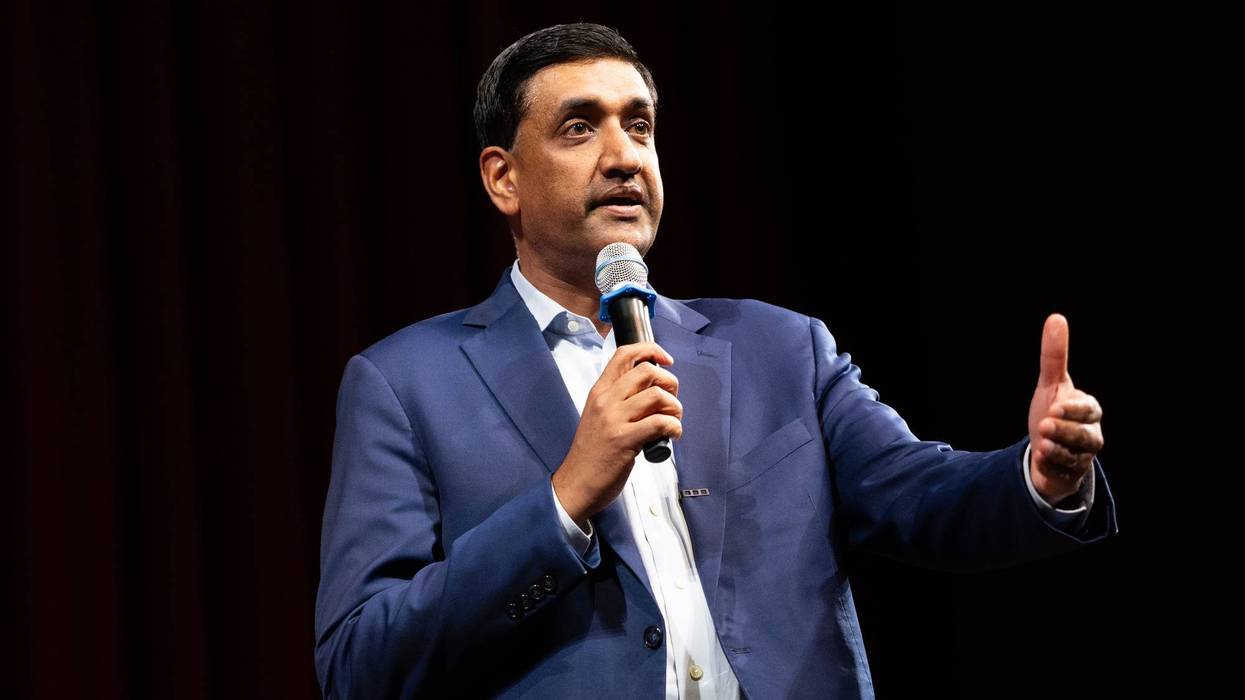
US Rep. Ro Khanna on Saturday demanded swift action from Congress to stop the Trump administration's unauthorized military assault on Iran, saying in a video posted to social media that "the American people are tired of regime change wars that cost us billions of dollars and risk our lives."
"We don't want to be at war with a country of 90 million people in the Middle East," said Khanna (D-Calif.), calling on Congress to reconvene for a vote on Monday.
"Every member of Congress should go on record today on how they will vote on Thomas Massie and my War Powers resolution," Khanna added, referring to the Kentucky Republican who is co-leading the measure.
If passed, the resolution would require the president "to terminate the use of United States Armed Forces from hostilities against the Islamic Republic of Iran or any part of its government or military, unless explicitly authorized by a declaration of war or specific authorization for use of military force against Iran."
The White House reportedly only notified some members of the House and Senate Armed Services Committees after the US-Israeli military assault on Iran began. According to Reuters, an Israeli defense official said that "the operation had been planned for months in coordination with Washington, and that the launch date was decided weeks ago."
Watch Khanna's remarks:
Trump has launched an illegal regime change war in Iran with American lives at risk. Congress must convene on Monday to vote on @RepThomasMassie & my WPR to stop this. Every member of Congress should go on record this weekend on how they will vote. pic.twitter.com/tlRi3Vz849
— Ro Khanna (@RoKhanna) February 28, 2026
Days prior to the US-Israeli attack on Iran, the House Democratic leadership announced it would force a vote next week on the Khanna-Massie War Powers resolution following reports that top Democrats were slowwalking the measure behind closed doors.
Senate Democrats also said they planned to vote next week on a War Powers resolution led by Sens. Tim Kaine of Virginia.
In a statement on Saturday, Kaine called the US attacks on Iran "illegal" and said that "every single senator needs to go on the record about this dangerous, unnecessary, and idiotic action."
“Has President Trump learned nothing from decades of US meddling in Iran and forever wars in the Middle East? Is he too mentally incapacitated to realize that we had a diplomatic agreement with Iran that was keeping its nuclear program in check, until he ripped it up during his first term?" Kaine asked. "These strikes are a colossal mistake, and I pray they do not cost our sons and daughters in uniform and at embassies throughout the region their lives. The Senate should immediately return to session and vote on my War Powers resolution."
The chances of a War Powers resolution getting through the Republican-controlled Congress are virtually nonexistent, even though the American public overwhelmingly opposes US military action against Iran. Senate Majority Leader John Thune (R-SD) and House Speaker Mike Johnson (R-La.) both issued statements applauding Trump for the unauthorized Saturday attacks.
Cavan Kharrazian, senior policy adviser to the advocacy group Demand Progress, said that "Trump has no authority to launch another war on his own."
"The Constitution is clear. The need for a War Powers resolution is clear. Congress decides when this country goes to war, not the president," said Kharrazian. "Next week, every member of Congress will have to choose. Side with illegal, endless war, or side with the American people and reject yet another regime change war in the Middle East. Like with Iraq, the choice they make will echo loudly for years to come.”
Keep ReadingShow Less
'The Behavior of Rogue States': Global Revulsion as US and Israel Launch War on Iran
"The attacks on Iran by Israel and the United States are illegal, unprovoked, and unjustifiable," said Jeremy Corbyn, an independent member of the UK Parliament.
Feb 28, 2026
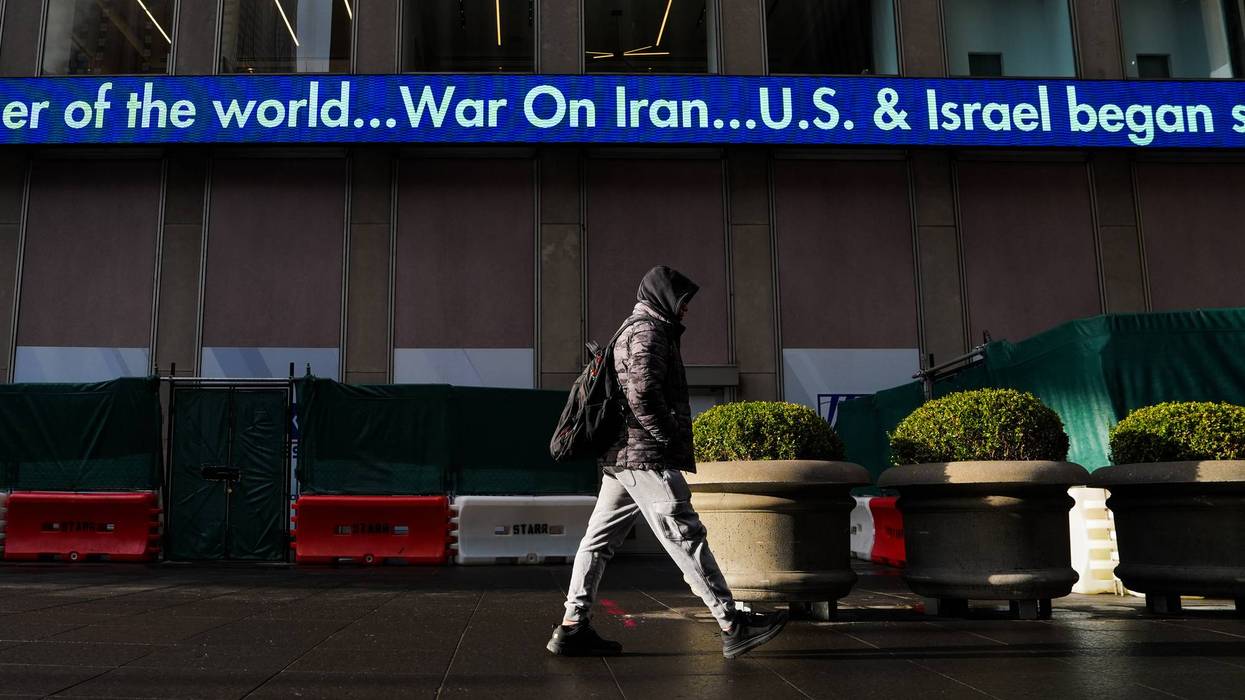
Elected officials, activists, and experts around the world voiced horror and outrage Saturday as US President Donald Trump and Israeli Prime Minister Benjamin Netanyahu jointly launched an illegal war on Iran with the explicit goal of toppling the nation's government, sparking chaos throughout the Middle East.
The wave of bombings, expected to mark the beginning of a wider assault, spurred airspace closures and flight cancellations across the region as countries braced for the fallout. While European leaders offered milquetoast responses to the unlawful military attack and Canadian and Australian officials openly endorsed it, leftist politicians and others unequivocally condemned the US and Israel as the aggressors.
"The attacks on Iran by Israel and the United States are illegal, unprovoked, and unjustifiable," said Jeremy Corbyn, an independent member of the British Parliament and former leader of the UK Labour Party. "Peace and diplomacy was possible. Instead, Israel and the United States chose war."
"This is the behavior of rogue states—and they have jeopardized the safety of humankind around the world with this catastrophic act of aggression," Corbyn added. "Our government must condemn this flagrant breach of international law, and urgently pursue a foreign policy based on justice, sovereignty, and peace."
Progressive International co-founder Yanis Varoufakis, the former finance minister of Greece, echoed Corbyn's criticism of the US and Israel as "rogue states."
"Israel and the USA," he wrote on social media, "have started a war not against Iran but against the whole world. We stand with Iranians, with humanity, against the notion that Israel and the US can bomb anyone their fancy takes them to bomb."
Badr Albusaidi, the foreign minister of Oman and the mediator of recent US-Iran talks, said he was "dismayed" by news of the US-Israel attacks on Iran, which were quickly followed by reports of horrific atrocities. Albusaidi said hours before the bombs started falling on Iran that a diplomatic resolution was within reach.
"Active and serious negotiations have yet again been undermined," Albusaidi lamented on Saturday. "Neither the interests of the United States nor the cause of global peace are well served by this. And I pray for the innocents who will suffer. I urge the United States not to get sucked in further."
Leftist Colombian President Gustavo Petro said he believes "President Donald Trump has made a mistake today" and implored the "helpless United Nations" to "convene immediately" in response to the US-Israel attacks and retaliation by Iran and allied groups in the region.
Iran vowed a "crushing" response to the US-Israeli onslaught, firing drones and missiles at Israel and pledging to hit US military installations in the region.
Al Jazeera reported that "Iran has targeted United States assets across the Gulf Arab states in retaliation for a huge joint attack on Iran by the US and Israel, as the region’s worst fears of being ignited in the flames of a sustained war loom."
"The Iranian government on Saturday confirmed its attacks on several targets, according to the Fars news agency, including Bahrain, Kuwait, Qatar, and the United Arab Emirates, where US airbases are hosted," the outlet noted.
Keep ReadingShow Less
Most Popular