

SUBSCRIBE TO OUR FREE NEWSLETTER
Daily news & progressive opinion—funded by the people, not the corporations—delivered straight to your inbox.
5
#000000
#FFFFFF
To donate by check, phone, or other method, see our More Ways to Give page.
Daily news & progressive opinion—funded by the people, not the corporations—delivered straight to your inbox.

Jenn Ettinger, 202-265-1490 x 35
At the upcoming February 8 meeting, the Federal Communications Commission plans to have a presentation on the "status of the comprehensive reform efforts to improve the agency's fact-based data-drive decision making." Now twenty-five organizations, including the National Organization for Women, Rainbow PUSH, National Hispanic Media Coalition, Office of Communication, Inc. of the United Church of Christ, Media Access Project, and Free Press, as well as twenty academics, have called on the Commission to analyze and make available to the public data it has already collected showing the extent to which minorities and women own broadcast stations.
Concerned that its data on minority and female ownership of broadcast stations was unreliable, the Commission changed its data collection process in 2009. The Commission directed broadcast station owners to file revised ownership forms by November 2009. The Commission also promised to make the data available to the public in a database that could be verified, searched and analyzed.
The Commission subsequently extended the filing deadline to July 2010. Although broadcast station owners filed the information at that time, the Commission still has not made the data available to the public in a usable form and has been unable to say when it will be available for public use.
The most recently available data, now several years old, showed that minorities, which comprised 33% of the population, owned only about 8% of commercial radio stations and just over 3% of television stations. Women, who made up 51% of the population, owned just under 6% of radio stations and 5% of television stations.
Georgetown Law Professor Angela Campbell, one of the signers of the letter, notes that the FCC is currently reviewing proposals that could affect - either positively or negatively - the opportunities for minorities and women to own broadcast stations. She supports the Commission's goal of improving its data collection and decision-making processes, but "the Commission cannot make fact-based, data-driven decisions if the Commission and the public do not have the necessary data."
Free Press was created to give people a voice in the crucial decisions that shape our media. We believe that positive social change, racial justice and meaningful engagement in public life require equitable access to technology, diverse and independent ownership of media platforms, and journalism that holds leaders accountable and tells people what's actually happening in their communities.
(202) 265-1490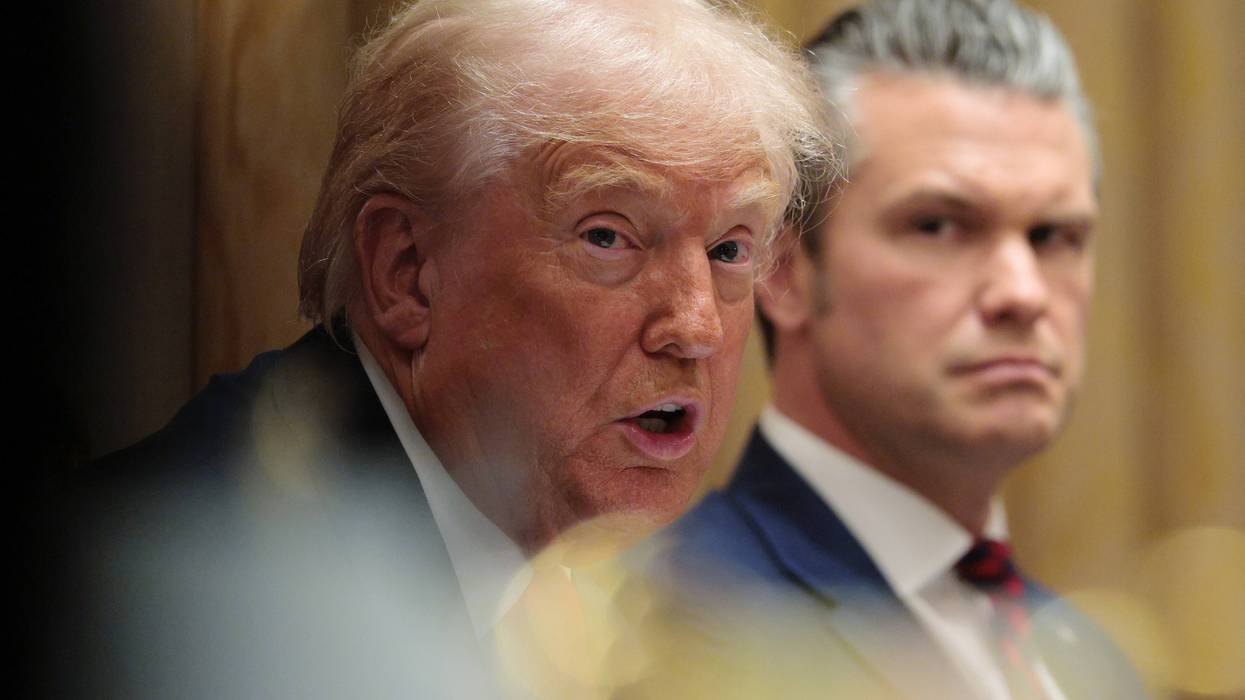
“The $1.5 trillion Pentagon budget request represents more than $9,000 per individual taxpayer."
As the Republican-controlled US Congress advances President Donald Trump's requested $1.5 trillion budget for "rebuilding" a military that's already more powerful than any armed force in human history, a group of former national security officials is urging Americans to challenge "out of control" Pentagon spending.
On Monday, the Eisenhower Media Network published a full-page advertisement in USA Today written by EMN executive director and retired Maj. Gen. Dennis Laich decrying what he called a military budget "of the Pentagon, by the Congress, and for the War Profiteers."
Invoking Thomas Paine's 1776 essay "Common Sense" and former Republican President Dwight D. Eisenhower's repeated warnings about the dangers of the then-burgeoning military-industrial complex, the ad asserts that "time and reason strongly suggest that the US 'defense' budget is out of control, unsustainable, and absent of accountability."
"Only the American people can rein it in," Laich argued.
The advertisement notes that the US military budget is already "larger than the next eight nations (most of whom are allies) in the world combined, while American citizens lack healthcare, childcare, and other basic needs."
The ad continues:
The defense industry’s lobbyists team up with US politicians, who receive campaign financing from the industry, to draft the annual National Defense Authorization Act, which sets military policy, the expensive weaponry to be purchased, and the overall military budget. The industry takes the ensuing windfall and puts it toward stock buybacks, which increase the share price, making the rich richer; dividend payments for shareholders; eight-figure annual compensation packages for corporate executives; and the continual political graft (campaign contributions and lobbyists) that keeps the wheel spinning. Incredibly, some contracts stipulate that only the contractor may repair and maintain equipment. The most embarrassing example of this practice is the F-35 stealth fighter, which is grossly over budget, behind schedule, and is only 25% fully mission capable.
"Money talks in America, but few members of Congress choose to talk about the $39 trillion national debt to which military spending is a major contributor," Laich wrote.
"Additionally, the Pentagon cannot tell the American taxpayer where the money went, since it is unable to pass a financial audit as required by law—something every other department of the federal government is able to do," the ad notes. "Now, they are requesting a 50% increase in the defense budget to $1.5 trillion. This is equivalent to your child asking for more money a day after receiving his/her allowance. When you ask what happened to the money he/she received yesterday, the child can’t answer the question, but yougive him/her more money regardless."
Laich accused "uniformed bureaucrats" of lacking "the courage to stand up against a draft dodger and a Rambo-wannabe," an apparent swipe at Trump and, perhaps, Defense Secretary Pete Hegseth.
Meanwhile, despite having the best-funded and most powerful military on paper, the ad points out that since World War II, "the US has won one war (the first Gulf War), lost four (Vietnam, Iraq, Afghanistan, and Iran), and tied one (Korea). Iran may be as much an embarrassment as a loss. The United States has failed to achieve its stated objectives in any recent war."
The ad asks, "What football coach could keep his job with a 1-4-1 record?"
"The $1.5 trillion Pentagon budget request represents more than $9,000 per individual taxpayer," EMN said. "If we Americans are tired of seeing our tax dollars spent on endless wars, bombing campaigns, and military excess while our own communities struggle with the costs of healthcare, childcare, education, and infrastructure, then the time has come to do what Thomas Paine asked Americans to do 250 years ago: challenge the assumptions that have become accepted simply because they are old."
"The courage required today is not to defeat an empire abroad, but to confront one at home—the military-industrial-congressional complex—and reclaim a government that serves the American people rather than the interests of perpetual war," the ad concludes.
EMN's advertisement follows an ad released by Hegseth in May touting Trump's $1.5 trillion proposal, which would add nearly $7 trillion to the US national debt over the next decade, according to the nonpartisan watchdog group Committee for a Responsible Federal Budget.
A survey conducted in May by ReThink Media and the Costs of War Project at Brown University's Watson Institute for International and Public Affairs revealed that nearly 60% of Americans believe the proposed Pentagon budget is too large, including 40% who say $1.5 trillion is “much too high” to spend on the military.
Last month, US Sen. Ed Markey (D-Mass.) introduced the Slash the Pentagon Act, which would set a hard cap of $750 billion on the amount Congress could authorize for national defense spending in fiscal year 2027.
"As Americans struggle to pay for healthcare, rent, electricity, groceries, and gas... Trump has spent over $100 billion on his expensive, dangerous, and unnecessary war with Iran," Markey said at a Capitol Hill press conference introducing the legislation. “We should invest in our hospitals, schools, affordable housing, and the real security American families need right now—not expensive wars and weapons that make us less safe.”

Critics noted that "20% of the value of any cargo is actually substantially MORE than Iran is seeking to charge ships to transit the strait."
Following fresh US airstrikes against Iran over the weekend, President Donald Trump said Monday that the United States would reimpose a naval blockade on the Mideast country, serve as the "guardian" of the Strait of Hormuz, and charge a 20% toll for cargo ships trying to safely travel on the key trade route.
Trump made the comments while calling in to "Fox & Friends" on Monday morning, as well as on his Truth Social platform.
"We're just gonna hit them very hard, and we're gonna keep the strait, and we'll probably run it. We'll become the guardian of the strait. Maybe we'll call it the guardian angel of the strait. And we should be reimbursed for that," Trump said on the Fox News morning show.
"When we do that, we're gonna be reimbursed, because the other nations are very wealthy. They're on our side, and we can't be expected to do that for nothing," the president said. "Now we're gonna guard it, and we're gonna get paid for guarding it—a lot of money."
Later Monday morning, Trump wrote on Truth that "the Hormuz Strait is OPEN, and will remain OPEN, with or without Iran. We are reinstating the THE IRANIAN BLOCKADE, so named because it is only stopping Iran's ships or customers from entering or leaving. All other countries will have fair and open use of the Strait."
"The U.S.A. will be, from this point forward, known as 'THE GUARDIAN OF THE HORMUZ STRAIT,' but as such, and as a matter of FAIRNESS, will be reimbursed, at the rate of 20% on all cargo shipped, for any and all costs necessary to do the job of providing safety and security to this very volatile section of the World," he added. "The process and formation will begin immediately."
Bloomberg energy and commodities columnist Javier Blas pointed to US Secretary of State Marco Rubio's remarks just a couple of weeks ago that "no country is allowed to charge tolls or fees on an international waterway."
Critics and experts were also quick to note that, as immigration attorney Aaron Reichlin-Melnick put on the platform X, "20% of the value of any cargo is actually substantially MORE than Iran is seeking to charge ships to transit the strait."
Trita Parsi, executive vice president of the Quincy Institute for Responsible Statecraft, quipped that it "seems like Trump just made a pitch for the Iranian toll system. :) Because the Iranians were going to charge $1 million per ship, which would amount to 1-2% of the value of the cargo of an oil tanker. But Trump is going to charge 20%! :)"
In an early Monday blog post, Parsi had written that "for all practical purposes, the US-Iran memorandum of (mis)understanding is over. The dispute over how to manage the Strait of Hormuz in the interim has pushed the two sides back into open war."
As Parsi explained:
The dispute over the strait turns, at least on the surface, on paragraph 5 of the MOU: whether Iran is responsible for safe passage throughout the strait for the duration of the agreement, or only for the waterway's northern corridor.
Beneath the surface, however, lies a more fundamental strategic disagreement. Even before the MOU was signed, Tehran believed Washington's objective was to establish a southern shipping corridor through Omani waters that would gradually erode Iran's control over the strait. Such a corridor would require Oman's cooperation, which may explain why Trump at one point threatened to bomb Oman unless it abandoned its proposal for joint management of the strait, with administrative fees collected by Muscat and Tehran.
The corridor would remain operational even if war resumed and Iran sought once again to close the strait. From Tehran's perspective, Washington used the MOU to strengthen this alternative route, and the US military's escort of commercial shipping without coordinating with Iran marked a significant step in that direction. If successful, the strategy would deprive Iran of its most important source of leverage—which is precisely why it appeals to Washington.
"This is why Tehran has insisted that all ships transiting the strait—regardless of the corridor they use—coordinate with Iran, consistent with its reading of paragraph 5 of the MOU," he continued. "Washington, by contrast, argues that the MOU merely assigns Iran responsibility for ensuring the safe passage of commercial vessels, without granting it operational control over all maritime traffic."
Sina Toossi, a senior nonresident fellow at the Center for International Policy, warned in a statement about Trump's Monday comments that "if implemented, the announced re-blockade would effectively restart the economic clock that the MOU had temporarily paused. Iran would once again face mounting pressure on its ability to export, store, and monetize oil, while the United States and the global economy would again confront the risks of prolonged disruption to Persian Gulf energy flows."
"The strategic environment, however, is no longer what it was before the war," he added. "US strategic petroleum reserves continued to decline during the MOU period and remain at historically low levels, while global inventories also remain tight. As a result, there is less cushion to absorb a prolonged supply disruption than in the previous round of fighting, increasing the risks of sharper energy price spikes, higher inflation, and broader economic disruption."
This article has been updated with comment from Sina Toossi.

Trump claimed to have "59% approval" while not a single pollster even has him above water. Meanwhile, oil prices are shooting back up after he restarted the war in Iran.
It is once again Opposite Day for President Donald Trump, who claimed in a late-night social media post that his approval rating is high and oil prices are dropping, neither of which is actually true.
"59 percent Approval Rating. Prices coming down along with the lowering of oil and gas. Thank you! President DJT," Trump wrote Sunday night on Truth Social.
Trump did not specify what poll had him at 59% approval, presumably because it does not exist. Not a single one of the polls tracked by The New York Times or RealClearPolling's aggregators shows Trump even breaking even with the public.
The Times average as of Monday morning has his approval rating at 39%, with 58% disapproval—on par with the worst metrics of his second term. RCP’s average is only slightly more merciful, showing the president’s approval at just under 40% and his disapproval at 57%.
Even the GOP-friendly pollster Rasmussen shows him with just 44% approval and 54% disapproval—generous outlier numbers for the president.
It is, of course, possible that Trump was referring to some heavily massaged poll that only he has seen, though he has a long history of inflating his popularity while claiming that polls showing otherwise are "fake news."
The price of oil, on the other hand, is something that can't be faked, though it didn't stop Trump from trying.
This weekend, Trump launched a new series of attacks against Iran, after declaring earlier in the week that the peace framework signed last month was “over” and saying negotiations were a “waste of time.”
Iran responded by announcing late Saturday night that it would seal off the Strait of Hormuz to most traffic, once again choking off a main route for global oil and gas transport.
Asked about the closure on Sunday, Trump told reporters, "I don't want to talk about it."
His post seems to reveal a further commitment to denying reality. Contrary to his claim about the "lowering of oil and gas," US gas prices on Monday averaged $3.87 per gallon, up from $3.80 a week earlier.
Meanwhile, the price of Brent crude has shot up by more than 9% over the past week, from $72 per barrel last Monday to nearly $79 as of this writing. At the time of Trump’s tweet, oil prices had already climbed by about 4% and continued to increase into Monday morning.
Prices are down from the war's height in the springtime, when gas surpassed $4.50 per gallon and a barrel of oil cost more than $110. But crude prices are still 9% higher than prewar, while gas is up about 31%, with companies capitalizing on the war to pad their profit margins at the expense of consumers and businesses.