SUBSCRIBE TO OUR FREE NEWSLETTER
Daily news & progressive opinion—funded by the people, not the corporations—delivered straight to your inbox.
5
#000000
#FFFFFF
To donate by check, phone, or other method, see our More Ways to Give page.


Daily news & progressive opinion—funded by the people, not the corporations—delivered straight to your inbox.

Anjuli Verma, (831) 471-9000 x11; averma@aclu.org
Hamedah
Hasan, a mother and grandmother serving her 17th year of a 27-year
federal prison sentence for a non-violent crime, asked President Obama
today to commute her remaining sentence. Hasan's petition was filed
with the U.S. Department of Justice's Office of the Pardon Attorney,
and was accompanied by almost 50 letters of support from prison
chaplains, community members, advocates, friends and family. The
American Civil Liberties Union represents Hasan in her commutation
petition.
"As our nation prepares to celebrate
President's Day, I am keenly aware that you - and you alone - Mr.
President, have the power to reunite me with my family," said Hasan.
"My intention is in no way to diminish the seriousness of my past
criminal actions or to deflect responsibility, but simply to ask for a
second chance. From everything I have observed, I believe you are a
compassionate and just man. I pray that you recognize my redeeming
qualities, see my 27-year sentence as excessive and grant me and my
family another chance to be together."
Hasan was convicted in 1993 for a
first time, non-violent crack cocaine conspiracy offense. Had Hasan
been convicted of the same crime involving the powder form of the drug,
she would have completed her prison sentence by now. This is because,
under federal law, it takes 100 times the amount of powder cocaine as
crack cocaine to trigger the same mandatory minimum sentence. The
impact of this disparity falls disproportionately on African Americans.
Although Hasan never used violence, never used drugs, had no previous
criminal record and played a peripheral role in the operation, the
United States Sentencing Guidelines at that time prescribed a sentence
of life in prison. Changes in the Sentencing Guidelines later resulted
in a reduction of Hasan's sentence to 27 years, over 16 of which she
has served with an outstanding behavior and work performance record.
"Hamedah's case is a textbook
example of how our nation's crack sentencing laws have produced
racially skewed and unfairly harsh sentences," said ACLU attorney Scott
Michelman. "Rarely does a commutation petition offer the president the
chance to redeem not just one person but also a larger aspect of our
nation's justice system."
In an unusual display of support for
a commutation petition by a federal judge, the Honorable Richard G.
Kopf, U.S. District of Nebraska, who sentenced Hasan in 1993, wrote a
letter to the Department of Justice Pardon Attorney's Office. In it,
Judge Kopf said, "...I can say, without equivocation, that Ms. Hasan is
deserving of the President's mercy. I have never supported such a
request in the past, and I doubt that I will support another one in the
future. That said, in this unique case, justice truly cries out for
relief."
In June 2009, the Honorable Laurie
Smith Camp, U.S. District of Nebraska, called Hasan's 27-year sentence
"unreasonable and excessive" and issued a dramatic downward departure
to 12 years, time served, which would have freed Hasan. Five days
later, Judge Smith Camp reluctantly reversed herself "with profound
regret and sincere apology to Defendant, Hasan," ruling that recent
changes in sentencing law did not apply to Hasan.
President Obama, Vice President
Biden and Attorney General Holder have publicly called for equalization
of federal sentences for crack and powder cocaine, and the U.S.
Sentencing Commission has called for reform of the crack-powder
sentencing disparity four times. President Obama's "Blueprint for
Change," published soon after he was elected in 2008, stated, "...the
disparity between sentencing crack and powder-based cocaine is wrong
and should be completely eliminated."
"By granting Hamedah Hasan's
petition, President Obama can signal to Congress and to the nation that
he's serious about restoring fairness to our criminal justice system,"
said Michelman.
Legislation is pending in the U.S.
House of Representatives and Senate. The Fairness in Cocaine Sentencing
Act, H.R.3245, introduced by Representative Robert Scott (D-VA), and
the Fair Sentencing Act of 2009, S. 1789, introduced by Senator Richard
Durbin (D-IL), would greatly reduce or completely eliminate the
sentencing disparity between the two forms of the same drug. Even if
the proposed reforms pass into law, however, Hasan's sentence will
remain intact because the legislation does not explicitly guarantee
retroactive application to current prisoners.
Hasan's petition is the first of
several in a larger project, dubbed "Dear Mr. President, Yes You Can."
The Dear Mr. President Project brings together civil rights advocates,
legal scholars, law school clinics, pro bono counsel and others to urge
President Obama to depart from the practices of his immediate
predecessors and use the pardon and commutation power in a principled
way, consistent with his administration's position that the crack
Sentencing Guidelines have been far too harsh. The Project also aims to
promote the president's clemency power as a means to correct historical
injustices.
Baylor Law School professor and
former federal prosecutor Mark Osler, who is a founding member of the
Project, noted, "President Obama has gone 387 days (and counting)
without granting a single pardon or commutation. This makes him one of
the slowest-acting presidents in history to exercise the power of
forgiveness. Thomas Jefferson employed the pardon power to eliminate
the sentences of those convicted under the shameful Alien and Sedition
Acts. President John F. Kennedy granted over 100 commutations in less
than three years in office. President Lyndon Johnson commuted 226
sentences. It's time for President Obama to revive the noble and
necessary function of executive clemency in Hamedah Hasan's case."
Hasan is the mother of three
daughters, Kamyra, 16, to whom Hasan gave birth in prison, Ayesha, 21,
and Kasaundra, 26. Hasan also has two grandchildren.
Hasan's commutation petition materials are available at: www.dearmrpresidentyesyoucan.org
The American Civil Liberties Union was founded in 1920 and is our nation's guardian of liberty. The ACLU works in the courts, legislatures and communities to defend and preserve the individual rights and liberties guaranteed to all people in this country by the Constitution and laws of the United States.
(212) 549-2666"Sounds like Trump preparing himself an off-ramp and trying to dump the Hormuz mess on others," said one observer.
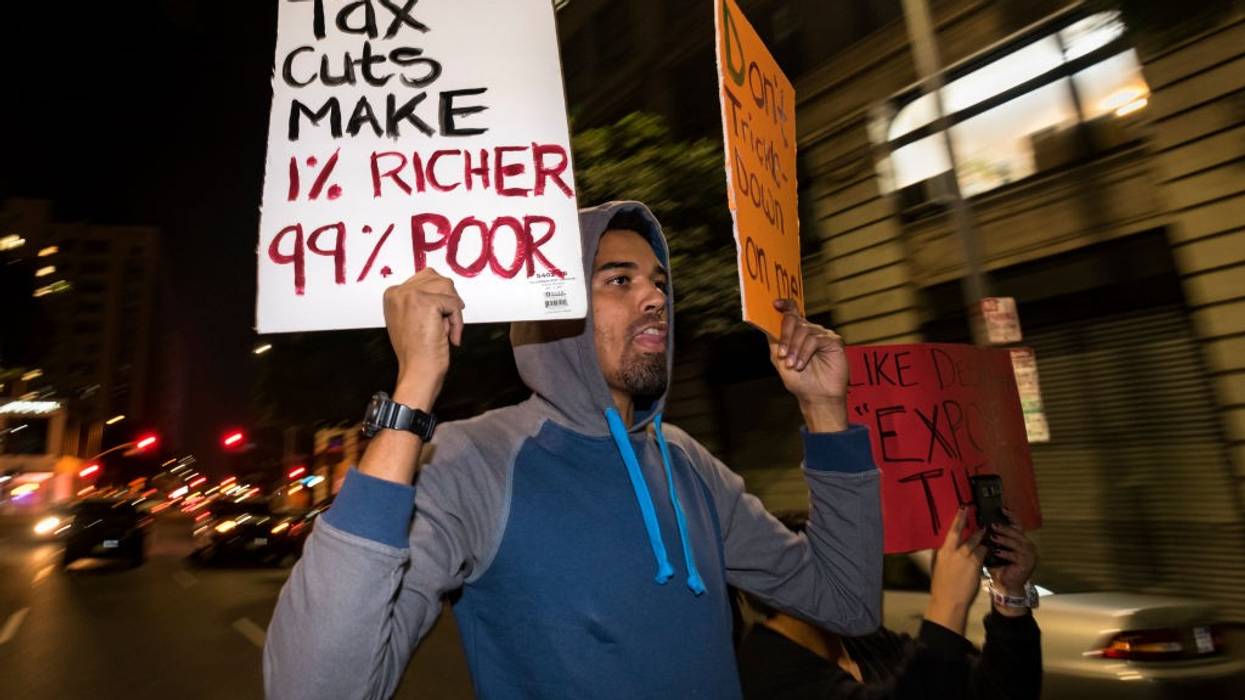
President Donald Trump on Friday continued to send contradictory messages on his plans for the US-Israeli assault on Iran, declaring that he is not interested in a ceasefire but is nevertheless considering "winding down" the three-week war, just two days after ordering thousands more troops to the Middle East
Trump wrote on his Truth Social network, "We are getting very close to meeting our objectives as we consider winding down our great Military efforts in the Middle East with respect to the Terrorist Regime of Iran."
Separately, the president told reporters Friday that he does not "want to do a ceasefire" in Iran.
This, after the president reportedly ordered 4,000 additional US troops deployed to the Mideast. On Friday, an unnamed US official told Axios that Trump is considering sending even more troops in order to secure the opening of the Strait of Hormuz and possibly occupy Kharg Island, home to a port from which around 90% of Iran's crude oil is exported.
Sound like Trump preparing himself an offramp and trying to dump the Hormuz mess on others. But as it is Trump, who knows and this could change in short order.
[image or embed]
— Brian Finucane (@bcfinucane.bsky.social) March 20, 2026 at 2:21 PM
Trump also said Friday that the Strait of Hormuz must be "guarded and policed" by other nations that use the vital waterway, through which around 20 million barrels of oil passed daily before the war.
Some observers questioned the timing of Trump's "winding down" post. Investment adviser Amit Kukreja said on X that Trump "obviously saw the market reaction towards the end of the day," and "now once again, he’s trying to convince everyone that the war is done; just not sure if the market believes it anymore."
Others mocked Trump's assertion—which he has repeated for two weeks—that the war is almost won, and his claim that he is winding down the operation as he sends more troops and asks Congress for $200 billion in additional funds.
Still others warned against sending US ground troops into Iran—a move opposed by more than two-thirds of American voters, according to a Data for Progress survey published Thursday.
"I cannot overstate what a disastrous decision it would be for President Trump to order American boots on the ground in this illegal war and send US troops to fight and die in Iran," Sen. Elizabeth Warren (D-Mass.) said Friday on social media.
Noting other Trump contradictions—including his declaration that "we're flying wherever we want" and "have nobody even shooting at us" a day after a US F-35 fighter jet was hit by Iranian air defenses—Chicago technology and political commentator Tom Joseph said Friday on X that "Trump has no idea what he’s doing."
"Call out Trump’s incompetence. This war is like a cartoon to him. He desperately needs a series of a catastrophes to distract from Epstein so he’s letting it happen," Joseph added, referring to the late convicted child sex criminal and former Trump friend Jeffrey Epstein. The war is solvable, but Trump has to go be removed from office first."
"It's unfortunate that it took this long for the Pentagon's ridiculous policy to be thrown in the trash," said one press freedom advocate.
A federal judge in Washington, DC blocked the US Department of Defense's widely decried press policy on Friday, which The New York Times and reporter Julian Barnes had argued violates their rights under the First and Fifth amendments to the Constitution.
The Times filed its lawsuit in December, shortly after the first briefing for the "Pentagon Propaganda Corps," which critics called those who signed the DOD's pledge not to report on any information unless it is explicitly authorized by the Trump administration. Journalists who refused the agreement turned over their press credentials and carried out boxes of their belongings.
"A primary purpose of the First Amendment is to enable the press to publish what it will and the public to read what it chooses, free of any official proscription," Judge Paul Friedman, who was appointed to the US District Court for DC by former President Bill Clinton, wrote in a 40-page opinion.
"Those who drafted the First Amendment believed that the nation's security requires a free press and an informed people and that such security is endangered by governmental suppression of political speech," he continued. "That principle has preserved the nation’s security for almost 250 years. It must not be abandoned now."
Friedman recognized that "national security must be protected, the security of our troops must be protected, and war plans must be protected," but also stressed that "especially in light of the country's recent incursion into Venezuela and its ongoing war with Iran, it is more important than ever that the public have access to information from a variety of perspectives about what its government is doing—so that the public can support government policies, if it wants to support them; protest, if it wants to protest; and decide based on full, complete, and open information who they are going to vote for in the next election."
The newspaper said that Friday's ruling "enforces the constitutionally protected rights for the free press in this country. Americans deserve visibility into how their government is being run, and the actions the military is taking in their name and with their tax dollars. Today's ruling reaffirms the right of the Times and other independent media to continue to ask questions on the public's behalf."
The Times had hired a prominent First Amendment lawyer, Theodore Boutrous Jr. of Gibson Dunn, who celebrated the decision as "a powerful rejection of the Pentagon's effort to impede freedom of the press and the reporting of vital information to the American people during a time of war."
"As the court recognized, those provisions violate not only the First Amendment and the due process clause, but also the founding principle that the nation's security depends upon a free press," Boutrous said. "The district court's opinion is not just a win for the Times, Mr. Barnes, and other journalists, but most importantly, for the American people who benefit from their coverage of the Pentagon."
Seth Stern, chief of advocacy at Freedom of the Press Foundation, also welcomed the ruling, saying that "the judge was right to see the Pentagon's outrageous censorship for what it is, but this wasn't exactly a close call. If the same issue was presented as a hypothetical question on a first-year law school exam, the professor would be criticized for making the test too easy."
"It's shocking that this sweeping prior restraint was the official policy of our federal government and that Department of Justice lawyers had the nerve to argue that journalists asking questions of the government is criminal," Stern declared. "Fifty years ago, the Supreme Court called prior restraints on the press 'the most serious and the least tolerable' of First Amendment violations. At the time, the court was talking about relatively targeted orders restraining specific reporting because of a specific alleged threat—like in the Pentagon Papers case, where the government falsely claimed that the documents about the Vietnam War leaked by Daniel Ellsberg threatened national security."
"Courts back then could never have anticipated the government broadly restraining all reporting that it doesn't authorize without any justification beyond hypothetical speculation," he added. "It's unfortunate that it took this long for the Pentagon's ridiculous policy to be thrown in the trash. Especially now that we are spending money and blood on yet another war based on constantly shifting pretexts, journalists should double down on their commitment to finding out what the Pentagon does not want the public to know rather than parroting 'authorized' narratives."
The Trump administration has not yet said whether it will appeal the decision in the case, which was brought against the DOD—which President Donald Trump calls the Department of War—as well as Defense Secretary Pete Hegseth and the Pentagon’s chief spokesperson, Sean Parnell.
"When the international community didn't stop Israel as it deliberately killed nearly 75,000 Palestinians in Gaza, including 20,000 children, Israel knew they could kill civilians with impunity," said one critic.
Eighty percent of Lebanese people killed in Israel's renewed airstrikes on its northern neighbor were slain in attacks targeting only or mainly civilians, a leading international conflict monitor said Friday.
Reuters, using data provided by the Madison, Wisconsin-based Armed Conflict Location and Event Data (ACLED), reported that 666 people were killed by Israeli strikes on Lebanon between March 1-16. As of Thursday, Lebanese officials said the death toll from Israeli attacks had topped 1,000.
While Lebanese authorities do not break down the combatant status of those killed and wounded during the war, Israel's targeting of civilian infrastructure, including entire apartment buildings, and reports of whole families being wiped out, have belied Israeli officials' claims that they do everything possible to avoid harming civilians.
Classified Israel Defense Forces (IDF) data leaked last year revealed that—despite Israeli government claims of a historically low civilian-to-combatant kill ratio—83% of Palestinians killed during the first 19 weeks of the genocidal war on Gaza were civilians.
According to Gaza officials, 2,700 families were erased from the civil registry in the Palestinian exclave during Israel's genocidal assault.
"When the international community didn't stop Israel as it deliberately killed nearly 75,000 Palestinians in Gaza, including 20,000 children, Israel knew they could kill civilians with impunity," Lebanese diplomat Mohamad Safa said on social media earlier this week. "The result is exactly what we're seeing in Lebanon and Iran right now."
US-Israeli bombing of Iran has killed at least 1,444 people, according to officials in Tehran. The independent, Washington, DC-based monitor Human Rights Activists in Iran (HRAI) says the death toll is over twice as high as the official count and includes nearly 1,400 civilians.
The February 28 US massacre of around 175 children and staff at an elementary school for girls in the southern city of Minab—which US President Donald Trump initially tried to blame on Iran—remains the deadliest known incident of the three-week war.
As Israeli airstrikes intensify and the IDF prepares for a possible ground invasion of southern Lebanon—which Israel occupied from 1982-2000—experts are warning that noncombatants will once again pay the heaviest price.
United Nations officials and others assert that Israel's intentional attacks on civilians are war crimes. Israel is the subject of an ongoing genocide case filed by South Africa at the International Court of Justice, and the International Criminal Court has issued arrest warrants for Israeli Prime Minister Benjamin Netanyahu and former Defense Minister Yoav Gallant, who are accused of crimes against humanity and war crimes in Gaza.
"Deliberately attacking civilians or civilian objects amounts to a war crime," UN High Commissioner for Human Rights spokesperson Thameen al-Kheetan said earlier this week. "In addition, international law provides for specific protections for healthcare workers, as well as people at heightened risk, such as the elderly, women, and displaced people."
As was the case during Israel's bombing of Gaza and Lebanon following the October 7, 2023 attack, journalists are apparently being deliberately targeted again. Reporters Without Borders said in December that, for the third straight year, Israel was the world's leading killer of journalists in 2025.
"This was a deliberate, targeted attack on journalists," said RT correspondent Steve Sweeney after narrowly surviving an IDF airstrike on Thursday. "There's no mistake about it. This was an Israeli precision strike from a fighter jet."
"But if they think they’re going to silence us, if they think we're going to stay out of the field, they’re very, very much mistaken," he added.