

SUBSCRIBE TO OUR FREE NEWSLETTER
Daily news & progressive opinion—funded by the people, not the corporations—delivered straight to your inbox.
5
#000000
#FFFFFF
To donate by check, phone, or other method, see our More Ways to Give page.
Daily news & progressive opinion—funded by the people, not the corporations—delivered straight to your inbox.
The Brady Center has issued a report, Capital Under Fire, analyzing
the impact of a bill before the U.S. House of Representatives that
would eliminate most of the gun laws in the District of Columbia.
"It is hard to believe that the recent anniversary of the terrible
losses suffered on 9/11 will be followed so closely by the House
considering a bill threatening Homeland Security and our nation's
capital city," said Paul Helmke, President of the Brady Center. "This
proposal by the gun lobby would allow AK-47's, .50-caliber sniper
rifles, and other military-style weapons on the streets of D.C.
Congress needs to defeat this ill-considered proposal."
The Brady Center report highlights the real-world effects the bill,
H.R. 6691, could have on the Nation's Capital. It would allow people
to carry loaded assault weapons on city streets. It would remove
restrictions barring gun possession by people who have committed
violent or drug-related misdemeanor crimes unrelated to domestic
violence; by mental patients who had been voluntarily committed to a
mental institution; and even by the blind. Teenagers and children
would be allowed to carry assault and sniper rifles, as the bill
repeals all age restrictions on the possession of long guns. D.C.
would be barred from imposing any reasonable requirements on gun
possession, such as firearms proficiency or vision testing.
DC Police Chief Cathy L. Lanier told a Congressional committee on
September 9, 2008 to "imagine how difficult it will be for law
enforcement to safeguard the public, not to mention the new President
at the Inaugural Parade, if carrying semi-automatic rifles were
suddenly to become legal in Washington."
The report is available on the Brady Center website at https://www.bradycenter.org/xshare/pdf/reports/capital-under-fire.pdf.
Among its findings:
Proponents of the bill claim it is needed to "restore Second
Amendment rights in the District of Columbia" even though the Supreme
Court's June 26, 2008 decision on the Second Amendment in D.C. v.
Heller does not mandate the "any gun, anywhere" policy of H.R. 6691.
While that decision struck down D.C.'s ban on handguns in the home,
Justice Scalia wrote that a wide range of gun laws are "presumptively
lawful." This bill attempts to strip D.C. of virtually all its gun
laws while the D.C. government is in the midst of rewriting its laws to
protect the rights actually recognized in Heller.
Both The New York Times and The Washington Post have editorialized in strong opposition to the bill. Harry Jaffe, a columnist for the conservative D.C. Examiner newspaper
and self-described National Rifle Association member, wrote "the NRA is
pushing a bill in Congress that is so radical it could turn moderate,
sensible, reasonable gun owners against it."
A vote on H.R. 6691 could come as early as Tuesday, September 16, 2008.
Brady United formerly known as The Brady Center to Prevent Gun Violence and its legislative and grassroots affiliate, the Brady Campaign and its dedicated network of Million Mom March Chapters, is the nation's largest, non-partisan, grassroots organization leading the fight to prevent gun violence. We are devoted to creating an America free from gun violence, where all Americans are safe at home, at school, at work, and in our communities.
"Every time Palestinians and their supporters organize internationally, Washington reaches for the terrorism label to shut them down," said one critic.
Palestine defenders decried Tuesday's announcement by the Trump administration of US sanctions targeting four nonviolent campaigners involved in the recent humanitarian flotillas that tried to break Israel's illegal siege of Gaza.
The US Department of the Treasury said in a statement that its Office of Foreign Assets Control "is taking action against four individuals associated with the pro-Hamas flotilla organized by the US-designated Popular Conference for Palestinians Abroad (PCPA) that is attempting to access Gaza in support of Hamas."
The sanctioned individuals are Saif Abu Keshek, a Palestinian with Spanish and Swedish citizenship and PCPA leader who helped organize and lead Global Sumud Flotilla (GSF) missions; Jordan-based PCPA president Hisham Abdallah Sulayman Abu Mahfuz; Mohammed Khatib, who is based in Belgium and is the European coordinator for Samidoun, the Palestinian Prisoner Solidarity Network; and Jaldia Abubakra Aueda, Samidoun's coordinator in Madrid.
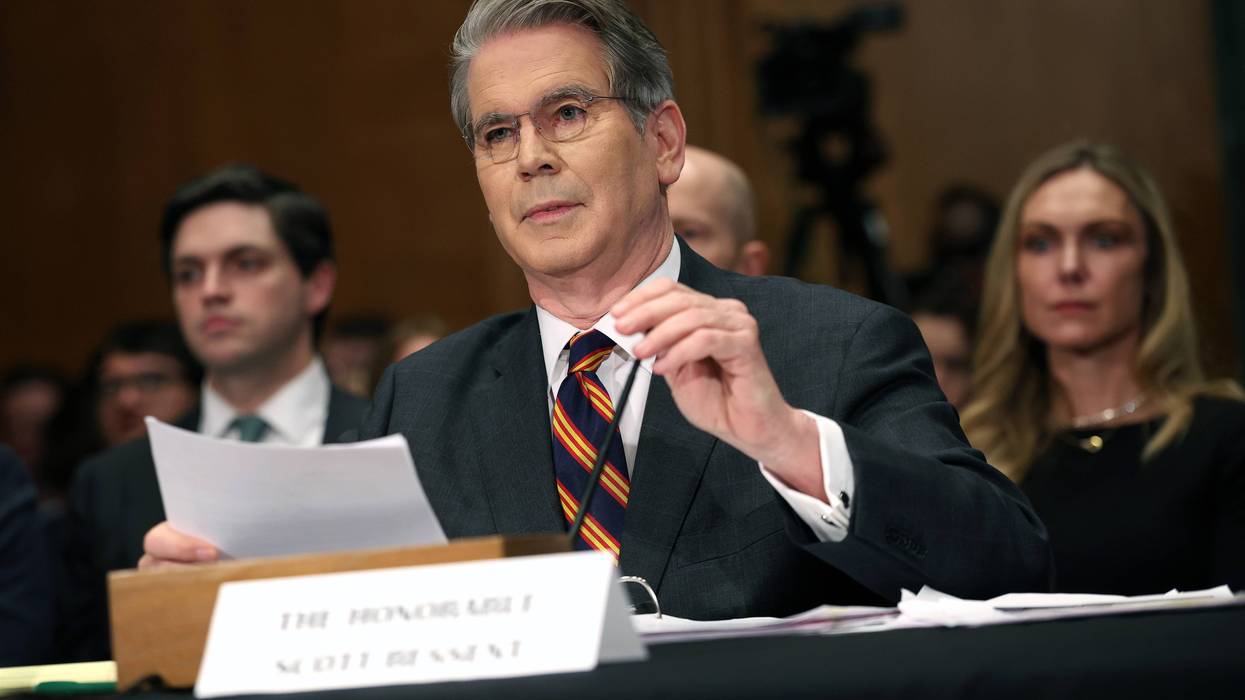
“The pro-terror flotilla attempting to reach Gaza is a ludicrous attempt to undermine President [Donald] Trump’s successful progress toward lasting peace in the region," Treasury Secretary Scott Bessent said in a statement Tuesday. “Treasury will continue to sever Hamas’ global financial support networks, no matter where in the world they are.”
There is no substantiated evidence that the Gaza flotillas are linked to Hamas. Meanwhile, United Nations experts, numerous national governments, human rights groups, and experts say Israel is perpetrating genocide, apartheid, colonization, occupation, and ethnic cleansing against Palestinians.
Samidoun called the sanctions—which freeze any of the targets' US assets and ban Americans from doing business with them—“the latest manifestation of the ongoing US genocidal war on the Palestinian people" and pointed to Israel's ongoing violent interception and seizure of GSF vessels on the high seas off the coast of Gaza.
“Today’s sanctions by the US come hand-in-hand with today’s Israeli piracy of the Global Sumud Flotilla and the Freedom Flotilla, and the abduction of hundreds of international activists at sea,” the group said in a statement. “All of these sanctions targeting Palestinian organizations, not only those targeting us, are aiding and abetting genocide."
Since the Hamas-led attack of October 7, 2023, the Biden and Trump administrations have supported Israel with tens of billions of dollars worth of armed aid and diplomatic cover, including vetoes of numerous United Nations Security Council Gaza ceasefire resolutions. Total US financial support for Israel since it was founded in 1948—largely via the ethnic cleansing of Palestinian Arabs—is approaching $300 billion in inflation-adjusted dollars.
Since returning to office, Trump has cracked down on pro-Palestinian activists, students, organizations, and foreign nationals. Critics—including advocacy groups, academics, and some judges—have condemned what they have called attacks on free speech, association, and academic freedom.
The Trump administration has sanctioned International Criminal Court Prosecutor Karim Khan and other numerous other ICC jurists after the Hague-based tribunal issued warrants for the arrest of Israeli Prime Minister Benjamin Netanyahu and former Defense Minister Yoav Gallant for alleged war crimes and crimes against humanity in Gaza. The ICC also issued arrest warrants for three Hamas leaders who were killed by Israeli attacks.
On Tuesday, far-right Israeli Finance Minister Bezalel Smotrich said that the ICC is also seeking his arrest, and that he would "fight back" by ordering the ethnic cleansing of hundreds of Palestinians from their homes in the illegally occupied West Bank.
The US administration has also sanctioned independent UN Palestine expert Francesca Albanese and her family—a move that was temporarily blocked earlier this month by a federal judge who asserted that the Italian humanitarian "has done nothing more than speak."
“Every time Palestinians and their supporters organize internationally, Washington reaches for the terrorism label to shut them down," Isabelle Hayslip, advocacy manager at Democracy for the Arab World Now, told Al Jazeera on Tuesday. "The net keeps widening. Palestinian diaspora communities now live under constant threat of designation for demanding their rights.”

"The number and cruelty of allegations compiled portray gross disregard by Israel of its duty to treat all detainees humanely."
A United Nations expert on Tuesday delivered a report offering evidence of systemic torture, brutality, and sexual abuse of Palestinian prisoners held in Israeli captivity.
Alice Jill Edwards, the UN special rapporteur on torture, said she had gathered substantial evidence of torture and sexual violence committed by Israeli authorities against Arab citizens of Israel as well as Palestinian detainees from Gaza and the West Bank.
After Hamas’ attack on October 7, 2023, Israel not only launched a military assault on Gaza but also introduced emergency detention measures that Edwards argued “exposed Palestinian detainees to torture, potentially unlawful deaths, incommunicado detention, and degrading conditions.”
Among other things, Edwards' report documents nine allegations of "rape, attempted rape, and threats of rape"; eleven allegations of "beatings, grabbing, electrocution, or mauling by dogs" of male detainees' genitals; 23 allegations of "beatings with weapons or other objects, kicking, and punching"; five allegations of electrocution by electric batons or other devices; and four allegations of forced kneeling for periods lasting up to a full day.
The report also notes that 94 Palestinians died in custody from October 2023 through August 2025, although it acknowledges that "a lack of transparency into the cause of these deaths makes it unclear which deaths are attributed to natural causes or unlawful conduct."
However, the report cites a review of 10 postmortem examinations of detainees who died in Israeli custody which found signs of physical abuse in five cases, and signs of bruising "consistent with beatings and use of restraints" in two cases.
"Findings also included multiple rib fractures, hemorrhages on the skin and near internal organs, and lacerations of intra-abdominal organs," the report adds. "One case documented intracranial hemorrhage resulting from a head injury apparently sustained during arrest."
Edwards said that the sheer volume of torture and abuse allegations documented in the report cannot be written off as the work of rogue actors.
"It is my view that the number and cruelty of allegations compiled portray gross disregard by Israel of its duty to treat all detainees humanely and without discrimination," she said, "and this has encouraged, tolerated, and condoned torture and ill-treatment, at times with support at ministerial and functional levels."
The descriptions of torture in Edwards' report echo recent reporting by New York Times columnist Nicholas Kristof, who wrote that his interviews with Palestinian detainees revealed "a pattern of widespread Israeli sexual violence against men, woman, and even children—by soldiers, settlers, interrogators in the Shin Bet internal security agency and, above all, prison guards."
"I think they're afraid of a working-class person," said firefighters union president Bob Brooks after a Republican PAC dumped $1 million to blunt his momentum in the Democratic Primary for Pennsylvania's 7th Congressional District.
Republicans are pulling out all the stops to prevent a working-class populist from snatching the Democratic nomination in the heart of Pennsylvania coal country on Tuesday and earning the right to challenge one of the GOP's most vulnerable incumbents, Congressman Ryan Mackenzie.
In the waning days of the Democratic primary for Pennsylvania's 7th congressional district, a deceptively named Republican-aligned political action committee (PAC) called Lead Left—created just weeks before—dumped $1 million into the race to run ads against Bob Brooks, a retired firefighter from Bethlehem and president of the largest firefighters' union in Pennsylvania.
Even in the GOP wave of 2024, the freshman congressman barely edged out the former Democratic Rep. Susan Wild, by about 4,000 votes. With Republicans' approval ratings collapsing nationwide, his seat in the Lehigh Valley has become one of the juiciest targets for Democrats in November.
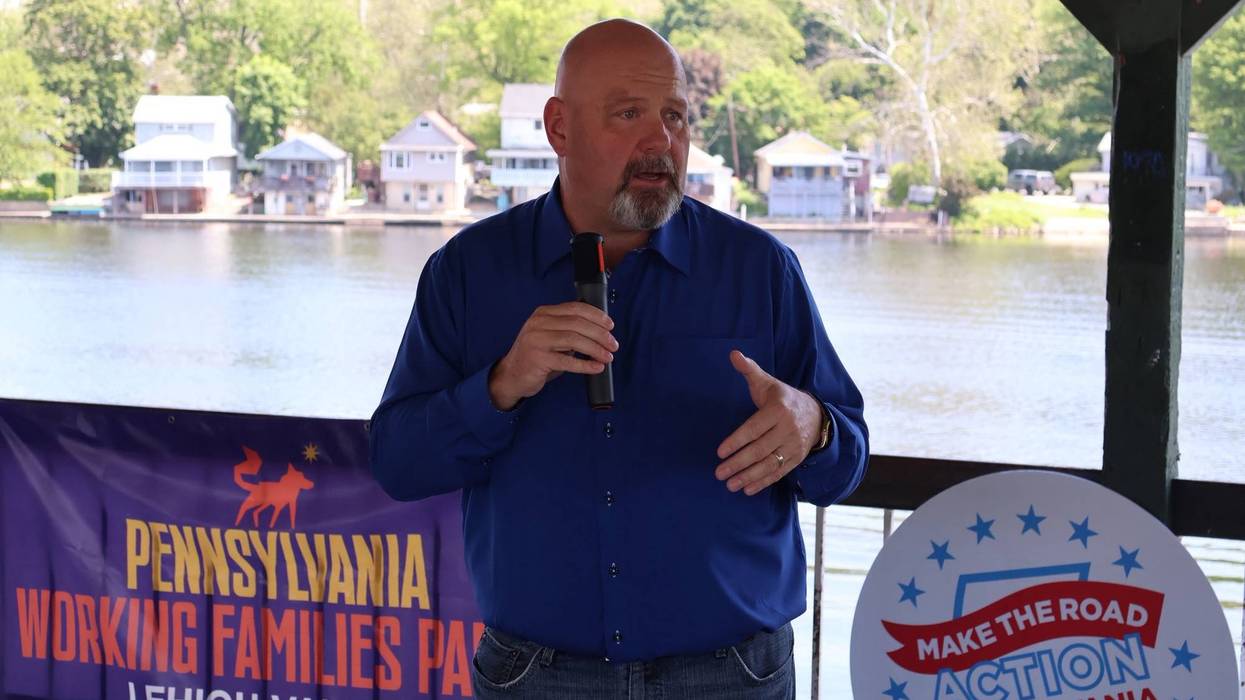
“I think they’re afraid of a working-class person,” Brooks said of Republicans’ decision to spend against him in the primary during a speech in Allentown on Sunday. “I think they’ve been voting against us for years, and they’re gonna continue to do that. They don’t want to see a working-class guy run against their boy in the general."
"I've worked every job this side of the Mississippi—most of them two, three jobs at a time," said Brooks, who worked as a bartender, dishwasher, snowplow driver, landscaper, and many other jobs before the age of 30, according to his campaign website. "Ryan Mackenzie's never had one. He's gone from Harvard to the state House, straight to Washington. It's about time he fills out an application."
Brooks—who advocates a progressive platform that includes Medicare for All, a repeal of Citizens United, an increased minimum wage, and policies to strengthen unions—has pulled into a comfortable lead in the four-way primary, with help from a broad coalition of backers that spans the ideological field of the Democratic Party.
He's attracted the expected progressive support, including from Sen. Bernie Sanders (I-Vt.), who has described him as someone with "the guts to stand up to corporate greed and a corrupt political system," and the Working Families Party, which praised him as an exemplar of "real working-class leadership," noting that he “spent time in dozens of jobs before becoming a firefighter and running into burning buildings.”
But Pennsylvania's centrist Democratic Gov. Josh Shapiro was also among his earliest big-name supporters, even though his opponents boasted deeper institutional ties to the state's Democratic Party. At a rally for Brooks on Sunday, Shapiro described him as someone who "understands what real people are dealing with, isn’t afraid of anybody, and... can bring people together to get stuff done.”
His roster of prominent supporters runs deep and wide. He has the backing of a slew of local unions and local politicians. He's secured both left-wing stalwarts like Justice Democrats and the Congressional Progressive Caucus and conservative Democrats in the Blue Dog PAC. And he's being cheered by big-name Democrats ranging from Sen. Ruben Gallego (Ariz.) to Sen. Elizabeth Warren (Mass.).
Brooks' broad appeal stands out at a time when Democrats have an opportunity to win back Rust Belt voters disillusioned as Trumpism decays into something without the barest figment of populist appeal.
Where Democrats would have once pushed for a reactionary Blue Dog or highly educated party lifer to run in a district like PA-07, Dustin Guastella, a research associate at the Center for Working Class Politics and the director of operations for Teamsters Local 623, described Brooks' surge toward the nomination over a trio of more credentialed insiders as a sign of a welcome shift in strategy.
"Working-class voters simply prefer blue-collar candidates. They like electricians and schoolteachers more than attorneys and executives. That’s because working-class candidates better speak to the economic challenges most workers face, and they do so in plain language," Guastella wrote in The Guardian on Tuesday.
"Brooks hasn’t had the privilege of a college education. He’s a veteran firefighter and now the head of the statewide firefighters union. His grandfather was a Teamster truck driver. He was raised by a single mother who worked as a bartender. He’s a varsity baseball coach at Nazareth High School," he said.
But Guastella noted that Brooks' appeal goes far beyond aesthetics. "How can progressives win back the working class? For those concerned with this question, populism has proven the obvious answer," he argued. He noted the success of other candidates in traditionally red constituencies like Nebraska, where independent Dan Osborn, a former union leader, looks poised to unseat Republican Sen. Pete Ricketts on the back of a similar worker-focused platform.
"He’s got what it takes to flip this district," Guastella said of Brooks. "Which is why the Republican Party is already spending big money to influence the election. That’s frustrating, but it’s also a sign that Brooks is a real threat."