Today, 107 leading religious
officials - including, Rev. Richard Cizik, National Association of
Evangelicals; Richard Stearns, President, World Vision; Rabbi Steve Gutow, Jewish
Council for Public Affairs; Rev. Dr. Michael Kinnamon, National Council of
Churches; Dr. Ingrid Matterson, Islamic Society of North America; Fr. Larry
Snyder, Catholic Charities USA; Rev. David Beckmann, Bread for the World; and
Rev. Jim Wallis, Sojourners - are calling for not just a charitable
response but for a just moral response to driving for resident-led human rights
based federal solutions helping families.
Three years after the current administration first promised
to rebuild the region devastated by Hurricanes Katrina and Rita, the slow pace
of recovery and recent devastation of hurricanes Gustav and Ike have created a
moral crisis in the Gulf
Coast. The collapse
of local institutions, homelessness, internal displacement, poverty, abusive
labor practices and environmental degradation in the Gulf Coast
demands a powerful response from people of faith. Diverse faith leaders
have partnered with the Gulf Coast Civic Works Campaign to call for bi-partisan
resident-led federal solutions helping families return and participate in
rebuilding their communities, creating living wage jobs, restoring the coastal
wetland and ensuring human rights in the Gulf Coast
region a national priority.
The Gulf Coast Civic Works Campaign is a
nonpartisan partnership of community, faith, environmental, student, and human
rights organizations in Alabama, Louisiana, and Mississippi and their national
allies advocating for federal legislation based on HR 4048, the Gulf Coast
Civic Works Act and urging national leaders to make creating jobs, rebuilding
infrastructure and affordable housing, and restoring natural flood protection
along the Gulf Coast a national priority.
Support this effort by contacting your member of Congress
at: https://www.colorofchange.org/gulfcoast/message.html.
[Copy of Statement]
Gulf
Coast Civic Works
Campaign Interfaith Statement
Supporting Human Rights in Gulf Coast
Recovery Is a Moral Priority
As Hurricanes Ike and Gustav
hit the Gulf Coast,
internally displacing over one million people, we as a nation were reawakened
to the needs of the Gulf
Coast. Three years after
Hurricanes Katrina and Rita struck and the levees breached, the slow pace of
recovery and the new needs caused by Ike and Gustav's destruction have
created a moral crisis along the Gulf
Coast that demands a
powerful response from people of faith.
While the nation has
learned to better prepare for this latest hurricane, whether by inaction or
injustice, we have still failed to protect the wellbeing of Gulf Coast
survivors, new residents and their families, especially the children, the poor,
the sick, and the vulnerable through just long term rebuilding policies which
fully support human rights. The collapse of local institutions, homelessness,
internal displacement, poverty, abusive labor practices and environmental
degradation mean they continue to suffer and struggle unduly. A spiritual wound
remains open across the region, one felt in God's creation and every community
across this country.
Our God is a God of
justice, of humanity and of healing, and this moral injustice calls each of us
to bold action in support of the common good. We must act to justly
rebuild communities, restore the Gulf
Coast, and empower
families to overcome the devastation they suffered in our nation's worst
natural disasters.
As people of faith and
as Americans we believe in transcendent human dignity and place our trust in
basic human rights. Many of the survivors of these disasters lack the resources
to return to their communities to reunite with their families. Many families
still have not recovered and have not been able to resume their lives with the
dignity and safety that are their right. New residents who came to work
in the recovery face hardships and abuses.
Gulf
Coast
communities continue to suffer from toxic trailers; closed schools, police
stations, and hospitals; a shortage of affordable housing; crumbling roads and
water systems; and workplace abuse.
As we have seen during
Hurricane Gustav, an inadequate flood protection system and accelerating
erosion of the wetlands left residents vulnerable to this and future disasters.
Through years of improper stewardship, preventable coastal erosion has
destroyed billions of dollars worth of natural flood protection and threatens
the homes, places of worship, schools, and businesses of those who live along
the Gulf Coast. This also threatens the security
of the majority of our nation's energy infrastructure, parts of which were
once built above land and now reside below salt water. The result is an
American human rights and national security crisis that requires the attention
all Americans, regardless of where they live, their faith, or their political
party.
Together Hurricanes
Katrina, Rita, Ike and Gustav killed more than 2,000 people. They destroyed
thousands of homes, businesses, and places of worship, causing over $150
billion in damages and displacing hundreds of thousands of families. Members of
diverse faith communions have responded generously, volunteering thousands of
hours to rebuild lives across Alabama, Louisiana, Mississippi
and Texas and
giving millions in charitable donations. Faith groups have formed powerful new
partnerships with local community leaders, non-profits, and other
denominations, to lead some of the most successful efforts in the recovery.
We have learned that
acts of faith and mercy alone, no matter how profound, cannot provide
everything needed for a sustainable recovery. Gulf Coast
families deserve a federal government that recognizes their needs by rebuilding
their communities, supporting basic human rights of all communities, addressing
poverty and displacement, and confronting coastal erosion. The government must
empower local communities to take the lead in rebuilding their neighborhoods,
renewing their lives, and restoring God's creation. We believe it is a
moral obligation for the federal government to fulfill its promises for Gulf Coast
recovery: empowering residents to return and participate in equitably
rebuilding their communities.
Now we are joining
community and faith leaders across Alabama, Louisiana, Mississippi
and Texas and calling on people of faith to
form a new partnership for a renewed and just federal Gulf
Coast recovery policy to put all Gulf Coast
communities, regardless of race, ethnicity or income, on the path to an
economically, socially and environmentally sustainable recovery.
We ask national leaders
of both parties, Democrats and Republicans, as they discuss the future of our
nation, to honor the third anniversary of Hurricanes Katrina and Rita and the
survivors of Hurricanes Ike and Gustav by pledging to fulfill these obligations
in the next Administration and Congress, including:
-
Passing policy based on the Gulf Coast Civic Works Act for a resident-led
partnership to rebuild vital public infrastructure, restore the environment,
and create good jobs and economic opportunities for residents and returning
displaced families to help create stronger, safer, and more equitable
communities;
-
Increasing funding for federal, state, and local partnerships in the Gulf Coast
to create more affordable housing and promote home-ownership for returning
families, workers, and residents moving out of unsafe FEMA trailers; and
-
Supporting federal funding to restore the coastal wetlands and barrier islands
that form the Gulf Coast's natural barriers to flooding and to build
improved levee systems to create a comprehensive flood control system which could
protect all Gulf Coast communities from another Category 5 storm.
Signed,
Rev. Richard Cizik, Vice President, National Association of Evangelicals*
Rabbi Steve Gutow, Executive Director, Jewish Council for Public Affairs
Rev. Dr. Michael Kinnamon, General Secretary, National Council of Churches
Dr. Ingrid Mattson, President, The Islamic Society of North America
Fr. Larry Snyder, President, Catholic Charities, USA
Rev. David Beckmann, President, Bread for the World
Richard Stearns, President, World Vision
Rev. Jim Wallis, President, Sojourners
The Rt. Rev. Wayne Burkette, President, The Moravian Church, Southern Province
The Rt. Rev. David L. Wickmann, President, The Moravian Church, Northern Province
Rev. Jacob Jang, General Secretary, Korean Presbyterian Church in America
The Most Reverend Dr. Katharine Jefferts Schori, Presiding Bishop, The Episcopal Church
Stanley Noffsinger, General Secretary, Church of the Brethren
Rev. Dr. John H. Thomas, General Minister and President, United Church of Christ
Rev. Dr. Sharon Watkins, General Minister and President, Christian Church (Disciples of Christ)
Rev. Jim Winkler, General Secretary, The United Methodist Church General Board of Church and Society
Dr. Robert C. Andringa, President Emeritus, Council for Christian Colleges and Universities
Roberta Avila, Executive Director, Mississippi Coast Interfaith Disaster Task Force
His Eminence Archbishop Vicken Aykazian, President, National Council of Churches
Dr. David R. Black, President, Eastern University*
Rev. Dr. Ken Brooker Langston, Coordinator, Disciples Center for Public Wellness, Church of Christ
Sr. Simone Campbell, Director, NETWORK, A National Catholic Social Justice Lobby
Dr. Tony Campolo, , Eastern University, St. David's, PA*
Dr. Iva Carruthers, General Secretary, Samuel Dewitt Proctor Convention
Rev. Alfred Carter, President, Bayou Interfaith Shared Community Organizing
Rev. Noel Castellanos, CEO, Christian Community Development Association
Charles Clements, President and CEO, Unitarian Universalist Service Committee
Dr. Luis Cortes, Executive Director, Nueva Esperanza
Dr. Paul Corts, President, Council for Christian Colleges and Universities*
Sr. Anne Curtis, RSM, Leadership Team, Institute of the Sisters of Mercy of the Americas
Marie Dennis, Co-President, Pax Christi International and Director, Maryknoll Office for Global Concerns
Rev. Dr. Bob Edgar, President, Common Cause, Former General Secretary of the National Council of Churches
Rabbi Jerome M. Epstein, Executive Vice-President, United Synagogue of Conservative Judaism
Rabbi Marla J. Feldman, Director, Commission on Social Action of Reform Judaism
Mary Fontenot, Executive Director, All Congregations Together
Rev. Dr. C. Welton Gaddy, President, Interfaith Alliance
Sharon Gauthe, Executive Director, Bayou Interfaith Shared Community Organizing
Sr. Donna Graham, OSF, Franciscan Justice and Peace Office and OFM for Province of St. John the Baptist
Dr. David Gushee, Presidents, Evangelicals for Human Rights*
Rev. Dr. Derrick Harkins, Treasurer, Senior Pastor, World Relief, Nineteen Street Baptist Church*
Rev. Dr. Leo Hartshorn, Minister of Peace and Justice, Mennonite Mission Network, U.S. Ministries
Dr. Frederick Haynes, III, Senior Pastor, Friendship West Baptist Church, Dallas, Texas
Dr. Obery Hendricks, Professor of Biblical Interpretation, New York Theological Seminary, Author of "The Politics of Jesus"*
Bishop Thomas J. Hoyt, Co-Chair, National Council of Churches Special Commission on the Just Rebuilding of the Gulf Coast
Dr. John Huffman, Senior Pastor, St. Andrew's Presbyterian Church*
Dr. George Hunsinger, Professor, Princeton Theological Seminary, Founder, National Religious Campaign Against Torture
Dr. Joel C. Hunter, Senior Pastor, Northland, A Distributed Church*
Dr. Ada Maria Isasi-Diaz, Professor of Christian Ethics and Theology, Drew University, Madison, NJ*
Rev. M. Linda Jaramillo, Justice and Witness Ministry, United Church of Christ
David E. Jehnsen, Chair of the Board, Every Church a Peace Church
Ven. Michael S. Kendall, President, Episcopal Network for Economic Justice
Hon. Kathleen Kennedy Townsend, Author of "Failing America's Faithful", former Lt. Gov. of Maryland and Board Member, RFK Memorial
Rabbi Asher Knight, , Temple Emanu-El, Dallas Texas
Chris Kromm, Executive Director, Institute for Southern Studies, Author of "Faith in the Gulf"
Rabbi Irwin Kula, President, The Center for Leadership and Learning
Dr. Peter Kuzmic, Distinguished Professor, Gordon Cornwell Theological Seminary
Rabbi Michael Lerner, Founder, TIKKUN and Network of Spiritual Progressives
Rev. Michael E. Livingston, Co-Chair, National Council of Churches Special Commission on the Just Rebuilding of the Gulf Coast
Dr. Jo Anne Lyon, Founder and CEO, World Hope International
Renaye Manley, Organizaing Director, Interfaith Worker Justice
Bishop A.C. "Chip" Marble Jr., Assisting Bishop, Diocese of North Carolina, Greensboro Office*
Dr. Molly T. Marshall, President and Professor of Theology and Spiritual Formation, Central Baptist Theological Seminary
Rev. Timothy McDonald III, President, African American Ministers in Action
Dr. Brian D. McLaren, best-selling Author, Pastor and intellectual leader of "emerging church,"*
Rev. LeDayne McLeese Polaski, Program Coordinator, Baptist Peace Fellowship of North America
Fr. T. Michael McNulty, SJ, Justice and Peace Director, Conference of Major Superiors of Men
Rev. Gail E. Mengel, Ecumenical and Interfaith Officer, Community of Christ
Rabbi Jack Moline, Chair of the Board, Interfaith Alliance and Senior Rabbi, Agudas Achim Congregation
Rev. Jethroe Moore, II, President, San Jose NAACP
Imam Abdul Malik Mujahid, Chair, Council of the Islamic Organizations of Greater Chicago
Dr. Pamela Nath, , Listening & Discernment, Mennonite Central Committee
Sr. Ann Oestreich, IHM, Congressional Coordinator, Congregation Justice Committee, Sisters of the Holy Cross
Vicky Partin, Lay Missioner, Chattahoochee Valley Episcopal Ministry
Dr. Ron Patterson, Executive Director, Christian Disaster Response
Sara Pottschmidt Lisherness, Director, Compassion, Peace, and Justice Ministries, Presbyterian Church USA
Sr. Claire Regan, Office of Justice and Peace, Sisters of Charity of New York
Rev. Carl W. Rehling, Director, Episcopal Diocese of Maryland, Diocesan Liaison for Justice and Peace
Sr. Jane Remson, O.Carm. Main Representative to UN, Carmelite NGO Congregation of Our Lady of Mount Carmel
Dr. Meg Riley, Director of Advocacy and Witness, Unitarian Universalist Association Congregation
Bill Robinson, President, Whitworth University*
Rev. Samuel Rodriguez, President, National Hispanic Christian Leadership Conference
Robert S. Runkle, Chair, Social Justice and Outreach Ministries Commission, Episcopal Diocese of Spokane
Dr. Andrew Ryskamp, Director, Christian Reformed World Relief Committee
Rev. Gabriel Salguero, Director, Hispanic/Latino Leadership Program, Princeton Theological Seminary*
Rev. Dr. Virginia Samuel, Interim Dean of Campus Life and Student Affairs, Drew University, Madison, NJ*
Sr. Marylin K. Scheib, Regional Administrative Office, Sisters of Mercy of the Regional Community of St. Louis
Rev. Bill Schulz, Chairman, Unitarian Universalist Service Committee Board of Directors
Rev. Dr. Ronald J. Sider, President, Evangelicals for Social Action
Dr. Ann E. Smith, President, Gamaliel Foundation
Rev.Dr. Cory Sparks, Chair, Commission on Stewardship of the Environment, Louisiana Interchurch Conference
Dr. Glen Harold Stassen, Lewis B. Smedes Professor of Christian Ethics, Fuller Seminary*
Rev. Ron Stief, Organizing Director, Faith in Public Life
Russ Testa, Executive Director, Franciscan Action Network
Rabbi Uri Topolosky, Senior Rabbi, Congregation Beth Israel, A Community Synagogue in New Orleans
Rev. Romal Tune, President, Clergy Strategic Alliances
Sr. Mari Turgi, CSC, Director, Holy Cross International Office
Rabbi Stewart Vogel, President, Southern California Board of Rabbis
Rabbi Brian Walt, Executive Director, Rabbis for Human Rights
Rabbi Arthur Waskow, Executive Director, Shalom Center
Alix Webb, Program Manager, The Poverty Initiative, Union Theological Seminary
Rev.Dr. C. David Williams, President, Union of Black Episcopalians
Dr. Lauren Winner, Assistant Professor of Christian Spirituality, Duke Divinity School, Duke University*
Rabbi David Wolpe, Senior Rabbi, Sinai Temple*
Dr. Aidsand Wright-Riggins III, Executive Director, National Ministries, American Baptist Church, USA
Dr. Amos Yong, Professor of Theology, Regent University School of Divinity*
Susan Youmans, Executive Director, Environmental Partnership
* Organization is listed for identification purposes only

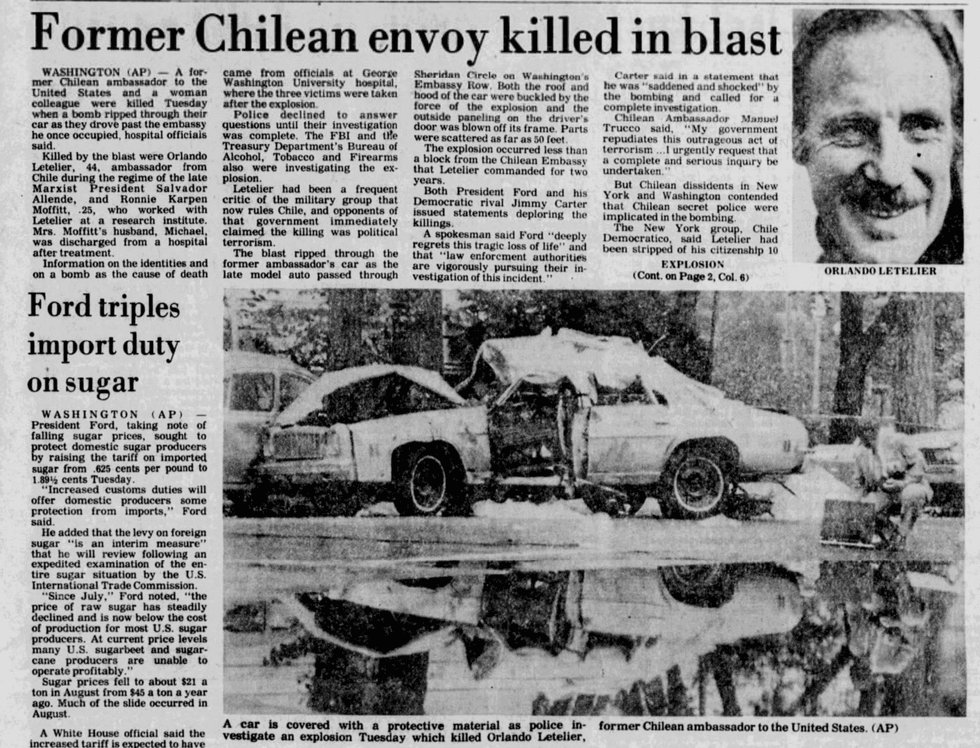 Associated Press coverage of the Letelier-Moffitt assassination, as published in the Fargo-Moorehead Forum on Sept. 22, 1976.