

SUBSCRIBE TO OUR FREE NEWSLETTER
Daily news & progressive opinion—funded by the people, not the corporations—delivered straight to your inbox.
5
#000000
#FFFFFF
To donate by check, phone, or other method, see our More Ways to Give page.
Daily news & progressive opinion—funded by the people, not the corporations—delivered straight to your inbox.
Phone (312) 782-6006
Doctors, nurses, consumers and community activists from throughout
New York State came together in Albany today to create a statewide
coalition to push for adoption of a single payer health care system at
the federal and state levels. Single Payer NY
will help coordinate grassroots education and outreach activities in
support of single payer throughout the state. They already have county
coordinators in two dozen counties.
"The American people overwhelmingly want health care for all. Labor, including the NYS AFL-CIO, have said they want health care to be a right through passage of HR 676. A
majority of doctors now want a single payer national health care system
because they are fed up dealing with the bureaucracy, delay and
confusion of the private health care system. Everyone who studies the
issue says of course it makes sense to eliminate the huge waste and
expense of private health insurance. For once, we need elected
officials to do what is right for Americans, not what is right for the
insurance and drug companies," said stated Mike Keenan, President, Troy
Area Labor Council and a Vice President of the Capital District Area
Labor Federation, AFL-CIO. The Troy Area Labor Council, AFL-CIO represents 10,000 union members and their families in Rensselaer County. The Capital District Area Labor Federation, AFL-CIO represents 100,000 union members throughout the Capital District Region.
A recent national survey by Indiana University of 2,193 doctors
found a solid majority, almost 60 percent, supporting government
legislation to establish national health insurance (NHI) - a 10 percent
increase in support since 2002. Public opinion polls have consistently
shown strong public support for a universal health care system. For
instance, a March 2007 poll by CBS/ NY Times
found that 64 percent of the respondents said the government should
guarantee health insurance for all; 27 percent said it should not. An
overwhelming majority in the poll said the health care system needed
fundamental change or total reorganization.
"It is critical that New York reform its dysfunctional system in
favor of one that guarantees health care access to all New Yorkers,"
said Tina Gerardi, RN, chief executive
officer of the New York State Nurses Association. "Access to
comprehensive, quality, affordable, health care is a right, not a
privilege, and must no longer be a function of income or employment
status. We wholeheartedly support the mission of the Single Payer New
York coalition to bring about change in the right direction."
HR 676 (Conyers), known as Medicare for all, has 91 cosponsors, including NY Congressional representatives Engel, Hinchey, Maloney, McNulty, Nader, Owens, Rangel, Serrano, Towns, Weiner and Velazquez.
Among the dozens of groups helping to create Single Payer New York
are: New York State Nurses Association, Troy Area Labor Council,
Capital District Area Labor Federation, AFL-CIO,
Hunger Action Network of New York State Tompkins County Health Care
Task Force, Capital District Alliance for Universal Health Care, Health
Care-NOW, Albany Presbytery, various chapters of the Physicians for a
National Health Program, League of Women Voters of Saratoga County,
Long Island Coalition for a National Health Plan, Rochester Interfaith
Health Care Coalition, Green Party of NYS, and New York StateWide Senior Action
"The US spends more than twice as much on
health care as the average of other developed nations, all of which
boast universal coverage. Why is the U. S.
so different? The short answer is that we alone treat health care as a
commodity distributed according to the ability to pay, rather than as a
social service to be distributed according to medical need," said Mark
Dunlea, Executive Director of Hunger Action Network of NYS.
"Instead of overcrowded emergency rooms, let's plan for easy access
to urgent care. Instead of harried doctors, let's begin a restoration
of physician and patient autonomy. Instead of medical debt forcing
medical students into specialties, let's have realistic and
compassionate medical education funding. A great nation deserves a
great healthcare system for all. Let us begin to create the system we
want and need," Richard Propp, MD, Chair Capital District Alliance for Universal Healthcare, Inc.
Nearly 50 million Americans are currently without health insurance,
more than 75 million went without insurance for some length of time
within the past two years, and tens of millions more have inadequate
coverage. More than 18,000 Americans die annually due to a lack of
insurance. Dr. Martin Luther KingJr. noted that "of all the forms of
inequality, injustice in health care is the most shocking and inhumane."
It is estimated that a single payer national health care program
could save as much as $350 billion a year (New England Journal of
Medicine, 2003) by eliminating the system of private health insurance.
As much as a third of every health care dollar going through private
health insurance goes to pay for their overhead, profits, marketing
costs and excessive CEO salaries. Doctors on
average have to hire 2.5 staff people just to deal with the conflicting
paperwork, rules and bureaucracy of private health insurance.
A key point of Single Payer New York is that private forprofit
health insurance is a core problem and therefore can not be part of the
solution. Donna Smith was featured in Michael Moore's movie SICKO. She and husband were forced to move back in with their children due to their higher medical bill.
"Having health insurance no longer means having peace of mind. If
you get sick and you are insured you may find yourself underinsured or
worse - unable to get necessary care. You may have premiums rising so
high that you can no longer afford both housing and health insurance.
You may have deductibles and co-pays that effectively and efficiently
squeeze you away from seeking care. You may have collectors pursuing
medical debt hound you to the point of garnishment and humiliation - as
we did. You may have an employer that no longer wants you covered by
the group health insurance plan with rising premiums and huge
deductibles. And you may not know these things until in the grip of a
health care crisis with no options and no ability to dig out," said
Smith. "Half measures will not do. Universal, free health care must
become reality," she added.
"A prime benefit of a national single payer system is that it would
save several hundred billion dollars annually by eliminating the high
overhead and profits of the private, investor-owned insurance industry.
Doctors and hospitals would be freed from the burdens and expenses of
paperwork created by having to deal with multiple insurers with
different rules - often rules designed to avoid payment," added Dunlea.
"We are the only industrialized country to allow for-profit insurance
companies to be middlemen in our health system. In their drive to
enroll healthy (and profitable) patients and screen out the sick,
private insurance waste vast sum on billing, marketing, underwriting,
utilization review and other activities that enhance profits but divert
resources from care and hassle patients and physicians," Dunlea added.
Single Payer is defined as financing health care expenditures for
the entire population through a single source, presumably the
government, with funds collected through progressive taxation of
citizens and businesses. While the groups want to see a single payer
system (e.g., HR 676) enacted at the federal
level, they are also urging the state to adopt a single payer system as
soon as possible. Single payer legislation (A7354 Gottfried / S3107 Schneiderman)
is pending in both the Assembly and Senate. A majority of Assembly
members (85) are co-sponsors of the single payer bill. This fall the
State will complete a study of the various ways to provide health care
to all. The Governor is then expected to make a recommendation to
lawmakers.
While the United States has very skilled health providers, our
health care system performs poorly, with its overall quality only
ranked 37th by the World Health Organization. US
spending on health care is now over 2.1 trillion dollars - nearly
$7,000 per person. This is more the double the world average of $2,571.
This amounts to a whopping 15.5% of our GNP
on health care - far more than any other country - which puts our
businesses at a competitive disadvantage in the international
marketplace.
A number of state legislators issued statements in support of the organizing effort.
Assembly Health Committee Chair Richard Gottfried said "H.R. 676 is
the best solution for America's health care system. Universal,
publicly-sponsored, and publicly-funded health coverage is the answer
for those who have coverage, for the uninsured, for health care
providers, for employers, and for taxpayers. It's the right thing to
do, whether nationally or at the state level."
"I am proud to support the formation of the Single Payer New York
coalition. The 2.6 million uninsured New Yorkers can't afford to wait
for a new Democratic president or a new Congress to get the health care
they deserve. It is imperative that New York State act now to ensure
that every New Yorker has access to high quality, affordable health
care. Working together through the Single Payer New York coalition, I
am hopeful that we can make universal health care a reality in New York
State," said Senator Eric T. Schneiderman, lead sponsor of the single payer bill in the State Senate. Gottfried is the lead sponsor in the Assembly.
"As a strong proponent of Universal Single Payer health care, I am
thrilled to hear that this new coalition, Single Payer New York, is
forming. The timing is ideal, as I believe many New Yorkers and
Americans now understand that we are paying more for health care than
other countries, but with worse outcomes overall. It is time to turn
that public understanding and frustration into political action. My
congratulations and thanks for taking on this critical task.," said
Barbara Lifton, Assemblymember, 125th District
"Health care is not just another issue for me, it's a value. I
believe it is everyone's right to accessible, affordable, quality
health care. In 2006, 2.8 million people in New York State, including
500,000 children, went without health insurance. We can do better, and
we must do better. The United States Congress must pass H.R. 676. H.R. 676
would provide quality health insurance coverage for everyone for just
about everything, restore our right to choose health care providers,
cut red tape, save billions and end outside interference in personal
medical decisions. As Assistant Speaker of the Assembly, a co-sponsor
of a resolution urging Congress to pass H.R. 676,
and a co-sponsor of Assembly legislation to create a single payer
system in our state, I know how a single payer system could help all
New Yorkers. I join with my friends in labor, the New York State Nurses
Association, women's organizations, and the entire coalition known as
Single Payer New York in calling for a health care system that puts
patients ahead of profits," said Assemblymember Rhoda S. Jacobs, 42nd Assembly District.
Assemblywoman Donna Lupardo (D-Endwell) added, "With 2.5 million
uninsured New Yorkers, we need to address this inequity as soon as
possible. While we are waiting for leadership in Washington, it is
important that we develop the grass roots support necessary to keep the
issue of health care in the forefront. I applaud the efforts of Single
Payer New York in championing the health care reform we need here in
New York and across the country."
Physicians for a National Health Program is a single issue organization advocating a universal, comprehensive single-payer national health program. PNHP has more than 21,000 members and chapters across the United States.

"This move undermines the integrity of nonpartisan election administration," said Arizona's secretary of state.
US President Donald Trump late Thursday forced out the remaining three members of an independent, bipartisan commission that assists state election officials across the country, a move that critics condemned as a "pathetic power grab" ahead of the 2026 midterms.
The two Democratic members of the Election Assistance Commission (EAC), Benjamin Hovland and Thomas Hicks, were fired, and Republican Commissioner Christy McCormick resigned at the White House's request, according to ProPublica. The agency, established by Congress more than two decades ago, now lacks leadership and any ability to make decisions, just months before the 2026 elections.
The EAC, as its website states, is "an independent, bipartisan commission whose mission is to help election officials improve the administration of elections and help Americans participate in the voting process." In an executive order last year, Trump ordered the EAC to implement proof-of-citizenship requirements in the federal voter registration process, along with other changes. The president's effort to impose his policy demands on the EAC was mostly blocked in federal court.
Trump, who has said he wants his administration to "take over" voting nationwide ahead of the 2026 midterms, has since taken other steps that watchdogs and Democratic lawmakers say amount to an attempt to preemptively subvert the coming elections, including a sweeping assault on mail-in voting—which is also facing legal challenges. Legislatively, Trump is pushing Republicans to pass the SAVE America Act, a bill that experts say would prevent millions of Americans from voting.
Michael Waldman, president and CEO of the Brennan Center for Justice, said Thursday's EAC firings "are deeply concerning in light of President Trump’s relentless efforts to try to interfere in elections."
"These removals leave the agency without leadership and unable to carry out its major responsibilities," said Waldman. "The guardrails Congress placed on this agency are clear and must be followed: The Election Assistance Commission was designed to be bipartisan with four members, no more than two of which can be from the same political party. The agency cannot make any significant decisions or take any significant actions unless three confirmed commissioners agree. Until bipartisan replacements are confirmed, the agency cannot lawfully make any decisions that affect how Americans vote."
Lisa Gilbert, co-president of Public Citizen, said Trump's termination of EAC commissioners underscores that "he’s scared of the voting power of the American people."
"This move is another pathetic attempt to sow doubt in our elections, which are safely and expertly run by states and localities," said Gilbert. "This agency deserves a steady hand and expert leadership. That said, it is important for voters to know that states and localities, not the EAC, run our elections. Even more importantly, it is the voters who decide who takes office."
The EAC firings came less than two weeks after the conservative-dominated US Supreme Court handed Trump the power to purge independent agencies at will with its Trump v. Slaughter ruling, erasing around 90 years of precedent.
Election law expert Rick Hasen warned in a blog post on Thursday that Trump "could try to direct the commissioner-less EAC to do his bidding, for example by stating that the EAC must amend the federal voter registration form that states must accept for federal elections to include documentary proof of citizenship."
"Trump’s first voting-related EO tried to do this, and he was stymied. But that was acting through the commissioners and before the Slaughter case," Hasen noted. "If he tries anything like this, it will be high-profile and very important litigation that will end up at the Supreme Court on the emergency docket over the summer."
Adrian Fontes, Arizona’s Democratic secretary of state, said in a statement late Thursday that the EAC purge was "irresponsible and dangerous," accusing the administration of remaining "dead set on causing chaos for our election officials across this country."
"This move undermines the integrity of nonpartisan election administration," Fontes added.
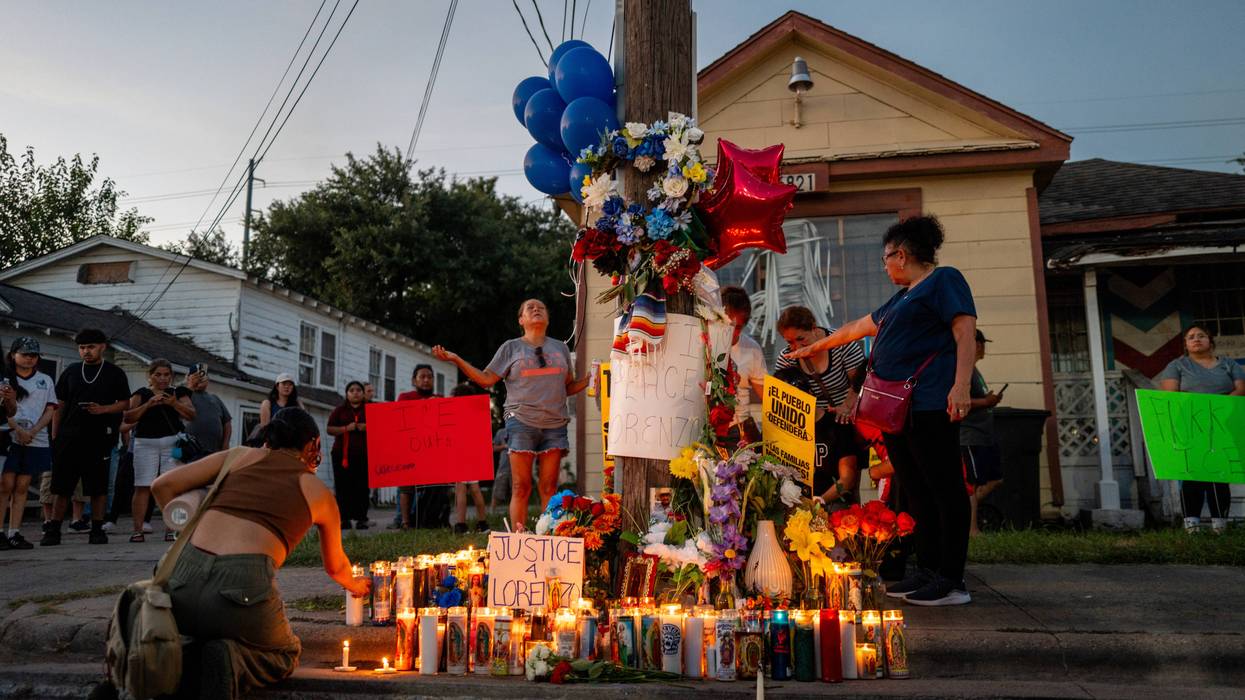
Salgado "called Houston home for 35 years," said New York's democratic socialist mayor. "On Tuesday, an ICE agent shot and killed him."
New York City Mayor Zohran Mamdani on Thursday renewed his call to "abolish ICE" after a US Immigration and Customs Enforcement agent fatally shot a man in Texas earlier this week.
"Lorenzo Salgado Araujo called Houston home for 35 years. On Tuesday, an ICE agent shot and killed him," Mamdani said on social media. "His family learned of his death from a video before anyone bothered to knock on their door."
"New York City stands with the Salgado family in demanding a full, independent investigation and real accountability," the mayor added. "To the Salgado family and any immigrant family in this city living in fear: We grieve with you, and we will continue to stand beside you in the pursuit of justice."
More than 1,000 people gathered in Houston's East End on Wednesday evening to denounce ICE and remember Salgado, a 52-year-old married father of three originally from Mexico who, according to relatives, was in the process of legalizing his status in the United States.
Salgado's son, school teacher Ronaldo Salgado, said that his father had "dedicated his life to giving his family the American dream."
Salgado was driving in the Magnolia Park neighborhood to pick up his construction crew on Tuesday morning when an unidentified ICE agent fatally shot him during an enforcement operation. ICE claimed that Salgado tried to evade arrest and threatened agents with his vehicle, but his family, civil rights advocates, and community leaders strongly dispute that account, pointing to surveillance footage and eyewitness accounts that they argue undermine the agency's narrative.
A Department of Homeland Security spokesperson told The New York Times late on Thursday that neither Salgado nor any of his three passengers were the targets of ICE enforcement, but that they drew agents' attention because one of them resembled a wanted man from Guatemala.
Democratic lawmakers and civil rights groups have joined Salgado's relatives in demanding an independent investigation of his killing.
Mexican President Claudia Sheinbaum announced Thursday that her government plans to file criminal complaints in the United States in connection with 14 Mexican nationals who died in ICE custody. Sheinbaum added that Salgado's killing "is not only sad and regrettable, but also appears to have been targeted."
On-duty officers from ICE and other Department of Homeland Security agencies have fatally shot at least four other people during President Donald Trump's deadly second-term crackdown on undocumented immigrants: Silverio Villegas González of Mexico and US citizens Ruben Ray Martinez, Renee Good, and Alex Pretti.
At least dozens of people have also died in ICE custody or shortly after being released during Trump's second term. Last month, ICE announced that it was rescinding a 2021 Biden administration policy requiring congressional notification and an investigation whenever a detainee died within 30 days of their release.

“Consumers are getting really screwed by all of this,” said one critic.
Political appointees installed by President Donald Trump are overruling career attorneys inside the Department of Justice's Antitrust Division, intervening to weaken or halt investigations into major corporate mergers in a way never seen before, MS NOW reported Thursday.
Three unnamed sources told the outlet "that DOJ staff have privately complained that the Trump administration is essentially deciding not to enforce antitrust laws that are critical to keeping companies from becoming single-source providers and being able to charge enormous sums for their product or service."
According to MS NOW:
The two mergers that DOJ leaders are ramming through include two low-cost Mexican air carriers, Viva Aerobus and Volaris, who announced their plans to merge last year, and the proposed merger of the Italian firm Saipem and UK firm Subsea7, who together control a sizable portion of sales for equipment used for subsea oil operations. Major oil companies, including ExxonMobil, Petrobras and TotalEnergies, have filed formal objections with federal regulators about the latter merger, arguing to antitrust regulators that the combined firms will create a subsea monopoly that will increase costs, delay critical projects and force clients into expensive, long-term contracts.
Experts say the aforementioned mergers are likely to drive up prices US consumers pay for airfare to Mexico and at the gas pump, yet again giving the lie to Trump's "America First" pledge.
Current and former DOJ officials described Trump's interference as without precedent.
“It’s unilateral surrender on antitrust enforcement; it’s absolutely unprecedented,” Bill Baer, the former assistant attorney general for the antitrust division during the Obama administration. “It’s definitely going to hurt consumers. It means prices will go up, concentration is going to increase—and quality often diminishes when you have only a few firms operating in the same market.”
The DOJ Antitrust Division was originally launched more than a century ago during the tail-end of the Progressive Era to combat monopolies and enforce antitrust legislation like the Clayton Antitrust Act and the Gilded Age-era Sherman Act. It was formally created during the Great Depression following weak enforcement of the Sherman and Clayton acts, as the Franklin D. Roosevelt administration viewed concentrated corporate power as a threat not only to consumers but to democracy itself.
While the postwar decades saw relatively aggressive antitrust enforcement by presidents of both major parties, the Reagan administration adopted a much more permissive merger philosophy that laid the groundwork for decades of consolidation across industries that has continued to this day, despite limited antitrust revivals during the Obama and Biden administrations.
Biden-era Federal Trade Commission Chair Lina Khan and DOJ officials pursued a more aggressive antitrust agenda that Trump has been rolling back in favor of deregulation. Critics have pointed out that Trump has sometimes used antitrust mechanisms selectively, targeting certain media or technology companies for political reasons rather than consistently applying a broad anti-monopoly approach.
According to an article published last month in The Wall Street Journal, Stanley Woodward, the senior DOJ official now overseeing antitrust enforcement, has told department lawyers that he favors resolving cases through settlements rather than taking corporations to trial. Some antitrust attorneys interpreted the remarks as a directive to avoid litigation and seek settlements in ongoing and future cases. Critics say Woodward’s posture could weaken the DOJ's ability to challenge monopolistic mergers in favor of fast-tracked settlements.
"He's taking litigation off the table, and you don’t get a settlement absent a litigation threat,” one person with knowledge of Woodward's actions told MS NOW. “I can’t think of an administration in history that would want to run antitrust policy like this.”
“Consumers are getting really screwed by all of this,” the person continued. “We’re talking 10 years of consumer harm that can’t be undone.”