SUBSCRIBE TO OUR FREE NEWSLETTER
Daily news & progressive opinion—funded by the people, not the corporations—delivered straight to your inbox.
5
#000000
#FFFFFF
To donate by check, phone, or other method, see our More Ways to Give page.
Daily news & progressive opinion—funded by the people, not the corporations—delivered straight to your inbox.
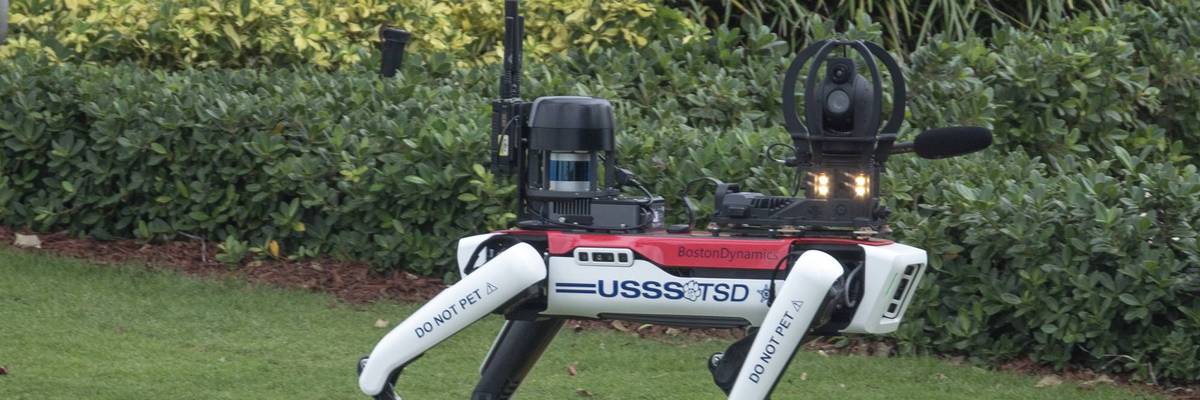
A US Secret Service robot dog manufactured by Boston Dynamics patrols the grounds at then President-elect Donald Trump's Mar-a-Lago resort on November 18, 2024, in Palm Beach, Florida.
These robots, known as "quadrupeds," are being used to patrol the sprawling energy-sucking complexes, which are increasingly being met with protest around the country.
As Americans grow fed up with the rapid encroachment of artificial intelligence data centers into their communities, tech companies are embracing a novel solution to protect their energy-sucking behemoths from danger: Even more robots... robot dogs, to be exact.
According to a report from Business Insider on Monday:
As companies pour billions into sprawling industrial campuses for cloud and AI computing, some data center operators are experimenting with four-legged bots—about the size of large dogs—that can patrol fences, inspect equipment, and flag any issues before they turn into costly outages.
These robots, known as "quadrupeds," are being used to patrol the complexes, which can sometimes reach the size of multiple football fields.
According to Fortune, tech companies are already pouring nearly $700 billion into building data centers across the US and are now spending hundreds of thousands of dollars more to enlist mechanical canines as security forces.
One model from Boston Dynamics, known as "Spot," can cost anywhere from $175,000 to $300,000. And while the technology may seem futuristic, Spot and other quadrupeds like it have already been enlisted in law enforcement and public safety for years.
Another company—Ghost Robotics—advertises its quadrupeds for "reconnaissance, intelligence, and surveillance use by the military."
With more than 5,000 data centers now in the US and 800-1,000 new ones in the process of being built, Michael Subhan, the chief growth officer for Ghost Robotics, told Business Insider he expects boom times are ahead for his industry.
As data centers expand their reach at breakneck speed, there may be more interlopers for the programmable pooches to sniff out.
Due to skyrocketing energy costs and water shortages in places where large data centers have been built, the sites of proposed projects from Illinois to Minnesota to South Carolina have drawn crowds of dozens and even hundreds of demonstrators in recent weeks.
Dear Common Dreams reader, It’s been nearly 30 years since I co-founded Common Dreams with my late wife, Lina Newhouser. We had the radical notion that journalism should serve the public good, not corporate profits. It was clear to us from the outset what it would take to build such a project. No paid advertisements. No corporate sponsors. No millionaire publisher telling us what to think or do. Many people said we wouldn't last a year, but we proved those doubters wrong. Together with a tremendous team of journalists and dedicated staff, we built an independent media outlet free from the constraints of profits and corporate control. Our mission has always been simple: To inform. To inspire. To ignite change for the common good. Building Common Dreams was not easy. Our survival was never guaranteed. When you take on the most powerful forces—Wall Street greed, fossil fuel industry destruction, Big Tech lobbyists, and uber-rich oligarchs who have spent billions upon billions rigging the economy and democracy in their favor—the only bulwark you have is supporters who believe in your work. But here’s the urgent message from me today. It's never been this bad out there. And it's never been this hard to keep us going. At the very moment Common Dreams is most needed, the threats we face are intensifying. We need your support now more than ever. We don't accept corporate advertising and never will. We don't have a paywall because we don't think people should be blocked from critical news based on their ability to pay. Everything we do is funded by the donations of readers like you. When everyone does the little they can afford, we are strong. But if that support retreats or dries up, so do we. Will you donate now to make sure Common Dreams not only survives but thrives? —Craig Brown, Co-founder |
As Americans grow fed up with the rapid encroachment of artificial intelligence data centers into their communities, tech companies are embracing a novel solution to protect their energy-sucking behemoths from danger: Even more robots... robot dogs, to be exact.
According to a report from Business Insider on Monday:
As companies pour billions into sprawling industrial campuses for cloud and AI computing, some data center operators are experimenting with four-legged bots—about the size of large dogs—that can patrol fences, inspect equipment, and flag any issues before they turn into costly outages.
These robots, known as "quadrupeds," are being used to patrol the complexes, which can sometimes reach the size of multiple football fields.
According to Fortune, tech companies are already pouring nearly $700 billion into building data centers across the US and are now spending hundreds of thousands of dollars more to enlist mechanical canines as security forces.
One model from Boston Dynamics, known as "Spot," can cost anywhere from $175,000 to $300,000. And while the technology may seem futuristic, Spot and other quadrupeds like it have already been enlisted in law enforcement and public safety for years.
Another company—Ghost Robotics—advertises its quadrupeds for "reconnaissance, intelligence, and surveillance use by the military."
With more than 5,000 data centers now in the US and 800-1,000 new ones in the process of being built, Michael Subhan, the chief growth officer for Ghost Robotics, told Business Insider he expects boom times are ahead for his industry.
As data centers expand their reach at breakneck speed, there may be more interlopers for the programmable pooches to sniff out.
Due to skyrocketing energy costs and water shortages in places where large data centers have been built, the sites of proposed projects from Illinois to Minnesota to South Carolina have drawn crowds of dozens and even hundreds of demonstrators in recent weeks.
As Americans grow fed up with the rapid encroachment of artificial intelligence data centers into their communities, tech companies are embracing a novel solution to protect their energy-sucking behemoths from danger: Even more robots... robot dogs, to be exact.
According to a report from Business Insider on Monday:
As companies pour billions into sprawling industrial campuses for cloud and AI computing, some data center operators are experimenting with four-legged bots—about the size of large dogs—that can patrol fences, inspect equipment, and flag any issues before they turn into costly outages.
These robots, known as "quadrupeds," are being used to patrol the complexes, which can sometimes reach the size of multiple football fields.
According to Fortune, tech companies are already pouring nearly $700 billion into building data centers across the US and are now spending hundreds of thousands of dollars more to enlist mechanical canines as security forces.
One model from Boston Dynamics, known as "Spot," can cost anywhere from $175,000 to $300,000. And while the technology may seem futuristic, Spot and other quadrupeds like it have already been enlisted in law enforcement and public safety for years.
Another company—Ghost Robotics—advertises its quadrupeds for "reconnaissance, intelligence, and surveillance use by the military."
With more than 5,000 data centers now in the US and 800-1,000 new ones in the process of being built, Michael Subhan, the chief growth officer for Ghost Robotics, told Business Insider he expects boom times are ahead for his industry.
As data centers expand their reach at breakneck speed, there may be more interlopers for the programmable pooches to sniff out.
Due to skyrocketing energy costs and water shortages in places where large data centers have been built, the sites of proposed projects from Illinois to Minnesota to South Carolina have drawn crowds of dozens and even hundreds of demonstrators in recent weeks.