SUBSCRIBE TO OUR FREE NEWSLETTER
Daily news & progressive opinion—funded by the people, not the corporations—delivered straight to your inbox.
5
#000000
#FFFFFF
To donate by check, phone, or other method, see our More Ways to Give page.
Daily news & progressive opinion—funded by the people, not the corporations—delivered straight to your inbox.
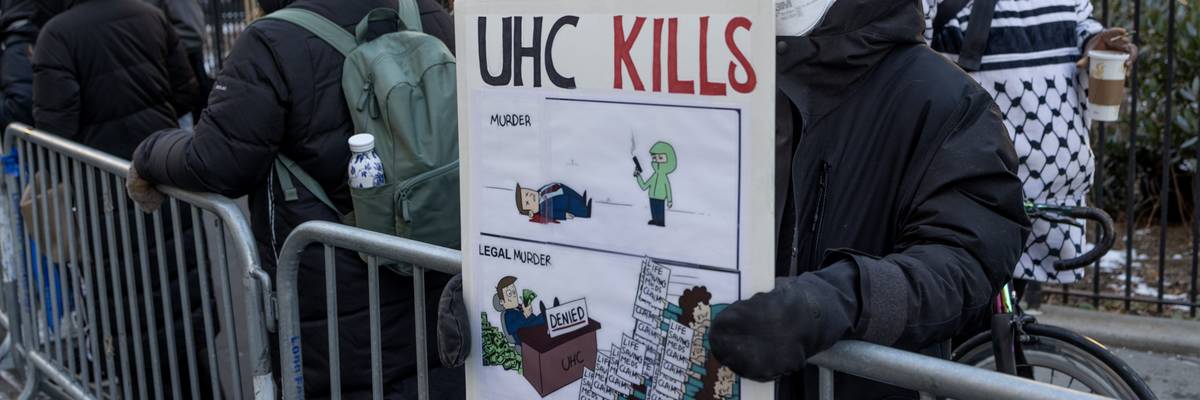
A protestor holds a sign outside of Manhattan Criminal Court on December 23, 2024 in New York City.
"Believing the health insurance industry is at least partly responsible for the murder of the UnitedHealthcare CEO is not some fringe position," wrote one journalist.
In the wake of the killing of UnitedHealthcare CEO Brian Thompson in early December, some political observers were taken aback by the public response to the event, which included morbid humor and expressions of "Schadenfreude," in the words of one woman who had battled an insurance company to secure treatment for her mother's cancer.
But according to a new poll released by NORC at the University of Chicago Friday night, the belief that the for-profit health insurance industry's business practices were largely to blame for the apparent targeted killing of Thompson is far from a fringe viewpoint.
Sixty-nine percent of respondents placed a "great deal or moderate amount" of blame on healthcare coverage denials by insurance companies like UnitedHealthcare, for Thompson's killing.
Sixty-seven percent said exorbitant profits made by health insurers were to blame.
UnitedHealthcare, which reported $16 billion in profits last year, has garnered outrage for its claims denial practices. A Senate investigation earlier this year found the company was one of three that were intentionally denying claims made by nursing home patients who had Medicare Advantage plans and had suffered falls and strokes, in order to increase profits.
The company is also facing a class-action lawsuit over its use of algorithms to deny care.
Last year, a Commonwealth Fund survey found the 17% of Americans had been told by an insurance company that a medical claim was denied, and the poll suggested many patients and doctors feel powerless to stop companies like United from denying them care; more than half said they and their physicians did not challenge the insurers' decision.
That poll matched the results of the NORC survey released on Friday, in which 15% of respondents said they had had a claim denied.
The poll was released the same day that NBC News published an investigation showing that cancer patients are disproportionately affected by claim denials and insurers' requirements that they obtain "prior authorization" in order to receive life-saving care, an arduous process that can delay treatment and allow their condition to worsen.
A study published in the Journal of the American Medical Association last year found that 22% of cancer patients did not receive treatment their doctors had prescribed because of denials or prior authorization requirements.
A survey of oncologists in 2022 found that 42% of prior authorizations were delayed by more than one business day, and 14% of the delays had a serious adverse impact on the patient.
The patients experienced "disease progression" 80% of the time and "loss of life" 36% of the time.
Insurers are increasingly relying on prior authorizations to delay or deny care for cancer patients, a 2023 study found. The number of nonspecialty oncology drugs that required prior authorization rose from 16% in 2010 to 78% in 2020.
NBC News told the story of one patient, Tracy Pike, who died after Blue Cross and Blue Shield of Illinois declined to cover a $40,000 treatment for Stage 4 stomach cancer—surgery and intensive chemotherapy—that had been recommended by his doctor.
Citing the findings of a company doctor—who was an obstetrician-gynecologist, not an oncologist—Blue Cross ruled the treatment was "experimental, investigational, and unproven," even though it is routinely prescribed for cancer patients.
Journalist Ken Klippenstein noted that the NORC poll included a nuance that was "sorely lacking in major media coverage" after Thompson's death, which at times suggested that people who acknowledged the insurance industry's deadly practices were "supporting" the fatal shooting.
The poll found that 78% of people believed the person who shot Thompson outside a hotel in Manhattan bore "a great deal" or a "moderate amount" of blame for the killing.
"Now compare that with the tsunami of corporate media op-eds and pundits expressing the sparkling insight that murder is wrong," wrote Klippenstein. "Yeah, we know. Episodes like these really show you how much contempt these elite media organs have for the public, which they apparently see as helpless children in need of a preschool level moral lesson."
"As the NORC poll shows, the vast majority of people know that, yes, of course murder is wrong—they just also happen to think there's more to the story than that," he continued. "And they're right: How can you have an honest discussion about any of this without addressing the Moloch-like industry that profits from denying people healthcare?"
But as Klippenstein wrote on Thursday, those who took part in that "honest discussion" in the days after Thompson's killing were branded as "extremists" not just by the media, but by law enforcement.
Days after the killing, Klippenstein wrote, the New York Police Department circulated an intelligence report on the suspected gunman, 26-year-old Luigi Mangione—but the report also included warnings about "ordinary people" who expressed sympathy for Mangione online.
"Warning of 'a wide range of extremists' that 'may view Mangione as a martyr,' the report's title singles out 'disdain for corporate greed," wrote Klippenstein, noting that the document was circulated to law enforcement and counterterrorism agencies nationally.
But as the latest polling shows, he wrote, "believing the health insurance industry is at least partly responsible for the murder of the UnitedHealthcare CEO is not some fringe position."
Dear Common Dreams reader, It’s been nearly 30 years since I co-founded Common Dreams with my late wife, Lina Newhouser. We had the radical notion that journalism should serve the public good, not corporate profits. It was clear to us from the outset what it would take to build such a project. No paid advertisements. No corporate sponsors. No millionaire publisher telling us what to think or do. Many people said we wouldn't last a year, but we proved those doubters wrong. Together with a tremendous team of journalists and dedicated staff, we built an independent media outlet free from the constraints of profits and corporate control. Our mission has always been simple: To inform. To inspire. To ignite change for the common good. Building Common Dreams was not easy. Our survival was never guaranteed. When you take on the most powerful forces—Wall Street greed, fossil fuel industry destruction, Big Tech lobbyists, and uber-rich oligarchs who have spent billions upon billions rigging the economy and democracy in their favor—the only bulwark you have is supporters who believe in your work. But here’s the urgent message from me today. It's never been this bad out there. And it's never been this hard to keep us going. At the very moment Common Dreams is most needed, the threats we face are intensifying. We need your support now more than ever. We don't accept corporate advertising and never will. We don't have a paywall because we don't think people should be blocked from critical news based on their ability to pay. Everything we do is funded by the donations of readers like you. When everyone does the little they can afford, we are strong. But if that support retreats or dries up, so do we. Will you donate now to make sure Common Dreams not only survives but thrives? —Craig Brown, Co-founder |
In the wake of the killing of UnitedHealthcare CEO Brian Thompson in early December, some political observers were taken aback by the public response to the event, which included morbid humor and expressions of "Schadenfreude," in the words of one woman who had battled an insurance company to secure treatment for her mother's cancer.
But according to a new poll released by NORC at the University of Chicago Friday night, the belief that the for-profit health insurance industry's business practices were largely to blame for the apparent targeted killing of Thompson is far from a fringe viewpoint.
Sixty-nine percent of respondents placed a "great deal or moderate amount" of blame on healthcare coverage denials by insurance companies like UnitedHealthcare, for Thompson's killing.
Sixty-seven percent said exorbitant profits made by health insurers were to blame.
UnitedHealthcare, which reported $16 billion in profits last year, has garnered outrage for its claims denial practices. A Senate investigation earlier this year found the company was one of three that were intentionally denying claims made by nursing home patients who had Medicare Advantage plans and had suffered falls and strokes, in order to increase profits.
The company is also facing a class-action lawsuit over its use of algorithms to deny care.
Last year, a Commonwealth Fund survey found the 17% of Americans had been told by an insurance company that a medical claim was denied, and the poll suggested many patients and doctors feel powerless to stop companies like United from denying them care; more than half said they and their physicians did not challenge the insurers' decision.
That poll matched the results of the NORC survey released on Friday, in which 15% of respondents said they had had a claim denied.
The poll was released the same day that NBC News published an investigation showing that cancer patients are disproportionately affected by claim denials and insurers' requirements that they obtain "prior authorization" in order to receive life-saving care, an arduous process that can delay treatment and allow their condition to worsen.
A study published in the Journal of the American Medical Association last year found that 22% of cancer patients did not receive treatment their doctors had prescribed because of denials or prior authorization requirements.
A survey of oncologists in 2022 found that 42% of prior authorizations were delayed by more than one business day, and 14% of the delays had a serious adverse impact on the patient.
The patients experienced "disease progression" 80% of the time and "loss of life" 36% of the time.
Insurers are increasingly relying on prior authorizations to delay or deny care for cancer patients, a 2023 study found. The number of nonspecialty oncology drugs that required prior authorization rose from 16% in 2010 to 78% in 2020.
NBC News told the story of one patient, Tracy Pike, who died after Blue Cross and Blue Shield of Illinois declined to cover a $40,000 treatment for Stage 4 stomach cancer—surgery and intensive chemotherapy—that had been recommended by his doctor.
Citing the findings of a company doctor—who was an obstetrician-gynecologist, not an oncologist—Blue Cross ruled the treatment was "experimental, investigational, and unproven," even though it is routinely prescribed for cancer patients.
Journalist Ken Klippenstein noted that the NORC poll included a nuance that was "sorely lacking in major media coverage" after Thompson's death, which at times suggested that people who acknowledged the insurance industry's deadly practices were "supporting" the fatal shooting.
The poll found that 78% of people believed the person who shot Thompson outside a hotel in Manhattan bore "a great deal" or a "moderate amount" of blame for the killing.
"Now compare that with the tsunami of corporate media op-eds and pundits expressing the sparkling insight that murder is wrong," wrote Klippenstein. "Yeah, we know. Episodes like these really show you how much contempt these elite media organs have for the public, which they apparently see as helpless children in need of a preschool level moral lesson."
"As the NORC poll shows, the vast majority of people know that, yes, of course murder is wrong—they just also happen to think there's more to the story than that," he continued. "And they're right: How can you have an honest discussion about any of this without addressing the Moloch-like industry that profits from denying people healthcare?"
But as Klippenstein wrote on Thursday, those who took part in that "honest discussion" in the days after Thompson's killing were branded as "extremists" not just by the media, but by law enforcement.
Days after the killing, Klippenstein wrote, the New York Police Department circulated an intelligence report on the suspected gunman, 26-year-old Luigi Mangione—but the report also included warnings about "ordinary people" who expressed sympathy for Mangione online.
"Warning of 'a wide range of extremists' that 'may view Mangione as a martyr,' the report's title singles out 'disdain for corporate greed," wrote Klippenstein, noting that the document was circulated to law enforcement and counterterrorism agencies nationally.
But as the latest polling shows, he wrote, "believing the health insurance industry is at least partly responsible for the murder of the UnitedHealthcare CEO is not some fringe position."
In the wake of the killing of UnitedHealthcare CEO Brian Thompson in early December, some political observers were taken aback by the public response to the event, which included morbid humor and expressions of "Schadenfreude," in the words of one woman who had battled an insurance company to secure treatment for her mother's cancer.
But according to a new poll released by NORC at the University of Chicago Friday night, the belief that the for-profit health insurance industry's business practices were largely to blame for the apparent targeted killing of Thompson is far from a fringe viewpoint.
Sixty-nine percent of respondents placed a "great deal or moderate amount" of blame on healthcare coverage denials by insurance companies like UnitedHealthcare, for Thompson's killing.
Sixty-seven percent said exorbitant profits made by health insurers were to blame.
UnitedHealthcare, which reported $16 billion in profits last year, has garnered outrage for its claims denial practices. A Senate investigation earlier this year found the company was one of three that were intentionally denying claims made by nursing home patients who had Medicare Advantage plans and had suffered falls and strokes, in order to increase profits.
The company is also facing a class-action lawsuit over its use of algorithms to deny care.
Last year, a Commonwealth Fund survey found the 17% of Americans had been told by an insurance company that a medical claim was denied, and the poll suggested many patients and doctors feel powerless to stop companies like United from denying them care; more than half said they and their physicians did not challenge the insurers' decision.
That poll matched the results of the NORC survey released on Friday, in which 15% of respondents said they had had a claim denied.
The poll was released the same day that NBC News published an investigation showing that cancer patients are disproportionately affected by claim denials and insurers' requirements that they obtain "prior authorization" in order to receive life-saving care, an arduous process that can delay treatment and allow their condition to worsen.
A study published in the Journal of the American Medical Association last year found that 22% of cancer patients did not receive treatment their doctors had prescribed because of denials or prior authorization requirements.
A survey of oncologists in 2022 found that 42% of prior authorizations were delayed by more than one business day, and 14% of the delays had a serious adverse impact on the patient.
The patients experienced "disease progression" 80% of the time and "loss of life" 36% of the time.
Insurers are increasingly relying on prior authorizations to delay or deny care for cancer patients, a 2023 study found. The number of nonspecialty oncology drugs that required prior authorization rose from 16% in 2010 to 78% in 2020.
NBC News told the story of one patient, Tracy Pike, who died after Blue Cross and Blue Shield of Illinois declined to cover a $40,000 treatment for Stage 4 stomach cancer—surgery and intensive chemotherapy—that had been recommended by his doctor.
Citing the findings of a company doctor—who was an obstetrician-gynecologist, not an oncologist—Blue Cross ruled the treatment was "experimental, investigational, and unproven," even though it is routinely prescribed for cancer patients.
Journalist Ken Klippenstein noted that the NORC poll included a nuance that was "sorely lacking in major media coverage" after Thompson's death, which at times suggested that people who acknowledged the insurance industry's deadly practices were "supporting" the fatal shooting.
The poll found that 78% of people believed the person who shot Thompson outside a hotel in Manhattan bore "a great deal" or a "moderate amount" of blame for the killing.
"Now compare that with the tsunami of corporate media op-eds and pundits expressing the sparkling insight that murder is wrong," wrote Klippenstein. "Yeah, we know. Episodes like these really show you how much contempt these elite media organs have for the public, which they apparently see as helpless children in need of a preschool level moral lesson."
"As the NORC poll shows, the vast majority of people know that, yes, of course murder is wrong—they just also happen to think there's more to the story than that," he continued. "And they're right: How can you have an honest discussion about any of this without addressing the Moloch-like industry that profits from denying people healthcare?"
But as Klippenstein wrote on Thursday, those who took part in that "honest discussion" in the days after Thompson's killing were branded as "extremists" not just by the media, but by law enforcement.
Days after the killing, Klippenstein wrote, the New York Police Department circulated an intelligence report on the suspected gunman, 26-year-old Luigi Mangione—but the report also included warnings about "ordinary people" who expressed sympathy for Mangione online.
"Warning of 'a wide range of extremists' that 'may view Mangione as a martyr,' the report's title singles out 'disdain for corporate greed," wrote Klippenstein, noting that the document was circulated to law enforcement and counterterrorism agencies nationally.
But as the latest polling shows, he wrote, "believing the health insurance industry is at least partly responsible for the murder of the UnitedHealthcare CEO is not some fringe position."