SUBSCRIBE TO OUR FREE NEWSLETTER
Daily news & progressive opinion—funded by the people, not the corporations—delivered straight to your inbox.
5
#000000
#FFFFFF
To donate by check, phone, or other method, see our More Ways to Give page.
Daily news & progressive opinion—funded by the people, not the corporations—delivered straight to your inbox.
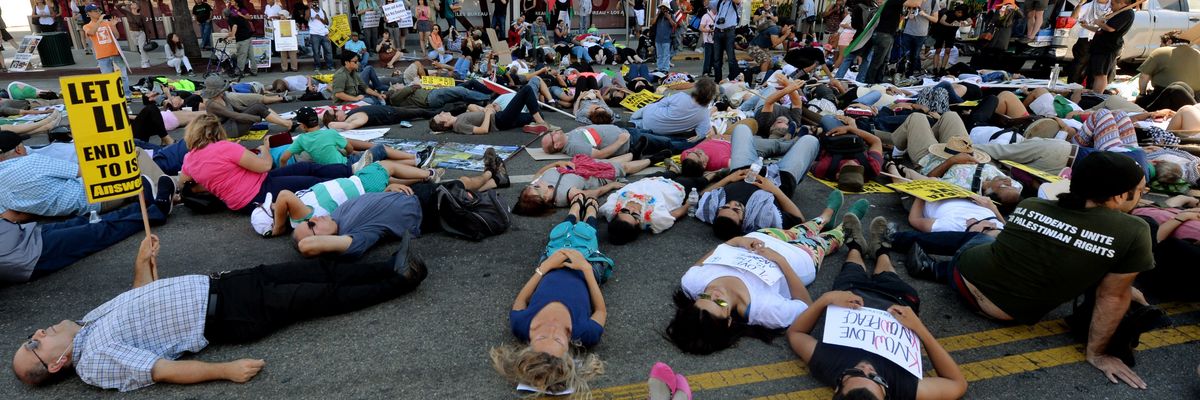
Palestinian Americans and their allies hold a die-in outside CNN headquarters in Los Angeles, California during a protest march against the Israeli assault on the Gaza Strip on August 16, 2014.
U.S. media, analysts said, "should elevate its coverage of the suffering in Gaza to be comparable to that of Ukraine, with the same urgent and moralizing tone."
As the death toll from the U.S.-backed Israeli assault on the Gaza Strip continued to climb on Monday, The Nation published a study revealing the "glaring double standard" for American corporate media coverage of that war and Russia's invasion of Ukraine.
The analysis was conducted by Adam Johnson, who co-hosts the podcast Citations Needed and writes media criticism at The Column, and Othman Ali, a researcher and data analyst with an advanced degree from the University of Oxford.
The pair—who released their full dataset on GitHub—focused on the first 100 days of each conflict. Russia invaded Ukraine on February 24, 2022 and Israel launched its war on Gaza in retaliation for the Hamas-led October 7, 2023 attack.
Since the Russian invasion, media critics have highlighted "the racist and dehumanizing double standards of war reporting." Over the past year, such criticism has mounted, with arguments that Western media are "enabling" genocide in Gaza.
In March, protesters frustrated with the U.S. "newspaper of record" even gathered in Manhattan and chanted, "New York Times you can't hide, we charge you with genocide." Watchdogs like Fairness & Accuracy In Reporting and Media Matters for America have published various critiques, with the latter often focusing on right-wing sources.
"CNN and MSNBC's pointed lack of sympathy with Palestinians is also important to examine because the media's consistent dehumanization and erasure of their suffering has helped 12 months of a killing campaign."
Johnson and Ali focused on commentary, editorial priorities, and reporting by CNN and MSNBC, explaining that "the third major cable network, Fox News, was not included in our analysis because the focus of our study is in the formation of liberal and Democratic Party-aligned support for Israel's war on Gaza."
They found that on the two networks, Palestinians in Gaza received "far less sympathetic and humanizing coverage than either Israelis during the same period or Ukrainians during the first 100 days after Russia's invasion."
"The point of this analysis is not that U.S. media should reduce its coverage of the tragedies in Ukraine to achieve parity with Gaza, but that it should elevate its coverage of the suffering in Gaza to be comparable to that of Ukraine, with the same urgent and moralizing tone," the pair stressed.
"CNN and MSNBC's pointed lack of sympathy with Palestinians is also important to examine because the media's consistent dehumanization and erasure of their suffering has helped 12 months of a killing campaign, backed by unending American military and political support, that is unprecedented in the 21st century," they added.
Johnson and Ali highlighted four key findings:
They found that for each child death in Ukraine during the first 100 days, there was the equivalent of 16.1 mentions on air, while kids in Gaza received the equivalent of 0.36 mentions. For journalist deaths, it was 24 versus 2.5. The study also shows that the networks "covered Ukrainian civilian suffering almost twice as often as they covered that in Gaza," despite the latter having a death toll that was 500% greater.
In just the first 30 days of the Russian invasion, cable news anchors, guests, and reporters used emotive terms for Russians killing Ukrainians 661 times. In the first month of Israel's assault on Gaza, they used such language to describe the killing of Israelis 1,053 times and Palestinians 43 times. Additionally, people appearing on-air for both networks described Ukrainians as being subjected to genocide or war crimes 1,790 times compared to just 104 times for Palestinian victims.
"One common rejoinder to this double standard is that Israel doesn't intentionally kill civilians, whereas Hamas and Russia do," Johnson and Ali pointed out. "But this assertion is based entirely on unsubstantiated conventional wisdom and is belied by scores of data points."
In a note attached to the article, the researchers detailed that the United Nations "estimated that around 4,000 civilians had been killed 100 days into the Ukraine war. The broadly accepted death toll in Gaza for the first 100 days is over 24,000, but this is a figure that doesn't distinguish between civilians and noncivilians. So, in the interest of being conservative, we are using the civilian death toll of 20,000—though this number, as several researchers have explained, is almost certainly a massive undercount because it only includes confirmed deaths, not those unidentified, under rubble, or dying from secondary causes such as preventable illness, starvation, etc."
More than 1,100 people were killed in Hamas' attack on Israel last October, and militants took over 240 others hostages. Some captives have been released, some have been killed—including by the
Israeli assault—and some are still believed to be alive.
As of Tuesday, Gaza officials put the confirmed death toll for Palestinians in the Hamas-governed enclave at 42,344, with another 99,013 wounded. In recent days, Israel has bombed a hospital complex and refugee camps. The vast majority of the strip's 2.3 million residents have been displaced, often several times over the past year.
The U.S. government has long supplied Israel with weapons and diplomatic backing and has ramped up such support since last October, despite global criticism. Multiple news outlets revealed Tuesday that in a Sunday letter, the Biden administration finally threatened to cut off U.S. arms unless Israel takes certain action to improve the humanitarian conditions in Gaza.
In response to the letter, Johnson
said on social media: "1) Israel can keep bombing all it wants 2) Criteria for 'improve' is vague and like 'invasion of Rafah' they'll just post facto change the definition."
"BUT what's noteworthy is the tacit admission the U.S. can condition military aid," Johnson added, "something I was told was pointless five [minutes] ago."
Dear Common Dreams reader, It’s been nearly 30 years since I co-founded Common Dreams with my late wife, Lina Newhouser. We had the radical notion that journalism should serve the public good, not corporate profits. It was clear to us from the outset what it would take to build such a project. No paid advertisements. No corporate sponsors. No millionaire publisher telling us what to think or do. Many people said we wouldn't last a year, but we proved those doubters wrong. Together with a tremendous team of journalists and dedicated staff, we built an independent media outlet free from the constraints of profits and corporate control. Our mission has always been simple: To inform. To inspire. To ignite change for the common good. Building Common Dreams was not easy. Our survival was never guaranteed. When you take on the most powerful forces—Wall Street greed, fossil fuel industry destruction, Big Tech lobbyists, and uber-rich oligarchs who have spent billions upon billions rigging the economy and democracy in their favor—the only bulwark you have is supporters who believe in your work. But here’s the urgent message from me today. It's never been this bad out there. And it's never been this hard to keep us going. At the very moment Common Dreams is most needed, the threats we face are intensifying. We need your support now more than ever. We don't accept corporate advertising and never will. We don't have a paywall because we don't think people should be blocked from critical news based on their ability to pay. Everything we do is funded by the donations of readers like you. When everyone does the little they can afford, we are strong. But if that support retreats or dries up, so do we. Will you donate now to make sure Common Dreams not only survives but thrives? —Craig Brown, Co-founder |
As the death toll from the U.S.-backed Israeli assault on the Gaza Strip continued to climb on Monday, The Nation published a study revealing the "glaring double standard" for American corporate media coverage of that war and Russia's invasion of Ukraine.
The analysis was conducted by Adam Johnson, who co-hosts the podcast Citations Needed and writes media criticism at The Column, and Othman Ali, a researcher and data analyst with an advanced degree from the University of Oxford.
The pair—who released their full dataset on GitHub—focused on the first 100 days of each conflict. Russia invaded Ukraine on February 24, 2022 and Israel launched its war on Gaza in retaliation for the Hamas-led October 7, 2023 attack.
Since the Russian invasion, media critics have highlighted "the racist and dehumanizing double standards of war reporting." Over the past year, such criticism has mounted, with arguments that Western media are "enabling" genocide in Gaza.
In March, protesters frustrated with the U.S. "newspaper of record" even gathered in Manhattan and chanted, "New York Times you can't hide, we charge you with genocide." Watchdogs like Fairness & Accuracy In Reporting and Media Matters for America have published various critiques, with the latter often focusing on right-wing sources.
"CNN and MSNBC's pointed lack of sympathy with Palestinians is also important to examine because the media's consistent dehumanization and erasure of their suffering has helped 12 months of a killing campaign."
Johnson and Ali focused on commentary, editorial priorities, and reporting by CNN and MSNBC, explaining that "the third major cable network, Fox News, was not included in our analysis because the focus of our study is in the formation of liberal and Democratic Party-aligned support for Israel's war on Gaza."
They found that on the two networks, Palestinians in Gaza received "far less sympathetic and humanizing coverage than either Israelis during the same period or Ukrainians during the first 100 days after Russia's invasion."
"The point of this analysis is not that U.S. media should reduce its coverage of the tragedies in Ukraine to achieve parity with Gaza, but that it should elevate its coverage of the suffering in Gaza to be comparable to that of Ukraine, with the same urgent and moralizing tone," the pair stressed.
"CNN and MSNBC's pointed lack of sympathy with Palestinians is also important to examine because the media's consistent dehumanization and erasure of their suffering has helped 12 months of a killing campaign, backed by unending American military and political support, that is unprecedented in the 21st century," they added.
Johnson and Ali highlighted four key findings:
They found that for each child death in Ukraine during the first 100 days, there was the equivalent of 16.1 mentions on air, while kids in Gaza received the equivalent of 0.36 mentions. For journalist deaths, it was 24 versus 2.5. The study also shows that the networks "covered Ukrainian civilian suffering almost twice as often as they covered that in Gaza," despite the latter having a death toll that was 500% greater.
In just the first 30 days of the Russian invasion, cable news anchors, guests, and reporters used emotive terms for Russians killing Ukrainians 661 times. In the first month of Israel's assault on Gaza, they used such language to describe the killing of Israelis 1,053 times and Palestinians 43 times. Additionally, people appearing on-air for both networks described Ukrainians as being subjected to genocide or war crimes 1,790 times compared to just 104 times for Palestinian victims.
"One common rejoinder to this double standard is that Israel doesn't intentionally kill civilians, whereas Hamas and Russia do," Johnson and Ali pointed out. "But this assertion is based entirely on unsubstantiated conventional wisdom and is belied by scores of data points."
In a note attached to the article, the researchers detailed that the United Nations "estimated that around 4,000 civilians had been killed 100 days into the Ukraine war. The broadly accepted death toll in Gaza for the first 100 days is over 24,000, but this is a figure that doesn't distinguish between civilians and noncivilians. So, in the interest of being conservative, we are using the civilian death toll of 20,000—though this number, as several researchers have explained, is almost certainly a massive undercount because it only includes confirmed deaths, not those unidentified, under rubble, or dying from secondary causes such as preventable illness, starvation, etc."
More than 1,100 people were killed in Hamas' attack on Israel last October, and militants took over 240 others hostages. Some captives have been released, some have been killed—including by the
Israeli assault—and some are still believed to be alive.
As of Tuesday, Gaza officials put the confirmed death toll for Palestinians in the Hamas-governed enclave at 42,344, with another 99,013 wounded. In recent days, Israel has bombed a hospital complex and refugee camps. The vast majority of the strip's 2.3 million residents have been displaced, often several times over the past year.
The U.S. government has long supplied Israel with weapons and diplomatic backing and has ramped up such support since last October, despite global criticism. Multiple news outlets revealed Tuesday that in a Sunday letter, the Biden administration finally threatened to cut off U.S. arms unless Israel takes certain action to improve the humanitarian conditions in Gaza.
In response to the letter, Johnson
said on social media: "1) Israel can keep bombing all it wants 2) Criteria for 'improve' is vague and like 'invasion of Rafah' they'll just post facto change the definition."
"BUT what's noteworthy is the tacit admission the U.S. can condition military aid," Johnson added, "something I was told was pointless five [minutes] ago."
As the death toll from the U.S.-backed Israeli assault on the Gaza Strip continued to climb on Monday, The Nation published a study revealing the "glaring double standard" for American corporate media coverage of that war and Russia's invasion of Ukraine.
The analysis was conducted by Adam Johnson, who co-hosts the podcast Citations Needed and writes media criticism at The Column, and Othman Ali, a researcher and data analyst with an advanced degree from the University of Oxford.
The pair—who released their full dataset on GitHub—focused on the first 100 days of each conflict. Russia invaded Ukraine on February 24, 2022 and Israel launched its war on Gaza in retaliation for the Hamas-led October 7, 2023 attack.
Since the Russian invasion, media critics have highlighted "the racist and dehumanizing double standards of war reporting." Over the past year, such criticism has mounted, with arguments that Western media are "enabling" genocide in Gaza.
In March, protesters frustrated with the U.S. "newspaper of record" even gathered in Manhattan and chanted, "New York Times you can't hide, we charge you with genocide." Watchdogs like Fairness & Accuracy In Reporting and Media Matters for America have published various critiques, with the latter often focusing on right-wing sources.
"CNN and MSNBC's pointed lack of sympathy with Palestinians is also important to examine because the media's consistent dehumanization and erasure of their suffering has helped 12 months of a killing campaign."
Johnson and Ali focused on commentary, editorial priorities, and reporting by CNN and MSNBC, explaining that "the third major cable network, Fox News, was not included in our analysis because the focus of our study is in the formation of liberal and Democratic Party-aligned support for Israel's war on Gaza."
They found that on the two networks, Palestinians in Gaza received "far less sympathetic and humanizing coverage than either Israelis during the same period or Ukrainians during the first 100 days after Russia's invasion."
"The point of this analysis is not that U.S. media should reduce its coverage of the tragedies in Ukraine to achieve parity with Gaza, but that it should elevate its coverage of the suffering in Gaza to be comparable to that of Ukraine, with the same urgent and moralizing tone," the pair stressed.
"CNN and MSNBC's pointed lack of sympathy with Palestinians is also important to examine because the media's consistent dehumanization and erasure of their suffering has helped 12 months of a killing campaign, backed by unending American military and political support, that is unprecedented in the 21st century," they added.
Johnson and Ali highlighted four key findings:
They found that for each child death in Ukraine during the first 100 days, there was the equivalent of 16.1 mentions on air, while kids in Gaza received the equivalent of 0.36 mentions. For journalist deaths, it was 24 versus 2.5. The study also shows that the networks "covered Ukrainian civilian suffering almost twice as often as they covered that in Gaza," despite the latter having a death toll that was 500% greater.
In just the first 30 days of the Russian invasion, cable news anchors, guests, and reporters used emotive terms for Russians killing Ukrainians 661 times. In the first month of Israel's assault on Gaza, they used such language to describe the killing of Israelis 1,053 times and Palestinians 43 times. Additionally, people appearing on-air for both networks described Ukrainians as being subjected to genocide or war crimes 1,790 times compared to just 104 times for Palestinian victims.
"One common rejoinder to this double standard is that Israel doesn't intentionally kill civilians, whereas Hamas and Russia do," Johnson and Ali pointed out. "But this assertion is based entirely on unsubstantiated conventional wisdom and is belied by scores of data points."
In a note attached to the article, the researchers detailed that the United Nations "estimated that around 4,000 civilians had been killed 100 days into the Ukraine war. The broadly accepted death toll in Gaza for the first 100 days is over 24,000, but this is a figure that doesn't distinguish between civilians and noncivilians. So, in the interest of being conservative, we are using the civilian death toll of 20,000—though this number, as several researchers have explained, is almost certainly a massive undercount because it only includes confirmed deaths, not those unidentified, under rubble, or dying from secondary causes such as preventable illness, starvation, etc."
More than 1,100 people were killed in Hamas' attack on Israel last October, and militants took over 240 others hostages. Some captives have been released, some have been killed—including by the
Israeli assault—and some are still believed to be alive.
As of Tuesday, Gaza officials put the confirmed death toll for Palestinians in the Hamas-governed enclave at 42,344, with another 99,013 wounded. In recent days, Israel has bombed a hospital complex and refugee camps. The vast majority of the strip's 2.3 million residents have been displaced, often several times over the past year.
The U.S. government has long supplied Israel with weapons and diplomatic backing and has ramped up such support since last October, despite global criticism. Multiple news outlets revealed Tuesday that in a Sunday letter, the Biden administration finally threatened to cut off U.S. arms unless Israel takes certain action to improve the humanitarian conditions in Gaza.
In response to the letter, Johnson
said on social media: "1) Israel can keep bombing all it wants 2) Criteria for 'improve' is vague and like 'invasion of Rafah' they'll just post facto change the definition."
"BUT what's noteworthy is the tacit admission the U.S. can condition military aid," Johnson added, "something I was told was pointless five [minutes] ago."