

SUBSCRIBE TO OUR FREE NEWSLETTER
Daily news & progressive opinion—funded by the people, not the corporations—delivered straight to your inbox.
5
#000000
#FFFFFF
To donate by check, phone, or other method, see our More Ways to Give page.
Daily news & progressive opinion—funded by the people, not the corporations—delivered straight to your inbox.
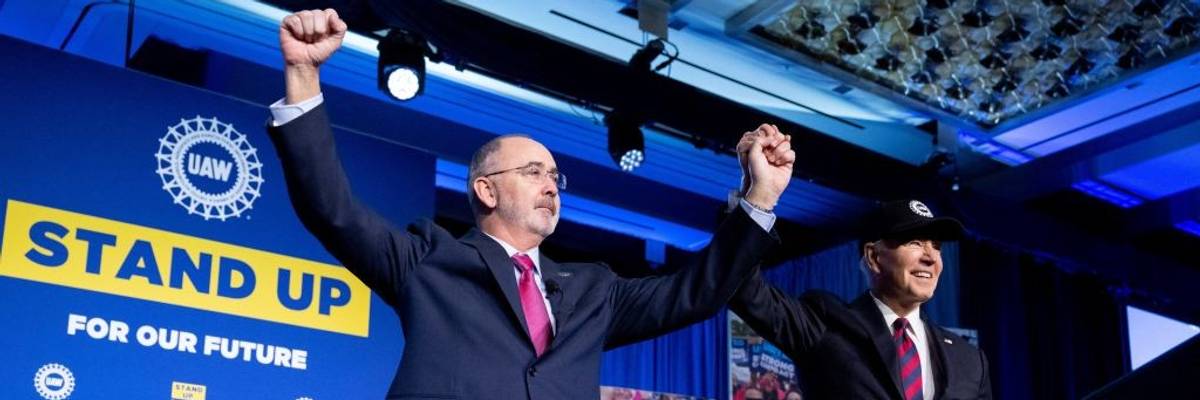
United Auto Workers leader Shawn Fain and U.S. President Joe Biden appear at a union conference at the Marriott Marquis in Washington, D.C., on January 24, 2024.
"The world is on fire," said one campaigner. "We need the Biden administration to maintain strong emissions rules that are one of the biggest extinguishers."
Green groups this week are responding with alarm to reporting that President Joe Biden's administration plans to relax the pace at which manufacturers must boost electric vehicle sales "in a concession to automakers and labor unions" as he seeks reelection on the heels of the hottest year in human history.
"A decision by President Biden to roll back the scale of his planned transition to EVs would be a monumental failure of his administration and of industry to take action toward a fossil-free future," Public Citizen's Chelsea Hodgkins said Monday. "President Biden isn't leaning into his full power to accelerate government action on one of the most effective strategies for preventing climate chaos—electrifying transport. In scaling back his ambition, he is kowtowing to the auto industry's propaganda."
Under the tailpipe emissions proposal unveiled last April, the Environmental Protection Agency (EPA) projected that EVs could account for 67% of all new light-duty vehicle sales by model year 2032. Citing three unnamed sources, The New York Times reported Saturday that officials finalizing the plan are adjusting it "so that electric vehicle sales would increase more gradually through 2030 but then would have to sharply rise."
The reporting comes after the Democratic president last month secured the crucial endorsement of the United Auto Workers, which followed a monthslong delay partly related to EV policy and came despite criticism from the UAW and residents of Michigan—the heart of the U.S. auto manufacturing industry—about Biden backing Israel's devastating war on the Gaza Strip.
Ali Zaidi, Biden's senior climate adviser, "declined to discuss the details of the final regulation" and a UAW spokesperson "declined multiple requests to interview" union president Shawn Fain, according to the Times.
Others suggested Biden's concession may be worth it to beat former President Donald Trump, the likely Republican nominee. David Victor, co-director of the Deep Decarbonization Initiative at the University of California, San Diego, told the newspaper that "you have more emissions for a few years but you raise the odds that the rule will stick."
However, Hodgkins argued that "with climate change fast accelerating, this is no time to capitulate to corporate demands."
The campaigner continued:
For decades, Big Auto has employed the same playbook as Big Oil to delay and prevent progress on rules that would clean our air, fight climate change, and save lives. Study after study, including the administration's own annual reporting, shows that the technology to reduce emissions and electrify fleets is not only available, but it will save automakers money in compliance fees and consumers money on fueling and overall costs. Yet, decades of the auto industry dragging its feet to take action means that it is further behind the curve.
Automakers have had decades to drive forward the transition to electric vehicles. They have failed time and again. The only factor that will usher in the needed transition to electric vehicles is firm and specific government requirements. Consumers will embrace electric vehicles when automakers make them the attractive option—which they will only do when the government requires them to do so.
"There's still time for the Biden administration to avoid this epic error and recommit to science-backed actions it has started," she stressed. "The world is on fire. We need the Biden administration to maintain strong emissions rules that are one of the biggest extinguishers."
Sierra Club executive director Ben Jealous similarly pressured the administration in a Tuesday statement, arguing that "strong EPA vehicle standards are essential to protecting clean air for communities across the country."
"Lobbying by auto manufacturers to stall the transition to electric vehicles could have severe consequences: Millions of Americans breathing deadly car pollution, suffering from the impacts of climate change, and spending too much on volatile gas prices," Jealous warned. "Enough excuses from the auto industry."
"Automakers have had more than enough time to prepare for the EV transition, and funding from the Inflation Reduction Act is rolling out the infrastructure necessary to support it," he added. "We can and must have union-made clean vehicles. We urge the EPA to remain steadfast in finalizing a strong rule that will improve public health and protect our future."
While Biden campaigned as a clear climate-friendly alternative to Trump in 2020, the Democrat has come under fire during his presidency for various decisions—including supporting certain oil and gas projects, continuing fossil fuel lease sales, skipping last year's United Nations summit, and declining to declare a national climate emergency.
Nearly two dozen Sunrise Movement campaigners were arrested at the president's campaign headquarters in Wilmington, Delaware last week and the youth-led climate group held dozens of actions across the country on Monday, warning that "Biden can either follow the lead of the young people who helped elect him in 2020 and declare a climate emergency or he's going to lose in November; backing a genocide and giving up our last chance to avert the worst of the climate crisis will be his legacy."
Dear Common Dreams reader, It’s been nearly 30 years since I co-founded Common Dreams with my late wife, Lina Newhouser. We had the radical notion that journalism should serve the public good, not corporate profits. It was clear to us from the outset what it would take to build such a project. No paid advertisements. No corporate sponsors. No millionaire publisher telling us what to think or do. Many people said we wouldn't last a year, but we proved those doubters wrong. Together with a tremendous team of journalists and dedicated staff, we built an independent media outlet free from the constraints of profits and corporate control. Our mission has always been simple: To inform. To inspire. To ignite change for the common good. Building Common Dreams was not easy. Our survival was never guaranteed. When you take on the most powerful forces—Wall Street greed, fossil fuel industry destruction, Big Tech lobbyists, and uber-rich oligarchs who have spent billions upon billions rigging the economy and democracy in their favor—the only bulwark you have is supporters who believe in your work. But here’s the urgent message from me today. It's never been this bad out there. And it's never been this hard to keep us going. At the very moment Common Dreams is most needed, the threats we face are intensifying. We need your support now more than ever. We don't accept corporate advertising and never will. We don't have a paywall because we don't think people should be blocked from critical news based on their ability to pay. Everything we do is funded by the donations of readers like you. When everyone does the little they can afford, we are strong. But if that support retreats or dries up, so do we. Will you donate now to make sure Common Dreams not only survives but thrives? —Craig Brown, Co-founder |
Green groups this week are responding with alarm to reporting that President Joe Biden's administration plans to relax the pace at which manufacturers must boost electric vehicle sales "in a concession to automakers and labor unions" as he seeks reelection on the heels of the hottest year in human history.
"A decision by President Biden to roll back the scale of his planned transition to EVs would be a monumental failure of his administration and of industry to take action toward a fossil-free future," Public Citizen's Chelsea Hodgkins said Monday. "President Biden isn't leaning into his full power to accelerate government action on one of the most effective strategies for preventing climate chaos—electrifying transport. In scaling back his ambition, he is kowtowing to the auto industry's propaganda."
Under the tailpipe emissions proposal unveiled last April, the Environmental Protection Agency (EPA) projected that EVs could account for 67% of all new light-duty vehicle sales by model year 2032. Citing three unnamed sources, The New York Times reported Saturday that officials finalizing the plan are adjusting it "so that electric vehicle sales would increase more gradually through 2030 but then would have to sharply rise."
The reporting comes after the Democratic president last month secured the crucial endorsement of the United Auto Workers, which followed a monthslong delay partly related to EV policy and came despite criticism from the UAW and residents of Michigan—the heart of the U.S. auto manufacturing industry—about Biden backing Israel's devastating war on the Gaza Strip.
Ali Zaidi, Biden's senior climate adviser, "declined to discuss the details of the final regulation" and a UAW spokesperson "declined multiple requests to interview" union president Shawn Fain, according to the Times.
Others suggested Biden's concession may be worth it to beat former President Donald Trump, the likely Republican nominee. David Victor, co-director of the Deep Decarbonization Initiative at the University of California, San Diego, told the newspaper that "you have more emissions for a few years but you raise the odds that the rule will stick."
However, Hodgkins argued that "with climate change fast accelerating, this is no time to capitulate to corporate demands."
The campaigner continued:
For decades, Big Auto has employed the same playbook as Big Oil to delay and prevent progress on rules that would clean our air, fight climate change, and save lives. Study after study, including the administration's own annual reporting, shows that the technology to reduce emissions and electrify fleets is not only available, but it will save automakers money in compliance fees and consumers money on fueling and overall costs. Yet, decades of the auto industry dragging its feet to take action means that it is further behind the curve.
Automakers have had decades to drive forward the transition to electric vehicles. They have failed time and again. The only factor that will usher in the needed transition to electric vehicles is firm and specific government requirements. Consumers will embrace electric vehicles when automakers make them the attractive option—which they will only do when the government requires them to do so.
"There's still time for the Biden administration to avoid this epic error and recommit to science-backed actions it has started," she stressed. "The world is on fire. We need the Biden administration to maintain strong emissions rules that are one of the biggest extinguishers."
Sierra Club executive director Ben Jealous similarly pressured the administration in a Tuesday statement, arguing that "strong EPA vehicle standards are essential to protecting clean air for communities across the country."
"Lobbying by auto manufacturers to stall the transition to electric vehicles could have severe consequences: Millions of Americans breathing deadly car pollution, suffering from the impacts of climate change, and spending too much on volatile gas prices," Jealous warned. "Enough excuses from the auto industry."
"Automakers have had more than enough time to prepare for the EV transition, and funding from the Inflation Reduction Act is rolling out the infrastructure necessary to support it," he added. "We can and must have union-made clean vehicles. We urge the EPA to remain steadfast in finalizing a strong rule that will improve public health and protect our future."
While Biden campaigned as a clear climate-friendly alternative to Trump in 2020, the Democrat has come under fire during his presidency for various decisions—including supporting certain oil and gas projects, continuing fossil fuel lease sales, skipping last year's United Nations summit, and declining to declare a national climate emergency.
Nearly two dozen Sunrise Movement campaigners were arrested at the president's campaign headquarters in Wilmington, Delaware last week and the youth-led climate group held dozens of actions across the country on Monday, warning that "Biden can either follow the lead of the young people who helped elect him in 2020 and declare a climate emergency or he's going to lose in November; backing a genocide and giving up our last chance to avert the worst of the climate crisis will be his legacy."
Green groups this week are responding with alarm to reporting that President Joe Biden's administration plans to relax the pace at which manufacturers must boost electric vehicle sales "in a concession to automakers and labor unions" as he seeks reelection on the heels of the hottest year in human history.
"A decision by President Biden to roll back the scale of his planned transition to EVs would be a monumental failure of his administration and of industry to take action toward a fossil-free future," Public Citizen's Chelsea Hodgkins said Monday. "President Biden isn't leaning into his full power to accelerate government action on one of the most effective strategies for preventing climate chaos—electrifying transport. In scaling back his ambition, he is kowtowing to the auto industry's propaganda."
Under the tailpipe emissions proposal unveiled last April, the Environmental Protection Agency (EPA) projected that EVs could account for 67% of all new light-duty vehicle sales by model year 2032. Citing three unnamed sources, The New York Times reported Saturday that officials finalizing the plan are adjusting it "so that electric vehicle sales would increase more gradually through 2030 but then would have to sharply rise."
The reporting comes after the Democratic president last month secured the crucial endorsement of the United Auto Workers, which followed a monthslong delay partly related to EV policy and came despite criticism from the UAW and residents of Michigan—the heart of the U.S. auto manufacturing industry—about Biden backing Israel's devastating war on the Gaza Strip.
Ali Zaidi, Biden's senior climate adviser, "declined to discuss the details of the final regulation" and a UAW spokesperson "declined multiple requests to interview" union president Shawn Fain, according to the Times.
Others suggested Biden's concession may be worth it to beat former President Donald Trump, the likely Republican nominee. David Victor, co-director of the Deep Decarbonization Initiative at the University of California, San Diego, told the newspaper that "you have more emissions for a few years but you raise the odds that the rule will stick."
However, Hodgkins argued that "with climate change fast accelerating, this is no time to capitulate to corporate demands."
The campaigner continued:
For decades, Big Auto has employed the same playbook as Big Oil to delay and prevent progress on rules that would clean our air, fight climate change, and save lives. Study after study, including the administration's own annual reporting, shows that the technology to reduce emissions and electrify fleets is not only available, but it will save automakers money in compliance fees and consumers money on fueling and overall costs. Yet, decades of the auto industry dragging its feet to take action means that it is further behind the curve.
Automakers have had decades to drive forward the transition to electric vehicles. They have failed time and again. The only factor that will usher in the needed transition to electric vehicles is firm and specific government requirements. Consumers will embrace electric vehicles when automakers make them the attractive option—which they will only do when the government requires them to do so.
"There's still time for the Biden administration to avoid this epic error and recommit to science-backed actions it has started," she stressed. "The world is on fire. We need the Biden administration to maintain strong emissions rules that are one of the biggest extinguishers."
Sierra Club executive director Ben Jealous similarly pressured the administration in a Tuesday statement, arguing that "strong EPA vehicle standards are essential to protecting clean air for communities across the country."
"Lobbying by auto manufacturers to stall the transition to electric vehicles could have severe consequences: Millions of Americans breathing deadly car pollution, suffering from the impacts of climate change, and spending too much on volatile gas prices," Jealous warned. "Enough excuses from the auto industry."
"Automakers have had more than enough time to prepare for the EV transition, and funding from the Inflation Reduction Act is rolling out the infrastructure necessary to support it," he added. "We can and must have union-made clean vehicles. We urge the EPA to remain steadfast in finalizing a strong rule that will improve public health and protect our future."
While Biden campaigned as a clear climate-friendly alternative to Trump in 2020, the Democrat has come under fire during his presidency for various decisions—including supporting certain oil and gas projects, continuing fossil fuel lease sales, skipping last year's United Nations summit, and declining to declare a national climate emergency.
Nearly two dozen Sunrise Movement campaigners were arrested at the president's campaign headquarters in Wilmington, Delaware last week and the youth-led climate group held dozens of actions across the country on Monday, warning that "Biden can either follow the lead of the young people who helped elect him in 2020 and declare a climate emergency or he's going to lose in November; backing a genocide and giving up our last chance to avert the worst of the climate crisis will be his legacy."

