SUBSCRIBE TO OUR FREE NEWSLETTER
Daily news & progressive opinion—funded by the people, not the corporations—delivered straight to your inbox.
5
#000000
#FFFFFF
To donate by check, phone, or other method, see our More Ways to Give page.
Daily news & progressive opinion—funded by the people, not the corporations—delivered straight to your inbox.
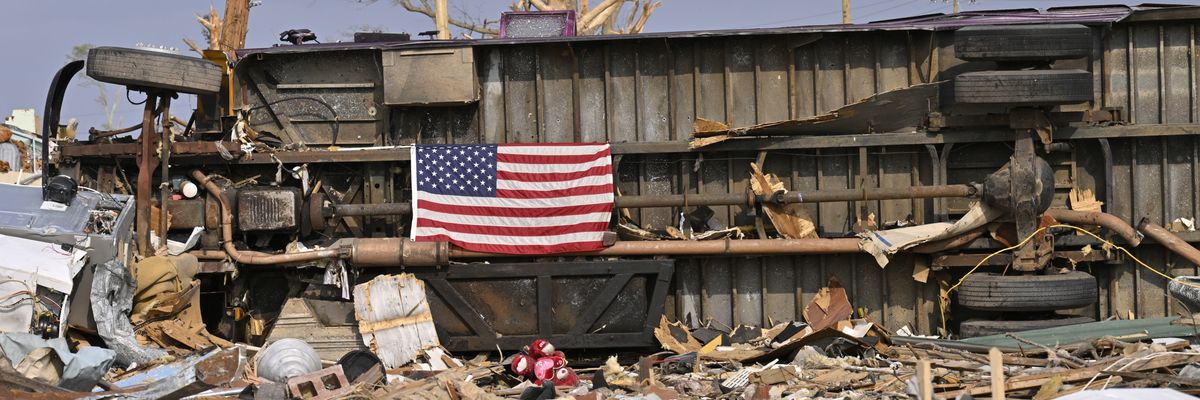
Residents are cleaning up after the devastating tornadoes while U.S. President Joe Biden along with First Lady Jill Biden visits in Rolling Fork, Mississippi, United States on March 31, 2023.
The numbers come as the nation has experienced 60 such disasters in the past three years, the most in that timeframe since record-keeping began in 1980.
Seven different billion-dollar or more extreme weather events struck the U.S. during the first four months of 2023.
That's one of the "notable" findings from the National Oceanic and Atmospheric Administration's (NOAA) April State of the Climate report, released Monday.
"The number of billion dollar disasters so far in 2023 is significant," NOAA wrote. "Only 2017 and 2020 had more during this timeframe, with eight separate disasters recorded in the January-April period."
In total, the extreme weather events killed 97 people and caused more than $19 billion in damages. They come as the nation has seen 60 such disasters in the past three years, the most in that timeframe since record-keeping began in 1980, The Weather Channel reported.
The costliest and deadliest events so far this year were two severe weather outbreaks in the Southeast as well as the ongoing flooding in California from a series of atmospheric rivers that brought heavy rain and record snow, according to NOAA.
Between March 2 and 3, at least 33 tornadoes touched down as part of a severe weather outbreak in the Southern Plains, Southeast, and Ohio Valley, The Weather Channel reported. Together, these storms claimed 13 lives and cost $4.5 billion, NOAA calculated.
A second "historic" tornado outbreak in the central U.S. on March 31 and April 1 generated at least 145 tornadoes that killed 33 people and cost $4.3 billion.
"The impacts of climate change are already being felt in communities across the country."
Storms in California, meanwhile, killed 22 people and cost $3.5 billion from late December to March, though they also helped to relieve the state's drought with record snowfall and plentiful rain.
"Flooding impacted many homes, businesses, levees, agriculture, and other infrastructure particularly across central California," NOAA wrote.
The other billion-or-more-dollar disasters included a winter storm and cold snap that froze the Northeast from February 2 to 5, costing $1.6 billion and claiming one life; another tornado outbreak that brought more than 40 twisters to Mississippi, Alabama, Georgia, and Tennessee from March 24 to 26, killing 23 and causing $1.9 billion in damage; a severe weather outbreak in central and southern states from April 4 to 6 that included more than 35 tornadoes, killed five, and cost $2.2 billion; and another severe weather outbreak in the central and southern states on April 15 that cost $1 billion.
In general, scientists have concluded that the climate crisis—driven primarily by the burning of fossil fuels—makes several types of extreme weather events either more frequent or severe or both.
"The impacts of climate change are already being felt in communities across the country," the authors of the Fourth National Climate Assessment wrote. "More frequent and intense extreme weather and climate-related events, as well as changes in average climate conditions, are expected to continue to damage infrastructure, ecosystems, and social systems that provide essential benefits to communities."
In particular, warmer temperatures are increasing the likelihood of extreme precipitation events, and this holds true for California's atmospheric rivers.
"Atmospheric rivers are becoming more intense with climate change because they're holding more moisture," University of Minnesota extreme weather expert Katerina Gonzales told Scientific American in January.
Many of 2023's billion-dollar disasters have involved tornadoes, and scientists know less about the climate footprints on these particularly dangerous storms, as CNN noted. However, a study published in the Bulletin of the American Meteorological Society in January found that supercells—the kind of thunderstorms that birth most deadly tornadoes and dangerous hail—are likely to become more frequent as the planet warms, shift their range eastward, and occur outside the bounds of the traditional storm season.
"These results suggest the potential for more significant tornadoes, hail, and extreme rainfall that, when combined with an increasingly vulnerable society, may produce disastrous consequences," the study authors wrote.
Tornado alley is already expanding from the Great Plains into the Midwest and Southeast, where the storms have the chance to do more damage.
"There's been explosive growth in the south in recent years and that unfortunately means we are turning up both the number of tornadoes in this area and the number of people exposed to them," Walker Ashley, lead author on the January study, told The Guardian. "This has consequences—we are all paying that through premiums and government grants as we've collectively determined it's OK to live in risky areas. We will need to think about building better and smarter, thinking more about how resilient the roof and garage doors are, for example, to live with these impacts. Because they are not going away."
Another signal of climate change in the latest NOAA report is the unseasonably warm winter many states experienced.
"So far, 2023 stands out for the remarkable warmth that covered many parts of the U.S., with some states seeing their warmest January—April period on record," NOAA said.
Dear Common Dreams reader, It’s been nearly 30 years since I co-founded Common Dreams with my late wife, Lina Newhouser. We had the radical notion that journalism should serve the public good, not corporate profits. It was clear to us from the outset what it would take to build such a project. No paid advertisements. No corporate sponsors. No millionaire publisher telling us what to think or do. Many people said we wouldn't last a year, but we proved those doubters wrong. Together with a tremendous team of journalists and dedicated staff, we built an independent media outlet free from the constraints of profits and corporate control. Our mission has always been simple: To inform. To inspire. To ignite change for the common good. Building Common Dreams was not easy. Our survival was never guaranteed. When you take on the most powerful forces—Wall Street greed, fossil fuel industry destruction, Big Tech lobbyists, and uber-rich oligarchs who have spent billions upon billions rigging the economy and democracy in their favor—the only bulwark you have is supporters who believe in your work. But here’s the urgent message from me today. It's never been this bad out there. And it's never been this hard to keep us going. At the very moment Common Dreams is most needed, the threats we face are intensifying. We need your support now more than ever. We don't accept corporate advertising and never will. We don't have a paywall because we don't think people should be blocked from critical news based on their ability to pay. Everything we do is funded by the donations of readers like you. When everyone does the little they can afford, we are strong. But if that support retreats or dries up, so do we. Will you donate now to make sure Common Dreams not only survives but thrives? —Craig Brown, Co-founder |
Seven different billion-dollar or more extreme weather events struck the U.S. during the first four months of 2023.
That's one of the "notable" findings from the National Oceanic and Atmospheric Administration's (NOAA) April State of the Climate report, released Monday.
"The number of billion dollar disasters so far in 2023 is significant," NOAA wrote. "Only 2017 and 2020 had more during this timeframe, with eight separate disasters recorded in the January-April period."
In total, the extreme weather events killed 97 people and caused more than $19 billion in damages. They come as the nation has seen 60 such disasters in the past three years, the most in that timeframe since record-keeping began in 1980, The Weather Channel reported.
The costliest and deadliest events so far this year were two severe weather outbreaks in the Southeast as well as the ongoing flooding in California from a series of atmospheric rivers that brought heavy rain and record snow, according to NOAA.
Between March 2 and 3, at least 33 tornadoes touched down as part of a severe weather outbreak in the Southern Plains, Southeast, and Ohio Valley, The Weather Channel reported. Together, these storms claimed 13 lives and cost $4.5 billion, NOAA calculated.
A second "historic" tornado outbreak in the central U.S. on March 31 and April 1 generated at least 145 tornadoes that killed 33 people and cost $4.3 billion.
"The impacts of climate change are already being felt in communities across the country."
Storms in California, meanwhile, killed 22 people and cost $3.5 billion from late December to March, though they also helped to relieve the state's drought with record snowfall and plentiful rain.
"Flooding impacted many homes, businesses, levees, agriculture, and other infrastructure particularly across central California," NOAA wrote.
The other billion-or-more-dollar disasters included a winter storm and cold snap that froze the Northeast from February 2 to 5, costing $1.6 billion and claiming one life; another tornado outbreak that brought more than 40 twisters to Mississippi, Alabama, Georgia, and Tennessee from March 24 to 26, killing 23 and causing $1.9 billion in damage; a severe weather outbreak in central and southern states from April 4 to 6 that included more than 35 tornadoes, killed five, and cost $2.2 billion; and another severe weather outbreak in the central and southern states on April 15 that cost $1 billion.
In general, scientists have concluded that the climate crisis—driven primarily by the burning of fossil fuels—makes several types of extreme weather events either more frequent or severe or both.
"The impacts of climate change are already being felt in communities across the country," the authors of the Fourth National Climate Assessment wrote. "More frequent and intense extreme weather and climate-related events, as well as changes in average climate conditions, are expected to continue to damage infrastructure, ecosystems, and social systems that provide essential benefits to communities."
In particular, warmer temperatures are increasing the likelihood of extreme precipitation events, and this holds true for California's atmospheric rivers.
"Atmospheric rivers are becoming more intense with climate change because they're holding more moisture," University of Minnesota extreme weather expert Katerina Gonzales told Scientific American in January.
Many of 2023's billion-dollar disasters have involved tornadoes, and scientists know less about the climate footprints on these particularly dangerous storms, as CNN noted. However, a study published in the Bulletin of the American Meteorological Society in January found that supercells—the kind of thunderstorms that birth most deadly tornadoes and dangerous hail—are likely to become more frequent as the planet warms, shift their range eastward, and occur outside the bounds of the traditional storm season.
"These results suggest the potential for more significant tornadoes, hail, and extreme rainfall that, when combined with an increasingly vulnerable society, may produce disastrous consequences," the study authors wrote.
Tornado alley is already expanding from the Great Plains into the Midwest and Southeast, where the storms have the chance to do more damage.
"There's been explosive growth in the south in recent years and that unfortunately means we are turning up both the number of tornadoes in this area and the number of people exposed to them," Walker Ashley, lead author on the January study, told The Guardian. "This has consequences—we are all paying that through premiums and government grants as we've collectively determined it's OK to live in risky areas. We will need to think about building better and smarter, thinking more about how resilient the roof and garage doors are, for example, to live with these impacts. Because they are not going away."
Another signal of climate change in the latest NOAA report is the unseasonably warm winter many states experienced.
"So far, 2023 stands out for the remarkable warmth that covered many parts of the U.S., with some states seeing their warmest January—April period on record," NOAA said.
Seven different billion-dollar or more extreme weather events struck the U.S. during the first four months of 2023.
That's one of the "notable" findings from the National Oceanic and Atmospheric Administration's (NOAA) April State of the Climate report, released Monday.
"The number of billion dollar disasters so far in 2023 is significant," NOAA wrote. "Only 2017 and 2020 had more during this timeframe, with eight separate disasters recorded in the January-April period."
In total, the extreme weather events killed 97 people and caused more than $19 billion in damages. They come as the nation has seen 60 such disasters in the past three years, the most in that timeframe since record-keeping began in 1980, The Weather Channel reported.
The costliest and deadliest events so far this year were two severe weather outbreaks in the Southeast as well as the ongoing flooding in California from a series of atmospheric rivers that brought heavy rain and record snow, according to NOAA.
Between March 2 and 3, at least 33 tornadoes touched down as part of a severe weather outbreak in the Southern Plains, Southeast, and Ohio Valley, The Weather Channel reported. Together, these storms claimed 13 lives and cost $4.5 billion, NOAA calculated.
A second "historic" tornado outbreak in the central U.S. on March 31 and April 1 generated at least 145 tornadoes that killed 33 people and cost $4.3 billion.
"The impacts of climate change are already being felt in communities across the country."
Storms in California, meanwhile, killed 22 people and cost $3.5 billion from late December to March, though they also helped to relieve the state's drought with record snowfall and plentiful rain.
"Flooding impacted many homes, businesses, levees, agriculture, and other infrastructure particularly across central California," NOAA wrote.
The other billion-or-more-dollar disasters included a winter storm and cold snap that froze the Northeast from February 2 to 5, costing $1.6 billion and claiming one life; another tornado outbreak that brought more than 40 twisters to Mississippi, Alabama, Georgia, and Tennessee from March 24 to 26, killing 23 and causing $1.9 billion in damage; a severe weather outbreak in central and southern states from April 4 to 6 that included more than 35 tornadoes, killed five, and cost $2.2 billion; and another severe weather outbreak in the central and southern states on April 15 that cost $1 billion.
In general, scientists have concluded that the climate crisis—driven primarily by the burning of fossil fuels—makes several types of extreme weather events either more frequent or severe or both.
"The impacts of climate change are already being felt in communities across the country," the authors of the Fourth National Climate Assessment wrote. "More frequent and intense extreme weather and climate-related events, as well as changes in average climate conditions, are expected to continue to damage infrastructure, ecosystems, and social systems that provide essential benefits to communities."
In particular, warmer temperatures are increasing the likelihood of extreme precipitation events, and this holds true for California's atmospheric rivers.
"Atmospheric rivers are becoming more intense with climate change because they're holding more moisture," University of Minnesota extreme weather expert Katerina Gonzales told Scientific American in January.
Many of 2023's billion-dollar disasters have involved tornadoes, and scientists know less about the climate footprints on these particularly dangerous storms, as CNN noted. However, a study published in the Bulletin of the American Meteorological Society in January found that supercells—the kind of thunderstorms that birth most deadly tornadoes and dangerous hail—are likely to become more frequent as the planet warms, shift their range eastward, and occur outside the bounds of the traditional storm season.
"These results suggest the potential for more significant tornadoes, hail, and extreme rainfall that, when combined with an increasingly vulnerable society, may produce disastrous consequences," the study authors wrote.
Tornado alley is already expanding from the Great Plains into the Midwest and Southeast, where the storms have the chance to do more damage.
"There's been explosive growth in the south in recent years and that unfortunately means we are turning up both the number of tornadoes in this area and the number of people exposed to them," Walker Ashley, lead author on the January study, told The Guardian. "This has consequences—we are all paying that through premiums and government grants as we've collectively determined it's OK to live in risky areas. We will need to think about building better and smarter, thinking more about how resilient the roof and garage doors are, for example, to live with these impacts. Because they are not going away."
Another signal of climate change in the latest NOAA report is the unseasonably warm winter many states experienced.
"So far, 2023 stands out for the remarkable warmth that covered many parts of the U.S., with some states seeing their warmest January—April period on record," NOAA said.