SUBSCRIBE TO OUR FREE NEWSLETTER
Daily news & progressive opinion—funded by the people, not the corporations—delivered straight to your inbox.
5
#000000
#FFFFFF
To donate by check, phone, or other method, see our More Ways to Give page.
Daily news & progressive opinion—funded by the people, not the corporations—delivered straight to your inbox.
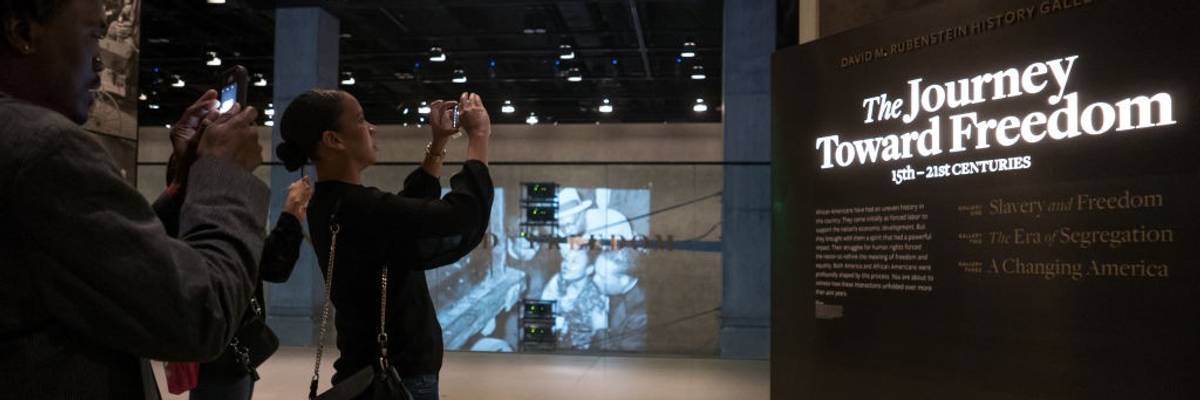
Guests tour the "Slavery & Freedom" exhibit at the Smithsonian's National Museum of African American History and Culture (NMAAHC) in Washington, DC, on February 3, 2017.
The White House said it would expand its review of museums' historical content to other institutions after it holds the Smithsonian "accountable."
A week after the White House announced it was examining the Smithsonian museums' exhibits to ensure they align with President Donald Trump's own "interpretation of American history," the president on Tuesday said the publicly funded museum system is "out of control" and contains materials that are overly negative about one of the most significant aspects of U.S. history: chattel slavery and its legacy.
"Everything discussed is how horrible our Country is, how bad Slavery was, and how unaccomplished the downtrodden have been—Nothing about Success, nothing about Brightness, nothing about the Future," said the president on his social media platform, Truth Social.
Trump's comments came days after Russell Vought, director of the White House Office of Management and Budget, sent a letter to the Smithsonian—which includes 21 museums, 14 educational centers, and a zoo—ordering officials at eight of its museums to turn over information about exhibits that are being planned to commemorate the United States' 250th anniversary next year.
The officials were given 120 days to adjust the "tone, historical framing, and alignment with American ideals" to match the administration's view of history—which, judging from Trump's comments, doesn't include the history of how Black Americans were impacted by enslavement, despite the fact that Republicans at the party's 2020 national convention claimed credit for abolishing the practice.
"Anyone who thinks there’s ANYTHING GOOD about enslaving human beings has no business running ANY country… much less the world's most influential democracy," said U.S. Rep. Jim McGovern (D-Mass.) in response to Trump's comments.
The White House also pushed the Smithsonian's National Museum of American History this month to remove references to the president's two impeachment trials—once for pressuring Ukraine to investigate his political opponents and once for inciting his followers to attack the U.S. Capitol on January 6, 2021.
"Anyone who thinks there's ANYTHING GOOD about enslaving human beings has no business running ANY country… much less the world's most influential democracy."
In May, NBC News reported that after Trump issued his executive order demanding the Smithsonian take down exhibits that he claimed "divide Americans based on race," officials removed at least 32 artifacts from the National Museum of African American History and Culture, including a hymn book owned by Harriet Tubman, a former slave who later fought for the abolishment of the institution.
The White House told NBC News Tuesday that Trump plans to hold the Smithsonian "accountable" and "then go from there," expanding his review of museums to other institutions.
In his post at Truth Social Tuesday, Trump said his attorneys will "go through the Museums, and start the exact same process that has been done with Colleges and Universities where tremendous progress has been made"—a reference to the pressure the White House has placed on universities including Columbia and Harvard to suppress academic freedom and curb free speech.
The administration has pushed some schools to end diversity, equity, and inclusion initiatives while coercing hundreds of millions of dollars in settlement payments.
Presidential historian Douglas Brinkley told The New York Times Tuesday that it was "the epitome of dumbness to criticize the Smithsonian for dealing with the reality of slavery in America."
"It's what led to our Civil War and is a defining aspect of our national history," said Brinkley. "And the Smithsonian deals in a robust way with what slavery was, but it also deals with human rights and civil rights in equal abundance."
Cornell William Brooks, a professor at Harvard, warned that "the SAME propaganda that said slavery wasn't so bad allowed people to feel so good about lynchings they mailed thousands of postcards" showing people who were lynched at public gatherings.
"My enslaved ancestors were kidnapped to South Carolina and subsequently beaten, raped, and humiliated," said Brooks. "'Brightness' is IN the history. Read the slavery narratives, talk to some Black people, OR just visit our powerful Smithsonian museums."
Dear Common Dreams reader, It’s been nearly 30 years since I co-founded Common Dreams with my late wife, Lina Newhouser. We had the radical notion that journalism should serve the public good, not corporate profits. It was clear to us from the outset what it would take to build such a project. No paid advertisements. No corporate sponsors. No millionaire publisher telling us what to think or do. Many people said we wouldn't last a year, but we proved those doubters wrong. Together with a tremendous team of journalists and dedicated staff, we built an independent media outlet free from the constraints of profits and corporate control. Our mission has always been simple: To inform. To inspire. To ignite change for the common good. Building Common Dreams was not easy. Our survival was never guaranteed. When you take on the most powerful forces—Wall Street greed, fossil fuel industry destruction, Big Tech lobbyists, and uber-rich oligarchs who have spent billions upon billions rigging the economy and democracy in their favor—the only bulwark you have is supporters who believe in your work. But here’s the urgent message from me today. It's never been this bad out there. And it's never been this hard to keep us going. At the very moment Common Dreams is most needed, the threats we face are intensifying. We need your support now more than ever. We don't accept corporate advertising and never will. We don't have a paywall because we don't think people should be blocked from critical news based on their ability to pay. Everything we do is funded by the donations of readers like you. When everyone does the little they can afford, we are strong. But if that support retreats or dries up, so do we. Will you donate now to make sure Common Dreams not only survives but thrives? —Craig Brown, Co-founder |
A week after the White House announced it was examining the Smithsonian museums' exhibits to ensure they align with President Donald Trump's own "interpretation of American history," the president on Tuesday said the publicly funded museum system is "out of control" and contains materials that are overly negative about one of the most significant aspects of U.S. history: chattel slavery and its legacy.
"Everything discussed is how horrible our Country is, how bad Slavery was, and how unaccomplished the downtrodden have been—Nothing about Success, nothing about Brightness, nothing about the Future," said the president on his social media platform, Truth Social.
Trump's comments came days after Russell Vought, director of the White House Office of Management and Budget, sent a letter to the Smithsonian—which includes 21 museums, 14 educational centers, and a zoo—ordering officials at eight of its museums to turn over information about exhibits that are being planned to commemorate the United States' 250th anniversary next year.
The officials were given 120 days to adjust the "tone, historical framing, and alignment with American ideals" to match the administration's view of history—which, judging from Trump's comments, doesn't include the history of how Black Americans were impacted by enslavement, despite the fact that Republicans at the party's 2020 national convention claimed credit for abolishing the practice.
"Anyone who thinks there’s ANYTHING GOOD about enslaving human beings has no business running ANY country… much less the world's most influential democracy," said U.S. Rep. Jim McGovern (D-Mass.) in response to Trump's comments.
The White House also pushed the Smithsonian's National Museum of American History this month to remove references to the president's two impeachment trials—once for pressuring Ukraine to investigate his political opponents and once for inciting his followers to attack the U.S. Capitol on January 6, 2021.
"Anyone who thinks there's ANYTHING GOOD about enslaving human beings has no business running ANY country… much less the world's most influential democracy."
In May, NBC News reported that after Trump issued his executive order demanding the Smithsonian take down exhibits that he claimed "divide Americans based on race," officials removed at least 32 artifacts from the National Museum of African American History and Culture, including a hymn book owned by Harriet Tubman, a former slave who later fought for the abolishment of the institution.
The White House told NBC News Tuesday that Trump plans to hold the Smithsonian "accountable" and "then go from there," expanding his review of museums to other institutions.
In his post at Truth Social Tuesday, Trump said his attorneys will "go through the Museums, and start the exact same process that has been done with Colleges and Universities where tremendous progress has been made"—a reference to the pressure the White House has placed on universities including Columbia and Harvard to suppress academic freedom and curb free speech.
The administration has pushed some schools to end diversity, equity, and inclusion initiatives while coercing hundreds of millions of dollars in settlement payments.
Presidential historian Douglas Brinkley told The New York Times Tuesday that it was "the epitome of dumbness to criticize the Smithsonian for dealing with the reality of slavery in America."
"It's what led to our Civil War and is a defining aspect of our national history," said Brinkley. "And the Smithsonian deals in a robust way with what slavery was, but it also deals with human rights and civil rights in equal abundance."
Cornell William Brooks, a professor at Harvard, warned that "the SAME propaganda that said slavery wasn't so bad allowed people to feel so good about lynchings they mailed thousands of postcards" showing people who were lynched at public gatherings.
"My enslaved ancestors were kidnapped to South Carolina and subsequently beaten, raped, and humiliated," said Brooks. "'Brightness' is IN the history. Read the slavery narratives, talk to some Black people, OR just visit our powerful Smithsonian museums."
A week after the White House announced it was examining the Smithsonian museums' exhibits to ensure they align with President Donald Trump's own "interpretation of American history," the president on Tuesday said the publicly funded museum system is "out of control" and contains materials that are overly negative about one of the most significant aspects of U.S. history: chattel slavery and its legacy.
"Everything discussed is how horrible our Country is, how bad Slavery was, and how unaccomplished the downtrodden have been—Nothing about Success, nothing about Brightness, nothing about the Future," said the president on his social media platform, Truth Social.
Trump's comments came days after Russell Vought, director of the White House Office of Management and Budget, sent a letter to the Smithsonian—which includes 21 museums, 14 educational centers, and a zoo—ordering officials at eight of its museums to turn over information about exhibits that are being planned to commemorate the United States' 250th anniversary next year.
The officials were given 120 days to adjust the "tone, historical framing, and alignment with American ideals" to match the administration's view of history—which, judging from Trump's comments, doesn't include the history of how Black Americans were impacted by enslavement, despite the fact that Republicans at the party's 2020 national convention claimed credit for abolishing the practice.
"Anyone who thinks there’s ANYTHING GOOD about enslaving human beings has no business running ANY country… much less the world's most influential democracy," said U.S. Rep. Jim McGovern (D-Mass.) in response to Trump's comments.
The White House also pushed the Smithsonian's National Museum of American History this month to remove references to the president's two impeachment trials—once for pressuring Ukraine to investigate his political opponents and once for inciting his followers to attack the U.S. Capitol on January 6, 2021.
"Anyone who thinks there's ANYTHING GOOD about enslaving human beings has no business running ANY country… much less the world's most influential democracy."
In May, NBC News reported that after Trump issued his executive order demanding the Smithsonian take down exhibits that he claimed "divide Americans based on race," officials removed at least 32 artifacts from the National Museum of African American History and Culture, including a hymn book owned by Harriet Tubman, a former slave who later fought for the abolishment of the institution.
The White House told NBC News Tuesday that Trump plans to hold the Smithsonian "accountable" and "then go from there," expanding his review of museums to other institutions.
In his post at Truth Social Tuesday, Trump said his attorneys will "go through the Museums, and start the exact same process that has been done with Colleges and Universities where tremendous progress has been made"—a reference to the pressure the White House has placed on universities including Columbia and Harvard to suppress academic freedom and curb free speech.
The administration has pushed some schools to end diversity, equity, and inclusion initiatives while coercing hundreds of millions of dollars in settlement payments.
Presidential historian Douglas Brinkley told The New York Times Tuesday that it was "the epitome of dumbness to criticize the Smithsonian for dealing with the reality of slavery in America."
"It's what led to our Civil War and is a defining aspect of our national history," said Brinkley. "And the Smithsonian deals in a robust way with what slavery was, but it also deals with human rights and civil rights in equal abundance."
Cornell William Brooks, a professor at Harvard, warned that "the SAME propaganda that said slavery wasn't so bad allowed people to feel so good about lynchings they mailed thousands of postcards" showing people who were lynched at public gatherings.
"My enslaved ancestors were kidnapped to South Carolina and subsequently beaten, raped, and humiliated," said Brooks. "'Brightness' is IN the history. Read the slavery narratives, talk to some Black people, OR just visit our powerful Smithsonian museums."