
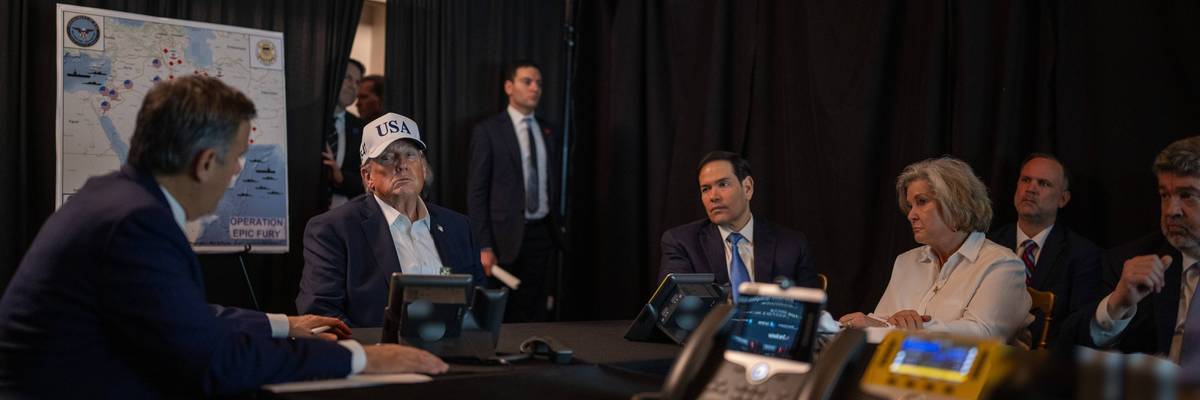
US President Donald Trump oversees the military assault on Iran with Central Intelligence Agency Director John Ratcliffe, Secretary of State Marco Rubio, and White House Chief of Staff Susie Wiles at Mar-a-Lago on February 28, 2026 in Palm Beach, Florida.
(Photo by Daniel Torok/White House via Getty Images)
Experts Pillory Trump Case for War on Iran: 'Flimsiest Excuse for Initiating a Major Attack' in Decades
"What they posed as the threat they were trying to preempt—an attack by Iran against US forces—is so extremely implausible, it is also laughable," said one analyst.
Mar 01, 2026
Senior Trump administration officials attempted during a briefing with reporters on Saturday to make their case for the joint US-Israeli military assault on Iran that has so far killed hundreds and plunged the Middle East into chaos.
According to experts who listened to the briefing, which was conducted on background, the justification for war was incredibly weak. Daryl Kimball, president of the Arms Control Association, told Laura Rozen of the Diplomatic newsletter that the administration's argument was "the flimsiest excuse for initiating a major attack on another country without congressional authorization, in violation of the UN Charter, in many decades."
During his early Saturday remarks announcing the attacks, President Donald Trump claimed that "imminent threats from the Iranian regime" against "the American people" drove him to act. But Kimball said that administration officials "provided absolutely no evidence" to back that assertion during the briefing.
"What they posed as the threat they were trying to preempt—an attack by Iran against US forces—is so extremely implausible, it is also laughable," said Kimball.
Following the start of Saturday's assault, which Trump explicitly characterized as a war aimed at overthrowing the Iranian government, unnamed administration officials began leaking the claim that Trump feared an Iranian attack on the massive US military buildup in the Middle East, prompting him to greenlight the bombing campaign in coordination with Israel and with a nudge from Saudi Arabia.
Kimball, in a social media post, took members of the US media to task for echoing the administration's narrative. "Reporters need to do more than stenography," he wrote in response to Punchbowl's Jake Sherman.
"The American people were lied to about Iraq. The American people are being lied to again today—and once again, it is ordinary people who will pay the price."
Trump and top administration officials also repeated the longstanding claim from US warhawks that Iran is bent on developing a nuclear weapon, something Iranian leaders have publicly denied—including during recent diplomatic talks. Neither US intelligence assessments nor international nuclear watchdogs have produced evidence indicating that Iran is moving rapidly in the direction of nukes, as claimed by the administration.
Rozen noted that some remarks from administration officials during Saturday's briefing "suggested Trump’s negotiators"—a team that included Jared Kushner and Steve Witkoff—"may not have had the expertise or experience to understand the Iranian proposal to curb its nuclear program." Rozen reported that one administration official kept misstating the acronym for the International Atomic Energy Agency (IAEA), the UN nuclear watchdog.
Trump administration officials, according to Rozen, seemed astonished that Iranian negotiators would not accept the US offer to provide free nuclear fuel "forever" for Iran's peaceful energy development, viewing the rejection as a suspicious indication that Iran was opposed to a diplomatic resolution—even though, according to Oman's foreign minister, Iran had already made concessions that went well beyond the terms of the 2015 nuclear accord that Trump abandoned during his first stint in the White House.
Experts said it should be obvious—particularly given Trump's decision to ditch the previous nuclear accord—why Iran would not trust the US to stick by such a commitment.
The administration's inability to provide a coherent justification for war tracks with the rapidly shifting narrative preceding Saturday's strikes—an indication, according to some observers, that Trump had made the decision to attack Iran even in the face of diplomatic progress and left officials to try to cobble together a rationale after the fact.
In a lengthy social media post, Pentagon Secretary Pete Hegseth insisted war was necessary because Iran "refused to make a deal" and because the Iranian government "has targeted and killed Americans," hardly the claim of an imminent threat push by the president and other administration officials.
Brian Finucane, a senior adviser to the US Program at the International Crisis Group, noted in response that the Trump administration has "sidelined anyone who could articulate... a coherent argument, partly because expertise is deep state and woke and partly because they just don't care."
The result is another potentially catastrophic war that runs roughshod over US and international law, puts countless civilians at risk, and threatens to spark a region-wide conflict.
"President Trump, along with his right-wing extremist Israeli ally Benjamin Netanyahu, has begun an illegal, premeditated, and unconstitutional war," US Sen. Bernie Sanders (I-Vt.) said in a statement on Saturday. "Tragically, Trump is gambling with American lives and treasure to fulfill Netanyahu's decades-long ambition of dragging the United States into armed conflict with Iran."
"The American people were lied to about Vietnam. The American people were lied to about Iraq," Sanders added. "The American people are being lied to again today—and once again, it is ordinary people who will pay the price."
An Urgent Message From Our Co-Founder
Dear Common Dreams reader, The U.S. is on a fast track to authoritarianism like nothing I've ever seen. Meanwhile, corporate news outlets are utterly capitulating to Trump, twisting their coverage to avoid drawing his ire while lining up to stuff cash in his pockets. That's why I believe that Common Dreams is doing the best and most consequential reporting that we've ever done. Our small but mighty team is a progressive reporting powerhouse, covering the news every day that the corporate media never will. Our mission has always been simple: To inform. To inspire. And to ignite change for the common good. Now here's the key piece that I want all our readers to understand: None of this would be possible without your financial support. That's not just some fundraising cliche. It's the absolute and literal truth. We don't accept corporate advertising and never will. We don't have a paywall because we don't think people should be blocked from critical news based on their ability to pay. Everything we do is funded by the donations of readers like you. Will you donate now to help power the nonprofit, independent reporting of Common Dreams? Thank you for being a vital member of our community. Together, we can keep independent journalism alive when it’s needed most. - Craig Brown, Co-founder |
Our work is licensed under Creative Commons (CC BY-NC-ND 3.0). Feel free to republish and share widely.
Senior Trump administration officials attempted during a briefing with reporters on Saturday to make their case for the joint US-Israeli military assault on Iran that has so far killed hundreds and plunged the Middle East into chaos.
According to experts who listened to the briefing, which was conducted on background, the justification for war was incredibly weak. Daryl Kimball, president of the Arms Control Association, told Laura Rozen of the Diplomatic newsletter that the administration's argument was "the flimsiest excuse for initiating a major attack on another country without congressional authorization, in violation of the UN Charter, in many decades."
During his early Saturday remarks announcing the attacks, President Donald Trump claimed that "imminent threats from the Iranian regime" against "the American people" drove him to act. But Kimball said that administration officials "provided absolutely no evidence" to back that assertion during the briefing.
"What they posed as the threat they were trying to preempt—an attack by Iran against US forces—is so extremely implausible, it is also laughable," said Kimball.
Following the start of Saturday's assault, which Trump explicitly characterized as a war aimed at overthrowing the Iranian government, unnamed administration officials began leaking the claim that Trump feared an Iranian attack on the massive US military buildup in the Middle East, prompting him to greenlight the bombing campaign in coordination with Israel and with a nudge from Saudi Arabia.
Kimball, in a social media post, took members of the US media to task for echoing the administration's narrative. "Reporters need to do more than stenography," he wrote in response to Punchbowl's Jake Sherman.
"The American people were lied to about Iraq. The American people are being lied to again today—and once again, it is ordinary people who will pay the price."
Trump and top administration officials also repeated the longstanding claim from US warhawks that Iran is bent on developing a nuclear weapon, something Iranian leaders have publicly denied—including during recent diplomatic talks. Neither US intelligence assessments nor international nuclear watchdogs have produced evidence indicating that Iran is moving rapidly in the direction of nukes, as claimed by the administration.
Rozen noted that some remarks from administration officials during Saturday's briefing "suggested Trump’s negotiators"—a team that included Jared Kushner and Steve Witkoff—"may not have had the expertise or experience to understand the Iranian proposal to curb its nuclear program." Rozen reported that one administration official kept misstating the acronym for the International Atomic Energy Agency (IAEA), the UN nuclear watchdog.
Trump administration officials, according to Rozen, seemed astonished that Iranian negotiators would not accept the US offer to provide free nuclear fuel "forever" for Iran's peaceful energy development, viewing the rejection as a suspicious indication that Iran was opposed to a diplomatic resolution—even though, according to Oman's foreign minister, Iran had already made concessions that went well beyond the terms of the 2015 nuclear accord that Trump abandoned during his first stint in the White House.
Experts said it should be obvious—particularly given Trump's decision to ditch the previous nuclear accord—why Iran would not trust the US to stick by such a commitment.
The administration's inability to provide a coherent justification for war tracks with the rapidly shifting narrative preceding Saturday's strikes—an indication, according to some observers, that Trump had made the decision to attack Iran even in the face of diplomatic progress and left officials to try to cobble together a rationale after the fact.
In a lengthy social media post, Pentagon Secretary Pete Hegseth insisted war was necessary because Iran "refused to make a deal" and because the Iranian government "has targeted and killed Americans," hardly the claim of an imminent threat push by the president and other administration officials.
Brian Finucane, a senior adviser to the US Program at the International Crisis Group, noted in response that the Trump administration has "sidelined anyone who could articulate... a coherent argument, partly because expertise is deep state and woke and partly because they just don't care."
The result is another potentially catastrophic war that runs roughshod over US and international law, puts countless civilians at risk, and threatens to spark a region-wide conflict.
"President Trump, along with his right-wing extremist Israeli ally Benjamin Netanyahu, has begun an illegal, premeditated, and unconstitutional war," US Sen. Bernie Sanders (I-Vt.) said in a statement on Saturday. "Tragically, Trump is gambling with American lives and treasure to fulfill Netanyahu's decades-long ambition of dragging the United States into armed conflict with Iran."
"The American people were lied to about Vietnam. The American people were lied to about Iraq," Sanders added. "The American people are being lied to again today—and once again, it is ordinary people who will pay the price."
Senior Trump administration officials attempted during a briefing with reporters on Saturday to make their case for the joint US-Israeli military assault on Iran that has so far killed hundreds and plunged the Middle East into chaos.
According to experts who listened to the briefing, which was conducted on background, the justification for war was incredibly weak. Daryl Kimball, president of the Arms Control Association, told Laura Rozen of the Diplomatic newsletter that the administration's argument was "the flimsiest excuse for initiating a major attack on another country without congressional authorization, in violation of the UN Charter, in many decades."
During his early Saturday remarks announcing the attacks, President Donald Trump claimed that "imminent threats from the Iranian regime" against "the American people" drove him to act. But Kimball said that administration officials "provided absolutely no evidence" to back that assertion during the briefing.
"What they posed as the threat they were trying to preempt—an attack by Iran against US forces—is so extremely implausible, it is also laughable," said Kimball.
Following the start of Saturday's assault, which Trump explicitly characterized as a war aimed at overthrowing the Iranian government, unnamed administration officials began leaking the claim that Trump feared an Iranian attack on the massive US military buildup in the Middle East, prompting him to greenlight the bombing campaign in coordination with Israel and with a nudge from Saudi Arabia.
Kimball, in a social media post, took members of the US media to task for echoing the administration's narrative. "Reporters need to do more than stenography," he wrote in response to Punchbowl's Jake Sherman.
"The American people were lied to about Iraq. The American people are being lied to again today—and once again, it is ordinary people who will pay the price."
Trump and top administration officials also repeated the longstanding claim from US warhawks that Iran is bent on developing a nuclear weapon, something Iranian leaders have publicly denied—including during recent diplomatic talks. Neither US intelligence assessments nor international nuclear watchdogs have produced evidence indicating that Iran is moving rapidly in the direction of nukes, as claimed by the administration.
Rozen noted that some remarks from administration officials during Saturday's briefing "suggested Trump’s negotiators"—a team that included Jared Kushner and Steve Witkoff—"may not have had the expertise or experience to understand the Iranian proposal to curb its nuclear program." Rozen reported that one administration official kept misstating the acronym for the International Atomic Energy Agency (IAEA), the UN nuclear watchdog.
Trump administration officials, according to Rozen, seemed astonished that Iranian negotiators would not accept the US offer to provide free nuclear fuel "forever" for Iran's peaceful energy development, viewing the rejection as a suspicious indication that Iran was opposed to a diplomatic resolution—even though, according to Oman's foreign minister, Iran had already made concessions that went well beyond the terms of the 2015 nuclear accord that Trump abandoned during his first stint in the White House.
Experts said it should be obvious—particularly given Trump's decision to ditch the previous nuclear accord—why Iran would not trust the US to stick by such a commitment.
The administration's inability to provide a coherent justification for war tracks with the rapidly shifting narrative preceding Saturday's strikes—an indication, according to some observers, that Trump had made the decision to attack Iran even in the face of diplomatic progress and left officials to try to cobble together a rationale after the fact.
In a lengthy social media post, Pentagon Secretary Pete Hegseth insisted war was necessary because Iran "refused to make a deal" and because the Iranian government "has targeted and killed Americans," hardly the claim of an imminent threat push by the president and other administration officials.
Brian Finucane, a senior adviser to the US Program at the International Crisis Group, noted in response that the Trump administration has "sidelined anyone who could articulate... a coherent argument, partly because expertise is deep state and woke and partly because they just don't care."
The result is another potentially catastrophic war that runs roughshod over US and international law, puts countless civilians at risk, and threatens to spark a region-wide conflict.
"President Trump, along with his right-wing extremist Israeli ally Benjamin Netanyahu, has begun an illegal, premeditated, and unconstitutional war," US Sen. Bernie Sanders (I-Vt.) said in a statement on Saturday. "Tragically, Trump is gambling with American lives and treasure to fulfill Netanyahu's decades-long ambition of dragging the United States into armed conflict with Iran."
"The American people were lied to about Vietnam. The American people were lied to about Iraq," Sanders added. "The American people are being lied to again today—and once again, it is ordinary people who will pay the price."
We've had enough. The 1% own and operate the corporate media. They are doing everything they can to defend the status quo, squash dissent and protect the wealthy and the powerful. The Common Dreams media model is different. We cover the news that matters to the 99%. Our mission? To inform. To inspire. To ignite change for the common good. How? Nonprofit. Independent. Reader-supported. Free to read. Free to republish. Free to share. With no advertising. No paywalls. No selling of your data. Thousands of small donations fund our newsroom and allow us to continue publishing. Can you chip in? We can't do it without you. Thank you.