SUBSCRIBE TO OUR FREE NEWSLETTER
Daily news & progressive opinion—funded by the people, not the corporations—delivered straight to your inbox.
5
#000000
#FFFFFF
To donate by check, phone, or other method, see our More Ways to Give page.
Daily news & progressive opinion—funded by the people, not the corporations—delivered straight to your inbox.
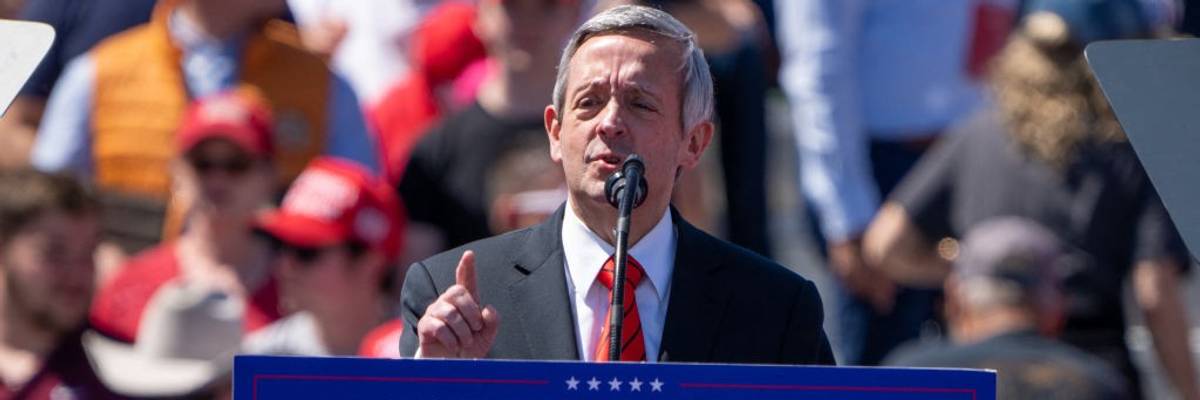
Pastor Robert Jeffress spoke at a campaign rally for then-former U.S. President Donald Trump in Waco, Texas, on March 25, 2023. The New York Times reported on July 30, 2025 that after Jeffress dined with Trump, his church urged the administration to end the Johnson Amendment.
"The Trump administration's radical reinterpretation of this federal law is a flagrant, self-serving attack on church-state separation that threatens our democracy," said one supporter of the Johnson Amendment.
As The New York Times reported on how an Easter dinner may have given "Christian conservatives their most significant victory involving church political organizing in 70 years," over 1,000 charitable nonprofits on Wednesday collectively urged President Donald Trump not to allow churches to endorse political candidates.
A provision of the U.S. tax code named for former President Lyndon B. Johnson conditions tax-exempt status on an organization not participating or intervening in campaigns for public office. However, in a bid to settle a federal lawsuit earlier this month, the Internal Revenue Service (IRS) proposed an exemption for houses of worship.
As the proposed exception to the Johnson Amendment awaits court approval, groups including the American Humanist Association, Americans United for Separation of Church and State (AU), Freedom From Religion Foundation, Independent Sector, Interfaith Alliance, National Council of Nonprofits, and Public Citizen on Wednesday launched the sign-on letter to Trump.
"For more than 70 years, it has ensured that all tax-exempt charitable nonprofits—including houses of worship—do not become conduits for partisan politics, protecting public trust in religious institutions and preserving the integrity of elections," the letter says of the Johnson Amendment. "Weakening the provision threatens to erode public trust, risk policy capture by special interests, and dilute regulatory oversight."
The letter warns that "if the court approves this settlement, houses of worship would be subject to intense political pressure to engage in electoral politics from downballot races and primaries to the presidency, distracting them from their missions. It would also create a loophole for the political donors to enjoy tax-deductible donations for their political campaign contributions, exploiting houses of worship for political gains."
As Public Citizen co-president Lisa Gilbert put it in a Wednesday statement, "We are witnessing in real-time the creation of a new and dangerous dark money channel."
The coalition warned that "weakening the Johnson Amendment would jeopardize the integrity of the entire nonprofit community," not just houses of worship.
"This is not a matter of religious freedom or speech. It is about fundamentally reshaping how political money flows through our system," the letter states. "Charitable nonprofits are among the last institutions where people from all walks of life come together to tackle local challenges. Undermining the legal safeguards that preserve their neutrality could seriously erode public trust and compromise the sector's ability to carry out its mission."
The groups urged the Trump administration "to immediately end its attempt to ignore the Johnson Amendment, reaffirm clear limits on partisan politicking in houses of worship, ensure impartial enforcement across sectors, and protect civil society."
Although the IRS already often does not enforce the Johnson Amendment against houses of worship, killing it has long been "one of the biggest political goals for conservative Christian activists," as the Times detailed Wednesday.
The Times reported that Robert Jeffress, pastor of First Baptist Dallas, attended an April dinner with the president and evangelist Billy Graham's son, Franklin Graham. According to the newspaper:
At Mr. Trump's request, Mr. Jeffress' church sent the White House Faith Office a seven-page letter outlining what it called "wrongful weaponization" of the law and the "unlawful targeting of our church." The letter, obtained by The New York Times, included recommended actions, and a mention of a Texas lawsuit, which offered a vehicle to declare that the law was wrong.
Three months later, conservative Christians scored a major victory.
In a signal of how the new letter may be received, a White House spokesperson told the Times that "President Trump is very proud of this victory for leaders of faith across the country protecting their First Amendment rights."
Still, nonprofits that oppose weakening the Johnson Amendment are working on various fronts to stop the settlement. In addition to promoting the letter, AU has requested to intervene in the case in the U.S. District Court for the Eastern District of Texas.
"This long-standing, commonsense rule protects the integrity of both our elections and nonprofits, including houses of worship. The majority of Americans don't want their charities and churches embroiled in the corrupting influence of partisan politics," the group's president and CEO, Rachel Laser, said Wednesday.
"The Trump administration's radical reinterpretation of this federal law is a flagrant, self-serving attack on church-state separation that threatens our democracy by plunging houses of worship into partisan battles," Laser added. "AU is committed to fight the administration's brazen ploy to use our houses of worship as political campaign tools."
The letter comes two days after the Trump administration issued a memo allowing federal employees to proselytize in the workplace, widely seen as another move to further erode the separation of church and state. Responding on social media, the American Humanist Association said that "this is what Christian Nationalism looks like."
Dear Common Dreams reader, It’s been nearly 30 years since I co-founded Common Dreams with my late wife, Lina Newhouser. We had the radical notion that journalism should serve the public good, not corporate profits. It was clear to us from the outset what it would take to build such a project. No paid advertisements. No corporate sponsors. No millionaire publisher telling us what to think or do. Many people said we wouldn't last a year, but we proved those doubters wrong. Together with a tremendous team of journalists and dedicated staff, we built an independent media outlet free from the constraints of profits and corporate control. Our mission has always been simple: To inform. To inspire. To ignite change for the common good. Building Common Dreams was not easy. Our survival was never guaranteed. When you take on the most powerful forces—Wall Street greed, fossil fuel industry destruction, Big Tech lobbyists, and uber-rich oligarchs who have spent billions upon billions rigging the economy and democracy in their favor—the only bulwark you have is supporters who believe in your work. But here’s the urgent message from me today. It's never been this bad out there. And it's never been this hard to keep us going. At the very moment Common Dreams is most needed, the threats we face are intensifying. We need your support now more than ever. We don't accept corporate advertising and never will. We don't have a paywall because we don't think people should be blocked from critical news based on their ability to pay. Everything we do is funded by the donations of readers like you. When everyone does the little they can afford, we are strong. But if that support retreats or dries up, so do we. Will you donate now to make sure Common Dreams not only survives but thrives? —Craig Brown, Co-founder |
As The New York Times reported on how an Easter dinner may have given "Christian conservatives their most significant victory involving church political organizing in 70 years," over 1,000 charitable nonprofits on Wednesday collectively urged President Donald Trump not to allow churches to endorse political candidates.
A provision of the U.S. tax code named for former President Lyndon B. Johnson conditions tax-exempt status on an organization not participating or intervening in campaigns for public office. However, in a bid to settle a federal lawsuit earlier this month, the Internal Revenue Service (IRS) proposed an exemption for houses of worship.
As the proposed exception to the Johnson Amendment awaits court approval, groups including the American Humanist Association, Americans United for Separation of Church and State (AU), Freedom From Religion Foundation, Independent Sector, Interfaith Alliance, National Council of Nonprofits, and Public Citizen on Wednesday launched the sign-on letter to Trump.
"For more than 70 years, it has ensured that all tax-exempt charitable nonprofits—including houses of worship—do not become conduits for partisan politics, protecting public trust in religious institutions and preserving the integrity of elections," the letter says of the Johnson Amendment. "Weakening the provision threatens to erode public trust, risk policy capture by special interests, and dilute regulatory oversight."
The letter warns that "if the court approves this settlement, houses of worship would be subject to intense political pressure to engage in electoral politics from downballot races and primaries to the presidency, distracting them from their missions. It would also create a loophole for the political donors to enjoy tax-deductible donations for their political campaign contributions, exploiting houses of worship for political gains."
As Public Citizen co-president Lisa Gilbert put it in a Wednesday statement, "We are witnessing in real-time the creation of a new and dangerous dark money channel."
The coalition warned that "weakening the Johnson Amendment would jeopardize the integrity of the entire nonprofit community," not just houses of worship.
"This is not a matter of religious freedom or speech. It is about fundamentally reshaping how political money flows through our system," the letter states. "Charitable nonprofits are among the last institutions where people from all walks of life come together to tackle local challenges. Undermining the legal safeguards that preserve their neutrality could seriously erode public trust and compromise the sector's ability to carry out its mission."
The groups urged the Trump administration "to immediately end its attempt to ignore the Johnson Amendment, reaffirm clear limits on partisan politicking in houses of worship, ensure impartial enforcement across sectors, and protect civil society."
Although the IRS already often does not enforce the Johnson Amendment against houses of worship, killing it has long been "one of the biggest political goals for conservative Christian activists," as the Times detailed Wednesday.
The Times reported that Robert Jeffress, pastor of First Baptist Dallas, attended an April dinner with the president and evangelist Billy Graham's son, Franklin Graham. According to the newspaper:
At Mr. Trump's request, Mr. Jeffress' church sent the White House Faith Office a seven-page letter outlining what it called "wrongful weaponization" of the law and the "unlawful targeting of our church." The letter, obtained by The New York Times, included recommended actions, and a mention of a Texas lawsuit, which offered a vehicle to declare that the law was wrong.
Three months later, conservative Christians scored a major victory.
In a signal of how the new letter may be received, a White House spokesperson told the Times that "President Trump is very proud of this victory for leaders of faith across the country protecting their First Amendment rights."
Still, nonprofits that oppose weakening the Johnson Amendment are working on various fronts to stop the settlement. In addition to promoting the letter, AU has requested to intervene in the case in the U.S. District Court for the Eastern District of Texas.
"This long-standing, commonsense rule protects the integrity of both our elections and nonprofits, including houses of worship. The majority of Americans don't want their charities and churches embroiled in the corrupting influence of partisan politics," the group's president and CEO, Rachel Laser, said Wednesday.
"The Trump administration's radical reinterpretation of this federal law is a flagrant, self-serving attack on church-state separation that threatens our democracy by plunging houses of worship into partisan battles," Laser added. "AU is committed to fight the administration's brazen ploy to use our houses of worship as political campaign tools."
The letter comes two days after the Trump administration issued a memo allowing federal employees to proselytize in the workplace, widely seen as another move to further erode the separation of church and state. Responding on social media, the American Humanist Association said that "this is what Christian Nationalism looks like."
As The New York Times reported on how an Easter dinner may have given "Christian conservatives their most significant victory involving church political organizing in 70 years," over 1,000 charitable nonprofits on Wednesday collectively urged President Donald Trump not to allow churches to endorse political candidates.
A provision of the U.S. tax code named for former President Lyndon B. Johnson conditions tax-exempt status on an organization not participating or intervening in campaigns for public office. However, in a bid to settle a federal lawsuit earlier this month, the Internal Revenue Service (IRS) proposed an exemption for houses of worship.
As the proposed exception to the Johnson Amendment awaits court approval, groups including the American Humanist Association, Americans United for Separation of Church and State (AU), Freedom From Religion Foundation, Independent Sector, Interfaith Alliance, National Council of Nonprofits, and Public Citizen on Wednesday launched the sign-on letter to Trump.
"For more than 70 years, it has ensured that all tax-exempt charitable nonprofits—including houses of worship—do not become conduits for partisan politics, protecting public trust in religious institutions and preserving the integrity of elections," the letter says of the Johnson Amendment. "Weakening the provision threatens to erode public trust, risk policy capture by special interests, and dilute regulatory oversight."
The letter warns that "if the court approves this settlement, houses of worship would be subject to intense political pressure to engage in electoral politics from downballot races and primaries to the presidency, distracting them from their missions. It would also create a loophole for the political donors to enjoy tax-deductible donations for their political campaign contributions, exploiting houses of worship for political gains."
As Public Citizen co-president Lisa Gilbert put it in a Wednesday statement, "We are witnessing in real-time the creation of a new and dangerous dark money channel."
The coalition warned that "weakening the Johnson Amendment would jeopardize the integrity of the entire nonprofit community," not just houses of worship.
"This is not a matter of religious freedom or speech. It is about fundamentally reshaping how political money flows through our system," the letter states. "Charitable nonprofits are among the last institutions where people from all walks of life come together to tackle local challenges. Undermining the legal safeguards that preserve their neutrality could seriously erode public trust and compromise the sector's ability to carry out its mission."
The groups urged the Trump administration "to immediately end its attempt to ignore the Johnson Amendment, reaffirm clear limits on partisan politicking in houses of worship, ensure impartial enforcement across sectors, and protect civil society."
Although the IRS already often does not enforce the Johnson Amendment against houses of worship, killing it has long been "one of the biggest political goals for conservative Christian activists," as the Times detailed Wednesday.
The Times reported that Robert Jeffress, pastor of First Baptist Dallas, attended an April dinner with the president and evangelist Billy Graham's son, Franklin Graham. According to the newspaper:
At Mr. Trump's request, Mr. Jeffress' church sent the White House Faith Office a seven-page letter outlining what it called "wrongful weaponization" of the law and the "unlawful targeting of our church." The letter, obtained by The New York Times, included recommended actions, and a mention of a Texas lawsuit, which offered a vehicle to declare that the law was wrong.
Three months later, conservative Christians scored a major victory.
In a signal of how the new letter may be received, a White House spokesperson told the Times that "President Trump is very proud of this victory for leaders of faith across the country protecting their First Amendment rights."
Still, nonprofits that oppose weakening the Johnson Amendment are working on various fronts to stop the settlement. In addition to promoting the letter, AU has requested to intervene in the case in the U.S. District Court for the Eastern District of Texas.
"This long-standing, commonsense rule protects the integrity of both our elections and nonprofits, including houses of worship. The majority of Americans don't want their charities and churches embroiled in the corrupting influence of partisan politics," the group's president and CEO, Rachel Laser, said Wednesday.
"The Trump administration's radical reinterpretation of this federal law is a flagrant, self-serving attack on church-state separation that threatens our democracy by plunging houses of worship into partisan battles," Laser added. "AU is committed to fight the administration's brazen ploy to use our houses of worship as political campaign tools."
The letter comes two days after the Trump administration issued a memo allowing federal employees to proselytize in the workplace, widely seen as another move to further erode the separation of church and state. Responding on social media, the American Humanist Association said that "this is what Christian Nationalism looks like."