SUBSCRIBE TO OUR FREE NEWSLETTER
Daily news & progressive opinion—funded by the people, not the corporations—delivered straight to your inbox.
5
#000000
#FFFFFF
To donate by check, phone, or other method, see our More Ways to Give page.
Daily news & progressive opinion—funded by the people, not the corporations—delivered straight to your inbox.
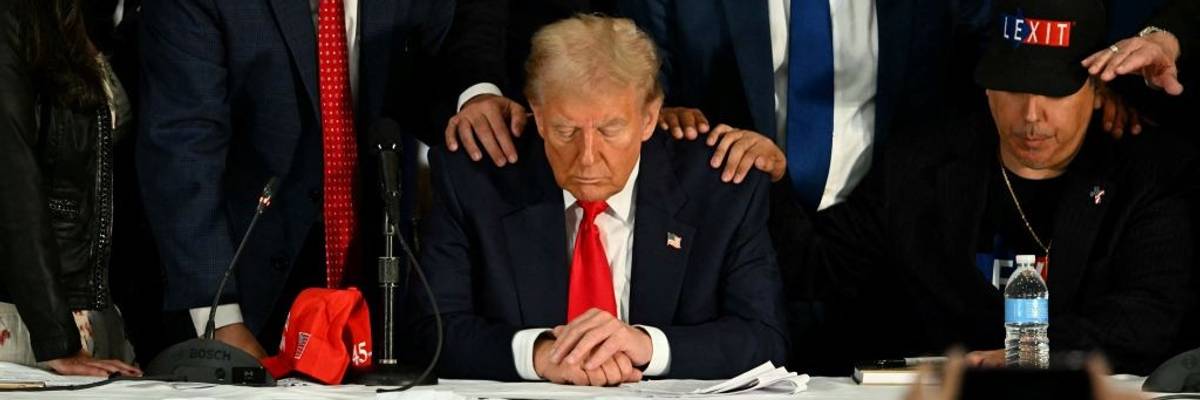
Republican presidential candidate and then-former U.S. President Donald Trump prays during a roundtable discussion with Latino community leaders at Trump National Doral Miami resort in Miami on October 22, 2024.
"The Trump regime just handed Christian nationalists a loaded weapon: your federal workplace," said one critic.
The Trump administration issued a memo Monday allowing federal employees to proselytize in the workplace, a move welcomed by many conservatives but denounced by proponents of the separation of church and state.
The U.S. Office of Personnel Management (OPM) memo "provides clear guidance to ensure federal employees may express their religious beliefs through prayer, personal items, group gatherings, and conversations without fear of discrimination or retaliation."
"Employees must be allowed to engage in private religious expression in work areas to the same extent that they may engage in nonreligious private expression," the memo states.
Federal workers "should be permitted to display and use items used for religious purposes or icons of a religiously significant nature, including but not limited to bibles, artwork, jewelry, posters displaying religious messages, and other indicia of religion (such as crosses, crucifixes, and mezuzahs) on their desks, on their person, and in their assigned workspaces," the document continues.
"Employees may engage in conversations regarding religious topics with fellow employees, including attempting to persuade others of the correctness of their own religious views, provided that such efforts are not harassing in nature," OPM said—without elaborating on what constitutes harassment.
"These shocking changes essentially permit workplace evangelizing."
"Employees may also encourage their coworkers to participate in religious expressions of faith, such as prayer, to the same extent that they would be permitted to encourage coworkers participate in other personal activities," the memo adds.
OPM Director Scott Kupor said in a statement that "federal employees should never have to choose between their faith and their career."
"This guidance ensures the federal workplace is not just compliant with the law but welcoming to Americans of all faiths," Kupor added. "Under President [Donald] Trump's leadership, we are restoring constitutional freedoms and making government a place where people of faith are respected, not sidelined."
The OPM memo was widely applauded by conservative social media users—although some were dismayed that the new rules also apply to Muslims.
Critics, however, blasted what the Freedom From Religion Foundation (FFRF) called "a gift to evangelicals and the myth of 'anti-Christian bias.'"
FFRF co-president Laurie Gaylor said that "these shocking changes essentially permit workplace evangelizing, but worse still, allow supervisors to evangelize underlings and federal workers to proselytize the public they serve."
"This is the implementation of Christian nationalism in our federal government," Gaylor added.
The Secular Coalition for America denounced the memo as "another effort to grant privileges to certain religions while ignoring nonreligious people's rights."
Monday's memo follows another issued by Kupor on July 16 that encouraged federal agencies to take a "generous approach" to evaluating government employees who request telework and other flexibilities due to their religious beliefs.
The OPM directives follow the U.S. Supreme Court's 2023 Groff v. DeJoy ruling, in which the court's right-wing majority declared that Article VII of the Civil Rights Act of 1964 "requires an employer that denies a religious accommodation to show that the burden of granting an accommodation would result in substantial increased costs in relation to the conduct of its particular business."
The new memo also comes on the heels of three religion-based executive orders issued by Trump during his second term. One order established a White House Faith Office tasked with ensuring religious organizations have a voice in the federal government. Another seeks to "eradicate" what Trump claims is the "anti-Christian weaponization of government." Yet another created a Religious Liberty Commission meant to promote and protect religious freedom.
Dear Common Dreams reader, It’s been nearly 30 years since I co-founded Common Dreams with my late wife, Lina Newhouser. We had the radical notion that journalism should serve the public good, not corporate profits. It was clear to us from the outset what it would take to build such a project. No paid advertisements. No corporate sponsors. No millionaire publisher telling us what to think or do. Many people said we wouldn't last a year, but we proved those doubters wrong. Together with a tremendous team of journalists and dedicated staff, we built an independent media outlet free from the constraints of profits and corporate control. Our mission has always been simple: To inform. To inspire. To ignite change for the common good. Building Common Dreams was not easy. Our survival was never guaranteed. When you take on the most powerful forces—Wall Street greed, fossil fuel industry destruction, Big Tech lobbyists, and uber-rich oligarchs who have spent billions upon billions rigging the economy and democracy in their favor—the only bulwark you have is supporters who believe in your work. But here’s the urgent message from me today. It's never been this bad out there. And it's never been this hard to keep us going. At the very moment Common Dreams is most needed, the threats we face are intensifying. We need your support now more than ever. We don't accept corporate advertising and never will. We don't have a paywall because we don't think people should be blocked from critical news based on their ability to pay. Everything we do is funded by the donations of readers like you. When everyone does the little they can afford, we are strong. But if that support retreats or dries up, so do we. Will you donate now to make sure Common Dreams not only survives but thrives? —Craig Brown, Co-founder |
The Trump administration issued a memo Monday allowing federal employees to proselytize in the workplace, a move welcomed by many conservatives but denounced by proponents of the separation of church and state.
The U.S. Office of Personnel Management (OPM) memo "provides clear guidance to ensure federal employees may express their religious beliefs through prayer, personal items, group gatherings, and conversations without fear of discrimination or retaliation."
"Employees must be allowed to engage in private religious expression in work areas to the same extent that they may engage in nonreligious private expression," the memo states.
Federal workers "should be permitted to display and use items used for religious purposes or icons of a religiously significant nature, including but not limited to bibles, artwork, jewelry, posters displaying religious messages, and other indicia of religion (such as crosses, crucifixes, and mezuzahs) on their desks, on their person, and in their assigned workspaces," the document continues.
"Employees may engage in conversations regarding religious topics with fellow employees, including attempting to persuade others of the correctness of their own religious views, provided that such efforts are not harassing in nature," OPM said—without elaborating on what constitutes harassment.
"These shocking changes essentially permit workplace evangelizing."
"Employees may also encourage their coworkers to participate in religious expressions of faith, such as prayer, to the same extent that they would be permitted to encourage coworkers participate in other personal activities," the memo adds.
OPM Director Scott Kupor said in a statement that "federal employees should never have to choose between their faith and their career."
"This guidance ensures the federal workplace is not just compliant with the law but welcoming to Americans of all faiths," Kupor added. "Under President [Donald] Trump's leadership, we are restoring constitutional freedoms and making government a place where people of faith are respected, not sidelined."
The OPM memo was widely applauded by conservative social media users—although some were dismayed that the new rules also apply to Muslims.
Critics, however, blasted what the Freedom From Religion Foundation (FFRF) called "a gift to evangelicals and the myth of 'anti-Christian bias.'"
FFRF co-president Laurie Gaylor said that "these shocking changes essentially permit workplace evangelizing, but worse still, allow supervisors to evangelize underlings and federal workers to proselytize the public they serve."
"This is the implementation of Christian nationalism in our federal government," Gaylor added.
The Secular Coalition for America denounced the memo as "another effort to grant privileges to certain religions while ignoring nonreligious people's rights."
Monday's memo follows another issued by Kupor on July 16 that encouraged federal agencies to take a "generous approach" to evaluating government employees who request telework and other flexibilities due to their religious beliefs.
The OPM directives follow the U.S. Supreme Court's 2023 Groff v. DeJoy ruling, in which the court's right-wing majority declared that Article VII of the Civil Rights Act of 1964 "requires an employer that denies a religious accommodation to show that the burden of granting an accommodation would result in substantial increased costs in relation to the conduct of its particular business."
The new memo also comes on the heels of three religion-based executive orders issued by Trump during his second term. One order established a White House Faith Office tasked with ensuring religious organizations have a voice in the federal government. Another seeks to "eradicate" what Trump claims is the "anti-Christian weaponization of government." Yet another created a Religious Liberty Commission meant to promote and protect religious freedom.
The Trump administration issued a memo Monday allowing federal employees to proselytize in the workplace, a move welcomed by many conservatives but denounced by proponents of the separation of church and state.
The U.S. Office of Personnel Management (OPM) memo "provides clear guidance to ensure federal employees may express their religious beliefs through prayer, personal items, group gatherings, and conversations without fear of discrimination or retaliation."
"Employees must be allowed to engage in private religious expression in work areas to the same extent that they may engage in nonreligious private expression," the memo states.
Federal workers "should be permitted to display and use items used for religious purposes or icons of a religiously significant nature, including but not limited to bibles, artwork, jewelry, posters displaying religious messages, and other indicia of religion (such as crosses, crucifixes, and mezuzahs) on their desks, on their person, and in their assigned workspaces," the document continues.
"Employees may engage in conversations regarding religious topics with fellow employees, including attempting to persuade others of the correctness of their own religious views, provided that such efforts are not harassing in nature," OPM said—without elaborating on what constitutes harassment.
"These shocking changes essentially permit workplace evangelizing."
"Employees may also encourage their coworkers to participate in religious expressions of faith, such as prayer, to the same extent that they would be permitted to encourage coworkers participate in other personal activities," the memo adds.
OPM Director Scott Kupor said in a statement that "federal employees should never have to choose between their faith and their career."
"This guidance ensures the federal workplace is not just compliant with the law but welcoming to Americans of all faiths," Kupor added. "Under President [Donald] Trump's leadership, we are restoring constitutional freedoms and making government a place where people of faith are respected, not sidelined."
The OPM memo was widely applauded by conservative social media users—although some were dismayed that the new rules also apply to Muslims.
Critics, however, blasted what the Freedom From Religion Foundation (FFRF) called "a gift to evangelicals and the myth of 'anti-Christian bias.'"
FFRF co-president Laurie Gaylor said that "these shocking changes essentially permit workplace evangelizing, but worse still, allow supervisors to evangelize underlings and federal workers to proselytize the public they serve."
"This is the implementation of Christian nationalism in our federal government," Gaylor added.
The Secular Coalition for America denounced the memo as "another effort to grant privileges to certain religions while ignoring nonreligious people's rights."
Monday's memo follows another issued by Kupor on July 16 that encouraged federal agencies to take a "generous approach" to evaluating government employees who request telework and other flexibilities due to their religious beliefs.
The OPM directives follow the U.S. Supreme Court's 2023 Groff v. DeJoy ruling, in which the court's right-wing majority declared that Article VII of the Civil Rights Act of 1964 "requires an employer that denies a religious accommodation to show that the burden of granting an accommodation would result in substantial increased costs in relation to the conduct of its particular business."
The new memo also comes on the heels of three religion-based executive orders issued by Trump during his second term. One order established a White House Faith Office tasked with ensuring religious organizations have a voice in the federal government. Another seeks to "eradicate" what Trump claims is the "anti-Christian weaponization of government." Yet another created a Religious Liberty Commission meant to promote and protect religious freedom.