
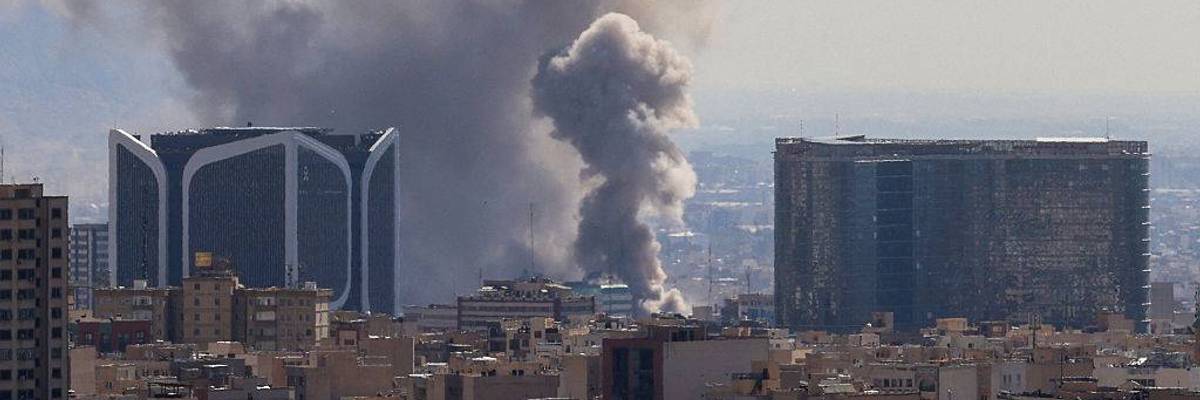
Plumes of smoke rise following reported explosions in Tehran on March 1, 2026.
(Photo by Atta Kenare/AFP via Getty Images)
Trump's Unprovoked War on Iran Triggers 10% Spike in Global Oil Prices
"When global energy security can be upended by a single flashpoint, it shows how unstable and risky our dependence on oil and gas is," said one critic.
Mar 02, 2026
President Donald Trump's unprovoked, unconstitutional, and politically unpopular war against Iran is about to cause pains for Americans at the gas pump.
CNBC reported on Monday that Brent crude oil prices surged by 9.3% to a 52-week high of $79.40 per barrel, while US West Texas Intermediate crude oil prices spike by 9% to $73.10 per barrel.
This spike in oil prices is projected to directly lead to an increase in gas prices in the coming days.
Petroleum industry analyst Patrick De Haan noted in a Monday update on his Substack page that gas prices in the US had already risen by roughly six cents in the last week, and that war with Iran would drive these prices higher.
"Developments surrounding Iran—particularly any threat to regional production or shipping flows—are likely to remain the dominant driver of oil prices," wrote De Haan, "and could keep crude elevated or push it higher if tensions intensify further."
A Sunday research note from Wells Fargo cited by CNBC drew attention to the importance of the Strait of Hormuz, which the Iranian government closed off over the week and which is used to transport roughly 20% of the global supplies of petroleum and liquified natural gas.
According to Wells Fargo, a "prolonged" closure of the strait would result in "an oil shock to $100+ per barrel," which it described as the "worst-case scenario" for global stock markets.
In addition to closing off the Strait of Hormuz, Iran has also been launching attacks on other nations' energy infrastructure.
According to a report from Bloomberg, Saudi Arabia’s largest oil refinery at Ras Tanura had to cease operations on Monday after being struck in a drone attack.
"An attack on major energy infrastructure is a nightmare scenario for global markets," noted Bloomberg, "with maritime traffic through the crucial Strait of Hormuz all but halting."
Olivia Langhoff, managing director at climate justice organization 350.org said that the global economic disruptions being caused by the Iran war shows the folly of continuing to rely on fossil fuels for energy needs.
"When global energy security can be upended by a single flashpoint, it shows how unstable and risky our dependence on oil and gas is," Langhoff said. "Renewable energy provides homegrown power that remains secure and affordable regardless of geopolitical shocks."
Langhoff's comments were echoed by Mads Christensen, executive director of Greenpeace International.
"As long as our world runs on oil and gas, our peace, security and our pockets will always be at the mercy of geopolitics," Christensen explained. "Increasing output may temporarily ease price pressures, but it does not address the structural vulnerability at the heart of this recurring crisis: the world’s continued dependence on fossil fuels."
The increase in gas prices comes at a time when US voters have been expressing widespread dissatisfaction with the economy under Trump, as polls show voters have been particularly anxious about the prices of groceries and utilities, among other essentials.
An Urgent Message From Our Co-Founder
Dear Common Dreams reader, The U.S. is on a fast track to authoritarianism like nothing I've ever seen. Meanwhile, corporate news outlets are utterly capitulating to Trump, twisting their coverage to avoid drawing his ire while lining up to stuff cash in his pockets. That's why I believe that Common Dreams is doing the best and most consequential reporting that we've ever done. Our small but mighty team is a progressive reporting powerhouse, covering the news every day that the corporate media never will. Our mission has always been simple: To inform. To inspire. And to ignite change for the common good. Now here's the key piece that I want all our readers to understand: None of this would be possible without your financial support. That's not just some fundraising cliche. It's the absolute and literal truth. We don't accept corporate advertising and never will. We don't have a paywall because we don't think people should be blocked from critical news based on their ability to pay. Everything we do is funded by the donations of readers like you. Will you donate now to help power the nonprofit, independent reporting of Common Dreams? Thank you for being a vital member of our community. Together, we can keep independent journalism alive when it’s needed most. - Craig Brown, Co-founder |
Our work is licensed under Creative Commons (CC BY-NC-ND 3.0). Feel free to republish and share widely.
President Donald Trump's unprovoked, unconstitutional, and politically unpopular war against Iran is about to cause pains for Americans at the gas pump.
CNBC reported on Monday that Brent crude oil prices surged by 9.3% to a 52-week high of $79.40 per barrel, while US West Texas Intermediate crude oil prices spike by 9% to $73.10 per barrel.
This spike in oil prices is projected to directly lead to an increase in gas prices in the coming days.
Petroleum industry analyst Patrick De Haan noted in a Monday update on his Substack page that gas prices in the US had already risen by roughly six cents in the last week, and that war with Iran would drive these prices higher.
"Developments surrounding Iran—particularly any threat to regional production or shipping flows—are likely to remain the dominant driver of oil prices," wrote De Haan, "and could keep crude elevated or push it higher if tensions intensify further."
A Sunday research note from Wells Fargo cited by CNBC drew attention to the importance of the Strait of Hormuz, which the Iranian government closed off over the week and which is used to transport roughly 20% of the global supplies of petroleum and liquified natural gas.
According to Wells Fargo, a "prolonged" closure of the strait would result in "an oil shock to $100+ per barrel," which it described as the "worst-case scenario" for global stock markets.
In addition to closing off the Strait of Hormuz, Iran has also been launching attacks on other nations' energy infrastructure.
According to a report from Bloomberg, Saudi Arabia’s largest oil refinery at Ras Tanura had to cease operations on Monday after being struck in a drone attack.
"An attack on major energy infrastructure is a nightmare scenario for global markets," noted Bloomberg, "with maritime traffic through the crucial Strait of Hormuz all but halting."
Olivia Langhoff, managing director at climate justice organization 350.org said that the global economic disruptions being caused by the Iran war shows the folly of continuing to rely on fossil fuels for energy needs.
"When global energy security can be upended by a single flashpoint, it shows how unstable and risky our dependence on oil and gas is," Langhoff said. "Renewable energy provides homegrown power that remains secure and affordable regardless of geopolitical shocks."
Langhoff's comments were echoed by Mads Christensen, executive director of Greenpeace International.
"As long as our world runs on oil and gas, our peace, security and our pockets will always be at the mercy of geopolitics," Christensen explained. "Increasing output may temporarily ease price pressures, but it does not address the structural vulnerability at the heart of this recurring crisis: the world’s continued dependence on fossil fuels."
The increase in gas prices comes at a time when US voters have been expressing widespread dissatisfaction with the economy under Trump, as polls show voters have been particularly anxious about the prices of groceries and utilities, among other essentials.
From Your Site Articles
- 'I Guess I Can Say I Am': Trump Confirms He's Considering Unprovoked Attack on Iran ›
- Trump Admin. Ratchets Up Tensions With Threat to Sanction Any Nation That Imports Iranian Oil ›
- 'The Tankers Just Keep Coming': US Military Movements Spike Fears of Imminent Attack on Iran ›
Related Articles Around the Web
President Donald Trump's unprovoked, unconstitutional, and politically unpopular war against Iran is about to cause pains for Americans at the gas pump.
CNBC reported on Monday that Brent crude oil prices surged by 9.3% to a 52-week high of $79.40 per barrel, while US West Texas Intermediate crude oil prices spike by 9% to $73.10 per barrel.
This spike in oil prices is projected to directly lead to an increase in gas prices in the coming days.
Petroleum industry analyst Patrick De Haan noted in a Monday update on his Substack page that gas prices in the US had already risen by roughly six cents in the last week, and that war with Iran would drive these prices higher.
"Developments surrounding Iran—particularly any threat to regional production or shipping flows—are likely to remain the dominant driver of oil prices," wrote De Haan, "and could keep crude elevated or push it higher if tensions intensify further."
A Sunday research note from Wells Fargo cited by CNBC drew attention to the importance of the Strait of Hormuz, which the Iranian government closed off over the week and which is used to transport roughly 20% of the global supplies of petroleum and liquified natural gas.
According to Wells Fargo, a "prolonged" closure of the strait would result in "an oil shock to $100+ per barrel," which it described as the "worst-case scenario" for global stock markets.
In addition to closing off the Strait of Hormuz, Iran has also been launching attacks on other nations' energy infrastructure.
According to a report from Bloomberg, Saudi Arabia’s largest oil refinery at Ras Tanura had to cease operations on Monday after being struck in a drone attack.
"An attack on major energy infrastructure is a nightmare scenario for global markets," noted Bloomberg, "with maritime traffic through the crucial Strait of Hormuz all but halting."
Olivia Langhoff, managing director at climate justice organization 350.org said that the global economic disruptions being caused by the Iran war shows the folly of continuing to rely on fossil fuels for energy needs.
"When global energy security can be upended by a single flashpoint, it shows how unstable and risky our dependence on oil and gas is," Langhoff said. "Renewable energy provides homegrown power that remains secure and affordable regardless of geopolitical shocks."
Langhoff's comments were echoed by Mads Christensen, executive director of Greenpeace International.
"As long as our world runs on oil and gas, our peace, security and our pockets will always be at the mercy of geopolitics," Christensen explained. "Increasing output may temporarily ease price pressures, but it does not address the structural vulnerability at the heart of this recurring crisis: the world’s continued dependence on fossil fuels."
The increase in gas prices comes at a time when US voters have been expressing widespread dissatisfaction with the economy under Trump, as polls show voters have been particularly anxious about the prices of groceries and utilities, among other essentials.
From Your Site Articles
- 'I Guess I Can Say I Am': Trump Confirms He's Considering Unprovoked Attack on Iran ›
- Trump Admin. Ratchets Up Tensions With Threat to Sanction Any Nation That Imports Iranian Oil ›
- 'The Tankers Just Keep Coming': US Military Movements Spike Fears of Imminent Attack on Iran ›
Related Articles Around the Web
We've had enough. The 1% own and operate the corporate media. They are doing everything they can to defend the status quo, squash dissent and protect the wealthy and the powerful. The Common Dreams media model is different. We cover the news that matters to the 99%. Our mission? To inform. To inspire. To ignite change for the common good. How? Nonprofit. Independent. Reader-supported. Free to read. Free to republish. Free to share. With no advertising. No paywalls. No selling of your data. Thousands of small donations fund our newsroom and allow us to continue publishing. Can you chip in? We can't do it without you. Thank you.