5
#000000
#FFFFFF
To donate by check, phone, or other method, see our More Ways to Give page.
Daily news & progressive opinion—funded by the people, not the corporations—delivered straight to your inbox.
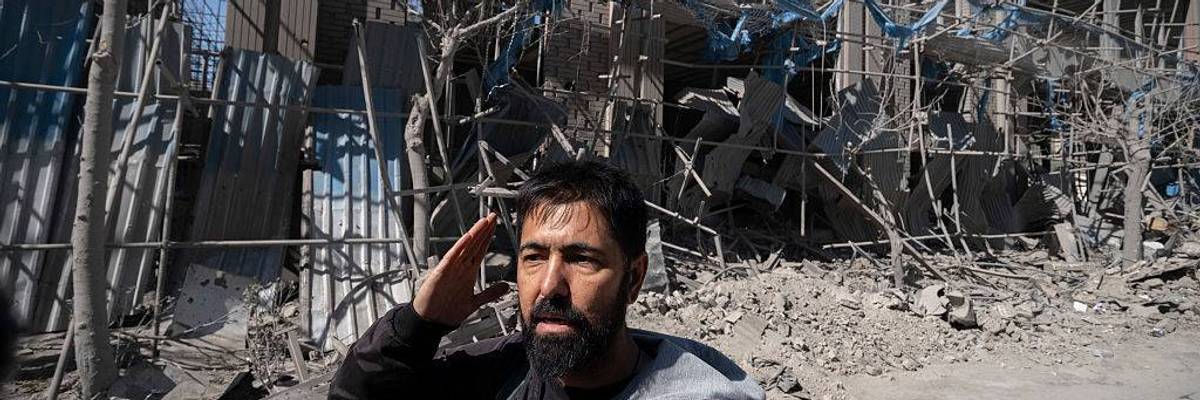
An unidentified man shouts anti-US and anti-Israeli slogans while standing in front of a destroyed building near a police station in Tehran, Iran, on March 3, 2026.
"Before more children are burned alive or buried under rubble, this lawless war must end."
Experts on international law throughout the world have concluded that the unprovoked US-Israeli attack on Iran that began on Saturday is illegal.
Adil Ahmad Haque, a Rutgers Law School professor, wrote an analysis for Just Security published on Monday that called the attacks by the US and Israel a "manifest violation of the United Nations Charter," which "prohibits the use of force against another State unless that use of force is authorized by the UN Security Council or is a necessary and proportionate act of individual or collective self-defense in response to an armed attack."
Haque also argued that Iran, in responding to the attacks, violated the UN Charter by launching drone strikes against US allies throughout the Middle East, even though none of those nations had taken part in the US-Israeli operations.
"The United States, Israel, and Iran, have each violated international law," Haque concluded. "Hundreds of civilians have paid the price. Before more children are burned alive or buried under rubble, this lawless war must end."
Marko Milanovic, a University of Reading School of Law professor, wrote at the blog of the European Journal of International Law that the US-Israeli strikes are "manifestly illegal" and "as plain a violation of the prohibition on the use of force in Article 2(4) of the UN Charter as one could possibly have."
Milanovic also said that, leaving legality aside, the war would likely create a humanitarian disaster.
"Maybe, maybe, something good will come out of this... although I very much doubt it," he wrote. "It is far more likely that many innocent people are about to die, in Iran and possibly in Israel, and that their deaths will be for nothing."
The Center for International Environmental Law (CIEL) condemned the attacks on Iran as illegal under international law and dismissed any claims by US and Israel that they were necessary to liberate Iranians from a tyrannical government.
"Claims that launching an unprovoked and illegal attack is about defending human rights ring hollow," CIEL wrote, "when military strikes have already killed hundreds of civilians and intensified suffering as violence escalates—particularly when those same human rights are flagrantly violated by the US and by Israel, both domestically and abroad. Bombs do not yield peace, democracy, climate justice, or human rights."
Amnesty International secretary general Agnès Callamard described the US-Israeli attack as "a grave threat to multilateralism and to the integrity of the international legal order."
Callamard also said the international community needed "to intensify diplomatic efforts to prevent further military escalation to avert additional civilian harm, and halt any further crimes under international law against populations who have already endured decades of repression."
Human rights organization DAWN demanded that the UN General Assembly call an emergency session to declare the Iran attack a violation of the UN Charter.
Omar Shakir, executive director of DAWN, said that the war is also illegal under the US Constitution, which states that the US Congress has the power to declare war.
"This war is patently illegal," Shakir said, "and it must be stopped."
Dear Common Dreams reader, It’s been nearly 30 years since I co-founded Common Dreams with my late wife, Lina Newhouser. We had the radical notion that journalism should serve the public good, not corporate profits. It was clear to us from the outset what it would take to build such a project. No paid advertisements. No corporate sponsors. No millionaire publisher telling us what to think or do. Many people said we wouldn't last a year, but we proved those doubters wrong. Together with a tremendous team of journalists and dedicated staff, we built an independent media outlet free from the constraints of profits and corporate control. Our mission has always been simple: To inform. To inspire. To ignite change for the common good. Building Common Dreams was not easy. Our survival was never guaranteed. When you take on the most powerful forces—Wall Street greed, fossil fuel industry destruction, Big Tech lobbyists, and uber-rich oligarchs who have spent billions upon billions rigging the economy and democracy in their favor—the only bulwark you have is supporters who believe in your work. But here’s the urgent message from me today. It's never been this bad out there. And it's never been this hard to keep us going. At the very moment Common Dreams is most needed, the threats we face are intensifying. We need your support now more than ever. We don't accept corporate advertising and never will. We don't have a paywall because we don't think people should be blocked from critical news based on their ability to pay. Everything we do is funded by the donations of readers like you. When everyone does the little they can afford, we are strong. But if that support retreats or dries up, so do we. Will you donate now to make sure Common Dreams not only survives but thrives? —Craig Brown, Co-founder |
Experts on international law throughout the world have concluded that the unprovoked US-Israeli attack on Iran that began on Saturday is illegal.
Adil Ahmad Haque, a Rutgers Law School professor, wrote an analysis for Just Security published on Monday that called the attacks by the US and Israel a "manifest violation of the United Nations Charter," which "prohibits the use of force against another State unless that use of force is authorized by the UN Security Council or is a necessary and proportionate act of individual or collective self-defense in response to an armed attack."
Haque also argued that Iran, in responding to the attacks, violated the UN Charter by launching drone strikes against US allies throughout the Middle East, even though none of those nations had taken part in the US-Israeli operations.
"The United States, Israel, and Iran, have each violated international law," Haque concluded. "Hundreds of civilians have paid the price. Before more children are burned alive or buried under rubble, this lawless war must end."
Marko Milanovic, a University of Reading School of Law professor, wrote at the blog of the European Journal of International Law that the US-Israeli strikes are "manifestly illegal" and "as plain a violation of the prohibition on the use of force in Article 2(4) of the UN Charter as one could possibly have."
Milanovic also said that, leaving legality aside, the war would likely create a humanitarian disaster.
"Maybe, maybe, something good will come out of this... although I very much doubt it," he wrote. "It is far more likely that many innocent people are about to die, in Iran and possibly in Israel, and that their deaths will be for nothing."
The Center for International Environmental Law (CIEL) condemned the attacks on Iran as illegal under international law and dismissed any claims by US and Israel that they were necessary to liberate Iranians from a tyrannical government.
"Claims that launching an unprovoked and illegal attack is about defending human rights ring hollow," CIEL wrote, "when military strikes have already killed hundreds of civilians and intensified suffering as violence escalates—particularly when those same human rights are flagrantly violated by the US and by Israel, both domestically and abroad. Bombs do not yield peace, democracy, climate justice, or human rights."
Amnesty International secretary general Agnès Callamard described the US-Israeli attack as "a grave threat to multilateralism and to the integrity of the international legal order."
Callamard also said the international community needed "to intensify diplomatic efforts to prevent further military escalation to avert additional civilian harm, and halt any further crimes under international law against populations who have already endured decades of repression."
Human rights organization DAWN demanded that the UN General Assembly call an emergency session to declare the Iran attack a violation of the UN Charter.
Omar Shakir, executive director of DAWN, said that the war is also illegal under the US Constitution, which states that the US Congress has the power to declare war.
"This war is patently illegal," Shakir said, "and it must be stopped."
Experts on international law throughout the world have concluded that the unprovoked US-Israeli attack on Iran that began on Saturday is illegal.
Adil Ahmad Haque, a Rutgers Law School professor, wrote an analysis for Just Security published on Monday that called the attacks by the US and Israel a "manifest violation of the United Nations Charter," which "prohibits the use of force against another State unless that use of force is authorized by the UN Security Council or is a necessary and proportionate act of individual or collective self-defense in response to an armed attack."
Haque also argued that Iran, in responding to the attacks, violated the UN Charter by launching drone strikes against US allies throughout the Middle East, even though none of those nations had taken part in the US-Israeli operations.
"The United States, Israel, and Iran, have each violated international law," Haque concluded. "Hundreds of civilians have paid the price. Before more children are burned alive or buried under rubble, this lawless war must end."
Marko Milanovic, a University of Reading School of Law professor, wrote at the blog of the European Journal of International Law that the US-Israeli strikes are "manifestly illegal" and "as plain a violation of the prohibition on the use of force in Article 2(4) of the UN Charter as one could possibly have."
Milanovic also said that, leaving legality aside, the war would likely create a humanitarian disaster.
"Maybe, maybe, something good will come out of this... although I very much doubt it," he wrote. "It is far more likely that many innocent people are about to die, in Iran and possibly in Israel, and that their deaths will be for nothing."
The Center for International Environmental Law (CIEL) condemned the attacks on Iran as illegal under international law and dismissed any claims by US and Israel that they were necessary to liberate Iranians from a tyrannical government.
"Claims that launching an unprovoked and illegal attack is about defending human rights ring hollow," CIEL wrote, "when military strikes have already killed hundreds of civilians and intensified suffering as violence escalates—particularly when those same human rights are flagrantly violated by the US and by Israel, both domestically and abroad. Bombs do not yield peace, democracy, climate justice, or human rights."
Amnesty International secretary general Agnès Callamard described the US-Israeli attack as "a grave threat to multilateralism and to the integrity of the international legal order."
Callamard also said the international community needed "to intensify diplomatic efforts to prevent further military escalation to avert additional civilian harm, and halt any further crimes under international law against populations who have already endured decades of repression."
Human rights organization DAWN demanded that the UN General Assembly call an emergency session to declare the Iran attack a violation of the UN Charter.
Omar Shakir, executive director of DAWN, said that the war is also illegal under the US Constitution, which states that the US Congress has the power to declare war.
"This war is patently illegal," Shakir said, "and it must be stopped."