SUBSCRIBE TO OUR FREE NEWSLETTER
Daily news & progressive opinion—funded by the people, not the corporations—delivered straight to your inbox.
5
#000000
#FFFFFF
To donate by check, phone, or other method, see our More Ways to Give page.
Daily news & progressive opinion—funded by the people, not the corporations—delivered straight to your inbox.
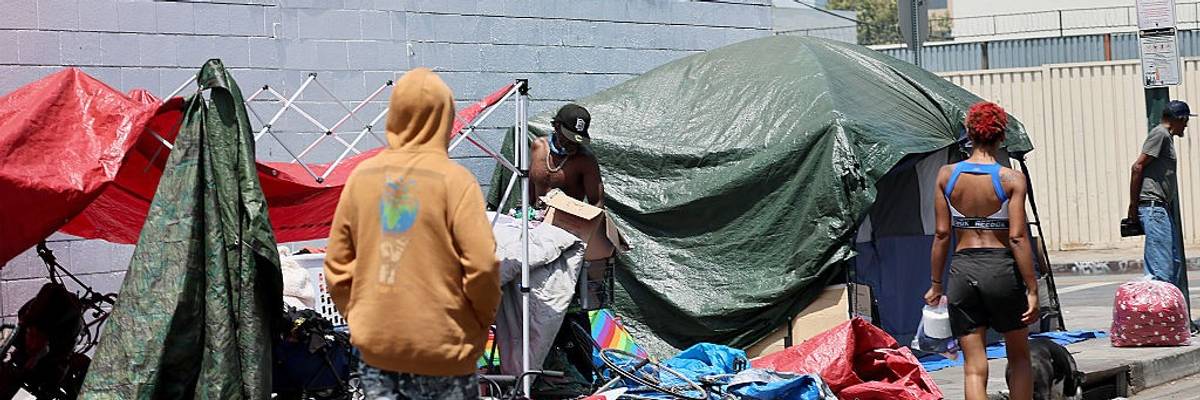
Tents are set up on a sidewalk in "Skid Row" in Los Angeles, California on June 25, 2025.
"Homelessness is a policy failure," said one ACLU leader. "Weaponizing federal funding to fuel cruel and ineffective approaches to homelessness won't solve this crisis."
Advocates for mental health and unhoused people blasted U.S. President Donald Trump on Thursday over his executive order titled "Ending Crime and Disorder on America's Streets."
Trump's order directs U.S. Attorney General Pam Bondi to end policies that restrict the government from institutionalizing "individuals on the streets who are a risk to themselves or others." She must also work with other Cabinet members "to prioritize grants for states and municipalities that enforce prohibitions on open illicit drug use, urban camping and loitering, and urban squatting, and track the location of sex offenders."
As a White House fact sheet highlights, the order also "redirects funding to ensure that individuals camping on streets and causing public disorder and that are suffering from serious mental illness or addiction are moved into treatment centers, assisted outpatient treatment, or other facilities." Further, it ensures grant money does not "fund drug injection sites or illicit drug use."
In a statement to USA Today, which first reported on the executive action, White House Press Secretary Karoline Leavitt said that "by removing vagrant criminals from our streets and redirecting resources toward substance abuse programs, the Trump administration will ensure that Americans feel safe in their own communities and that individuals suffering from addiction or mental health struggles are able to get the help they need."
Meanwhile, National Coalition for the Homeless executive director Donald Whitehead Jr. declared that "everyone deserves a safe place to live."
Trump's policies, he said, "ignore decades of evidence-based housing and support services in practice. They represent a punitive approach that has consistently failed to resolve homelessness and instead exacerbates the challenges faced by vulnerable individuals."
Predictable, but no less shocking or reprehensible: Trump just signed an executive order urging states to forcibly institutionalize homeless people, defund Housing First, criminalize encampments, and cut aid to cities that don't comply.
[image or embed]
— Brian Goldstone (@brian-goldstone.bsky.social) July 24, 2025 at 5:14 PM
The National Homelessness Law Center (NHLC) similarly called out the president for pushing policies that "treat homelessness and mental illness as a crime."
"Across America, sky-high rents are both the leading cause of homelessness and a primary cause of financial stress for most families," NHLC said. "Instead of helping people who are struggling to make ends meet, Donald Trump remains focused on backwards, expensive, and ineffective policies that make homelessness worse."
"The National Homelessness Law Center strongly condemns today's executive order, which deprives people of their basic rights and makes it harder to solve homelessness," the group added. "This executive order is rooted in outdated, racist myths about homelessness and will undoubtedly make homelessness worse."
Scout Katovich, senior staff attorney with the ACLU's Trone Center for Justice and Equality, tied the order to the Republican Party's broader agenda, saying that "from the so-called 'Big Beautiful Bill' that will strip healthcare from millions to this dangerous executive order, every action this administration takes displays remarkable disdain for the rights and dignity of vulnerable people."
"Pushing people into locked institutions and forcing treatment won't solve homelessness or support people with disabilities," she said. "The exact opposite is true—institutions are dangerous and deadly, and forced treatment doesn't work. We need safe, decent, and affordable housing as well as equal access to medical care and voluntary, community-based mental health and evidence-based substance use treatment from trusted providers."
"But instead of investing in these proven solutions, President Trump is blaming individuals for systemic failures and doubling down on policies that punish people with nowhere else to go—all after signing a law that decimates Medicaid, the number one payer for addiction and mental health services," Katovich added. "Homelessness is a policy failure. Weaponizing federal funding to fuel cruel and ineffective approaches to homelessness won't solve this crisis."
As The Washington Post reported:
The executive order was issued as the Trump administration has slashed more than $1 billion in Covid-era grants administered by the Substance Abuse and Mental Health Services Administration and is proposing to slash hundreds of millions more in agency grants.
"There's no question we need to do more to address both homelessness and untreated substance use disorder and mental health conditions in the U.S.," said Regina LaBelle, director of the Addiction and Public Policy Initiative at the Georgetown University Law Center and a former drug policy official in the Biden White House. "But issuing an executive order, while disinvesting in treatment and other funding that will help prevent homelessness and untreated health conditions, will do nothing to address the fundamental issues facing the country."
Trump's order comes after the latest federal figures showed a surge in homelessness, and the U.S. Supreme Court's right-wing majority ruled last year that local governments can enforce bans on sleeping outdoors, effectively criminalizing homelessness.
Dear Common Dreams reader, It’s been nearly 30 years since I co-founded Common Dreams with my late wife, Lina Newhouser. We had the radical notion that journalism should serve the public good, not corporate profits. It was clear to us from the outset what it would take to build such a project. No paid advertisements. No corporate sponsors. No millionaire publisher telling us what to think or do. Many people said we wouldn't last a year, but we proved those doubters wrong. Together with a tremendous team of journalists and dedicated staff, we built an independent media outlet free from the constraints of profits and corporate control. Our mission has always been simple: To inform. To inspire. To ignite change for the common good. Building Common Dreams was not easy. Our survival was never guaranteed. When you take on the most powerful forces—Wall Street greed, fossil fuel industry destruction, Big Tech lobbyists, and uber-rich oligarchs who have spent billions upon billions rigging the economy and democracy in their favor—the only bulwark you have is supporters who believe in your work. But here’s the urgent message from me today. It's never been this bad out there. And it's never been this hard to keep us going. At the very moment Common Dreams is most needed, the threats we face are intensifying. We need your support now more than ever. We don't accept corporate advertising and never will. We don't have a paywall because we don't think people should be blocked from critical news based on their ability to pay. Everything we do is funded by the donations of readers like you. When everyone does the little they can afford, we are strong. But if that support retreats or dries up, so do we. Will you donate now to make sure Common Dreams not only survives but thrives? —Craig Brown, Co-founder |
Advocates for mental health and unhoused people blasted U.S. President Donald Trump on Thursday over his executive order titled "Ending Crime and Disorder on America's Streets."
Trump's order directs U.S. Attorney General Pam Bondi to end policies that restrict the government from institutionalizing "individuals on the streets who are a risk to themselves or others." She must also work with other Cabinet members "to prioritize grants for states and municipalities that enforce prohibitions on open illicit drug use, urban camping and loitering, and urban squatting, and track the location of sex offenders."
As a White House fact sheet highlights, the order also "redirects funding to ensure that individuals camping on streets and causing public disorder and that are suffering from serious mental illness or addiction are moved into treatment centers, assisted outpatient treatment, or other facilities." Further, it ensures grant money does not "fund drug injection sites or illicit drug use."
In a statement to USA Today, which first reported on the executive action, White House Press Secretary Karoline Leavitt said that "by removing vagrant criminals from our streets and redirecting resources toward substance abuse programs, the Trump administration will ensure that Americans feel safe in their own communities and that individuals suffering from addiction or mental health struggles are able to get the help they need."
Meanwhile, National Coalition for the Homeless executive director Donald Whitehead Jr. declared that "everyone deserves a safe place to live."
Trump's policies, he said, "ignore decades of evidence-based housing and support services in practice. They represent a punitive approach that has consistently failed to resolve homelessness and instead exacerbates the challenges faced by vulnerable individuals."
Predictable, but no less shocking or reprehensible: Trump just signed an executive order urging states to forcibly institutionalize homeless people, defund Housing First, criminalize encampments, and cut aid to cities that don't comply.
[image or embed]
— Brian Goldstone (@brian-goldstone.bsky.social) July 24, 2025 at 5:14 PM
The National Homelessness Law Center (NHLC) similarly called out the president for pushing policies that "treat homelessness and mental illness as a crime."
"Across America, sky-high rents are both the leading cause of homelessness and a primary cause of financial stress for most families," NHLC said. "Instead of helping people who are struggling to make ends meet, Donald Trump remains focused on backwards, expensive, and ineffective policies that make homelessness worse."
"The National Homelessness Law Center strongly condemns today's executive order, which deprives people of their basic rights and makes it harder to solve homelessness," the group added. "This executive order is rooted in outdated, racist myths about homelessness and will undoubtedly make homelessness worse."
Scout Katovich, senior staff attorney with the ACLU's Trone Center for Justice and Equality, tied the order to the Republican Party's broader agenda, saying that "from the so-called 'Big Beautiful Bill' that will strip healthcare from millions to this dangerous executive order, every action this administration takes displays remarkable disdain for the rights and dignity of vulnerable people."
"Pushing people into locked institutions and forcing treatment won't solve homelessness or support people with disabilities," she said. "The exact opposite is true—institutions are dangerous and deadly, and forced treatment doesn't work. We need safe, decent, and affordable housing as well as equal access to medical care and voluntary, community-based mental health and evidence-based substance use treatment from trusted providers."
"But instead of investing in these proven solutions, President Trump is blaming individuals for systemic failures and doubling down on policies that punish people with nowhere else to go—all after signing a law that decimates Medicaid, the number one payer for addiction and mental health services," Katovich added. "Homelessness is a policy failure. Weaponizing federal funding to fuel cruel and ineffective approaches to homelessness won't solve this crisis."
As The Washington Post reported:
The executive order was issued as the Trump administration has slashed more than $1 billion in Covid-era grants administered by the Substance Abuse and Mental Health Services Administration and is proposing to slash hundreds of millions more in agency grants.
"There's no question we need to do more to address both homelessness and untreated substance use disorder and mental health conditions in the U.S.," said Regina LaBelle, director of the Addiction and Public Policy Initiative at the Georgetown University Law Center and a former drug policy official in the Biden White House. "But issuing an executive order, while disinvesting in treatment and other funding that will help prevent homelessness and untreated health conditions, will do nothing to address the fundamental issues facing the country."
Trump's order comes after the latest federal figures showed a surge in homelessness, and the U.S. Supreme Court's right-wing majority ruled last year that local governments can enforce bans on sleeping outdoors, effectively criminalizing homelessness.
Advocates for mental health and unhoused people blasted U.S. President Donald Trump on Thursday over his executive order titled "Ending Crime and Disorder on America's Streets."
Trump's order directs U.S. Attorney General Pam Bondi to end policies that restrict the government from institutionalizing "individuals on the streets who are a risk to themselves or others." She must also work with other Cabinet members "to prioritize grants for states and municipalities that enforce prohibitions on open illicit drug use, urban camping and loitering, and urban squatting, and track the location of sex offenders."
As a White House fact sheet highlights, the order also "redirects funding to ensure that individuals camping on streets and causing public disorder and that are suffering from serious mental illness or addiction are moved into treatment centers, assisted outpatient treatment, or other facilities." Further, it ensures grant money does not "fund drug injection sites or illicit drug use."
In a statement to USA Today, which first reported on the executive action, White House Press Secretary Karoline Leavitt said that "by removing vagrant criminals from our streets and redirecting resources toward substance abuse programs, the Trump administration will ensure that Americans feel safe in their own communities and that individuals suffering from addiction or mental health struggles are able to get the help they need."
Meanwhile, National Coalition for the Homeless executive director Donald Whitehead Jr. declared that "everyone deserves a safe place to live."
Trump's policies, he said, "ignore decades of evidence-based housing and support services in practice. They represent a punitive approach that has consistently failed to resolve homelessness and instead exacerbates the challenges faced by vulnerable individuals."
Predictable, but no less shocking or reprehensible: Trump just signed an executive order urging states to forcibly institutionalize homeless people, defund Housing First, criminalize encampments, and cut aid to cities that don't comply.
[image or embed]
— Brian Goldstone (@brian-goldstone.bsky.social) July 24, 2025 at 5:14 PM
The National Homelessness Law Center (NHLC) similarly called out the president for pushing policies that "treat homelessness and mental illness as a crime."
"Across America, sky-high rents are both the leading cause of homelessness and a primary cause of financial stress for most families," NHLC said. "Instead of helping people who are struggling to make ends meet, Donald Trump remains focused on backwards, expensive, and ineffective policies that make homelessness worse."
"The National Homelessness Law Center strongly condemns today's executive order, which deprives people of their basic rights and makes it harder to solve homelessness," the group added. "This executive order is rooted in outdated, racist myths about homelessness and will undoubtedly make homelessness worse."
Scout Katovich, senior staff attorney with the ACLU's Trone Center for Justice and Equality, tied the order to the Republican Party's broader agenda, saying that "from the so-called 'Big Beautiful Bill' that will strip healthcare from millions to this dangerous executive order, every action this administration takes displays remarkable disdain for the rights and dignity of vulnerable people."
"Pushing people into locked institutions and forcing treatment won't solve homelessness or support people with disabilities," she said. "The exact opposite is true—institutions are dangerous and deadly, and forced treatment doesn't work. We need safe, decent, and affordable housing as well as equal access to medical care and voluntary, community-based mental health and evidence-based substance use treatment from trusted providers."
"But instead of investing in these proven solutions, President Trump is blaming individuals for systemic failures and doubling down on policies that punish people with nowhere else to go—all after signing a law that decimates Medicaid, the number one payer for addiction and mental health services," Katovich added. "Homelessness is a policy failure. Weaponizing federal funding to fuel cruel and ineffective approaches to homelessness won't solve this crisis."
As The Washington Post reported:
The executive order was issued as the Trump administration has slashed more than $1 billion in Covid-era grants administered by the Substance Abuse and Mental Health Services Administration and is proposing to slash hundreds of millions more in agency grants.
"There's no question we need to do more to address both homelessness and untreated substance use disorder and mental health conditions in the U.S.," said Regina LaBelle, director of the Addiction and Public Policy Initiative at the Georgetown University Law Center and a former drug policy official in the Biden White House. "But issuing an executive order, while disinvesting in treatment and other funding that will help prevent homelessness and untreated health conditions, will do nothing to address the fundamental issues facing the country."
Trump's order comes after the latest federal figures showed a surge in homelessness, and the U.S. Supreme Court's right-wing majority ruled last year that local governments can enforce bans on sleeping outdoors, effectively criminalizing homelessness.