SUBSCRIBE TO OUR FREE NEWSLETTER
Daily news & progressive opinion—funded by the people, not the corporations—delivered straight to your inbox.
5
#000000
#FFFFFF
To donate by check, phone, or other method, see our More Ways to Give page.
Daily news & progressive opinion—funded by the people, not the corporations—delivered straight to your inbox.
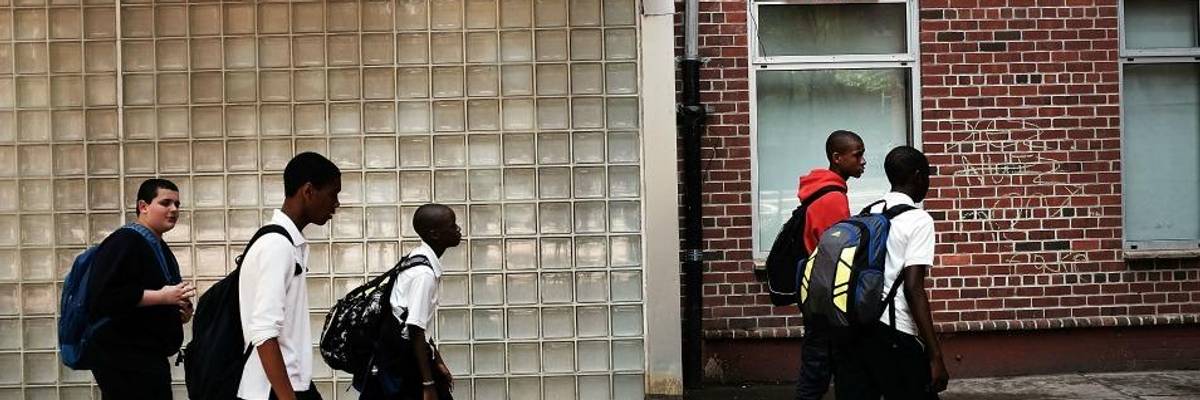
Young residents stand outside of an East Harlem public housing complex on May 19, 2015 in New York City. A new proposal by the Department of Housing and Urban Development could evict tens of thousands of children from public housing, mostly in New York, California, and Texas. (Photo: Spencer Platt/Getty Images)
Using the federal agency that oversees public housing to wage its latest attack on immigrants, the Trump administration has proposed a rule that critics warn would result in tens of thousands of children being evicted from their homes.
Weeks after announcing it would tighten restrictions on undocumented immigrants who live in public housing, the Department of Housing and Urban Development (HUD) unveiled a proposal on Friday which would take away all housing aid from families with at least one member who is an undocumented immigrant.
An analysis by HUD openly admitted that the rule would likely have a major impact on about 25,000 families with "mixed" immigration status, putting many at risk for homelessness--with extremely limited benefits for families that are currently waiting for apartments in public housing complexes.
Kristen Clarke, president of the Lawyers' Committee for Civil Rights Under Law, called the proposal "a callous action by HUD and Secretary Ben Carson."
Robert Greenstein, president of the Center for Budget and Policy Priorities (CBPP) said the proposal was the latest in "the barrage of policies the administration has put forward" as part of its attempt at "sharply altering our nation's immigration policies and making life more difficult for immigrants."
"Coming on top of other executive orders and actions that have placed various immigrants at risk, the draft rule is another severe and unjustified measure that would harm both immigrant families and U.S. citizens and ill serve our country," Greenstein continued. "Threatening people who want to build better lives for themselves and their families is contrary to the national interest and our nation's most cherished values."
About 55,000 children are among the 108,000 people who could lose their homes thanks to the rule.
Many families would likely separate, with undocumented members leaving the rest of the family to continue living in public housing. Many others would be forcibly evicted or would leave in fear of the rule--a possibility that Diane Yentel, president of the National Low Income Housing Coalition, argued was likely "the true motivation behind the proposed rule."
"Temporary homelessness could arise for a household, if they are unable to find alternative housing, for example in tight housing markets," the HUD analysis acknowledges.
"The cruelty of it is really breathtaking, and it would do real harm to kids and to families--and for what?" Yentel told NPR.
While the proposal is ostensibly aimed at reserving housing aid for families in which all members are legal residents or citizens, NPR noted, "HUD's unusually frank analysis concludes that there would be few benefits from the change for other low-income families waiting for aid."
"Mixed status" households generally get lower subsidies than other families, so HUD would likely begin spending more per year if all undocumented residents were forced to leave their homes.
HUD would likely "have to reduce the quantity and quality of assisted housing in response to higher costs," the agency wrote.
The new policy would "have an impact on the quality of service, e.g., maintenance of the units and possibly deterioration of the units that could lead to vacancy," the report added.
If Carson and President Donald Trump "really cared about housing wait lists," wrote Clarke on Twitter, "they would ask Congress for money for affordable housing."
Dear Common Dreams reader, It’s been nearly 30 years since I co-founded Common Dreams with my late wife, Lina Newhouser. We had the radical notion that journalism should serve the public good, not corporate profits. It was clear to us from the outset what it would take to build such a project. No paid advertisements. No corporate sponsors. No millionaire publisher telling us what to think or do. Many people said we wouldn't last a year, but we proved those doubters wrong. Together with a tremendous team of journalists and dedicated staff, we built an independent media outlet free from the constraints of profits and corporate control. Our mission has always been simple: To inform. To inspire. To ignite change for the common good. Building Common Dreams was not easy. Our survival was never guaranteed. When you take on the most powerful forces—Wall Street greed, fossil fuel industry destruction, Big Tech lobbyists, and uber-rich oligarchs who have spent billions upon billions rigging the economy and democracy in their favor—the only bulwark you have is supporters who believe in your work. But here’s the urgent message from me today. It's never been this bad out there. And it's never been this hard to keep us going. At the very moment Common Dreams is most needed, the threats we face are intensifying. We need your support now more than ever. We don't accept corporate advertising and never will. We don't have a paywall because we don't think people should be blocked from critical news based on their ability to pay. Everything we do is funded by the donations of readers like you. When everyone does the little they can afford, we are strong. But if that support retreats or dries up, so do we. Will you donate now to make sure Common Dreams not only survives but thrives? —Craig Brown, Co-founder |
Using the federal agency that oversees public housing to wage its latest attack on immigrants, the Trump administration has proposed a rule that critics warn would result in tens of thousands of children being evicted from their homes.
Weeks after announcing it would tighten restrictions on undocumented immigrants who live in public housing, the Department of Housing and Urban Development (HUD) unveiled a proposal on Friday which would take away all housing aid from families with at least one member who is an undocumented immigrant.
An analysis by HUD openly admitted that the rule would likely have a major impact on about 25,000 families with "mixed" immigration status, putting many at risk for homelessness--with extremely limited benefits for families that are currently waiting for apartments in public housing complexes.
Kristen Clarke, president of the Lawyers' Committee for Civil Rights Under Law, called the proposal "a callous action by HUD and Secretary Ben Carson."
Robert Greenstein, president of the Center for Budget and Policy Priorities (CBPP) said the proposal was the latest in "the barrage of policies the administration has put forward" as part of its attempt at "sharply altering our nation's immigration policies and making life more difficult for immigrants."
"Coming on top of other executive orders and actions that have placed various immigrants at risk, the draft rule is another severe and unjustified measure that would harm both immigrant families and U.S. citizens and ill serve our country," Greenstein continued. "Threatening people who want to build better lives for themselves and their families is contrary to the national interest and our nation's most cherished values."
About 55,000 children are among the 108,000 people who could lose their homes thanks to the rule.
Many families would likely separate, with undocumented members leaving the rest of the family to continue living in public housing. Many others would be forcibly evicted or would leave in fear of the rule--a possibility that Diane Yentel, president of the National Low Income Housing Coalition, argued was likely "the true motivation behind the proposed rule."
"Temporary homelessness could arise for a household, if they are unable to find alternative housing, for example in tight housing markets," the HUD analysis acknowledges.
"The cruelty of it is really breathtaking, and it would do real harm to kids and to families--and for what?" Yentel told NPR.
While the proposal is ostensibly aimed at reserving housing aid for families in which all members are legal residents or citizens, NPR noted, "HUD's unusually frank analysis concludes that there would be few benefits from the change for other low-income families waiting for aid."
"Mixed status" households generally get lower subsidies than other families, so HUD would likely begin spending more per year if all undocumented residents were forced to leave their homes.
HUD would likely "have to reduce the quantity and quality of assisted housing in response to higher costs," the agency wrote.
The new policy would "have an impact on the quality of service, e.g., maintenance of the units and possibly deterioration of the units that could lead to vacancy," the report added.
If Carson and President Donald Trump "really cared about housing wait lists," wrote Clarke on Twitter, "they would ask Congress for money for affordable housing."
Using the federal agency that oversees public housing to wage its latest attack on immigrants, the Trump administration has proposed a rule that critics warn would result in tens of thousands of children being evicted from their homes.
Weeks after announcing it would tighten restrictions on undocumented immigrants who live in public housing, the Department of Housing and Urban Development (HUD) unveiled a proposal on Friday which would take away all housing aid from families with at least one member who is an undocumented immigrant.
An analysis by HUD openly admitted that the rule would likely have a major impact on about 25,000 families with "mixed" immigration status, putting many at risk for homelessness--with extremely limited benefits for families that are currently waiting for apartments in public housing complexes.
Kristen Clarke, president of the Lawyers' Committee for Civil Rights Under Law, called the proposal "a callous action by HUD and Secretary Ben Carson."
Robert Greenstein, president of the Center for Budget and Policy Priorities (CBPP) said the proposal was the latest in "the barrage of policies the administration has put forward" as part of its attempt at "sharply altering our nation's immigration policies and making life more difficult for immigrants."
"Coming on top of other executive orders and actions that have placed various immigrants at risk, the draft rule is another severe and unjustified measure that would harm both immigrant families and U.S. citizens and ill serve our country," Greenstein continued. "Threatening people who want to build better lives for themselves and their families is contrary to the national interest and our nation's most cherished values."
About 55,000 children are among the 108,000 people who could lose their homes thanks to the rule.
Many families would likely separate, with undocumented members leaving the rest of the family to continue living in public housing. Many others would be forcibly evicted or would leave in fear of the rule--a possibility that Diane Yentel, president of the National Low Income Housing Coalition, argued was likely "the true motivation behind the proposed rule."
"Temporary homelessness could arise for a household, if they are unable to find alternative housing, for example in tight housing markets," the HUD analysis acknowledges.
"The cruelty of it is really breathtaking, and it would do real harm to kids and to families--and for what?" Yentel told NPR.
While the proposal is ostensibly aimed at reserving housing aid for families in which all members are legal residents or citizens, NPR noted, "HUD's unusually frank analysis concludes that there would be few benefits from the change for other low-income families waiting for aid."
"Mixed status" households generally get lower subsidies than other families, so HUD would likely begin spending more per year if all undocumented residents were forced to leave their homes.
HUD would likely "have to reduce the quantity and quality of assisted housing in response to higher costs," the agency wrote.
The new policy would "have an impact on the quality of service, e.g., maintenance of the units and possibly deterioration of the units that could lead to vacancy," the report added.
If Carson and President Donald Trump "really cared about housing wait lists," wrote Clarke on Twitter, "they would ask Congress for money for affordable housing."