

SUBSCRIBE TO OUR FREE NEWSLETTER
Daily news & progressive opinion—funded by the people, not the corporations—delivered straight to your inbox.
5
#000000
#FFFFFF
To donate by check, phone, or other method, see our More Ways to Give page.
Daily news & progressive opinion—funded by the people, not the corporations—delivered straight to your inbox.
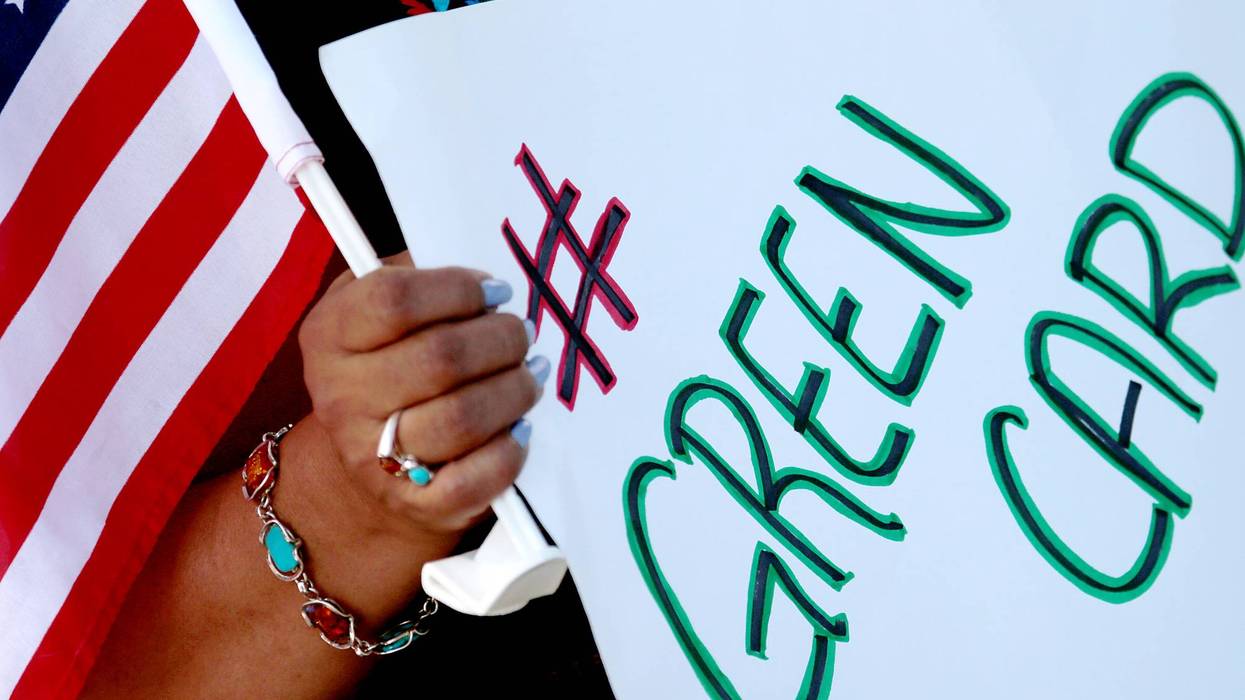
The policy effectively redesigns the system such that for some nationalities—predominantly those from African, Asian, Caribbean, and Latin American countries—no realistic legal pathway to obtain a green card exists.
On May 22, the US Citizenship and Immigration Services issued a policy memo announcing a major shift in immigration policy. As USCIS Spokesperson Zach Kahler explains: “From now on, an alien who is in the US temporarily and wants a Green Card must return to their home country to apply, except in extraordinary circumstances. This policy allows our immigration system to function as the law intended instead of incentivizing loopholes.”
This new policy is unlawful, immoral, and xenophobic. Under the Immigration and Nationality Act (INA) as well as the LIFE Act, Congress created various pathways for immigrants to apply for “adjustment of status.” This allows a temporary legal resident to apply for legal permanent resident (LPR) status without having to leave the US.
Such adjustments are not limited to “extraordinary circumstances.” As the USCIS Policy Manual makes clear:
Aliens who are present in the United States and who are beneficiaries of approved immigrant petitions may generally file an application with USCIS to adjust their status to that of an LPR, or they may depart the United States and apply for an immigrant visa abroad. One reason Congress created the adjustment of status provision was to enable certain aliens physically present in the United States to become LPRs without incurring the expense and inconvenience of traveling abroad to obtain an immigrant visa. Congress has added additional adjustment of status provisions to: Ensure national security and public safety; Advance economic growth and a robust immigrant labor force; Promote family unity; and Accommodate humanitarian resettlement.
If Congress intended “adjustment of status” to be limited to “extraordinary circumstances,” then they would have made that clear. What’s more, if that was their intention, then they would not have consistently added more adjustment provisions. The fact of the matter is that neither the plain language of the relevant statutes nor the history of “adjustment of status” guidelines justify this policy revision. Rather than “returning to the original intent of the law” as USCIS Director Joseph Edlow claims, the agency is twisting the law to satisfy President Donald Trump’s desires.
That USCIS had the audacity to even release such an obviously politically motivated and illegal policy speaks to the broader decline in the integrity of American institutions.
As former USCIS senior adviser Doug Rand noted, “Trump has banned people from over 100 countries from returning to the US, so forcing them to go abroad for consular processing is no pathway at all.” This includes nationals from Iran, Iraq, Syria, Nigeria, Somalia, and Yemen—countries that Trump has bombed in his second term; as well as Cuba, which is still suffering under a US oil blockade and sanctions.
For those from countries not included in one of Trump’s travel bans, the new process will be significantly more expensive, time-consuming, and complicated. Applicants will be forced to leave their loved ones and wait months or years before they can return to the US.
Now, the memo does acknowledge “limited exceptions” to this new requirement. This includes people on “dual intent” visas such as the H-1B (for specialized workers) or O-1 (for those with “extraordinary ability or achievement”), as well as “immigrant categories where only adjustment of status provides a pathway to permanent resident status.” While the memo fails to specify, the latter may include refugees and asylum-seekers.
Two points are worth emphasizing here: First, the policy memo states that “adjustment under most provisions is granted only as ‘a matter of discretion and administrative grace.’” Maintaining lawful status under a H-1B or O-1 visa “is not sufficient, on its own, to warrant a favorable exercise of discretion.” As Kahler further clarified in an email to Newsweek on May 24, “People who present applications that provide an economic benefit or otherwise are in the national interest will likely be able to continue on their current path.” He added, others “may be asked to apply abroad depending on individualized circumstances.”
Ultimately, however, as the memorandum makes clear, USCIS officers are advised to consider “if approval of the alien’s adjustment of status application is in the best interest of the United States.” This means weighing multiple factors, including “the applicant’s moral character.”
Second, even if one of the “limited exceptions” applies to refugees, it may amount to very little given the Trump administration’s concerted efforts to weaken the US Refugee Admissions Program (USRAP).
In October 2025, the Trump administration lowered the cap on the number of refugees the US will admit to 7,500. Between October 2025 and April 2026, the US only admitted 4,499 refugees. All, except three from Afghanistan, were South African.
In November 2025, USCIS issued a memo ordering the review of about 233,000 refugees who entered the US between January 20, 2021 and February 20, 2025. It also halted all processing of green card applications for refugees who entered during that period.
As part of their operations in Minnesota in January 2026, the Department of Homeland Security (DHS) and USCIS launched a sweeping initiative to re-review and potentially terminate the protective status of refugees who had not yet obtained permanent resident status. This led to more than 100 refugees with no criminal records being arrested by Immigration and Customs Enforcement on allegations of fraud, transferred to detention centers in Texas, and threatened with deportation.
The USCIS policy effectively redesigns the system such that for some nationalities—predominantly those from African, Asian, Caribbean, and Latin American countries—no realistic legal pathway to obtain a green card exists. For all others, it becomes a matter of administrative discretion—or more precisely, Trump’s discretion. The true dividing line here is not whether one contributes economically to the US or follows its laws, but rather whether Trump believes a person comes from a “shithole” country or a “nice” country.
This divide has a further implication: Under Trump’s birthright ban, only children born of US citizens and lawful permanent residents automatically acquire citizenship. If the Supreme Court upholds his order, and if this policy revision survives its inevitable lawsuit, then it would dramatically alter who could become a citizen. This has been an underlying goal of Trump’s immigration agenda from the start.
Kahler insists that this policy is necessary to close a dangerous loophole that immigrants exploit to stay in the US indefinitely. He remarks, “When aliens apply from their home country, it reduces the need to find and remove those who decide to slip into the shadows and remain in the US illegally after being denied residency.”
This is bullshit, plain and simple. US Customs and Border Protection calculated that in 2024 the US visa overstay rate was 1.15%. “In other words, 98.85% of the in-scope nonimmigrant visitors departed the United States on-time and in accordance with the terms of their admissions.”
The true goal rather is to force people to leave the US and have consular officers abroad quickly and quietly reject their applications without any consideration for due process or the applicant’s legal rights. As the CATO Institute reports, even prior to this new policy, DHS had already cut green card approvals by roughly half.
Hopefully, the courts or Congress will intervene and put an end to this policy. However, that USCIS had the audacity to even release such an obviously politically motivated and illegal policy speaks to the broader decline in the integrity of American institutions. Even if this attempt fails, the Trump administration will continue to go after immigrants. They will not stop; so, neither can we. We must remain vigilant and continue to keep our communities safe.

The policy change means "we could have families separated for months or years," said one expert.
Critics are slamming the Trump administration for implementing a new rule that foreigners who apply for green cards must do so from abroad.
US Citizenship and Immigration Services (USCIS) on Friday announced that foreigners currently in the US who want to establish permanent legal residency must first return to their countries of origin to apply for a green card.
This announcement broke with decades of US immigration policy, which made it possible for immigrants in the US to obtain green cards without having to leave the country.
Doug Rand, a former senior advisor at USCIS under President Joe Biden, said in an interview with The Associated Press that "the goal of this policy is very explicit," which is to block a path to citizenship "for as many people as possible."
Sarah Pierce, a former USCIS policy analyst, told The New York Times that the rule change could have particularly dire consequences to foreigners who are married to US citizens and will now have to apply for permanent residency from overseas.
"Our consular processing system through which they would have to apply is already overburdened," Pierce explained. "So that means we could have families separated for months or years."
Aaron Reichlin-Melnick, senior fellow at the American Immigration Council, similarly noted that the new policy "could force people to leave their jobs, homes, and families for weeks or months, all at their own expense" just to stay in a country where they have already established roots.
Reichlin-Melnick said that the full scope of the policy isn't yet clear because there are several unknown details about how broadly it will be applied, but added that "in the meantime, hundreds of thousands of immigrants now have to worry about upending their lives to get a legal status that they are entitled to under our laws."
Drop Site News reporter Ryan Grim argued that the new policy rips the mask off Trump administration claims that they aren't opposed to all immigration, they simply want to reduce undocumented immigration.
"The talking point that we do want legal immigration, we just want people to get in line and follow the rules, is BS," Grim commented. "This is an attempt to blow up the line, blow up the rules, and make it insanely difficult to immigrate legally."
Rep. Chuy García (D-Ill.) echoed Grim's comments by pointing out that the new policy shows the Trump administration's disdain for immigration overall.
"This new policy will force thousands of LEGAL immigrants, including spouses of US citizens, to leave their homes, families, and jobs for weeks or even months to get their green card outside the US," said García. "This is an absurd and cruel policy."
Rep. Adriano Espaillat (D-NY), chairman of the Congressional Hispanic Caucus, condemned the new policy for targeting "students, scientists, entrepreneurs, spouses of US citizens, and other individuals following legal immigration processes."
"Aspiring lawful permanent residents are valued members of our communities, workforce, and economy," Espaillat emphasized. "I will continue fighting to protect the rights of aspiring green card holders and immigrant families."