

SUBSCRIBE TO OUR FREE NEWSLETTER
Daily news & progressive opinion—funded by the people, not the corporations—delivered straight to your inbox.
5
#000000
#FFFFFF
To donate by check, phone, or other method, see our More Ways to Give page.
Daily news & progressive opinion—funded by the people, not the corporations—delivered straight to your inbox.
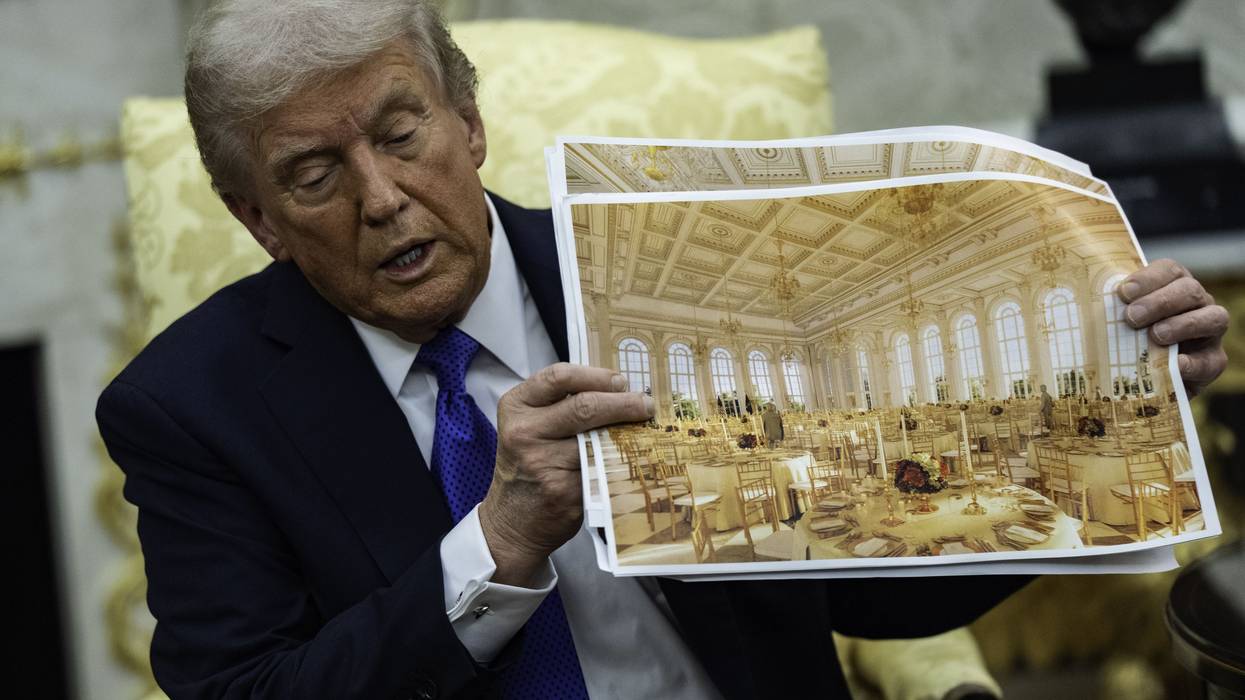
"At every turn, President Trump has sought to conceal the facts about his monstrous multimillion-dollar ballroom,” said Sen. Richard Blumenthal.
While the financing of President Donald Trump's planned $400 million White House ballroom has been shrouded in mystery for months, government watchdog Public Citizen has obtained important new information about the project's funding.
Public Citizen on Tuesday unveiled a copy of the funding agreement the Trump administration has used for the ballroom project after months of legal wrangling that forced the group to file a lawsuit to compel enforcement of a Freedom of Information Act (FOIA) request it made last year.
As summarized by The Washington Post, the ballroom contract's provisions "allow wealthy donors with business before the federal government to contribute anonymously to a sitting president’s pet project, while exempting the White House from key conflict of interest safeguards and limiting scrutiny by Congress and the public."
While dozens of big-name corporate donors—including Amazon, Apple, Lockheed Martin, Google, Altria, and Union Pacific Railroad—have been public about their donations to the project, the fact that some donors can choose to remain anonymous is raising serious concerns among ethics experts.
Charles Tiefer, a retired law professor at the University of Baltimore with a long history of scrutinizing government contracts, told the Post that the contract's anonymity provisions could give the Trump administration an escape hatch from future congressional scrutiny.
"If Congress knocks on the door," Tiefer said, "the White House is going to slam it shut and say, ‘You’re not allowed to know these donors.'"
This means that there is no way to know whether these donors have business before the government, and no way to know if they expect to get something in return for their donations.
Kathleen Clark, a government ethics lawyer and law professor at Washington University in St. Louis, told the Post that the contract's very narrow scope of reviewing for conflicts of interest among donors renders it "nothing more than a sham."
Jon Golinger, democracy advocate for Public Citizen, said the key takeaway from the newly unearthed documents is that "anonymous donations are the heart of this agreement."
"The questions this raises are, of the hundreds of millions being funneled in secret, who are these anonymous donors, and what are they hiding?" Golinger added. "The American people deserve answers, and we’ll keep fighting until they get them."
Wendy Liu, Public Citizen attorney and lead counsel on the lawsuit to obtain the contract, said the administration's initial refusal to comply with a FOIA request was "flatly unlawful," and "the American people are entitled to transparency over this multimillion-dollar project, and this win gets us a bit closer to knowing the truth."
Sen. Richard Blumenthal (D-Conn.) blasted the Trump administration's efforts to hide the contract in a statement given to the Post.
“At every turn, President Trump has sought to conceal the facts about his monstrous multimillion-dollar ballroom,” Blumenthal said. “His administration has kept the contract under wraps, the identities of big dollar donors secret, and the American people in the dark about what big corporations have to gain by funding this boondoggle.”
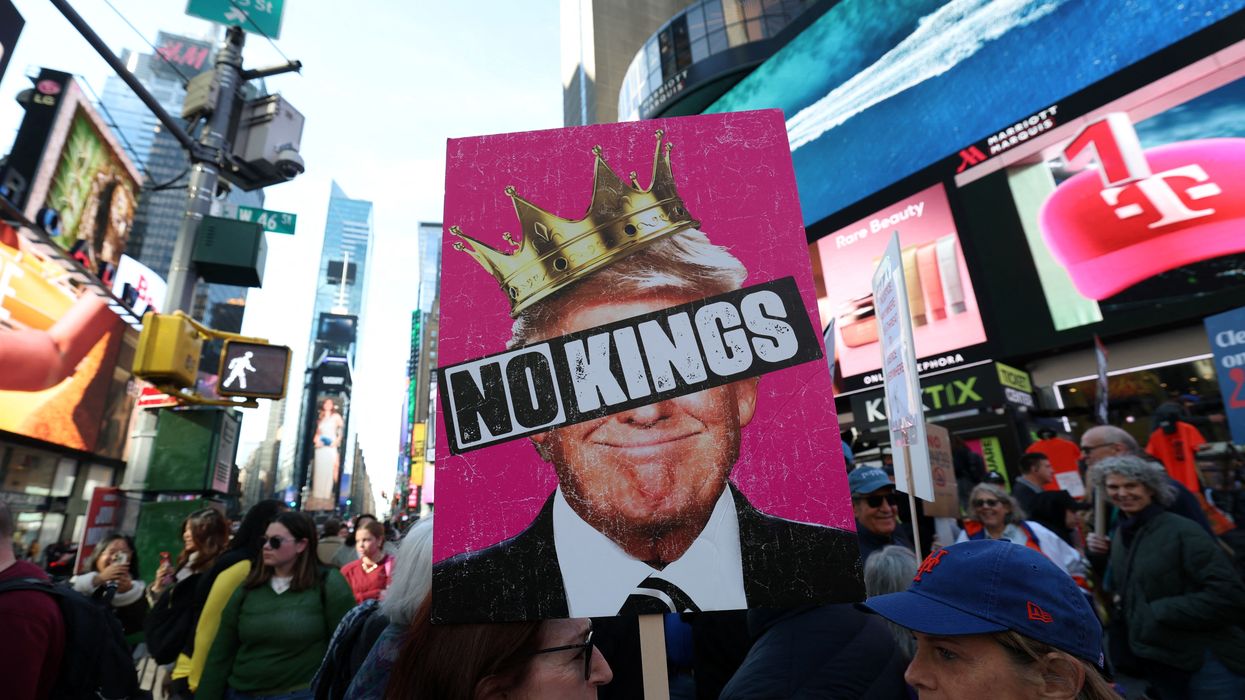
"If senior officials are processing this grift behind closed doors... that is not just bad optics, it is a direct threat to government integrity."
A democracy advocacy organization is stepping up pressure on the federal government to release more information on President Donald Trump's scheme to receive a $230 million payout from the US Department of Justice.
Democracy Forward on Monday filed a Freedom of Information Act (FOIA) complaint against the DOJ and the US Department of Treasury, alleging that both agencies have so far refused to turn over any records related to what the group describes as Trump's "stunning effort to obtain a $230 million taxpayer-funded payout for investigations into his own misconduct."
The group notes that it has already filed multiple FOIA requests over the last several weeks, and in response neither DOJ or Treasury has "produced a single substantial record or issued a legally required determination."
The complaint asks courts to compel DOJ and Treasury "to conduct searches for any and all responsive records" related to Democracy Forward's past FOIA requests, and also to force the government "to produce, by a date certain, any and all non-exempt responsive records," and to create an index "of any responsive records withheld under a claim of exemption."
Skye Perryman, president and CEO of Democracy Forward, said her organization's lawsuit was a simple demand for government transparency.
"People in America deserve to know whether the Department of Justice is entertaining the president’s request to cut himself a taxpayer-funded $230 million check," Perryman said. "If senior officials are processing this grift behind closed doors—including officials who used to represent him—that is not just bad optics, it is a direct threat to government integrity."
Democracy Forward's complaint stems from an October New York Times report that Trump was lobbying DOJ to fork over hundreds of millions of dollars to him as compensation for the purported hardships he endured throughout the multiple criminal investigations and indictments leveled against him.
Trump was indicted in 2023 on federal charges related to his mishandling of top-secret government documents that he'd stashed in his Mar-a-Lago resort, as well as his efforts to illegally remain in power after losing the 2020 presidential election. Both cases were dropped after Trump won the 2024 presidential election.
When asked about the DOJ payout scheme in the wake of the Times report, Trump insisted he would give any money paid out by the department to charity and asserted that he had been "damaged very greatly" by past criminal probes.
Perryman, however, insisted that Trump was not entitled to enrich himself off taxpayer funds.
"President Trump may think he can invoice people for the consequences of his own actions," she said, "but this country still has laws, and we demand they be enforced.”
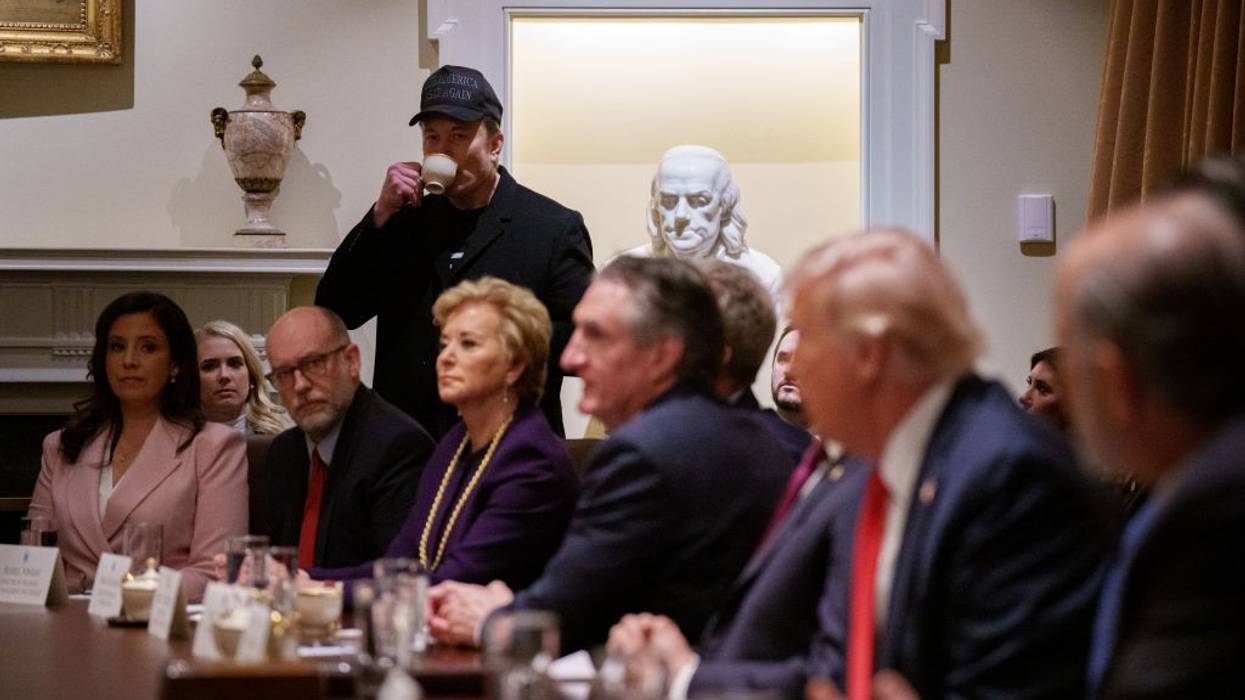
"The American people deserve to know what is going on—including if and how artificial intelligence is being used to reshape the departments and agencies people rely on daily."
A watchdog organization on Monday launched a public records probe to determine the extent to which the Trump administration and its billionaire wrecking ball, Elon Musk, are using artificial intelligence as part of their lawless effort to purge the federal workforce.
"The American people deserve to know what is going on—including if and how artificial intelligence is being used to reshape the departments and agencies people rely on daily," said Skye Perryman, president and CEO of Democracy Forward, the group behind the new investigation.
"We will continue to use every tool at our disposal to force the Trump-Vance administration to fulfill its obligation to the public and to our system of laws," Perryman added.
The probe comes days after NBC News reported that federal workers' responses to Musk's email ultimatum were "expected to be fed into an artificial intelligence system to determine whether those jobs are necessary."
"The information will go into an LLM (Large Language Model), an advanced AI system that looks at huge amounts of text data to understand, generate and process human language," the news outlet reported, citing unnamed sources. "The AI system will determine whether someone's work is mission-critical or not."
Additionally, according to The Washington Post, Musk lieutenants "have fed sensitive data from across the Education Department into artificial intelligence software."
"For an administration that claimed it wanted to bring about transparency and efficiency in government, the Trump-Vance administration's purge of public servants and sloppy processes have done just the opposite."
Democracy Forward said Monday that it would use Freedom of Information Act (FOIA) requests in an attempt to shine light on the administration's reliance on AI for personnel decisions. The Trump Justice Department argued in a court filing last week that the Musk-led Department of Government Efficiency, or DOGE, is exempt from public records requests—a claim that experts have rejected and condemned as an attempt to skirt oversight.
"For an administration that claimed it wanted to bring about transparency and efficiency in government, the Trump-Vance administration's purge of public servants and sloppy processes have done just the opposite," Perryman said Monday. "DOGE and this administration are operating in a shroud of secrecy, and their 'govern by chaos' tactics have only made government less efficient and caused disruptions to our safety and security."
Democracy Forward said its new FOIA requests were sent to DOGE as well as the Office of Personnel Management, the State Department, the Education Department, the U.S. Agency for International Development, and the General Services Administration, among other agencies.
Wired reported last month that "Thomas Shedd, the recently appointed Technology Transformation Services director and Elon Musk ally, told General Services Administration workers that the agency's new administrator is pursuing an 'AI-first strategy.'"
"Shedd provided a handful of examples of projects GSA Acting Administrator Stephen Ehikian is looking to prioritize, including the development of 'AI coding agents' that would be made available for all agencies," Wired added. "Shedd made it clear that he believes much of the work at [Technology Transformation Services] and the broader government, particularly around finance tasks, could be automated.
Geoffrey Fowler, the Post's technology columnist, noted Monday that "lots of recent evidence shows that relying on automation alone to make critical decisions can lead to big government mistakes."
"Just ask New York City, where last year a government AI chatbot advised businesses to break the law," Fowler wrote. "Or Australia, where a deeply flawed algorithm called Robodebt created the opposite of efficiency: the government had to settle for more than a billion dollars with citizens for wrongly reclaiming benefits."
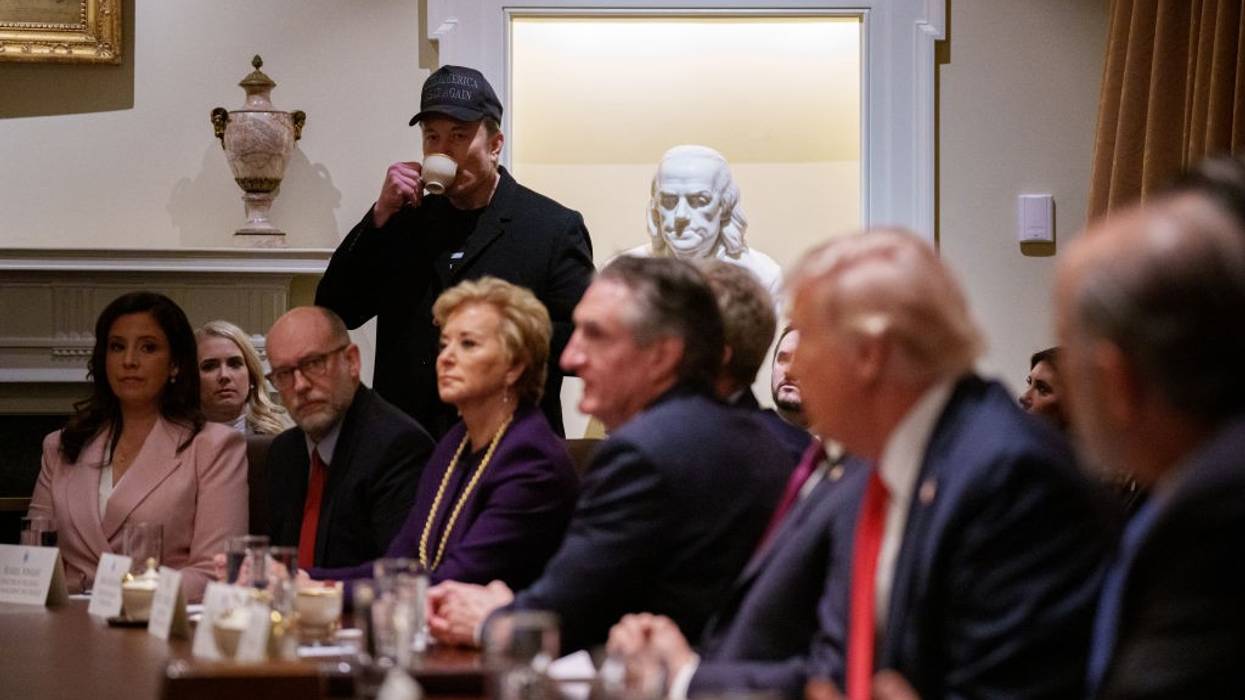
"The public has every right to know what kind of rogue agency Elon Musk and his tech-bro army have created."
A U.S. conservation group sued the Trump administration in a Washington, D.C. federal court on Thursday to reveal details about the so-called Department of Government Efficiency and its apparent leader, billionaire Elon Musk.
"The public has every right to know what kind of rogue agency Elon Musk and his tech-bro army have created," said Brett Hartl, government affairs director at the Center for Biological Diversity, in a statement about the group's suit.
"Musk's wrecking ball outfit should be called the Department of Government Evisceration because he's destroying critical federal agencies that keep us and the environment safe and healthy," Hartl declared. "The reality is that rebuilding functioning federal agencies will cost far more in the long run than any trivial savings gained."
"The center and its members are deeply interested in, and affected by, how the stated mission for DOGE and its related activities could harm, undermine, or negate the center's long-standing efforts to protect the environment and the livability of our planet."
The center noted that its case "appears to be the first contending that DOGE itself is an 'agency' for purposes of" the Freedom of Information Act (FOIA), a federal law that gives the public—including reporters—the right to request government records.
As Musk and his minions have attempted to gut government agencies and obtained Americans' sensitive data, journalists and other observers have sounded the alarm over difficulties accessing information about DOGE and its billionaire leader—whose companies have gotten at least $38 billion from the U.S. government since 2006, according to The Washington Post.
Trump announced just after his reelection that Musk, the richest person on Earth, would chair an initiative designed to slash federal spending and regulations. On his first day back in office, the Republican signed an executive order establishing the DOGE Service Temporary Organization and rebranding the United States Digital Service (USDS) as the U.S. DOGE Service.
A Trump official has since claimed in a declaration to a federal court that Musk is neither the administrator nor an employee of USDS or the temporary organization—he is officially a White House Office employee serving as "a senior adviser to the president," allegedly with "no actual or formal authority to make government decisions himself."
Given how those claims conflict with Trump and Musk's comments and behaviors over the past few months, Congressman Gerry Connolly (D-Va.), ranking member of the House Committee on Oversight and Government Reform, launched an investigation last week and demanded answers from the White House by March 6.
The conservation group aims to reveal similar information: the identities of DOGE's workers and volunteers, meeting details, communications involving Musk's businesses, and directives from the White House. The complaint names Musk, DOGE, USDS, Amy Gleason—the acting administrator of those two entities, according to the White House—and the Office of Management and Budget (OMB).
Fuck the broligarchy keychain on the ground
[image or embed]
— Tierra Curry (@savelifeonearth.bsky.social) February 27, 2025 at 10:42 AM
The records that the center is requesting "are subject to FOIA, and their relevance is extremely time-sensitive given DOGE's ongoing efforts to refashion the federal government and workforce in fundamental ways with no or minimal transparency," the complaint states. "FOIA was designed to ensure that monumental and consequential undertakings such as this could not take place without transparency. Yet that is what is occurring as defendants are engaging in wholesale disregard for FOIA's pro-disclosure mandate."
"In the absence of judicial intervention, they will continue to do so," the suit warns. "Specifically, President Trump established DOGE to repeal, rescind, and otherwise eliminate various facets of the federal government in the name of cost-cutting."
"Given the substantial protections for air and water, wildlife and nature, climate, public lands, and the environment generally implemented through federal staff and regulations," the complaint adds, "the center and its members are deeply interested in, and affected by, how the stated mission for DOGE and its related activities could harm, undermine, or negate the center's long-standing efforts to protect the environment and the livability of our planet."
The filing follows the center's January suit against OMB seeking DOGE documents. The group said Thursday that "to date, the government has failed to provide any records in response to the center's Freedom of Information Act requests."

"Definitely never seen this type of response to a FOIA request," quipped one journalist.
When CNN put in a Freedom of Information Act request with the Office of Personnel Management for information related to security clearances for billionaire Elon Musk and other personnel at the so-called Department of Government Efficiency who have been allowed access to sensitive or classified government networks, the outlet got an unexpected response.
"Good luck with that, they just fired the whole privacy team," an OPM email address wrote back, according to Tuesday reporting from CNN. An OPM official told the outlet that the federal government's human resources agency did not layoff the entire privacy team, but did not comment further on the matter.
"Definitely never seen this type of response to a FOIA request," quipped CBS News journalist Jim LaPorta reacting to the news on X.
According to CNN, OPM's privacy team "is tasked with ensuring the agency's data privacy practices meet legal requirements and protect the trust of the public." Members of the agency's communications staff and employees who handle FOIA requests were also terminated, per CNN, which cited two unnamed sources.
Federal agencies are required to furnish information requested via FOIA unless the information falls within an exemption.
These firings at OPM, which is the chief human resources agency of the federal government, constitute "a move that limits outside access to government records related to the security clearances granted to Elon Musk and his associates," according to CNN, citing unnamed sources "familiar with the matter."
OPM was one of the first federal agencies to be infiltrated by Musk's associates at the Department of Government Efficiency and has been at the forefront of the Trump administration's purge of federal workers.
Last month, OPM sent out the now infamous "Fork in the Road" memo, which offered a widely decried deferred resignation program for nearly all federal employees. The message resembled—including the verbatim wording of the subject line—an email that Musk sent Twitter employees in 2022, when he took over the social media platform now known as X.
CNN's coverage also noted that the move to fire members of OPM's privacy and communication teams echoes Musk's decision to fire the media relations department at Twitter.
On X, Washington Post video journalist Jorge Ribas wrote the word "'transparency'" in response to CNN's reporting about the FOIA request, in an apparent nod to Musk's assertion that DOGE is attempting to be transparent in carrying out its operations.

A new lawsuit seeks to kill a recent Trump administration rule that critics say deals a blow to transparency by giving the Environmental Protection Agency broad authority to shoot down public information requests.
The new rule--put in place without public input--was published on the Federal Register June 26 and goes into effect July 26.
"This rule is a shameful attempt to keep Americans in the dark about the Trump administration's sickening failures to protect our air, water, and wildlife," said Meg Townsend, open government attorney with the Center for Biological Diversity. "We have a right to know what EPA is trying to hide and which Trump appointee is trying to hide it."
In their suit filed Wednesday in the U.S. District Court for the District Columbia, the Center for Biological Diversity and the Environmental Integrity Project argue that the new regulation violates the Freedom of Information Act by allowing for information requests to be denied on the basis of "responsiveness," and violates the Administrative Procedure Act (APA) by allowing for responses to be delayed. The administration also violated the APA by not allowing for public comment on the rule change, the suit says.
In addition,
Plaintiffs also challenge EPA's adoption of FOIA directives, which are substantive rules of general applicability governing EPA's FOIA practices, but which have never been published in the Federal Register or subjected to public comment in violation of the procedural rulemaking requirements of both FOIA and the APA. These secretly adopted FOIA directives institutionalize procedures and practices that serve to delay and often frustrate public access to public records by allowing EPA political appointees to oversee what information is made available to the public, and what information never sees the light of day.
"Government transparency is essential to modern democracy," the lawsuit states. "Congress enacted FOIA to provide the public with the right to federal agency records that illuminate government actions and empower the public to hold agencies accountable."
As The Hill reported last month,
While the EPA administrator and other political appointees have had the ability to grant or deny FOIA requests, doing so under the "basis of responsiveness" and "no response" option is a new addition in the forthcoming rule.
Other major changes in the rule include a decision to no longer allow EPA regional offices to handle initial FOIA requests. All requests instead must first be sent to the agency's National FOIA Office, which will then delegate the requests to the proper office.
Any requests sent first to regional offices by members of the press, the public, or any organizations will not be redirected and won't be considered received.
In a statement last month, the Sierra Club said the administration's motivation for the rule change was clear.
"Trump and [EPA Administrator Andrew] Wheeler are trying to end transparency and FOIA as we know it in a blatant attempt to hide their backdoor dealings with polluters," said Pat Gallagher, director of the organization's Environmental Law Program. "Make no mistake--this is happening precisely because transparency laws have revealed numerous embarrassing and even career ending scandals for Scott Pruitt and others."
The Center for Biological Diversity and the Environmental Integrity Project joined a number of other advocacy organizations to express concerns about the new rule in a letter (pdf) to Wheeler earlier this month.
Among their concerns were that the "rule inappropriately authorizes political appointees to make FOIA determinations and significantly increases the potential for abuse of the FOIA process." In addition, they warned, "Requiring all FOIA requests to be submitted to, and reviewed by, EPA Headquarters increases the potential for political abuse of the FOIA process."
The Environmental Integrity Project issued fresh criticism on Wednesday.
"EPA's rule would let political appointees decide whether or when to release information they are required to disclose by law," said Sylvia Lam, an attorney at the watchdog organization. "Not surprisingly, this administration has made that decision without even giving the public a chance to comment on this radical departure from current practice, which is to allow an agency's expert attorneys to make these legal determinations."
"The Freedom of Information Act holds government accountable to the governed by letting the public see how decisions are made," she said. "EPA's action strikes a blow at democratic values that are more important today than ever before."
Lawmakers have also taken aim at the new rule, with a bipartisan group of senators on Tuesday introducing related legislation.
Called the Open and Responsive Government Act (S. 2220) and introduced by Sens. Chuck Grassley (R-Iowa), Patrick Leahy (D-Vt.), John Cornyn (R-Texas), and Dianne Feinstein (D-Calif.), the measure is meant to counter to the EPA FOIA change as well as the recent Supreme Court ruling last month that "the term 'confidential' can be interpreted broadly to allow the government to withhold from disclosure under FOIA private businesses' financial or commercial data in the government's possession, even if the disclosure of that information would not cause any harm to the businesses," as CNN reported.
Leahy, in a statement, said: "Our bill is a targeted, commonsense step to bolster our premier transparency law, the Freedom of Information Act. The bill would limit the extent to which the government can use a recent Supreme Court opinion to justify abuses of a particular FOIA exemption to withhold information.
"And," he continued, "it would codify another court decision--one that the Trump administration increasingly ignores--prohibiting the government from withholding information on the tenuous rationale that it is supposedly not responsive to the FOIA request."
Dust off your fax machine. The FBI is planning to take a big step backward for government transparency.
As of March 1, the Bureau will no longer accept Freedom of Information Act (FOIA) requests via email. Anyone seeking public records from the FBI will have to use a new online portal -- or send requests via fax or snail mail.
Online FOIA portals may seem like a good idea in theory, but government agencies make them difficult to use -- with way too many burdensome requirements.
The Freedom of Information Act gives us a legal right to request public records, which allow journalists and watchdogs to hold the government accountable. FOIA requests uncovered harmful covert operations like COINTELPRO -- an FBI program designed to dismantle civil rights groups, among others -- and also exposed government surveillance of Black Lives Matter activists.
Our friends at MuckRock, which helps journalists and others access public records, raised the alarm when the terms of service of the new FBI portal came to light. These include arbitrary restrictions that aren't consistent with the law:
While these terms of service might be improved going forward, the FBI has shown that it can and will arbitrarily change them without public comment.
MuckRock founder Michael Morisy told us he's concerned about what this step backward signals for government transparency. "The FBI is a hugely important agency, and if the FBI gets away with it, we worry that a lot of other agencies will follow suit."
Freedom-of-information advocates have been fighting with the federal government about FOIA for a long time. And this isn't the first time a government agency has spent taxpayer money to make public records less accessible.
You can help by signing our petition urging the FBI to keep accepting email requests and cut out arbitrary restrictions when it launches its online FOIA portal on March 1.
Given the Trump administration's hostile attitude toward the press and activists, we need our government to be more transparent, not less.
Citing an investigation that revealed federal agents went undercover to spy on environmental activists, the Center for Biological Diversity (CBD) on Thursday filed nine Freedom of Information Act requests seeking information on surveillance of peaceful protests at federal fossil fuel auctions.
As they wrote at The Intercept in July, journalists Lee Fang and Steve Horn obtained emails showing that in May, local law enforcement and federal agents monitored and infiltrated a "Keep it in the Ground" protest at a Bureau of Land Management (BLM) auction in Lakewood, Colorado.
"The emails, which were obtained through an open records act request, show that the Lakewood Police Department collected details about the protest from undercover officers as the event was being planned," they wrote. "During the auction, both local law enforcement and federal agents went undercover among the protesters."
What's more, The Intercept reported:
The emails further show that police monitored Keep it in the Ground participating groups such as 350.org, Break Free Movement, Rainforest Action Network, and WildEarth Guardians, while relying upon intelligence gathered by Anadarko, one of the largest oil and gas producers in the region.
Now, CBD wants to know not only what happened at the Lakewood protest, but whether similar surveillance strategies have been pursued at other fossil fuel auction protests.
"Every oil and gas lease sale on public lands since September 2015 has faced climate protests as part of the 'Keep it in the Ground' movement that is calling on President Obama to end all new fossil fuel leasing on public lands," a CBD press statement reads, noting that such protests "have halted several BLM fossil fuel auctions, and spurred BLM and [Bureau of Ocean Energy Management] to begin conducting fossil fuel auctions online to avoid public controversy."
In turn, Thursday's filings (pdf) apply to all federal fossil fuel auctions conducted by BLM and BOEM since August 2015, including 14 fossil fuel auctions that faced public "Keep it in the Ground" protests.
"There's a large and growing movement of peaceful protesters calling on their government to make a moral choice to save our climate and end new fossil fuel leasing on public lands," said Taylor McKinnon of CBD. "The public has a right to know whether the government has launched a surveillance program targeting climate activists who are courageously speaking up for what's right."
In the end, McKinnon said, "Neither undercover surveillance nor moving fossil fuel auctions online will hide the dangerous disconnect between the Obama administration's climate rhetoric and its fossil fuel leasing policies. Until those policies align with U.S. climate goals, they'll continue to face growing public protest--and rightfully so."
Law enforcement surveillance and shifty procedural moves aren't the only threats facing climate activists. DeSmog Blog recently reported on how environmentalists like Bill McKibben and Tom Steyer "are being stalked by a team of GOP-trained camera operators."
Still, as McKibben wrote in a New York Times op-ed this weekend addressing such claims: "The fossil-fuel industry may threaten us as a planet, as a nation, and as individuals, but when we rise up together we've got a fighting chance against the powers that be."
"And perhaps," he said, "that realization is just a little bit scary for them."
For the second year in a row, the Obama administration has set a record in rejecting Freedom of Information Act requests, according to new analysis published Tuesday by the Associated Press.
Under the president's instructions, the U.S. should not withhold or censor government files merely because they might be embarrassing, but federal employees last year regularly misapplied the law. In emails that AP obtained from the National Archives and Records Administration about who pays for Michelle Obama's expensive dresses, the agency blacked-out a sentence under part of the law intended to shield personal, private information, such as Social Security numbers, phone numbers or home addresses. But it failed to censor the same passage on a subsequent page.
The sentence: "We live in constant fear of upsetting the WH (White House)."
AP president Gary Pruitt criticized the government for its evasive policies in a column released last week. "What we discovered reaffirmed what we have seen all too frequently in recent years," Pruitt wrote. "The systems created to give citizens information about their government are badly broken and getting worse all the time."
The White House is set to announce Tuesday that it will exempt its Office of Administration from federal rules requiring it to comply with Freedom of Information Act requests, allowing the record-keeping agency to reject transparency asks.
Formalizing a de facto policy that was upheld under previous presidencies, the move came in the form of a "final rule," which means it will be codified without public comment. The action effectively eliminates any formal process for the public to request that the White House voluntarily release records through a system known as "discretionary disclosure."
The Office of Administration is part of the Executive Office of the President, which is federally required to hand over certain documents when they are requested. Although it complied with those rules for 30 years, the Office of Administration generally ceased responding to FOIA requests under President George W. Bush and has continued to ignore them under President Barack Obama.
Although the rule stems from a years-long lawsuit, filed before Obama took office in 2008, the announcement comes at a particularly ironic time--the start of Sunshine Week, during which civil liberties watchdogs promote accountability and push for the government to be open in disclosing information. Monday was National Freedom of Information Act Day.
"It's a little tone deaf to do this on Sunshine Week, even if it's an administrative housecleaning," Rick Blum, coordinator of the Sunshine in Government initiative for the Reporters Committee for Freedom of the Press, told USA Today.
"[T]he systems created to give citizens information about their government are badly broken and getting worse all the time."
--Greg Pruitt, Associated Press
Among the records that the Office of Administration keeps are White House emails. In 2007, the government watchdog group Center for Responsibility and Ethics in Washington (CREW) requested documents from the office to look into a cache of up to 22 million emails missing from White House servers. The center's request was denied.
CREW filed a lawsuit against the office, but that claim and a lengthy appeal were overturned by a 2009 court ruling which found that the Office of Administration was not an "agency" as defined by FOIA, and thus lacked independent authority.
White House emails are not required to be given out under FOIA, the appeals court ruled. Instead, they had to be released under the Presidential Records Act--but not until five or more years after the end of the administration.
A signature promise of Obama's presidential campaign was to create the "most transparent" administration in history. On Tuesday, the White House announced the rule change by stating, "Generally speaking, the Administration has gone to great lengths to release more information on the front end so that individuals do not have to file a FOIA to get access to government data and other information."
CREW interim executive director and senior counsel Anne Weissmann told The Hill that the move by the White House "makes mockery of that commitment [to transparency], especially given that it's Sunshine Week. The White House has reversed a decades long practice of opening the files of OA to the public. Apparently they have abandoned even the appearance of transparency."
On Friday, Associated Press president Gary Pruitt criticized the government for increasingly undermining FOIA and other right-to-know laws. "[T]he systems created to give citizens information about their government are badly broken and getting worse all the time," Pruitt wrote in a statement.
"As the president said, the United States should not withhold or censor government files merely because they might be embarrassing," Pruitt continued. "But it happens anyway."
Disapproval of the rule change came from across the political aisle. Tom Fitton of the conservative Judicial Watch told USA Today, "This is an office that operated under the FOIA for 30 years, and when it became politically inconvenient, they decided they weren't subject to the Freedom of Information Act any more."
Rick Blum of Freedom of the Press told USA Today that the bigger issue is the fact that a White House office was responsible for its own record-keeping in the first place.
"I think what we've all learned in in the last few weeks is the person who creates a record--whether it's running a program or writing an e-mail--is the one who gets to decide whether it's an official record," Blum said. "And there ought to be another set of eyes on that. That's the essential problem."