SUBSCRIBE TO OUR FREE NEWSLETTER
Daily news & progressive opinion—funded by the people, not the corporations—delivered straight to your inbox.
5
#000000
#FFFFFF
To donate by check, phone, or other method, see our More Ways to Give page.
Daily news & progressive opinion—funded by the people, not the corporations—delivered straight to your inbox.
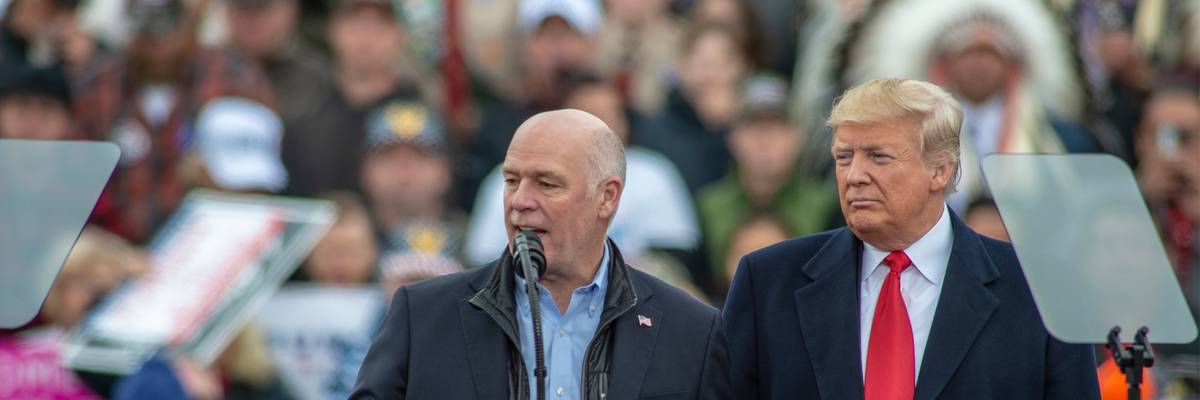
Greg Gianforte joins Donald Trump at a rally in Belgrade, Montana on November 3, 2018.
"We will never trade our First Amendment rights for cheap political points," said the civil liberties group.
The ACLU and other civil liberties groups accused the Montana GOP of running roughshod over free expression after Republican Gov. Greg Gianforte signed a bill completely banning TikTok in the state and prohibiting private companies from allowing Montanans to download the popular social media app.
Gianforte's move made Montana the first state in the U.S. to ban TikTok as congressional Republicans—and some Democrats—push for a federal ban or heavy restrictions, casting the short-form video platform as a national security threat with little to no supporting evidence.
TikTok is a subsidiary of the Chinese tech firm ByteDance. Gianforte echoed the typical GOP line on TikTok in a statement Wednesday, saying the new ban is aimed at protecting "Montanans' private data and sensitive personal information from being harvested by the Chinese Communist Party."
But the ACLU of Montana said in response that "there's no public evidence of harm that would meet the high bar set by the U.S. and Montana Constitutions" to justify a total ban on a widely used communication platform.
"With this ban, Governor Gianforte and the Montana legislature have trampled on the free speech of hundreds of thousands of Montanans who use the app to express themselves, gather information, and run their small business in the name of anti-Chinese sentiment," said Keegan Medrano, the ACLU of Montana's policy director. "We will never trade our First Amendment rights for cheap political points."
Montana's new ban, which is set to take effect on January 1, 2024, sets financial penalties of up to $10,000 a day for companies—including TikTok itself—that continue to make the app available for Montanans to download.
"This unconstitutional ban undermines the free speech and association of Montana TikTok users and intrudes on TikTok's interest in disseminating its users' videos," the Electronic Frontier Foundation wrote on Twitter. "It is a blatant violation of the First Amendment, whether it's done by Congress or Montana."
More than 150 million Americans use TikTok, according to the company's own figures.
Earlier this year, the Biden administration launched a fresh effort to force ByteDance to sell TikTok, reprising a failed pressure campaign first launched by the Trump White House. Late last year, President Joe Biden signed into law a spending bill containing a provision barring the TikTok app from devices issued by the federal government.
Congressional Republicans, including Sen. Josh Hawley (R-Mo.), have demanded legislative action to prohibit TikTok nationwide, drawing pushback from progressive lawmakers who say the push is fueled by dangerous anti-China sentiment and unfounded national security fears.
"I am opposed to efforts by some Republicans and Democrats to unilaterally ban an entire social media platform," Rep. Ilhan Omar (D-Minn.) said in a statement in late March, echoing Reps. Alexandria Ocasio-Cortez (D-N.Y.), Jamaal Bowman (D-N.Y.), and others.
"I don't like censorship," Omar added.
Dear Common Dreams reader, It’s been nearly 30 years since I co-founded Common Dreams with my late wife, Lina Newhouser. We had the radical notion that journalism should serve the public good, not corporate profits. It was clear to us from the outset what it would take to build such a project. No paid advertisements. No corporate sponsors. No millionaire publisher telling us what to think or do. Many people said we wouldn't last a year, but we proved those doubters wrong. Together with a tremendous team of journalists and dedicated staff, we built an independent media outlet free from the constraints of profits and corporate control. Our mission has always been simple: To inform. To inspire. To ignite change for the common good. Building Common Dreams was not easy. Our survival was never guaranteed. When you take on the most powerful forces—Wall Street greed, fossil fuel industry destruction, Big Tech lobbyists, and uber-rich oligarchs who have spent billions upon billions rigging the economy and democracy in their favor—the only bulwark you have is supporters who believe in your work. But here’s the urgent message from me today. It's never been this bad out there. And it's never been this hard to keep us going. At the very moment Common Dreams is most needed, the threats we face are intensifying. We need your support now more than ever. We don't accept corporate advertising and never will. We don't have a paywall because we don't think people should be blocked from critical news based on their ability to pay. Everything we do is funded by the donations of readers like you. When everyone does the little they can afford, we are strong. But if that support retreats or dries up, so do we. Will you donate now to make sure Common Dreams not only survives but thrives? —Craig Brown, Co-founder |
The ACLU and other civil liberties groups accused the Montana GOP of running roughshod over free expression after Republican Gov. Greg Gianforte signed a bill completely banning TikTok in the state and prohibiting private companies from allowing Montanans to download the popular social media app.
Gianforte's move made Montana the first state in the U.S. to ban TikTok as congressional Republicans—and some Democrats—push for a federal ban or heavy restrictions, casting the short-form video platform as a national security threat with little to no supporting evidence.
TikTok is a subsidiary of the Chinese tech firm ByteDance. Gianforte echoed the typical GOP line on TikTok in a statement Wednesday, saying the new ban is aimed at protecting "Montanans' private data and sensitive personal information from being harvested by the Chinese Communist Party."
But the ACLU of Montana said in response that "there's no public evidence of harm that would meet the high bar set by the U.S. and Montana Constitutions" to justify a total ban on a widely used communication platform.
"With this ban, Governor Gianforte and the Montana legislature have trampled on the free speech of hundreds of thousands of Montanans who use the app to express themselves, gather information, and run their small business in the name of anti-Chinese sentiment," said Keegan Medrano, the ACLU of Montana's policy director. "We will never trade our First Amendment rights for cheap political points."
Montana's new ban, which is set to take effect on January 1, 2024, sets financial penalties of up to $10,000 a day for companies—including TikTok itself—that continue to make the app available for Montanans to download.
"This unconstitutional ban undermines the free speech and association of Montana TikTok users and intrudes on TikTok's interest in disseminating its users' videos," the Electronic Frontier Foundation wrote on Twitter. "It is a blatant violation of the First Amendment, whether it's done by Congress or Montana."
More than 150 million Americans use TikTok, according to the company's own figures.
Earlier this year, the Biden administration launched a fresh effort to force ByteDance to sell TikTok, reprising a failed pressure campaign first launched by the Trump White House. Late last year, President Joe Biden signed into law a spending bill containing a provision barring the TikTok app from devices issued by the federal government.
Congressional Republicans, including Sen. Josh Hawley (R-Mo.), have demanded legislative action to prohibit TikTok nationwide, drawing pushback from progressive lawmakers who say the push is fueled by dangerous anti-China sentiment and unfounded national security fears.
"I am opposed to efforts by some Republicans and Democrats to unilaterally ban an entire social media platform," Rep. Ilhan Omar (D-Minn.) said in a statement in late March, echoing Reps. Alexandria Ocasio-Cortez (D-N.Y.), Jamaal Bowman (D-N.Y.), and others.
"I don't like censorship," Omar added.
The ACLU and other civil liberties groups accused the Montana GOP of running roughshod over free expression after Republican Gov. Greg Gianforte signed a bill completely banning TikTok in the state and prohibiting private companies from allowing Montanans to download the popular social media app.
Gianforte's move made Montana the first state in the U.S. to ban TikTok as congressional Republicans—and some Democrats—push for a federal ban or heavy restrictions, casting the short-form video platform as a national security threat with little to no supporting evidence.
TikTok is a subsidiary of the Chinese tech firm ByteDance. Gianforte echoed the typical GOP line on TikTok in a statement Wednesday, saying the new ban is aimed at protecting "Montanans' private data and sensitive personal information from being harvested by the Chinese Communist Party."
But the ACLU of Montana said in response that "there's no public evidence of harm that would meet the high bar set by the U.S. and Montana Constitutions" to justify a total ban on a widely used communication platform.
"With this ban, Governor Gianforte and the Montana legislature have trampled on the free speech of hundreds of thousands of Montanans who use the app to express themselves, gather information, and run their small business in the name of anti-Chinese sentiment," said Keegan Medrano, the ACLU of Montana's policy director. "We will never trade our First Amendment rights for cheap political points."
Montana's new ban, which is set to take effect on January 1, 2024, sets financial penalties of up to $10,000 a day for companies—including TikTok itself—that continue to make the app available for Montanans to download.
"This unconstitutional ban undermines the free speech and association of Montana TikTok users and intrudes on TikTok's interest in disseminating its users' videos," the Electronic Frontier Foundation wrote on Twitter. "It is a blatant violation of the First Amendment, whether it's done by Congress or Montana."
More than 150 million Americans use TikTok, according to the company's own figures.
Earlier this year, the Biden administration launched a fresh effort to force ByteDance to sell TikTok, reprising a failed pressure campaign first launched by the Trump White House. Late last year, President Joe Biden signed into law a spending bill containing a provision barring the TikTok app from devices issued by the federal government.
Congressional Republicans, including Sen. Josh Hawley (R-Mo.), have demanded legislative action to prohibit TikTok nationwide, drawing pushback from progressive lawmakers who say the push is fueled by dangerous anti-China sentiment and unfounded national security fears.
"I am opposed to efforts by some Republicans and Democrats to unilaterally ban an entire social media platform," Rep. Ilhan Omar (D-Minn.) said in a statement in late March, echoing Reps. Alexandria Ocasio-Cortez (D-N.Y.), Jamaal Bowman (D-N.Y.), and others.
"I don't like censorship," Omar added.